
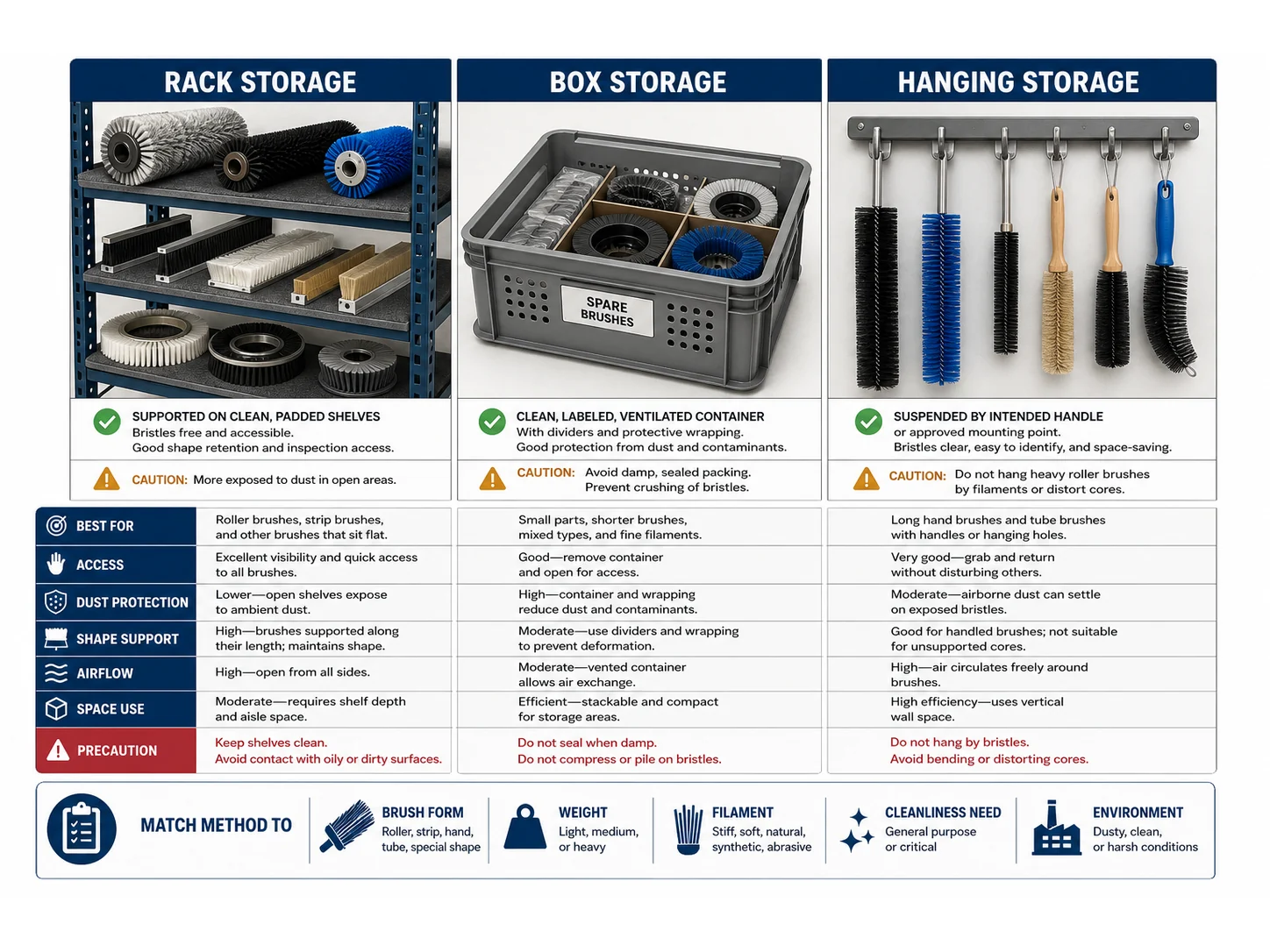
What Are the Common Storage Methods for Spare Brushes?
Three brush storage methods dominate workshops, janitorial closets, and industrial maintenance areas:
- Rack storage: Brushes rest horizontally on shelves or dedicated brush racks, often with cutouts or cradles that keep the handle and bristle head supported.
- Box storage: Brushes are placed inside closed containers, bins, or drawers that protect them from airborne dust, moisture, and physical knocks.
- Hanging storage: Brushes are suspended by a hole in the handle, a loop, or a clip on a wall-mounted rack, pegboard, or overhead rail, keeping the bristles off any surface.
Each method has unique advantages and trade-offs, and the best choice depends on brush design, bristle material, and the storage environment.
Rack Storage: Best for Accessibility and Shape Retention
Rack storage is often considered the gold standard for brush storage because it supports the brush body uniformly, preventing distortion. A well-designed rack holds brushes horizontally with the bristle head slightly elevated or resting on a soft cradle, so no pressure bends the bristles out of shape.
Benefits:
- Keeps brushes easily visible and accessible for daily use.
- Minimizes bristle deformation by distributing weight evenly.
- Allows air circulation around the brush head for drying and ventilation.
- Suitable for brushes of many sizes and handle styles.
Best for: Brushes with delicate or flexible bristles that must retain their original shape, such as paint brushes, dusting brushes, and fine cleaning brushes.
Box Storage: Best for Dust and Contaminant Protection
Box storage encloses brushes in a sealed or covered container, shielding them from airborne dirt, cleaning chemical vapors, and physical impact. This method is ideal when brushes are used where cleanliness is critical, such as in food processing, electronics, or laboratory environments.
Benefits:
- Blocks dust, grease mist, and other airborne contaminants.
- Prevents accidental crushing or bending during transport or when stored alongside heavy tools.
- Can be combined with desiccant packs or rust-inhibiting liners for metal brush bodies.
- Works well for irregularly shaped brushes that are hard to rack or hang.
Best for: Brushes that must stay impeccably clean, those with metal components prone to corrosion, and infrequently used spares that might otherwise gather dust.
Hanging Storage: Space-Saving with Precautions
Hanging storage saves floor and shelf space by using vertical wall area or overhead racks. It is popular in compact workshops, mobile service vehicles, and anywhere floor space is at a premium. However, it must be done correctly to avoid damaging the brush.
Benefits:
- Maximizes wall and vertical space in small storage areas.
- Keeps bristles completely off surfaces, preventing contamination and moisture wicking.
- Allows quick visual inventory checks.
- Easy to implement with simple hooks, pegboards, or slatwall systems.
Best for: Brushes with sturdy handles and a hanging hole, such as many industrial push brooms, scrub brushes, and wire brushes. Not recommended for brushes where the bristles might distort under their own weight or for those with soft, absorbent bristle materials.
Comparison Table: Rack vs Box vs Hanging
| Storage Method | Best For | Pros | Cons |
|---|---|---|---|
| Rack | Daily-use brushes with delicate bristles | Preserves shape, easy access, good ventilation | Requires shelf space, open to dust |
| Box | Clean-critical areas, long-term storage | Excellent dust protection, crush resistance | Less visible, can trap moisture if not vented |
| Hanging | Brushes with hanging holes, limited floor space | Saves floor space, keeps bristles off ground | Risk of gravity distortion, requires sturdy handle hole |
How to Choose Based on Brush Type
The right brush storage methods depend heavily on the brush design and intended use. Consider these matching rules:
- Soft bristle brushes (paint, dust, finish brushes): Rack storage with bristle support is ideal. Hanging can cause bristle splay; boxing can crush tips if not packed carefully.
- Stiff bristle brushes (wire brushes, deck scrubbers, heavy brooms): Hanging or rack works. Box storage may cause cross-contamination with other tools unless each brush has a dedicated slot.
- Hollow body brushes (bottle brushes, tube brushes): Hanging by the handle loop or racking on a peg keeps the brush head ventilated and prevents moisture trapping.
- Brushes with metal parts (end wire brushes, cup wire brushes): Box storage with rust protection is often best if humidity is high. A ventilated rack also works in dry climates.
- Food-grade or sanitary brushes: Box storage with a tight lid, and the box itself must be cleanable. Some applications require hanging to avoid surface contact entirely.
Storage Conditions: Temperature, Humidity, and Ventilation
Beyond the storage method itself, environmental factors can shorten or extend brush life:
- Temperature: Extreme heat can soften adhesives that bond bristles, while freezing cold can make plastic bristles brittle. Moderate, stable temperatures are best.
- Humidity: High humidity promotes corrosion on metal ferrules and wire bristles, and can cause natural fiber bristles to swell or host mold. Use silica gel packs in box storage or install dehumidifiers in storage rooms.
- Ventilation: Even with box storage, allow some airflow to prevent moisture buildup. Drill small vent holes or leave a slight gap.
Common Mistakes to Avoid
Even with good intentions, these mistakes can damage spare brushes:
- Storing brushes under weight: Stacking heavy items on top of bristles flattens and permanently bends them. Always store brushes with bristles upward or on a dedicated rack where nothing can press on them.
- Ignoring bristle memory: Many synthetic bristles take a set if stored bent. Always store in the neutral, straightened position.
- Putting away wet brushes: Moisture trapped inside box storage can lead to mildew and rust within days. Allow brushes to dry completely before boxing them.
- Mixing contaminated and clean brushes: A brush used with harsh chemicals or sticky residues can transfer those substances to clean brushes stored in the same box or rack section. Use separate storage zones or clearly labeled containers.
- Using hanging hooks that deform the handle hole: Thin wire hooks can elongate or crack the hanging hole over time. Use broad, smooth hooks or dedicated brush hanging clips.
When Climate-Controlled Storage Is Necessary
For most workshops, a dry, covered area with natural ventilation is sufficient. However, climate-controlled storage becomes necessary when:
- Brushes have natural fiber bristles (horsehair, tampico, hog bristle) that are sensitive to humidity swings.
- Brushes are stored in coastal or tropical environments where condensation is constant.
- Brushes are used for precision cleaning in electronic assembly or medical device manufacturing, where any corrosion or fiber shedding is unacceptable.
- Storage periods exceed several months; even seemingly stable environments can degrade bristles over long durations without temperature and humidity control.
In these cases, a simple sealed cabinet with a small dehumidifier or a climate-controlled tool locker can prevent slow, invisible damage.
Final Takeaway
There is no single best brush storage method for every situation, but rack storage often wins for daily-use brushes with delicate bristles, box storage shines when dust protection is critical, and hanging storage is a smart space-saver when handles are designed for it. Match the method to the brush type, let brushes dry completely before storing, and always keep them free from pressure that could cause permanent deformation. A little storage discipline goes a long way toward maintaining cleaning performance and extending brush life.
Frequently Asked Questions
Can I store different brush types together in one box?
Yes, but use dividers or individual sleeves to prevent cross-contamination and bristle entanglement. Brushes with sharp wire bristles can damage soft-bristled brushes if they rub together.
Is hanging always bad for brush shape?
Not if the brush is designed with a hanging hole and the bristles are stiff or short enough not to bend under gravity. Light, soft-bristled brushes are best stored horizontally on a rack instead.
How do I add a hanging hole to a brush that doesn’t have one?
Drilling a small hole into a wooden or plastic handle near the butt end is possible, but do it slowly to avoid cracking. For brushes with metal handles or no suitable spot, consider a clip-on hanging ring or a rack tray instead.
Can box storage trap moisture and cause rust?
Yes, especially if brushes are stored damp or the box is in a humid area. Choose boxes with ventilation holes and add desiccant packs to absorb moisture. Check metal brush parts periodically.
What is the best way to store a bottle brush?
Hang bottle brushes by the loop or handle hole in a well-ventilated area, or place them on a rack with the bristle head elevated. Avoid storing them tip-down in a cup, which can trap moisture and bend bristles.
How long can brushed be stored without use before they degrade?
With proper storage (dry, moderate temperature, no pressure), synthetic bristle brushes can last years. Natural fiber brushes may degrade faster in fluctuating humidity. Inspect stored brushes every few months for signs of mold, brittleness, or rust.
Should I clean brushes before putting them into long-term storage?
Absolutely. Remove all residues, chemicals, and moisture. A dirty brush stored away can grow bacteria, attract pests, or allow corrosive residues to eat away at bristles and ferrules over time.
Which natural bristle fiber fits this job — Horsehair, Goat Hair or Boar Bristle?
| Fiber | Continuous temperature (°C) | Peak temperature (°C) | Water absorption | Hardness |
|---|---|---|---|---|
| Horsehair | 60–80 | 100–120 | 8–15% | — |
| Goat Hair | 50–70 | 90–110 | 12–20% | — |
| Boar Bristle | 60–80 | 100–120 | 10–18% | — |
| Pig Bristle | 80 | 110 | 5–20% | Medium natural bristle; similar to boar bristle for polishing and gentle scrubbing. |
| Mohair | 80 | 110 | 5–20% | Very soft |
When are Tube & Pipe Bore Brushes the wrong choice?
- Tube & Pipe Bore Brushes — Use pigs, flushing, ultrasonic, chemical descaling, blasting, or a flexible cable system for long, sharply curved, or heavily scaled passages.
- Bottle & Container Brushes — Use a tube or bore brush for a long narrow passage with little vessel-body geometry, or use a non-brush method when the surface or residue cannot tolerate brushing.
- Horsehair — Not for aggressive scrubbing or wet chemical process cleaning.
- Tampico Fiber — Natural variation, moisture retention and lower cutting action make it unsuitable for precision abrasive finishing or hygienic storage without drying.
What should replace Tube & Pipe Bore Brushes when they stop working?
- Tube & Pipe Bore Brushes — Tube and bore brushes work by radial contact inside a confined diameter; wire wheels and cups work mainly on external edges, profiles, welds, and broad surfaces.
- Bottle & Container Brushes — Bottle and container brushes are selected around an opening plus a larger vessel body and bottom geometry; tube and bore brushes are selected mainly around a long diameter-controlled passage. Closest alternative: Tube & Pipe Bore Brushes.
- Horsehair — Compare Horsehair with Boar bristle, goat hair, microfiber. Change material when wet stiffness, temperature, chemical resistance, conductivity, particle shedding, or surface marking becomes the limiting factor.
- Tampico Fiber — Compare Tampico Fiber with Compare with horsehair for softer dry contact, sisal for firmer plant-fiber scrubbing and nylon for more uniform recovery. Change material when wet stiffness, temperature, chemical resistance, conductivity, particle shedding, or surface marking becomes the limiting factor.