What Is High Temperature Brush Failure?
High Temperature Brush Failure: Early Warning Signs should be evaluated from the actual cleaning task, not only from the product name. Start with surface finish, solvent exposure, access angle, scratch tolerance, and soil severity. The right brush reaches the surface, removes the target residue, and avoids damage or contamination under normal working conditions.
A high temperature brush fails when its components—bristles, core, adhesive, or structural body—deteriorate due to heat exposure beyond their design limits. Failure is rarely immediate; it usually reveals itself through progressive warning signs that operators can spot during routine inspection. Recognizing these signs early prevents wire breakage, bristle shedding, part damage, and safety incidents.
For heat-stress and high-temperature workplace context, this section references OSHA — Heat Exposure.
For brush construction terminology, bristle/fill/backing/stem terms, this section references American Brush Manufacturers Association — Brush Lingo.
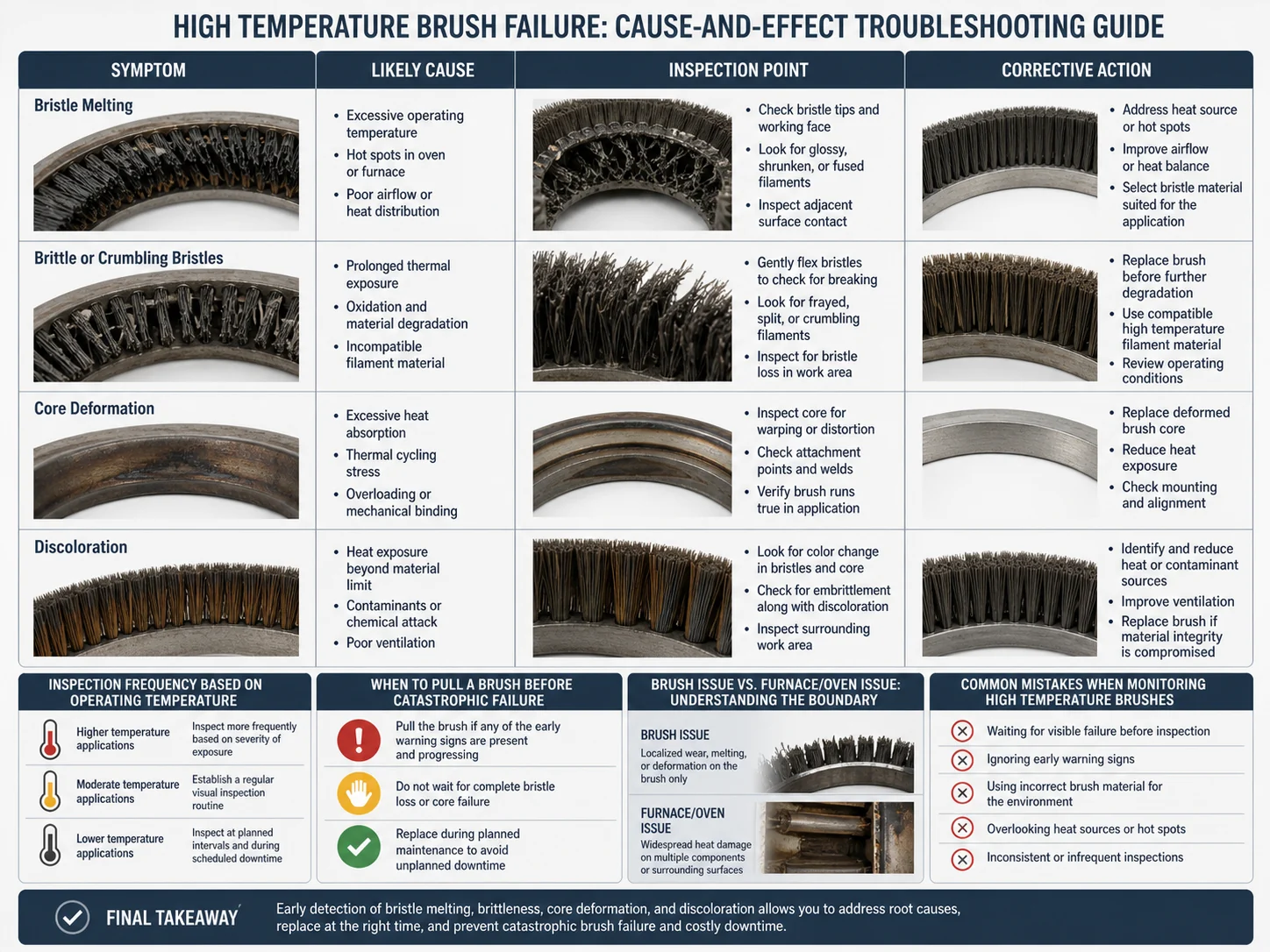
Early Warning Signs of High Temperature Brush Failure
The four most common warning signs are:
| Warning Sign | Description | Risk if Ignored |
|---|---|---|
| Bristle Melting | Bristles soften, lose shape, or fuse together. Appears as flattened, glossy, or stuck bristles. | Loss of cutting/cleaning action; possible contamination of workpiece with melted residue. |
| Bristle Brittleness | Bristles become hard, snap easily when bent, or break during use. Often seen as small broken fragments. | Premature bristle breakage that can damage surfaces or embed in the workpiece. |
| Core Deformation | The central hub, knot, or twisted wire core warps, loosens, or stretches. A deformed core may cause brush imbalance. | Brush imbalance leading to vibration, excessive wear on equipment, and potential ejection of bristles. |
| Discoloration | Changes in bristle or ferrule color—blueing or darkening—indicating heat exposure beyond the brush’s tempering range. | Loss of temper and mechanical strength; risk of sudden failure under load. |
Inspection Frequency Based on Operating Temperature
Inspection frequency should increase with operating temperature. As a general guideline:
For machine guarding and moving-part safety context, this section references OSHA — Machine Guarding.
For lockout/tagout and maintenance isolation context, this section references OSHA — 1910.147 Control of Hazardous Energy.
- Ambient to 250°F (120°C): Inspect before each shift or batch.
- 250–450°F (120–230°C): Inspect based on wear condition, operating load, and the equipment maintenance plan of continuous use.
- 450–600°F (230–315°C): Inspect every hour; pull brush for detailed check if any sign appears.
- Above 600°F (315°C): Always use brushes rated for the specific temperature; inspect every 30 minutes and pull immediately at first sign of change.
These intervals are not substitutes for manufacturer recommendations but provide a baseline for environments where temperature is a primary stressor.
When to Pull a Brush Before Catastrophic Failure
A brush should be removed from service immediately if:
- More than 10% of bristles show melting, brittleness, or breakage.
- The core shows visible warp or loosening when compared to a new brush.
- Discoloration extends into the working length of the bristles, not just the tips.
- Any sign of rust or oxidation on wire bristles that may have been accelerated by heat.
- Vibration, noise, or performance changes occur that are not explained by the workpiece or tool setup.
Delaying replacement risks sudden bristle ejection, tool damage, and safety hazards. It is more cost-effective to swap a brush early than to repair equipment or rework parts.
Brush Issue vs. Furnace/Oven Issue: Understanding the Boundary
A common diagnostic challenge is determining whether the problem lies with the brush or with the heating equipment itself. Use this comparison:
| Symptom | Likely Brush Issue | Possible Furnace/Oven Issue |
|---|---|---|
| Uneven bristle melting | Brush rated for lower temperature than process heat | Hot spots in furnace due to blocked airflow or element malfunction |
| Rapid discoloration of new brush | Incorrect brush material for the temperature | Temperature controller drift or sensor failure causing overtemperature |
| Core deformation after short use | Inadequate core design or material for high heat | Excessive radiant heat from a misaligned burner or heating element |
| Bristle brittleness only on one side | Brush held at improper angle, causing localized overheating | Uneven temperature distribution across the chamber |
If multiple brushes of different batches or types exhibit the same failure pattern quickly, the root cause likely lies in the heat source or process environment, not the brush. Consult equipment documentation and consider temperature verification tools before blaming the brush alone.
Common Mistakes When Monitoring High Temperature Brushes
- Ignoring early discoloration: Treat blue or straw-colored wire bristles as an immediate flag—not normal wear.
- Using the wrong brush material for the temperature: Stainless steel wire may have different oxidation resistance than carbon steel at high heat; always match brush material to operating temperature.
- Skipping core inspection: Operators often check bristles only. A loose or deformed core can cause brush failure even if bristles appear intact.
- Relying solely on “feels right” instead of measured temperature: High-heat brush ratings are absolute; do not assume a brush that “usually lasts” is suitable without verifying actual process temperature.
- Failing to log inspection results: Without records, progressive failure trends go unnoticed, and root cause analysis becomes guesswork.
Final Takeaway
High temperature brush failure rarely happens without warning. By routinely checking for bristle melting, brittleness, core deformation, and discoloration—and adjusting inspection frequency to match your operating temperature—you can catch failures early and avoid costly downtime or safety incidents. When in doubt, pull the brush. A preventive replacement is always cheaper than a failure in process.
Practical Use Note
In daily use, the practical test is simple: check whether the brush reaches the full contact area, removes the target residue, and leaves the surface in the required condition. Record what changes when surface finish, solvent exposure, access angle, scratch tolerance, and soil severity changes, because many brush failures are caused by the working condition shifting rather than by the brush body alone.
Frequently Asked Questions
Can a high-temperature brush fail even if it looks fine?
Yes. Internal core damage or loss of temper in bristles may not be visible until the brush is under load. Regular destructive testing on a sample from each batch is good practice.
What is the safest way to inspect a hot brush?
Always allow the brush to cool to a safe handling temperature before close inspection. Use heat-resistant gloves and place the brush on a non-flammable surface. A quick visual check for obvious melting can be done with the brush in place if no contact is needed.
How do I know if the bristle brittleness is from heat or chemical attack?
Heat-induced brittleness usually comes with discoloration (blue or straw colors on steel wire). Chemical brittleness may show pitting or residue without color change. If in doubt, consult a materials expert or run a controlled exposure test.
Can I extend brush life by reducing operating temperature?
Yes, if the brush is being used near its upper limit. Dialing down the temperature even 50°F can significantly slow thermal degradation. However, always ensure the process still meets quality requirements.
Is it normal for a new high-temperature brush to discolor slightly on first use?
Some surface oxidation or faint discoloration may occur, but deep blueing or blackening indicates excessive heat. When in doubt, compare with the manufacturer’s reference or a brand-new brush.
What should I do if I find melted bristle residue on workpieces?
Stop the process and remove the brush. The residue can affect subsequent operations or contaminate products. Clean workpieces and investigate the cause—likely overtemperature or wrong brush material.
How often should I replace high-temperature brushes as a preventative measure?
This depends on usage and temperature. Many facilities schedule replacement after a set number of hours or cycles, based on their inspection logs. Combining scheduled replacement with condition-based inspection provides the best safety and cost balance.
Are there brush designs that resist high-temperature failure better?
Yes. Brushes with crimped wire, high-density fill, and specially tempered alloys can handle higher heat. Butt-welded or mechanically locked cores may resist deformation better than adhesive-set cores. Selection should match the specific temperature, cycle, and load.