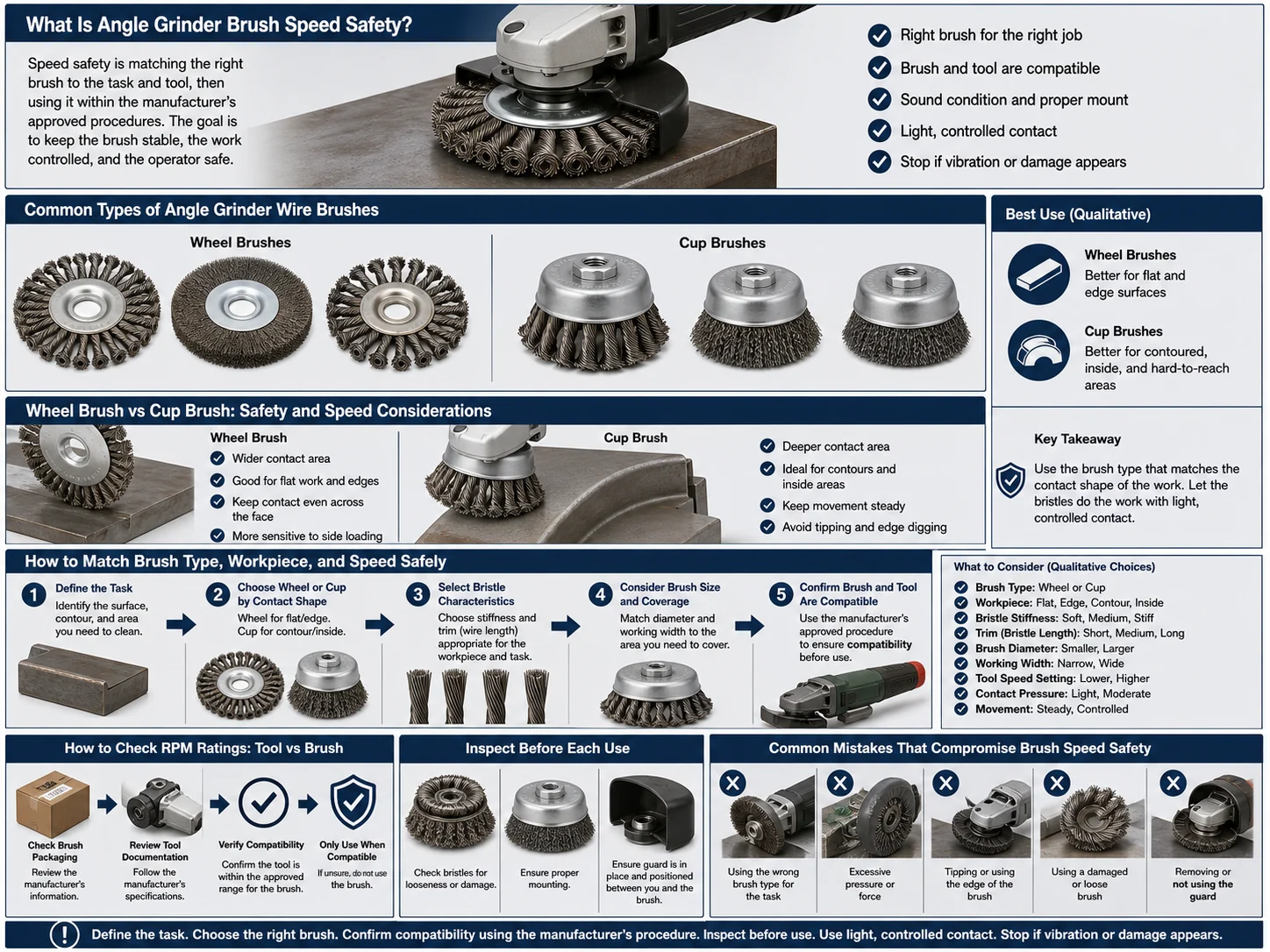
What Is Angle Grinder Brush Speed Safety?
Angle grinder brush speed safety is the practice of running a wire brush attachment at or below its rated maximum RPM, with the correct guard in place, appropriate contact pressure, and full personal protective equipment. Because angle grinders can spin far faster than many wire brushes are designed to handle, ignoring speed limits can cause wire breakage, brush disintegration, and serious injury. Safety begins with reading both the tool manual and the brush packaging—not guessing.
Core principles:
- Brush maximum speed (printed on the brush or its label) must equal or exceed the tool’s no‑load spindle speed.
- The guard must be properly fitted and positioned between the operator and the brush.
- Steady, moderate contact pressure prevents overheating and wire fatigue.
- Inspect brushes before each use; discard if wires are bent, missing, or corroded.
Common Types of Angle Grinder Wire Brushes
Different brush styles suit different cleaning, stripping, or surface preparation tasks. Choosing the right shape reduces the temptation to over-speed or force the tool.
- Wheel brushes (narrow face): Designed for cleaning edges, corners, weld seams, and tight spaces. Available in crimped or knotted wire.
- Cup brushes: Wider contact area for flat surfaces, large-area paint removal, and heavy rust. Knotted versions provide more aggression.
- End brushes: Small diameter, used for internal bores, holes, and confined areas.
- Specialty brushes: Brass‑coated for non‑sparking or softer metals, nylon‑abrasive for light deburring, and concrete/masonry brushes with rugged steel wire.
Wheel Brush vs Cup Brush: Safety and Speed Considerations
Both wheel and cup brushes are common, but they load the tool and operator differently. The table below highlights key safety factors—not performance alone—to help you choose.
| Factor | Wheel Brush | Cup Brush |
|---|---|---|
| Typical diameter range | 3 in – 6 in (often used on small grinders) | 2 in – 5 in (common on 4½ in grinders) |
| Maximum safe speed (typical) | Often rated 12,000–20,000 RPM (always check label) | Often rated 6,600–12,500 RPM (always check label) |
| Guard compatibility | Requires Type 27 guard; must fully cover wheel periphery | Type 27 guard with skirt; guard must extend past cup edge |
| Contact pressure | Edge contact only; excessive pressure bends wires | Face contact; pressing too hard overheats wires |
| Common injury risk | Thrown wires, wheel shatter if oversped | Wire breakage, cup detachment if arbor nut not tight |
| Best workpiece match | Edges, corners, weld prep, pipe | Flat surfaces, floors, large panels |
How to Match Brush Type, Workpiece, and Speed Safely
Not every wire brush fits every situation. Use this decision sequence before mounting a brush:
- Check the workpiece material: On aluminum or copper, use brass‑coated or stainless‑steel wire to avoid cross‑contamination. On concrete, use specially labeled masonry brushes with hardened wire.
- Pick brush shape based on access: Wheel for edges, cup for flat surfaces, end brush for bores.
- Verify RPM compatibility (see next section).
- Ensure the guard fits: Confirm the guard fully covers the brush’s rotating plane and is securely locked. Never modify or remove it.
- Select wire style: Crimped wire is more flexible and less aggressive (better for paint removal). Knotted wire is stiffer, more aggressive, and typically rated for higher speeds—but must still stay under its marked limit.
- Mount correctly: Use the original arbor nut, tighten firmly by hand with the spindle lock, and do not overtighten with a wrench.
How to Check RPM Ratings: Tool vs Brush
The single most important safety check is comparing the numbers. Follow these steps every time you change a brush:
- Find the tool’s no‑load speed in the manual or on the nameplate (typically in RPM). Never use the loaded speed; the no‑load maximum is the dangerous peak.
- Read the brush’s maximum safe RPM printed on the packaging or etched on the brush cup/hub. This number is the absolute ceiling.
- If the grinder has adjustable speed, set it so the no‑load RPM never exceeds the brush’s maximum.
- When using a single‑speed grinder, confirm the brush’s max RPM is higher than the tool’s no‑load RPM. If not, do not use that brush on that tool.
- Even with a match, speed should be controlled by trigger discipline: run the brush up slowly at first; listen for vibration or wobble.
Common Mistakes That Compromise Brush Speed Safety
Even experienced operators can make these errors:
- Removing the guard to “see better”: The guard is not optional. It contains thrown wires and shields the operator. Removing it voids safety certifications and invites injury.
- Choosing a brush by aggressiveness alone: High‑aggression knotted brushes often have lower max RPM ratings. Using them on a high‑speed grinder can exceed the safe limit.
- Ignoring brush diameter limits: A 9‑inch grinder running a 4‑inch wire wheel may seem harmless, but overspeeding can cause the wheel to burst. Always match brush max RPM, not just physical fit.
- Using damaged or worn brushes: Bent, corroded, or missing wires create imbalance, vibration, and unpredictable breakage. Replace brushes at the first sign of damage.
- Excessive contact pressure: Forcing the brush into the work increases friction heat, can exceed the brush’s design RPM under load, and accelerates wire fatigue.
- Mixing brush styles with incompatible guards: A cup brush on a Type 1 guard leaves the operator exposed. Ensure you have the correct guard type for the brush shape.
When Angle Grinder Brush Speed Safety Is the Wrong Choice
Recognize these boundaries where additional precautions or expert review are mandatory:
- Unfamiliar workpiece materials: When dealing with alloys, exotic metals, or coated surfaces that may release toxic dust or react violently, consult a material safety data sheet and involve a qualified safety officer.
- Damaged or modified tools: A grinder with a bent spindle, missing guard, or aftermarket speed control should be inspected by a qualified technician before any brush use.
- High‑risk environments: Confined spaces, explosive atmospheres, or work near flammable vapors may require non‑sparking brushes and additional ventilation—beyond normal speed safety.
- Unusual brush sizes or adapters: Using adapter nuts, stepped arbors, or brushes never tested with your grinder model can create dangerous speed mismatches and imbalance. Stick to brushes that mount directly to the spindle without modification.
Final Takeaway: Safe Speed Is a System, Not a Number
Angle grinder brush speed safety is not about chasing a single optimal RPM. It is about auditing the whole system: tool no‑load speed, brush max RPM, guard fit, workpiece match, wire condition, and operator technique. Always default to the most restrictive limit—the one stamped on the brush. When that limit is respected, the brush will cut, clean, and strip predictably. When it is ignored, even the best brush can turn into a hazard. Before every job, take 30 seconds to check the label, inspect the guard, and test at low speed. Your face and hands depend on it.
Frequently Asked Questions
Can I use a wire brush on an angle grinder without a guard?
No. The guard is a critical safety component. It protects you from thrown wires and debris. Always use the guard recommended by the tool manufacturer and ensure it is properly positioned and secured.
What happens if I run a wire brush faster than its rated RPM?
Exceeding the rated speed can cause wire breakage, bristle fatigue, premature wear, and in extreme cases, the brush body may disintegrate. Thrown wires can cause serious injury. Always stay at or below the brush’s maximum safe RPM.
Is a knotted wire brush always better for heavy rust removal?
It is more aggressive, but it usually has a lower maximum RPM than a crimped brush of similar size. Match the brush to the required cleaning result, but never sacrifice speed safety for aggressiveness. Check the ratings.
How do I know if a 4-inch wire brush fits my 4½-inch angle grinder safely?
Physical fit is only half the answer. The key is to compare the brush’s maximum RPM (printed on the label) with your grinder’s no‑load speed. A typical 4½‑inch grinder spins at 10,000–12,000 RPM. If the brush is rated only 6,600 RPM, it is unsafe, even if it threads on correctly.
Can I use a wire cup brush on concrete?
Only if it is specifically labeled for masonry or concrete. Standard steel wire brushes wear rapidly on concrete and can generate excessive dust. Look for brushes with hardened, coarse wire and pair them with a dust extraction system.
What should I check before mounting a used wire brush?
Inspect the brush for bent, broken, or missing wires; uneven wear; corrosion on the hub; and cracks in the cup or wheel body. Spin it by hand on the spindle to check for wobble. Discard if any damage is visible.
Is it safe to reduce speed with a variable‑speed grinder to match a lower‑rated brush?
Yes, if the grinder’s lowest speed setting is below the brush’s maximum RPM and you verify it with a tachometer. However, do not rely on feathering the trigger; consistent, controlled speed is essential. Set the dial to a safe maximum and leave it there.
Technical References
- ABMA — ANSI B165.1 Power Brush Safety Slips
- OSHA — 1910.242 Hand and Portable Powered Tools
- OSHA — 1910.215 Abrasive Wheel Machinery
- OSHA — Personal Protective Equipment
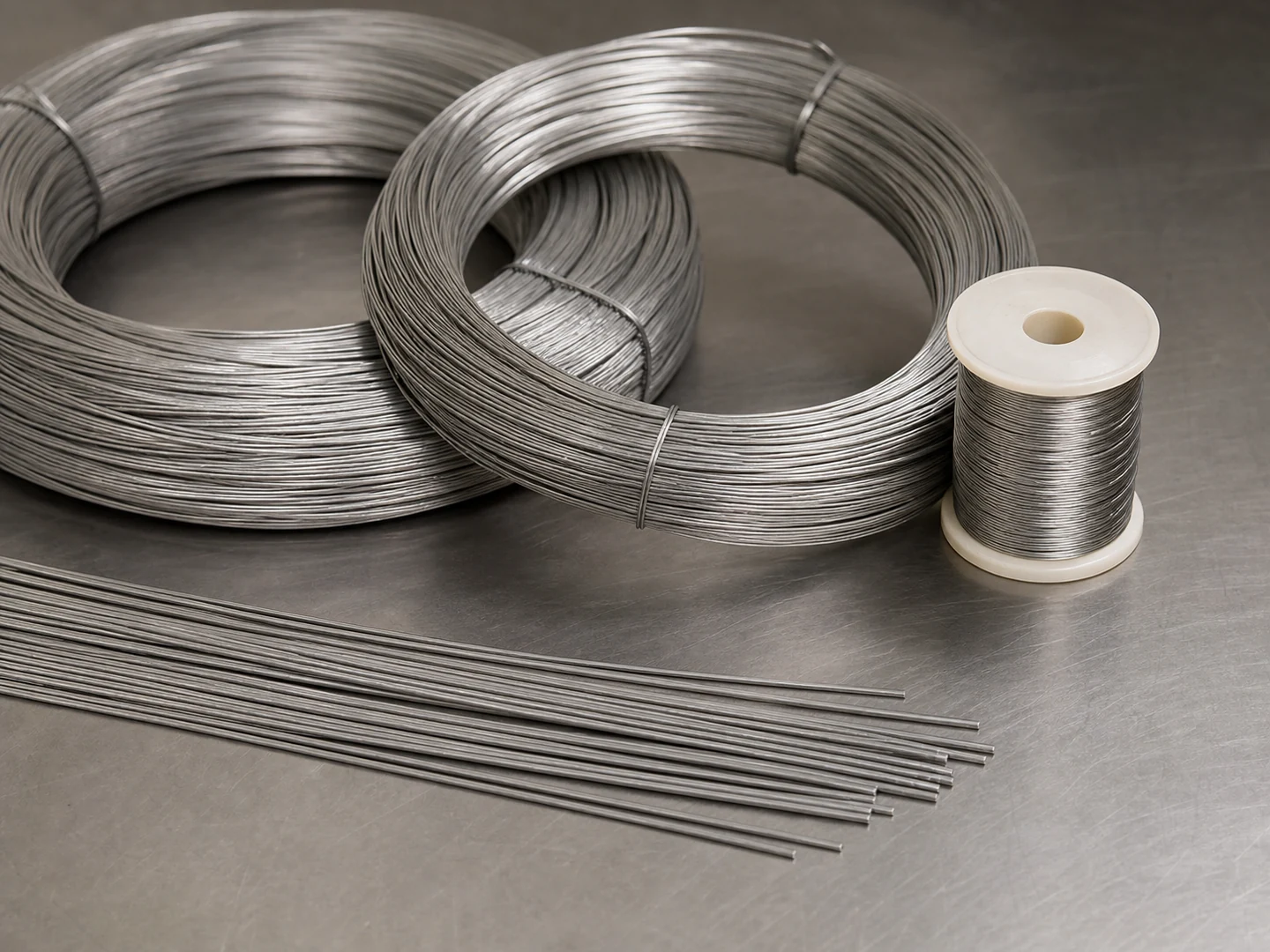
Which steel wire grade fits this job — AISI 304 Stainless Steel Wire, AISI 316 Stainless Steel Wire or Carbon Steel Wire?
| Wire grade | Continuous temperature (°C) | Peak temperature (°C) | Water absorption | Hardness |
|---|---|---|---|---|
| AISI 304 Stainless Steel Wire | 400 | 500 | 0% | Rockwell B 70–95 depending on temper and cold work |
| AISI 316 Stainless Steel Wire | 400 | 500 | 0% | Rockwell B 70–95 depending on temper and cold work |
| Carbon Steel Wire | 200–300 | 350–450 | 0% | Rockwell C 40–60 |
| Galvanized Steel Wire | 150–200 | 250–300 | 0% | Rockwell B 70–100 |
Figures as published by Alleima; Material manufacturer TDS / ISO / ASTM / industry reference. Confirm the exact grade against the supplier datasheet before ordering.
What should replace Wheel Brushes when they stop working?
- Wheel Brushes — Wheel brushes give narrow edge contact; cup brushes cover a broader open face, while end brushes concentrate contact at the end of a small stem for recesses.
- Cup Brushes — Cup brushes cover a broader face than wheel brushes; end brushes are better for small recesses or pockets where the cup body blocks access.
- AISI 304 Stainless Steel Wire — Use AISI 316 stainless steel wire for chloride, marine, dairy, beverage, chemical washdown, or higher pitting-resistance requirements. Use carbon steel for dry aggressive cutting and brass or abrasive nylon for lower marking risk.
- Nylon PA — Compare Nylon PA with PP, PBT, PET. Change material when wet stiffness, temperature, chemical resistance, conductivity, particle shedding, or surface marking becomes the limiting factor.