What Are Oscillating and Rotating Cleaning Brushes?
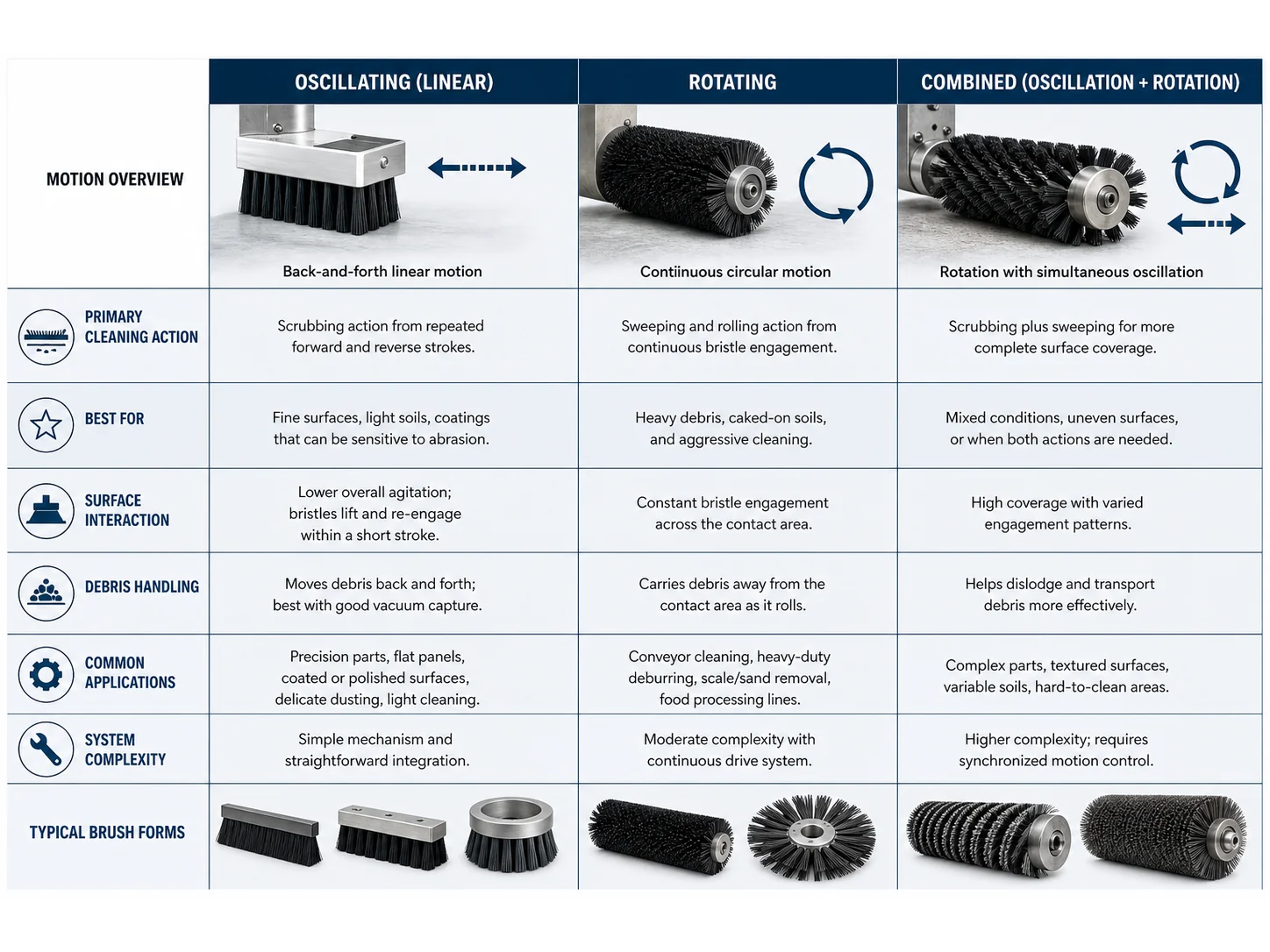
An oscillating cleaning brush moves back and forth in a rapid, short-stroke arc. This motion provides focused scrubbing with minimal surface impact. A rotating brush spins continuously in one direction, delivering constant tangential force that excels at lifting heavy soils and scale. Combined oscillation+rotation systems add a rotary spin to the oscillating head, offering both aggressive cutting and wider coverage.
Common Types of Brush Motion Systems
Cleaning brush machines typically fall into three motion categories, each suited to different industrial and commercial applications:
- Oscillation-only: The brush head pivots back and forth, often at high frequency. Common in precision cleaning, deburring, and delicate part washing where surface integrity must be preserved.
- Rotation-only: The brush spins around a fixed axis. Widely used in pipe cleaning, surface preparation, and rust removal where high material removal is acceptable.
- Oscillation + Rotation: The brush both oscillates and rotates, either simultaneously or in pre-set sequences. This hybrid motion offers deeper cleaning in one pass without compromising coverage. Used in parts washers, conveyorized systems, and automated deburring cells.
Oscillation vs Rotation vs Combined: Direct Comparison
| Feature | Oscillation | Rotation | Oscillation + Rotation |
|---|---|---|---|
| Cleaning Action | Scrubbing with short, overlapping strokes | Shearing and lifting with continuous force | Scrubbing plus tangential shear |
| Best For | Fine surfaces, fragile parts, light debris | Heavy deposits, scale, rust, weld cleanup | Mixed soils, textured surfaces, one-step finishing |
| Surface Impact | Low – minimizes scratching and abrasion | Higher – more aggressive material removal | Adjustable – can mimic either mode based on settings |
| Typical Speed Range | 500–3,000 oscillations per minute (OPM) | 500–5,000 revolutions per minute (RPM) | Varies; often 1,000–2,500 OPM with 50–300 RPM |
| Machine Complexity | Moderate – requires oscillation mechanism | Simple – motor and spindle | Higher – requires dual-motion actuator or gearbox |
| Cleaning Efficiency | Excellent for thin films, residues, and polishing | Excellent for rapid bulk removal | Very high – combines both benefits in one cycle |
How to Choose the Right Motion Mode
Start by defining three job parameters:
- Surface sensitivity: Will a rotary brush risk scratching or altering the surface? If yes, oscillation-only or combined with limited rotation is safer.
- Soil type and adhesion: Loose debris, light oil, or coolant films respond well to oscillation. Caked-on scale, rust, or heavy burrs need the constant force of rotation.
- Process goals: If throughput and cycle time dominate, combined oscillation+rotation often delivers the fastest clean with less dwell time. For precision finishing, pure oscillation may be the better path.
Also consider brush life, media loading, and the machine’s ability to maintain a consistent speed under load.
The Role of Speed and Frequency Pairing
Oscillation frequency (strokes per minute) and rotational speed (RPM) are not independent of each other. A common pairing rule is that higher oscillation frequencies improve fine cleaning, while slower rotation adds torque for tough deposits. In a combined system, the ratio between oscillation and rotation determines whether the brush behaves more like a surface finisher or a bulk remover. Most industrial controllers allow adjusting this ratio within limits. Operating outside the recommended frequency-RPM window can cause excessive vibration, premature wear, or inadequate cleaning.
Common Mistakes When Selecting Brush Motion
- Assuming rotation always cleans faster: For thin films or final finishing, oscillation can achieve results in less time with fewer consumable costs.
- Ignoring surface finish requirements: Using a rotary brush on a tolerance-critical surface may create unacceptable roughness.
- Overlooking machine capability: Not all brushing machines can switch between motion modes. A machine built for rotation-only cannot deliver true oscillation without retrofit.
- Neglecting fixture and part geometry: Oscillating brushes often handle irregular shapes better; rotating brushes may miss recessed areas.
- Selecting the wrong media for the motion: Some brush filaments perform poorly under oscillation because they require constant fiber reorientation, which rotation provides naturally.
When Oscillation or Rotation Alone Is the Wrong Choice
Certain tasks exceed the capability of a single motion mode. For example, thick polymer buildup may require high rotational speed for material removal, followed by oscillation to knock off remaining residues from corners. In such cases, a combined system becomes necessary. Additionally, if the required cleaning force demands a brush diameter beyond what a machine can oscillate efficiently, rotation may be the only viable motion. Finally, when cycle time is the primary constraint and a single-brush station must perform both aggressive deburring and fine finishing, a combined oscillating+rotating head may be the only practical answer—provided the machine supports it.
Final Takeaway
Choose oscillation when surface integrity is the top priority. Choose rotation when aggressive, fast removal of heavy soils is the goal. Select oscillation+rotation when you need both functions in a single step and your equipment allows it. Always verify that your machine’s drive, power, and controller can support the motion mode you plan to use. Matching the motion to the application—not settling for a default—makes the difference between rework and reliable cleaning.
Frequently Asked Questions
Can I retrofit an oscillation system onto a rotating brush machine?
It depends on the machine’s design. Some spindle-based machines can be upgraded with an oscillating adapter, but true high-frequency oscillation often requires a dedicated mechanism. Consult the machine builder to understand torque, stroke, and control requirements.
Is combined oscillation+rotation always better than single-mode?
Not always. Combined heads add complexity and cost. If your process only requires light cleaning, a pure oscillation setup may be more reliable and easier to maintain.
What is the typical oscillation frequency for fine surface cleaning?
Frequencies of 1,500 to 3,000 oscillations per minute are common for controlled finishing, but the exact number depends on the brush material and part geometry.
Does brush filament type affect the choice of motion?
How do I know if my machine limits my motion choice?
Check the technical specifications for maximum spindle speed, available oscillation stroke length, and programmable motion patterns. If the controller cannot coordinate two axes simultaneously, a combined mode may not be possible.
Which motion produces better edge cleaning?
Oscillation typically reaches edges and corners more effectively because the brush moves laterally across the feature, while rotation might ride along without biting into the edge.
Can I vary the ratio of oscillation to rotation during a cycle?
In advanced systems with servo or stepper motors, yes. A programmable recipe can adjust the ratio for different cleaning steps within the same cycle.
Which nylon grade fits this job — Nylon PA, PA6 Nylon or PA66 Nylon?
| Grade | Continuous temperature (°C) | Peak temperature (°C) | Water absorption | Hardness |
|---|---|---|---|---|
| Nylon PA | 93 | 121 | 0.3–9% by PA grade and conditioning | Medium to firm; filament diameter and trim length control bending force. |
| PA6 Nylon | 80–100 | 130–160 | 1.5–3.0% | Shore D 75–85 |
| PA66 Nylon | 100–120 | 150–180 | 1.0–1.8% | Shore D 80–88 |
| PA610 Nylon | 90–110 | 130–150 | 0.5–1.0% | Shore D 72–82 |
| PA612 Nylon | 90–110 | 130–150 | 0.3–0.7% | Shore D 70–80 |
Figures as published by Brushtec / DuPont. Confirm the exact grade against the supplier datasheet before ordering.
What should replace Nylon PA when it stops working?
- Nylon PA — Compare Nylon PA with PP, PBT, PET. Change material when wet stiffness, temperature, chemical resistance, conductivity, particle shedding, or surface marking becomes the limiting factor.