What Is Tire Mold Groove Cleaning and Why Does Brush Hardness Matter?
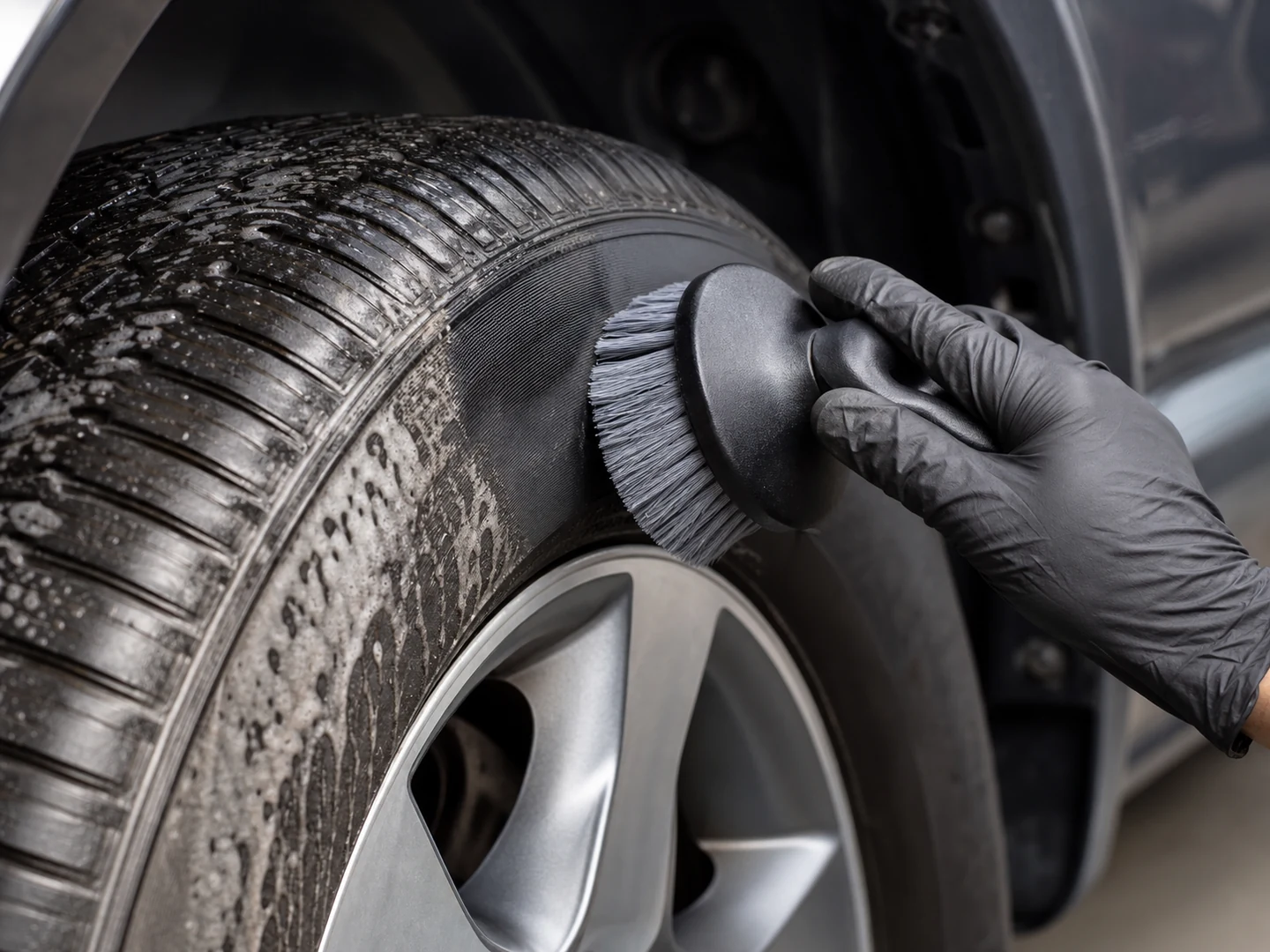
Tire mold groove cleaning is the process of removing cured rubber residue, release agent buildup, and debris from the narrow channels that form the tire tread pattern. Brushes with different bristle hardness levels are used to scrub these grooves. Hardness matters because a bristle that is too stiff can erode the mold base or round off sharp groove edges, while a bristle that is too soft may not remove stubborn deposits from deep or narrow features. Groove geometry—depth and width—determines how a bristle flexes, contacts the sidewalls, and transmits cleaning force.
For rubber materials, tire mold residue, heated rubber mold surfaces, and mold-cleaning material compatibility, this article cites James E. Mark, Burak Erman, Mike Roland, eds. — The Science and Technology of Rubber, 4th ed., Academic Press, 2013; rubber compound processing, mold surfaces, and tire/rubber material context.
Common Types of Brush Bristles for Mold Groove Cleaning
Maintenance teams typically choose from four bristle material groups. Each type offers a different hardness range and abrasiveness, influencing its suitability for specific groove dimensions.
- Nylon (general-purpose): Flexible, non-abrasive, good for light residue removal in shallow, wide grooves. Can be used with cleaning solvents.
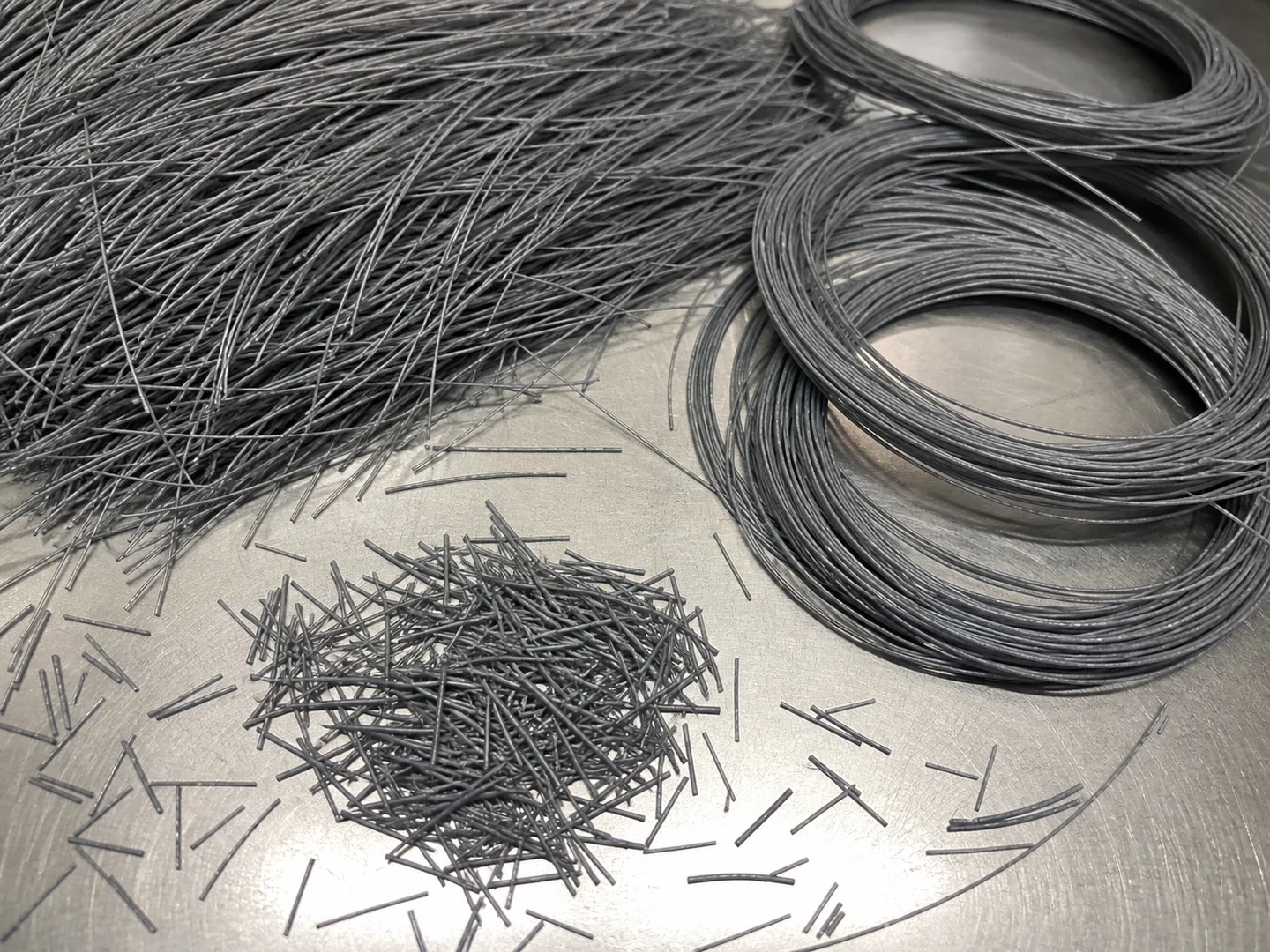
- Abrasive nylon (grit-impregnated): Contains silicon carbide or aluminum oxide particles. Offers aggressive cleaning without a separate abrasive paste. Effective for medium-depth grooves, but can wear aluminum molds if used dry and at high speed.
- Brass-coated steel or pure brass: Softer than mold steel, harder than nylon. Used for moderate caked-on rubber in steel molds. Risk of scratching aluminum molds is higher.
- Stainless steel: High stiffness and aggressive cleaning. Only for robust steel molds and deep, wide grooves where mold hardness significantly exceeds bristle hardness. Use with caution—premature mold wear is a common failure mode.
Brush Hardness vs Mold Geometry: What to Match
The table below maps typical groove aspect ratios to recommended bristle choices. It assumes standard aluminum (6061 or 7000 series) or P20 steel mold materials and a mechanical brushing process (rotary, linear, or robotic). Always validate with a test piece.
| Groove Geometry | Recommended Bristle Hardness | Notes |
|---|---|---|
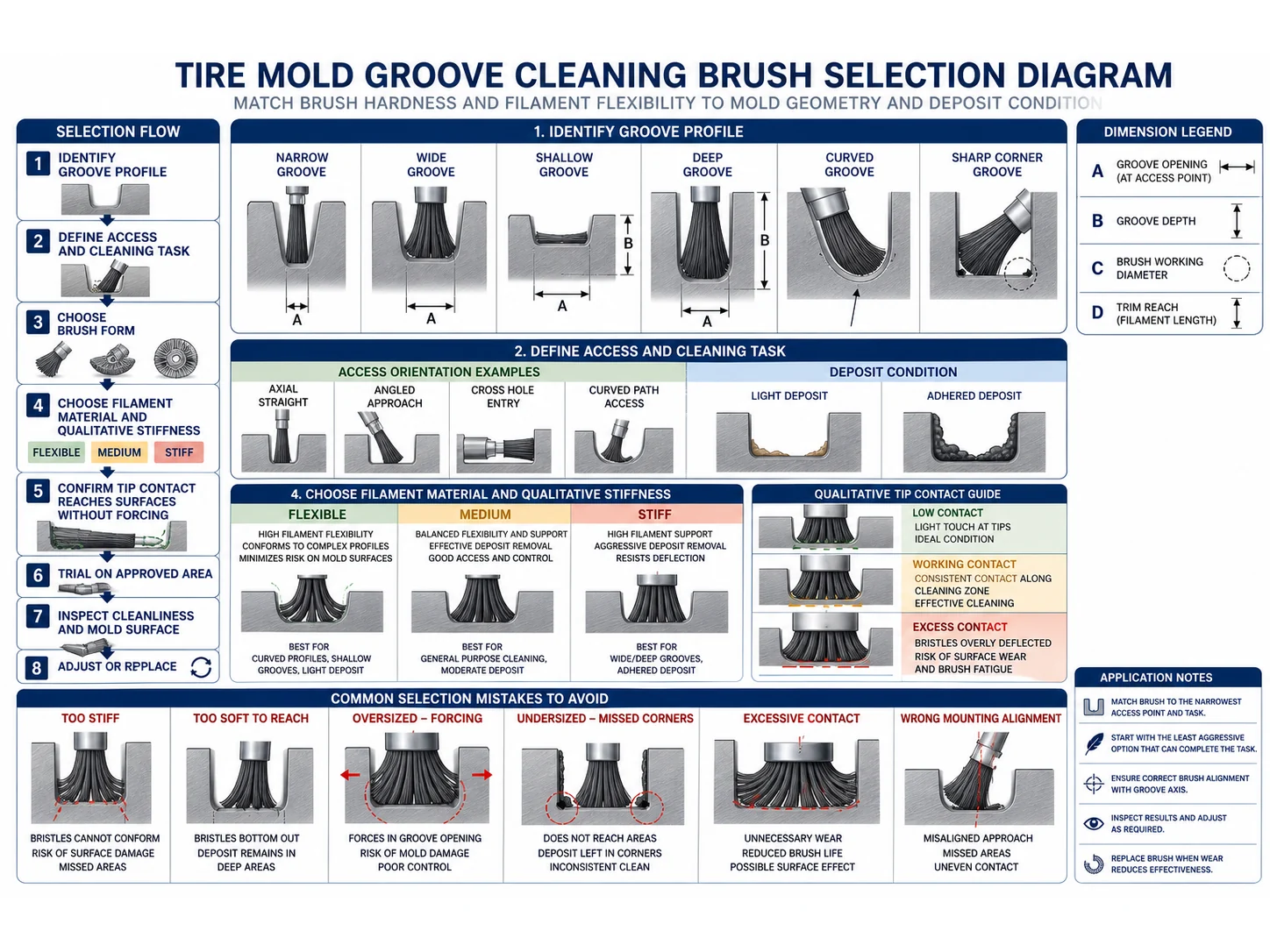
| Shallow & wide (depth < 3 mm, width > 5 mm) | Medium nylon or soft abrasive nylon (grit ≤ 120) | High flexibility needed to avoid bottom pressure; soft tips prevent rounding of wide groove edges. |
| Medium-depth & moderate width (depth 3–8 mm, width 3–5 mm) | Abrasive nylon, 120–240 grit, or fine brass | Stiffer filament must reach bottom without excessive sidewall friction. Check tip diameter relative to width. |
| Deep & narrow (depth > 8 mm, width < 3 mm) | Stiff abrasive nylon (grit ≥ 240) or fine stainless steel (if steel mold) | Bristle pack must be dense enough to prevent column buckling. Custom trim lengths often required. |
| Complex undercut or variable width | Combination brushes or custom profiled filaments | Standard hardness alone insufficient; requires brush design with varying filament angles or twisted wire profiles. |
How to Measure Tire Mold Groove Dimensions
Before selecting a brush, you need actual groove measurements from the production mold, not the tire drawing. Molds wear over time, and vent holes, plating thickness, or rework can alter as-built dimensions.
- Profile gauge or contour tracer: Quick manual method. Press a comb gauge into the groove, transfer the shape to paper, and measure depth and width with a caliper. Accuracy ±0.1 mm under good technique.
- Feeler gauge set: Use leaf combinations to measure the minimum opening width. Works for straight groove sections; not for curved or tapering shapes.
- Laser scanning or structured light systems: For critical or high-volume molds, non-contact scanning produces a 3D point cloud. Software extracts minimum, maximum, and average groove dimensions. Accuracy can reach ±0.02 mm.
- Silicone casting with optical comparator: Inject a two-part silicone into the groove, cure, remove, and measure under a comparator. Good for undercuts and complex geometry where direct access is limited.
Always measure at the groove entrance and at the deepest point. The cleaning brush must be able to reach the bottom without excessive lateral force that would splay the filaments too wide or cause base contact.
How to Select Brush Hardness Based on Groove Geometry
The core selection rule is this: choose a filament stiffness that provides enough elastic bending to scrub sidewalls, but not so much rigidity that the tip presses into the mold base at full penetration. Follow these steps:
- Measure groove width (W) and depth (D). Take at least three measurements along the groove’s length.
- Calculate aspect ratio R = D/W. Higher R indicates a deeper, narrower channel that requires stiffer, thinner bristles.
- Determine maximum bristle diameter d_max: A safe starting point is d_max ≤ 0.6 × W. This allows the bristle to access the groove without immediate sidewall friction that could prevent reaching the bottom.
- Select filament material: For aluminum molds, avoid steel bristles when R > 2 and abrasive nylon is available. For steel molds, fine stainless steel may be acceptable if W > 2 mm and mold surface hardness is > 48 HRC.
- Check tip geometry: Flagged (split-end) tips increase scrubbing area but require wider grooves. Crimped wire tips are more aggressive and should only be used on steel molds with simple straight grooves.
- Test on a sacrificial or non-critical mold area: Run a short cycle and inspect under magnification for micro-scratches or rounded edges.
Common Mistakes in Matching Brushes to Tire Mold Grooves
Even experienced maintenance teams can fall into these traps:
- Assuming all nylon is the same. Nylon bristle stiffness varies with diameter, moisture content, and filler. An off-the-shelf floor brush will not perform like an abrasive nylon filament designed for mold cleaning.
- Ignoring groove draft angles. Grooves with negative draft or zero draft can trap bristles and cause breakage, leading to plastic contamination or metal wire embedding in the mold.
- Over-penetrating with hard bristles. Setting brush engagement depth equal to groove depth without accounting for bristle deflection can result in tip contact with the mold base, causing micro-pitting.
- Using the same brush for all mold types. A brass brush safe for steel molds may scratch aluminum molds. Always segregate cleaning tools by mold material and compound type.
- Neglecting vent hole cleaning. Brushes sized for tread grooves often miss small vent passages. Separate micro-brushes or air jet cleaning is needed to prevent porosity in the tire.
When Standard Brushes Are the Wrong Choice: Custom Brush Profiles
Standard catalog brushes work for most straight-walled grooves with consistent width and depth. Custom brush profiles become necessary when:
- Grooves have an undercut or T-shaped cross-section.
- Width varies along a single groove by more than 30%.
- Deep, narrow grooves (R > 4) demand a filament density that standard tufting cannot provide without buckling.
- Mold materials include sensitive coatings (TiN, CrN, DLC) that cannot tolerate any metallic bristle contact.
Custom brushes typically involve variable trim lengths, twisted wire cores with multiple filament diameters, or abrasive-impregnated elastomeric pads shaped to the groove profile. The investment is justified when mold damage costs or cleaning cycle time outweigh the tooling charge. Work with a supplier who can receive your groove measurement data and simulate filament contact pressure using FEA or empirical models—not just a sample mold.
Final Takeaway
Matching brush hardness to tire mold groove geometry is a three-variable problem: groove depth, groove width, and mold material. Start with precise measurements, narrow down bristle diameter to less than 60% of groove width, and choose hardness based on the need to reach bottom without base impact. When aspect ratios exceed 4 or geometry becomes complex, standard brushes often fail, and a custom-profile solution is the safest path to consistent cleaning without mold damage.
Frequently Asked Questions
How can I quickly check if a brush is too hard for an aluminum mold?
Take a scrap piece of aluminum of similar grade and run the brush at your planned speed and pressure for 30 seconds. Look for surface scratching under 10× magnification. If scratches are visible, the brush is too aggressive or the engagement depth is excessive.
What is a safe bristle diameter for a groove that is 2 mm wide?
As a starting rule, use a bristle diameter no larger than 1.2 mm (0.6 × groove width). For abrasive nylon, the effective diameter includes the grit protrusion, so choose a filament with a core diameter around 0.8–1.0 mm.
Can I use a brush with varying hardness in the same automated cycle?
Yes, multi-stage cleaning protocols often start with a softer brush to remove loose dust and light residue, followed by a harder brush for baked-on material. The key is to control engagement depth and tool offset for each stage independently.
How do vent holes affect brush selection?
Standard tread groove brushes are usually too large for vent holes. Use dedicated micro-brushes with stem diameters matching the vent diameter. For molds with many vents, consider combining brush cleaning with ultrasonic or high-pressure water jetting.
Is there a way to measure groove width without expensive scanning equipment?
Yes, a simple profile gauge and a caliper with fine tips can often achieve ±0.1 mm accuracy on straight groove sections. For curved grooves, take a silicone impression and measure the cross-section under a shadowgraph or toolmaker microscope.
What cleaning compound should I use with nylon brushes?
Mold-specific alkaline cleaners or mild solvents are common. Avoid acidic solutions with nylon, as they can cause brittleness over time. Always verify chemical compatibility with both the brush filament and the mold material.
How often should I replace cleaning brushes in tire mold maintenance?
Replacement depends on filament wear, not just time. Inspect brushes after every 50 cleaning cycles or when bristles show signs of bending set, tip rounding, or grit loss. A worn brush can smear rubber residue instead of removing it.
Technical References
- World Stainless — Corrosion Resistance of Stainless Steels
- OSHA — Machine Guarding
- OSHA — 1910.147 Control of Hazardous Energy
- OSHA — Personal Protective Equipment
Which bristle material fits this job — Rubber, Abrasive Nylon or Nylon PA?
| Material | Continuous temperature (°C) | Peak temperature (°C) | Water absorption | Hardness |
|---|---|---|---|---|
| Rubber | 100 | 130 | very low | Specified by compound and Shore hardness; published TPE families can span roughly 50–80 Shore A, but that is a product-family example rather than a universal rubber range. |
| Abrasive Nylon | 120 | 150 | 0.1–1.0% | Abrasive filament; stiffness and cutting level is controlled by PA base, grit type, grit size, filament diameter and trim height. |
| Nylon PA | 93 | 121 | 0.3–9% by PA grade and conditioning | Medium to firm; filament diameter and trim length control bending force. |
| AISI 304 Stainless Steel Wire | 400 | 500 | 0% | Rockwell B 70–95 depending on temper and cold work |
Figures as published by Perlon; Brushtec / DuPont; Alleima. Confirm the exact grade against the supplier datasheet before ordering.
What should replace Rubber for tire?
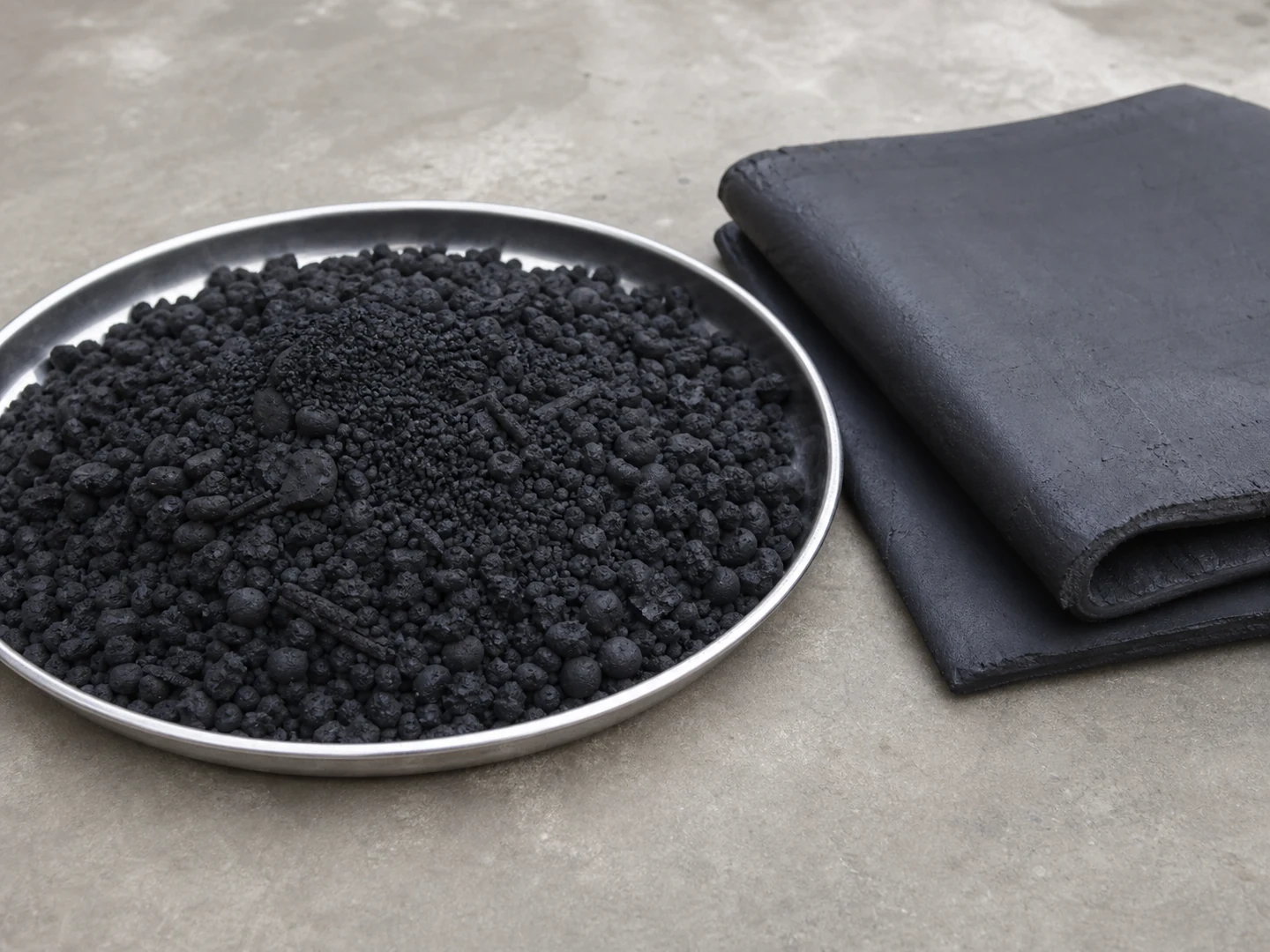
- Rubber — Compare Rubber with Silicone elastomer, TPE, PVC profile, PVA sponge. Change material when wet stiffness, temperature, chemical resistance, conductivity, particle shedding, or surface marking becomes the limiting factor.
- Abrasive Nylon — Compare Abrasive Nylon with PP, PBT, PET. Change material when wet stiffness, temperature, chemical resistance, conductivity, particle shedding, or surface marking becomes the limiting factor.
- Nylon PA — Compare Nylon PA with PP, PBT, PET. Change material when wet stiffness, temperature, chemical resistance, conductivity, particle shedding, or surface marking becomes the limiting factor.
- AISI 304 Stainless Steel Wire — Use AISI 316 stainless steel wire for chloride, marine, dairy, beverage, chemical washdown, or higher pitting-resistance requirements. Use carbon steel for dry aggressive cutting and brass or abrasive nylon for lower marking risk.