
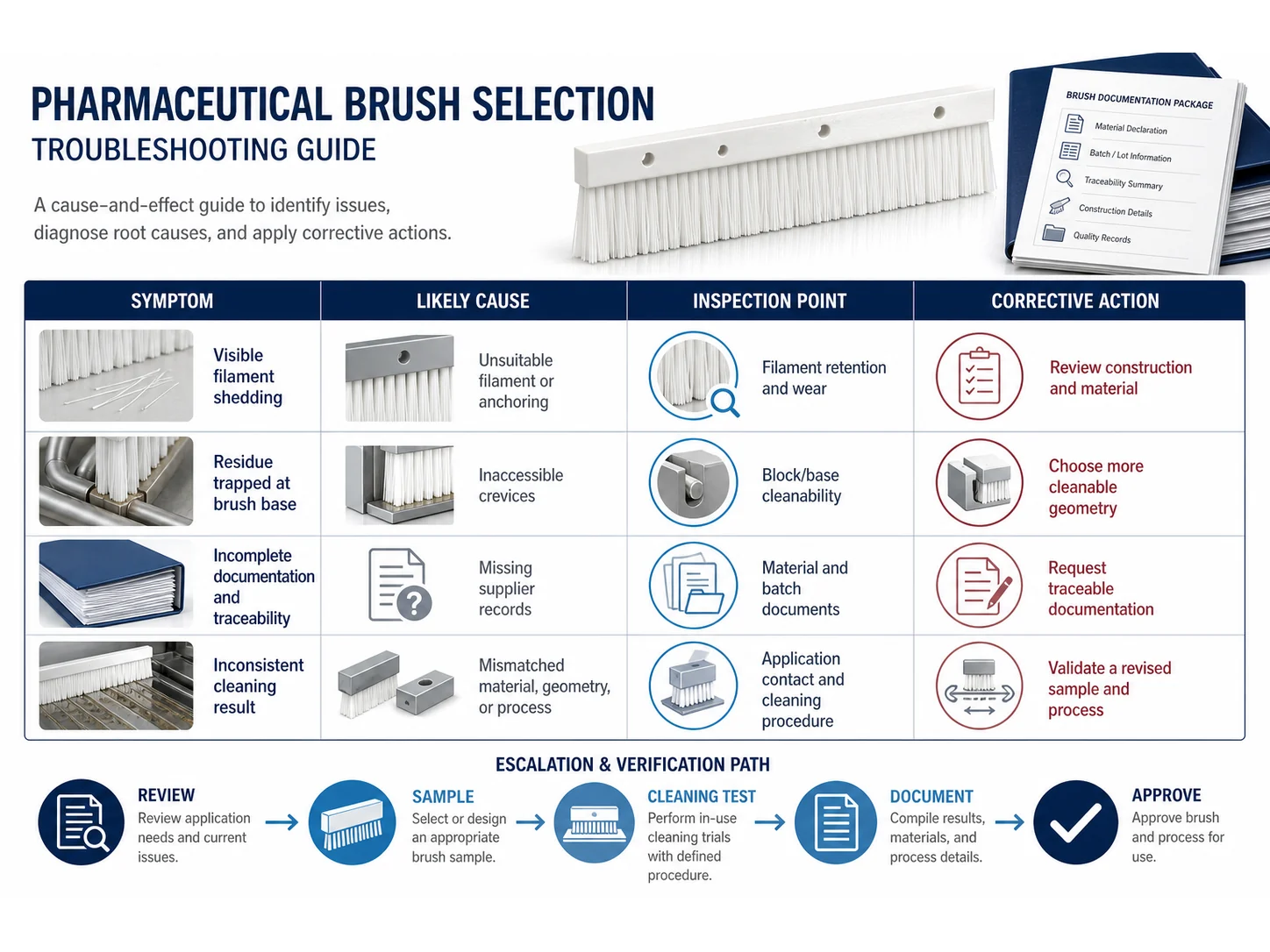
What Is Pharmaceutical Brush Selection?
Pharmaceutical brush selection means choosing a brush that can maintain product purity, withstand chemical cleaning or sterilization, and provide the necessary traceability for a tested process. The brush must not introduce fibers, metal particles, or other contaminants, and its construction should allow easy inspection and cleaning between uses. The selection process goes beyond basic stiffness or size; it requires evaluating material certifications, cleanability data, and whether the brush can be reused reliably or is intended for single use.
Common Brush Types in Pharmaceutical Applications
Pharmaceutical facilities use several brush styles depending on the task. Common types include:
- Tube and pipeline brushes: for cleaning transfer lines, fill pipes, and small-bore tubing.
- Vessel and tank brushes: larger heads for mixing vessels, reactors, and storage tanks.
- Test tube and laboratory brushes: small, often disposable brushes for glassware or sampling tools.
- Detail and swab brushes: for equipment crevices, fitting threads, and hard-to-reach areas.
- Sampling brushes: designed to collect surface or residue samples without adding contamination.
Each type demands materials and constructions that align with the cleaning regimen, solvent exposure, and sterilization method of the process.
Comparing Brush Materials and Constructions
Material and construction are the two biggest factors driving cleanability and contamination risk. The table below outlines how different options compare on key pharmaceutical requirements.
| Material / Construction | Cleanability | Chemical Resistance | Bristle Retention / Shedding | Metal‑Free | Typical Use |
|---|---|---|---|---|---|
| Nylon (molded plastic body) | High – smooth body, no crevices | Good against common CIP solutions; avoid strong acids | Very low shed when properly molded; bristles securely embedded | Yes | Multi‑use tube and vessel brushes |
| Polypropylene (molded) | High – similar to nylon | Excellent with acids and bases | Low shed; softer bristles may wear faster | Yes | Single‑use sampling brushes, aggressive chemical exposure |
| PTFE (molded or extruded) | High – non‑porous, easy to rinse | Nearly universal chemical resistance | Very low shed if bristles are securely set; can be abrasive | Yes | High‑purity solvents, API process contact |
| Stainless steel wire (twisted) | Moderate – wire twists trap residue; requires aggressive cleaning | Excellent for most chemicals; avoid strong chlorides | Metal bristles can break off; creates foreign object risk | No – metal detectable but not metal‑free | Heavy‑duty vessel cleaning, non‑product contact |
| Brass or bronze wire (twisted) | Moderate – similar to steel | Limited; corrode with many pharmaceuticals | Fine wires break easily; high shedding risk | No | Typically avoided in pharma; old utility brushes |
| Natural animal hair (twisted/molded) | Low – porous, absorbs moisture and contaminants | Poor – degrades with solvents and heat | High shed; inconsistent fiber size and retention | Yes, but fibers are a major contaminant | Discontinued in most tested processes |
Construction style also matters: molded brushes (where bristles are set into a plastic body) eliminate the central wire shaft found in twisted‑wire brushes, reducing crevices where residue can hide and making visual inspection easier.
Documentation and Traceability: What to Ask for Before Ordering
Before accepting a brush into a tested process, buyers should request the following documentation from the supplier:
- Material declaration or certificate of composition: lists all components (bristle polymer, body material, adhesives, colorants) to confirm no animal‑derived ingredients (TSE/BSE compliance) and no restricted substances.
- Lot traceability records: each brush or batch should carry a traceable lot number linked to raw material receipts and manufacturing date.
- Cleanability statement: a documented cleaning method (autoclave, CIP, manual) with rinse water analysis or visual inspection criteria.
- Shedding or particulate test data: results from a standardized test (e.g., fiber count after agitation) showing the brush meets an agreed low‑shed acceptance limit.
- Metal‑free support (if required): confirmation that no metallic components are used, and a method for metal detection if detectors are part of the process.
- Change control or resupply letter: a commitment to notify the buyer if raw materials or manufacturing processes change.
These documents support internal change control and regulatory audits without requiring the buyer to make GMP claims they cannot verify.
How to Evaluate Cleanability and Low-Shedding Claims
Many suppliers market “low‑lint” or “GMP‑ready” brushes, but such claims are meaningless without supporting data. Evaluation should include:
- Visual inspection under magnification: look for loose fibers, untrimmed bristle ends, and coating integrity.
- Rinse test: after the brush goes through the intended cleaning cycle, collect rinse water and examine for fibers or particulate under a microscope or filtration.
- Dye penetrant or UV tracer test: for molded brushes, check that bristles are fully set and the body has no cracks.
- Accelerated wear simulation: cycle the brush against a representative surface and measure shed particles over time.
- Chemical exposure simulation: soak the brush in the process solvents and cleaning agents, then repeat the shed test to ensure no degradation.
Procurement teams should ask suppliers to share their test protocols and typical results for the specific brush configuration, not generic marketing claims.
Common Mistakes When Selecting Pharmaceutical Brushes
Mistakes in brush selection often come from accepting incomplete data or overlooking how the brush will be used day‑to‑day. Avoid these common errors:
- Trusting unsupported low‑lint claims: never accept “low lint” without a defined test method and acceptance limit.
- Choosing by size and stiffness alone: ignore cleanability features like body design and bristle setting.
- Reusing single‑use brushes: brushes intended for one‑time use may degrade or shed after exposure to aggressive cleaning.
- Overlooking autoclave or sterilization compatibility: some nylon grades warp at high temperatures; verify with the supplier’s thermal data.
- Mixing metal brushes in metal‑free zones: even stainless steel can shed detectable particles that trigger alarms or product holds.
- Not involving quality early: waiting until after production orders to review documentation often causes delays or rejections.
When a Pharmaceutical Brush Is the Wrong Choice
There are situations where a catalog brush cannot meet the requirements, and a custom or more thoroughly documented solution is necessary:
- Unique geometries or access points: internal threads, dead legs, or narrow crevices may require a custom‑shaped brush with exact dimensions.
- Extreme chemical or temperature conditions: when the process involves strong oxidizers or continuous steam‑in‑place, standard materials may not survive, and accelerated aging data from a third party may be needed.
- Validated aseptic or sterile processes: any brush contacting product‑contact surfaces in an aseptic fill area typically needs full extractables and leachables testing, sterility assurance data, and a rigorous change‑control agreement.
- Metal‑detectable but non‑shedding requirements: hybrid brushes with detectable fillers require extensive qualification to confirm they do not compromise product purity.
In these cases, buyers should engage quality, regulatory, and engineering teams to define acceptance criteria and request a formal qualification package from the supplier, often with third‑party laboratory support.
Final Takeaway for Engineering and Procurement Teams
Pharmaceutical brush selection is a documentation‑driven decision, not just a product pick. Start by defining the cleaning method, chemical environment, sterilization cycle, and metal‑free needs. Compare molded polymer constructions for the best balance of cleanability and low shedding. Demand verifiable shedding and cleanability data from the supplier in advance. And when the process is validated, involve quality early to confirm that the brush’s documentation package will pass an audit. A well‑documented brush reduces changeover risk and helps maintain a state of control.
Frequently Asked Questions
What materials are best for low-shedding pharmaceutical brushes?
Molded nylon and PTFE brushes consistently show the lowest shedding in pharmaceutical environments. Nylon holds bristles tightly and is compatible with many cleaning chemicals, while PTFE offers extreme chemical inertness. Polypropylene is also low shedding but may soften above 80°C.
Can pharmaceutical brushes be cleaned in an autoclave?
Some, but not all. Check the brush material’s heat deflection temperature. Nylon 6/6 can withstand typical autoclave cycles (121°C) but may warp after repeated exposure; PTFE and high‑heat polypropylene are more stable. Molded bodies without metal inserts perform better in steam.
How do I request a material declaration for a brush?
Ask the supplier for a full composition statement that lists the polymer grade, any additives (colorants, stabilizers), and documented absence of BSE/TSE materials if animal‑free status is required. This document should be part of the lot‑specific traceability package.
What is the difference between single‑use and reusable brushes in pharma?
Single‑use brushes are typically low‑cost, intended for one process cycle, and may not have the cleanability data to support reuse. Reusable brushes must come with validated cleaning and inspection procedures, material certificates, and wear‑life data.
How can I test if a brush is truly low-shedding?
A common method is to agitate the brush in filtered water under controlled conditions, then count fibers released per surface area or per cycle using a membrane filter and microscopy. The acceptance limit should be defined before testing, and the test should be repeated after simulated cleaning and chemical exposure.
Are metal brushes ever acceptable in pharmaceutical processing?
They can be used in non‑product‑contact utility cleaning (e.g., floor drains, exterior equipment) but are generally avoided in processing areas because of shedding risk. If metal‑detectable brushes are needed, use a hybrid polymer with detectable additives rather than a pure wire brush.
What should I check in a supplier’s documentation before release?
Verify that the material composition matches your process chemistry, the lot number is traceable to raw materials, the cleanability statement includes the specific conditions you will use (chemicals, temperature, time), and that any shed-test data corresponds to the exact brush design you are buying.
How often should pharmaceutical brushes be replaced?
There is no universal rule. Replacement frequency depends on wear, shedding trends, and cleaning effectiveness. Trend analysis of visual inspections and rinse-water particulate counts over time should drive a preventive replacement schedule documented in your site’s cleaning SOP.
Technical References
- eCFR — 21 CFR 211.67 Equipment Cleaning and Maintenance
- eCFR — 21 CFR Part 211 Finished Pharmaceutical CGMP
- NIST — Metric SI
Which nylon grade fits this job — Nylon PA, PA6 Nylon or PA66 Nylon?
| Grade | Continuous temperature (°C) | Peak temperature (°C) | Water absorption | Hardness |
|---|---|---|---|---|
| Nylon PA | 93 | 121 | 0.3–9% by PA grade and conditioning | Medium to firm; filament diameter and trim length control bending force. |
| PA6 Nylon | 80–100 | 130–160 | 1.5–3.0% | Shore D 75–85 |
| PA66 Nylon | 100–120 | 150–180 | 1.0–1.8% | Shore D 80–88 |
| PA610 Nylon | 90–110 | 130–150 | 0.5–1.0% | Shore D 72–82 |
| PA612 Nylon | 90–110 | 130–150 | 0.3–0.7% | Shore D 70–80 |
Figures as published by Brushtec / DuPont. Confirm the exact grade against the supplier datasheet before ordering.
What should replace Nylon PA when it stops working?
- Nylon PA — Compare Nylon PA with PP, PBT, PET. Change material when wet stiffness, temperature, chemical resistance, conductivity, particle shedding, or surface marking becomes the limiting factor.
- AISI 304 Stainless Steel Wire — Use AISI 316 stainless steel wire for chloride, marine, dairy, beverage, chemical washdown, or higher pitting-resistance requirements. Use carbon steel for dry aggressive cutting and brass or abrasive nylon for lower marking risk.