
What Are Brush Assembly Methods?
A brush assembly method is the process by which bristles (filaments or wires) are secured into a brush body, channel, or hub. The method determines bristle retention strength, flexibility, chemical resistance, and how the brush handles heat, moisture, and mechanical stress. For custom orders, selecting the correct assembly method ensures the finished brush meets durability and performance expectations without unnecessary cost.
The Three Main Assembly Methods
Stapled Assembly
Common in strip brushes, stapling uses a continuous U‑shaped metal channel. Bristles are folded around a center wire and pressed into the channel, then the channel is mechanically crimped or “stapled” shut. This creates a firm, uniform grip on the bristle material. Stapled construction is fast, economical, and works well with synthetic filaments like polypropylene, nylon, and polyester. It is not suitable for wire bristles because the hard metal wire can deform the channel and reduce holding force.
Crimped Assembly
Crimping is primarily used for wire brushes, including crimped wire wheel brushes, crimped wire cup brushes, and twisted‑in‑wire brushes. Individual wire bristles or wire knots are mechanically crimped into a ferrule, hub, or metal back. The crimping process compresses the metal around the wire ends, creating a strong mechanical lock. This method tolerates high rotational speeds and heavy‑duty cleaning tasks. Crimped wire brushes are often compared to knotted wire brushes; crimped filaments are more flexible and provide a finer finish, while knotted wires are more aggressive.
Epoxy Assembly
Epoxy assembly embeds bristle ends in a two‑part epoxy resin inside a brush channel or hub. Once cured, the epoxy forms a rigid, chemical‑resistant bond. This method is ideal for synthetic brushes used in wet, corrosive, or high‑temperature environments where metal channels would rust or where stapling might damage the filament. Epoxy bonding is common in custom strip brushes for food processing, chemical stripping, and harsh washdown applications.
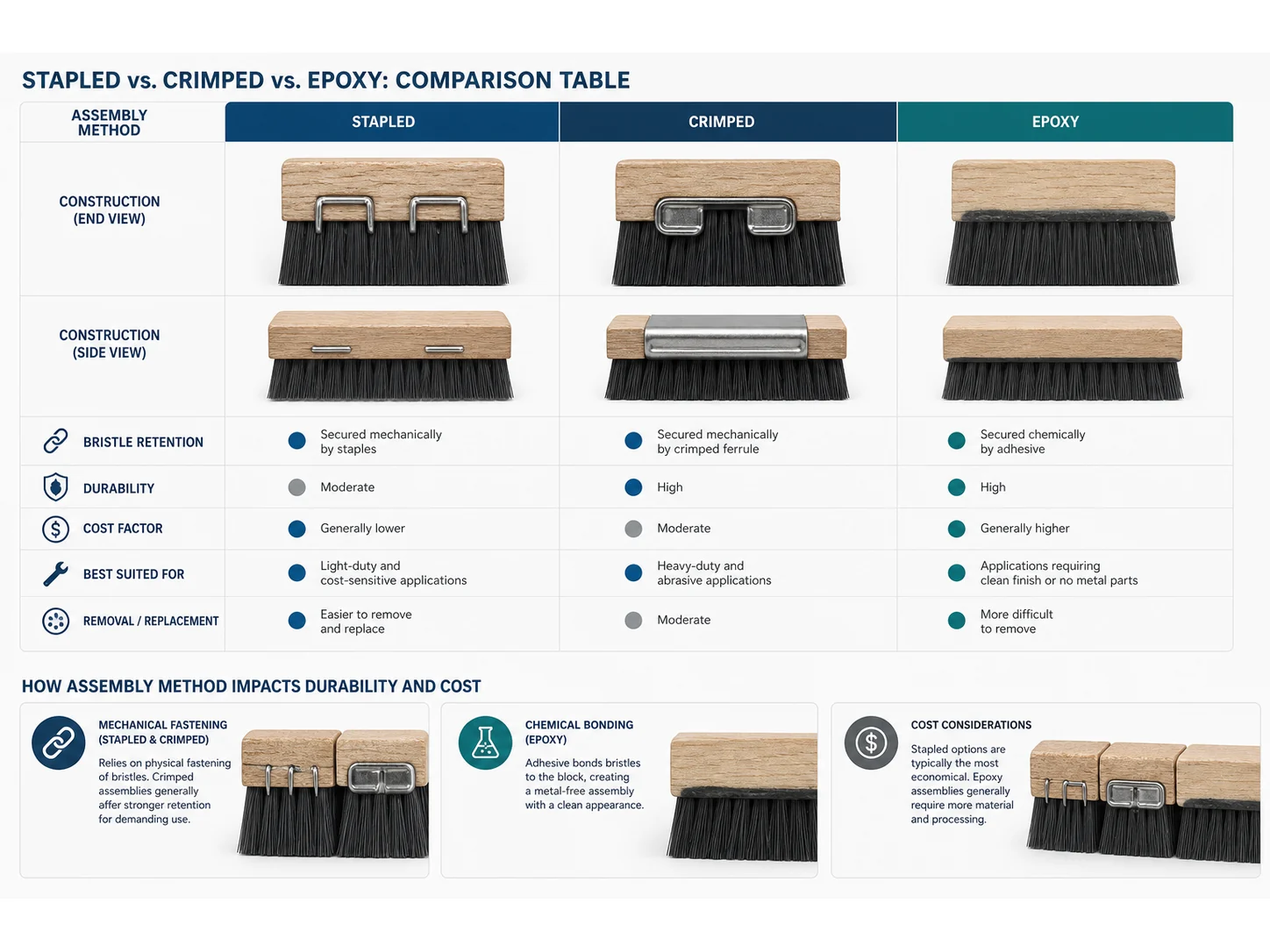
Stapled vs. Crimped vs. Epoxy: Comparison Table
| Method | Typical Brush Types | How It Works | Durability | cost | Best For |
|---|---|---|---|---|---|
| Stapled | Strip brushes with synthetic filaments | Bristles are folded around a wire and compressed into a metal channel | Good retention for light to medium pressure; channel may open under extreme flex or impact | Low material and labor cost; channel is inexpensive | Conveyor sealing, light sweep, dust guards, general‑purpose synthetic brushes |
| Crimped | Wire wheel brushes, cup brushes, twisted‑in‑wire brushes | Wire bristles are compressed into a metal ferrule or hub | Excellent for high‑speed, heavy‑duty applications; wire will break before pulling out | Moderate to high due to metal hub and precise crimping process | Weld cleaning, rust removal, deburring, heavy surface prep |
| Epoxy | Synthetic strip brushes, specialty pin brushes | Filaments are set in epoxy resin inside the channel | Superior chemical and moisture resistance; bond can fail at extreme temperatures beyond resin rating | Higher than stapled due to resin and curing time; comparable to crimped for complex shapes | Food‑grade applications, wet environments, chemical exposure, high‑temperature synthetic brushes |
How Assembly Method Impacts Durability and Cost
Durability is not just about bristle retention—it also covers environmental resistance. Stapled brushes rely on the channel’s spring tension; over time, repeated flexing or impact can fatigue the metal, leading to bristle loss. Crimped wire brushes hold up to intense mechanical forces but may corrode if the ferrule material isn’t matched to the environment. Epoxy‑set brushes resist water and chemicals well, but the resin must be rated for the operating temperature. A common mistake is choosing epoxy for a 300°F dry application; most standard epoxies soften above 200‑250°F.
Cost follows complexity. Stapled strip brushes offer the lowest cost for synthetic filaments. Crimped wire brushes require more precise manufacturing and stronger metal components, increasing cost. Epoxy assembly adds material cost and curing time, but for demanding washdown or chemical environments, the extended service life often lowers total ownership cost.
How to Choose the Right Assembly Method for Your Custom Order
Use this practical checklist when specifying a custom brush:
- Bristle material: Synthetic filaments (polypropylene, nylon, polyester) work with all three methods; wire bristles require crimping. Never specify stapled assembly for wire.
- Operating environment: Wet, acidic, or caustic conditions favor epoxy or stainless steel crimped components. Avoid plain steel channels in washdown areas.
- Mechanical load: High RPM, heavy pressure, or impact loading demands crimped wire construction. Light contact and static sealing can use stapled or epoxy.
- Budget vs. service life: Stapled is lowest-cost upfront; epoxy may cost more but reduces replacement frequency in corrosive settings; crimped wire brushes balance strength and moderate cost.
- Cleanability and regulatory needs: Food‑grade applications often require epoxy because it eliminates crevices where bacteria can grow and avoids metal channel corrosion.
Common Mistakes When Specifying Assembly Methods
- Defaulting to the lowest cost method without reviewing conditions. A stapled brush in a wet, chemical‑laden process will fail quickly, leading to more downtime than the savings are worth.
- Ignoring bristle compatibility. Specifying crimped assembly for soft synthetic filaments can crush or damage the fibers; those materials are better suited to stapling or epoxy.
- Overlooking channel material. Even with correct assembly, a plain steel channel will rust in humid or washdown environments. Stainless steel, aluminum, or polymer channels should be specified for those conditions.
- Misunderstanding temperature limits. Standard epoxy softens above 200°F. For high‑temperature ovens or dryers, specify a high‑temp epoxy or consider mechanical assembly with heat‑tolerant channel materials.
- Assuming all wire brushes are the same. “Crimped” vs “knotted” for wire wheels affects aggression and finish. Crimped provides flexibility; knotted is more rigid and aggressive. The same assembly method (crimping) can produce both, but the end‑use determines which is appropriate.
When Specifying the Assembly Method May Require a Manufacturer’s Review
Buyers can and should specify the preferred assembly method on an RFQ, but there are cases where an experienced brush manufacturer should review the choice before production:
- The application involves extreme temperature cycling (e.g., cryogenic to 400°F in one process). Thermal expansion differences between bristles, epoxy, and channel can cause premature failure.
- Strict FDA or USDA compliance is required. The manufacturer may propose alternative food‑grade epoxy formulas or specialized stainless‑steel crimping to meet 3‑A sanitary standards.
- Custom bristle blends or diameters are called for. Unusual filament diameters or mixed materials may need a different channel profile or assembly technique to ensure retention.
- The brush will be used in a safety‑critical function (e.g., explosion‑proof chamber seals, aircraft surface treatment). A design review helps confirm that the chosen assembly will hold under fault conditions.
In these situations, providing the manufacturer with full operating conditions and performance requirements allows them to validate—or recommend an alternative to—your specified assembly method. This collaboration reduces the risk of costly field failures.
Final Takeaway: Matching Assembly to Real‑World Demands
Stapled, crimped, and epoxy assembly are not interchangeable; each solves a different set of retention, environmental, and economic challenges. For custom brush orders, the best approach is to define your operating conditions first—then map those to the assembly method that balances durability and cost. When in doubt, share your requirements with a knowledgeable supplier who can confirm the selection before the order goes into production.
When Your Brush Assembly Method Is the Wrong Choice
This brush is not enough when the main problem is blocked access, unsafe working conditions, damaged equipment, incompatible chemicals, or a process setting that keeps recreating the residue. In those cases, review drawings, dimensions, mounting interface, filament material, stiffness, sample testing, and actual working conditions and confirm the surrounding cleaning method before increasing brush stiffness or contact pressure.
Frequently Asked Questions
Can I change the assembly method after the brush order is placed?
It depends on the production stage. Once the channel or hub tooling is set up and bristle material is cut, switching methods (e.g., from stapled to epoxy) often means starting a new production run. This can add cost and production schedule, so confirm the method before finalizing the order.
Is stapled assembly acceptable for food‑grade strip brushes?
Generally, no. Stapled channels have crevices that can trap food particles and harbor bacteria. Epoxy‑set bristles are preferred because they fill the channel and create a smooth, cleanable surface. If metal channels are unavoidable, stainless steel must be used, but epoxy remains the dominant choice for sanitary applications.
How do I know if I need crimped wire or knotted wire for my wheel brush?
Choose crimped wire when you need a flexible brushing action that conforms to uneven surfaces and leaves a finer finish (e.g., light rust removal, paint preparation). Choose knotted wire for aggressive material removal, heavy scale, and weld cleaning where rigidity is more important than finish quality. Both use crimped assembly to hold the wire; the difference is how the wire tips are arranged.
What happens if epoxy‑set brushes exceed their temperature rating?
The epoxy bond softens, loses strength, and can eventually fail, causing bristle shedding. Always check the resin’s heat deflection temperature (HDT) or glass transition temperature (Tg) and select a high‑temperature epoxy if the brush sees continuous heat near or above 200°F.
Can I use crimped assembly for synthetic filaments?
It is not recommended. The high compressive forces needed to crimp a metal ferrule around synthetic fibers can crush, deform, or crack the filaments. For synthetic bristles, stapled or epoxy methods are far more reliable.
Why do some strip brushes combine stainless steel channels with epoxy?
In washdown or corrosive environments, stainless channels resist rust, and epoxy bonds the bristles without additional metal‑to‑filament stress. This combination extends service life and maintains cleanliness, making it a common choice for food and pharmaceutical processing.
How do I compare quotes for custom brushes with different assembly methods?
Look beyond unit cost. Compare expected service life, maintenance downtime, and replacement labor. A more expensive epoxy brush that lasts three times longer in a corrosive line often yields lower total cost of ownership than a cheaper stapled brush that must be changed every month.
Which steel wire grade fits this job — AISI 304 Stainless Steel Wire, AISI 316 Stainless Steel Wire or Carbon Steel Wire?
| Wire grade | Continuous temperature (°C) | Peak temperature (°C) | Water absorption | Hardness |
|---|---|---|---|---|
| AISI 304 Stainless Steel Wire | 400 | 500 | 0% | Rockwell B 70–95 depending on temper and cold work |
| AISI 316 Stainless Steel Wire | 400 | 500 | 0% | Rockwell B 70–95 depending on temper and cold work |
| Carbon Steel Wire | 200–300 | 350–450 | 0% | Rockwell C 40–60 |
| Galvanized Steel Wire | 150–200 | 250–300 | 0% | Rockwell B 70–100 |
Figures as published by Alleima; Material manufacturer TDS / ISO / ASTM / industry reference. Confirm the exact grade against the supplier datasheet before ordering.
What should replace AISI 304 Stainless Steel Wire for custom orders?
- AISI 304 Stainless Steel Wire — Use AISI 316 stainless steel wire for chloride, marine, dairy, beverage, chemical washdown, or higher pitting-resistance requirements. Use carbon steel for dry aggressive cutting and brass or abrasive nylon for lower marking risk.
- Nylon PA — Compare Nylon PA with PP, PBT, PET. Change material when wet stiffness, temperature, chemical resistance, conductivity, particle shedding, or surface marking becomes the limiting factor.