
Custom Cleaning Brush
Kitchen Gap Cleaner Brush PP Antibacterial Comfortable Grip
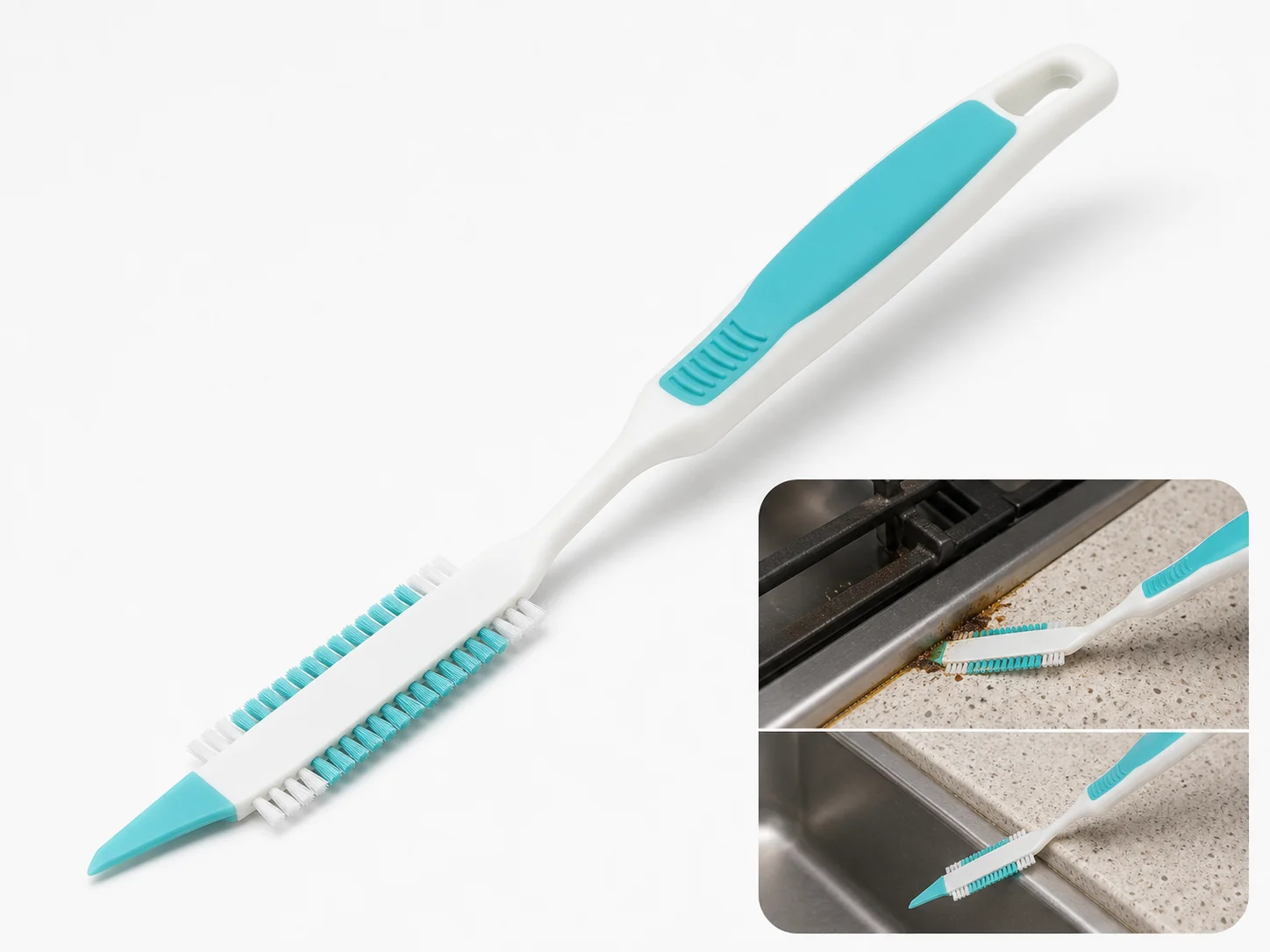
Slim PP gap cleaner brush with stiff antibacterial PBT filament and an ergonomic grip for kitchen corners, grout lines, tracks and appliance seams.
Small brush
500 pcs
Minimum order
Held in one hand: tube, bottle, detail and swab brushes — including long-handled ones with a small head.
Production lead time, once the specification is confirmed
- Up to 500 pcsWithin 7 days
- 501–50,000 pcsWithin 14 days
- Over 50,000 pcsWithin 21 days
Peak season can extend these times; the shipping date is confirmed in writing with your quotation. Sampling and shipping are quoted separately.
A slim-profile hand brush built for corners, seams, grout lines, tracks, and tight fixtures where cloths and flat scrubbers stop — stiff antibacterial PBT filament on a PP body with an ergonomic grip dislodges grease film, soap scum, limescale, mold, crumbs, and hair without scratching tile, stainless steel, plastic, or glass.
What can this brush do for you?
Reaches the actual gap, not just the surface around it
The tapering head ends in a narrow tip with short tufts, so the filaments enter the opening instead of bending back at the edge. Corners behind the faucet, the seam between counter and backsplash, stove knob collars, and refrigerator gasket folds become accessible without scraping around the outside of the gap.
Lifts dried-on residue without metal contact
PBT filament holds its shape in wet, greasy conditions, and the short trim length concentrates hand pressure into a small contact area. That combination breaks up dried grease, soap film, hard-water scale, and mold from grout lines and crevices where a sponge only smears the surface. Because the fill is synthetic, it removes attached dirt without wire-brush scratches on stainless steel, glass tile, or chrome.
Antibacterial fill slows regrowth on the tool itself
The antibacterial agent is incorporated into the filament material rather than applied as a surface coating. A damp brush left in a sink caddy is less likely to become a source of odor or bacterial buildup between uses. This protection does not replace rinsing and drying, but it keeps the brush more hygienic in everyday kitchen storage.
Comfortable grip keeps pressure steady in tight spots
The molded PP handle is shaped for a thumb-forward pinch grip, which improves control when you work inside a narrow door track or behind a fixture. Ribbed texture or an optional soft overmold reduces hand fatigue during repetitive detail work — a practical advantage for commercial kitchen porters and maintenance staff who spend hours cleaning equipment seams and corners.
Rinses clean so yesterday’s grease does not come back
Open tuft rows allow water to flush food particles, soap residue, and lifted debris out of the head. PP and PBT are non-porous, so the brush dries quickly and does not absorb the oils it removes. A fast rinse and shake-out is usually all the brush needs between uses.
What is a Kitchen Gap Cleaner Brush PP Antibacterial Comfortable Grip?
This gap cleaner is a hand-held detail brush built around a molded polypropylene body, a group of antibacterial-treated PBT filaments, and an ergonomic grip. It is not a general dish brush or a wide scrubber. The working end is narrow, tapered, and often angled so the operator can aim into the slot, seam, or corner where residue hides. The short trim length and fine filament diameter give the tip enough stiffness to scratch off attached dirt while the surrounding tufts sweep loosened particles out of the gap.
In use, the operator holds the handle in a pen-like or thumb-forward grip and works the tip through the opening with short back-and-forth strokes. The brush can be used wet or dry, with detergent or plain water. It removes soap film, grease, limescale, mold, dust, hair, crumbs, and burned residue from corners, grout lines, tracks, fixtures, drains, cookware details, tile, plastic, and metal surfaces when the fill material is matched to the contact surface.
The brush is not intended for large flat areas, deep tube or bottle interiors, or heavy carbon deposits that require wire fill. It is a targeted tool for the gaps, seams, and narrow details that broad brushes cannot enter.
Technical Specifications
The table below lists the standard ranges for this gap brush. Most dimensions and material choices can be adjusted for a specific cleaning job.
| Parameter | Value / Options |
|---|---|
| Head width | 20–35 mm at the widest point, tapering to 6–10 mm at the tip |
| Head length | 35–60 mm from handle to tip |
| Tip profile | Pointed, angled 15–30°, or custom shape for a specific gap |
| Filament material | PBT with antibacterial additive; PP alternative for softer, less aggressive contact |
| Filament diameter | 0.20–0.30 mm |
| Trim length | 15–25 mm at the tip, graduating to 20–30 mm at the base of the head |
| Tuft pattern | 3–5 staggered rows angled toward the tip |
| Handle material | PP with ribbed texture or TPE-overmolded grip |
| Overall length | 180–250 mm, selected for reach and control |
| Grip length | 100–130 mm |
| Operating temperature | 0–80°C continuous in water or detergent; brief rinse up to 100°C; avoid direct flame or oven contact |
| Chemical exposure | Compatible with standard kitchen detergents, mild acids and alkalis; avoid acetone, MEK, and long immersion in strong chlorine bleach |
| Hanging feature | Molded hole or hook option on the handle |
| Brush type | Custom Bottle & Container Brushes |
| How it is driven | Hand-guided |
| Cleaning target | faucet base, counter-to-backsplash seam and corner grout, and refrigerator door gasket cleaning |
| Surface or part | seams, corners, tracks, fixtures, molds, plastic, grout lines, and tile |
| Residue or debris | grease, mold, crumbs, hair, limescale, soap scum, scale, and dust |
| Mounting / connection | Fixed |
Where does this brush work best?
- Faucet bases, sink rims, and drain flanges — where soap residue and hard-water scale build in the tight arc around the fixture.
- Counter-to-backsplash seams and corner grout — where mops and cloths leave a visible film line that only a pointed brush can reach.
- Refrigerator door gaskets, oven door seams, and dishwasher gaskets — folds that collect grease, crumbs, and mold.
- Stove burner caps, control knob collars, vent slots, and microwave door edges — dried food and oil around small parts.
- Sliding door tracks and window channels — dust, hair, and crumbs packed into the bottom rail.
- Food-processor crevices, coffee machine seams, and appliance filter housings — where a narrow-head brush clears residue without damaging plastic or rubber seals.
How do I choose the right one?
Start with the actual gap, not the surface around it. Measure the narrowest opening in millimeters and check whether the brush tip can enter without forcing. A pointed tip with a 6–10 mm nose fits most grout lines, sink seams, and gasket folds. If the opening is under 5 mm, a blade scraper or flat pick usually works better than a filament brush.
Then match the filament stiffness to the residue and the contact surface.
- PBT with shorter trim of 15–20 mm is the firmer choice for dried-on grease, limescale, soap scum, and mold on tile, stainless steel, and hard plastic.
- PP with slightly longer trim of 20–30 mm is softer and more flexible for polished chrome, coated fixtures, glass, and light dusting in channels.
Set the handle length after the filling. A 180–220 mm overall length gives the most control for counter-level gaps and behind faucets. A longer handle of 220–250 mm, or a custom extended reach, helps access appliance backs, tall door tracks, and floor drain surrounds without bending. The comfortable grip matters most when the operator uses the brush for repetitive detail work, so specify overmold or texture if the job runs longer than a few minutes per session.
Check the operating environment before finalizing materials. Standard PP and PBT handle hot tap water and most kitchen detergents without softening, but continuous steam, boiling water, strong solvents, or commercial degreasers containing ketones or chlorinated solvents can shorten service life. If the cleaning chemistry is outside this range, discuss a different filament or handle material before ordering.
When a different tool fits better, choose the different tool. A wide dish brush or scrub pad is faster for open plates and cookware surfaces. A bottle or tube brush is needed for deep internal passages. A stainless steel or brass wire brush is the right call for burned-on carbon, rust scale, or aggressive mechanical stripping. Disposable wipes or swabs work better when cross-contamination control is the primary concern. This gap brush earns its place in corners, seams, tracks, and tight machine details.
Can I customize this brush?
The gap brush is built to the opening and residue it has to clean, not to a single fixed dimension. To define the configuration, send the narrowest gap dimension, the surface material, the residue type, the cleaning chemicals, and the handle preference. A photo or drawing of the gap helps us confirm tip entry and tuft reach.
We can adjust the following variables:
- Head geometry — width, taper angle, tip shape, head length, and tuft pattern.
- Filament — PBT or PP, antibacterial additive, diameter, trim length, stiffness, and color.
- Handle — overall length, grip profile, overmold, texture, hanging loop, and color.
- Head-to-handle design — molded one-piece construction or a separate replaceable head.
- Color and marking — brand color, pad print, laser mark, or molded logo.
- Packaging — bulk, individual bag, retail sleeve, or project-specific packing.
For commercial kitchen projects, we can also coordinate material declarations, third-party testing, and inspection support as part of the order.
Which filament survives the cleaning and still lasts on a kitchen gap cleaner brush PP antibacterial comfortable grip?
Will the antibacterial treatment wear off over time?
The antibacterial additive is part of the filament material rather than a surface coating, so it does not wash off quickly. Heavy abrasion, strong solvents, and long-term wear can still gradually reduce the treated surface. The brush still needs to be rinsed and dried after use — antibacterial protection is a backup, not a replacement for cleaning the tool.
What is the smallest gap this brush can clean effectively?
For the standard pointed tip, gaps around 5 mm wide are the practical lower limit. Below that, the tufts cannot spread enough to loosen residue, and a flat scraper, blade pick, or disposable swab gives better access. If you have many openings below 5 mm, specify the dimension during customization and we can check whether a narrower tip profile still holds enough filament.
Will this brush scratch polished stainless steel, chrome, or glass?
PP and PBT filaments are much softer than the metal underneath, so normal hand pressure will not scratch stainless steel, chrome, or glass. However, particles of sand or grit lodged in the tufts can scratch the surface. Rinse the brush before use on polished or coated finishes. Choose PP filament for the most delicate surfaces.
How can I tell when the brush needs to be replaced?
Check the tip first. If the tufts near the point have splayed outward, lost their shape, or no longer reach the bottom of the gap, the brush is losing effective pressure and should be swapped. Also replace the brush if the PP handle shows cracks around the head or the filament becomes brittle after exposure to solvents or heat.
What cleaning chemicals should I keep away from this brush?
Avoid acetone, MEK, paint thinner, and long soaks in strong chlorine bleach or concentrated acids. Standard dish detergents, spray degreasers, vinegar solutions, and diluted alkaline cleaners are acceptable for normal use. Rinse the brush after each chemical exposure and do not store it wet inside a chemical solution.
Does brushing replace scraping or wiping?
No. The brush loosens and lifts attached residue, but loosened material still needs to be wiped or rinsed away. For heavy burned-on deposits, a plastic scraper or wire brush may be needed before the gap brush is used for final detail cleaning. Brushing is one step in the cleaning sequence, not the entire sequence.
Guides that go deeper on this
Custom Manufacturing RFQ
Describe Your Application
An accurate custom quote starts with the dimensions, working surface, residue, material choice, connection, quantity, and reference files.
Drawing or photo optional — it speeds things up, it does not gate the enquiry.
Custom Brush RFQ
Send Your Brush Project
Upload a drawing, product photo, or sample photo and provide the core dimensions and cleaning conditions.
“We need a brush to remove wet residue from a stainless steel conveyor, about 800mm wide. The current brush wears quickly. We can send photos.”
“We sell drinkware and need a cleaning brush to include with the product. Quantity around 5,000 pieces.”