
Custom Cleaning Brush
Medical Channel Brush
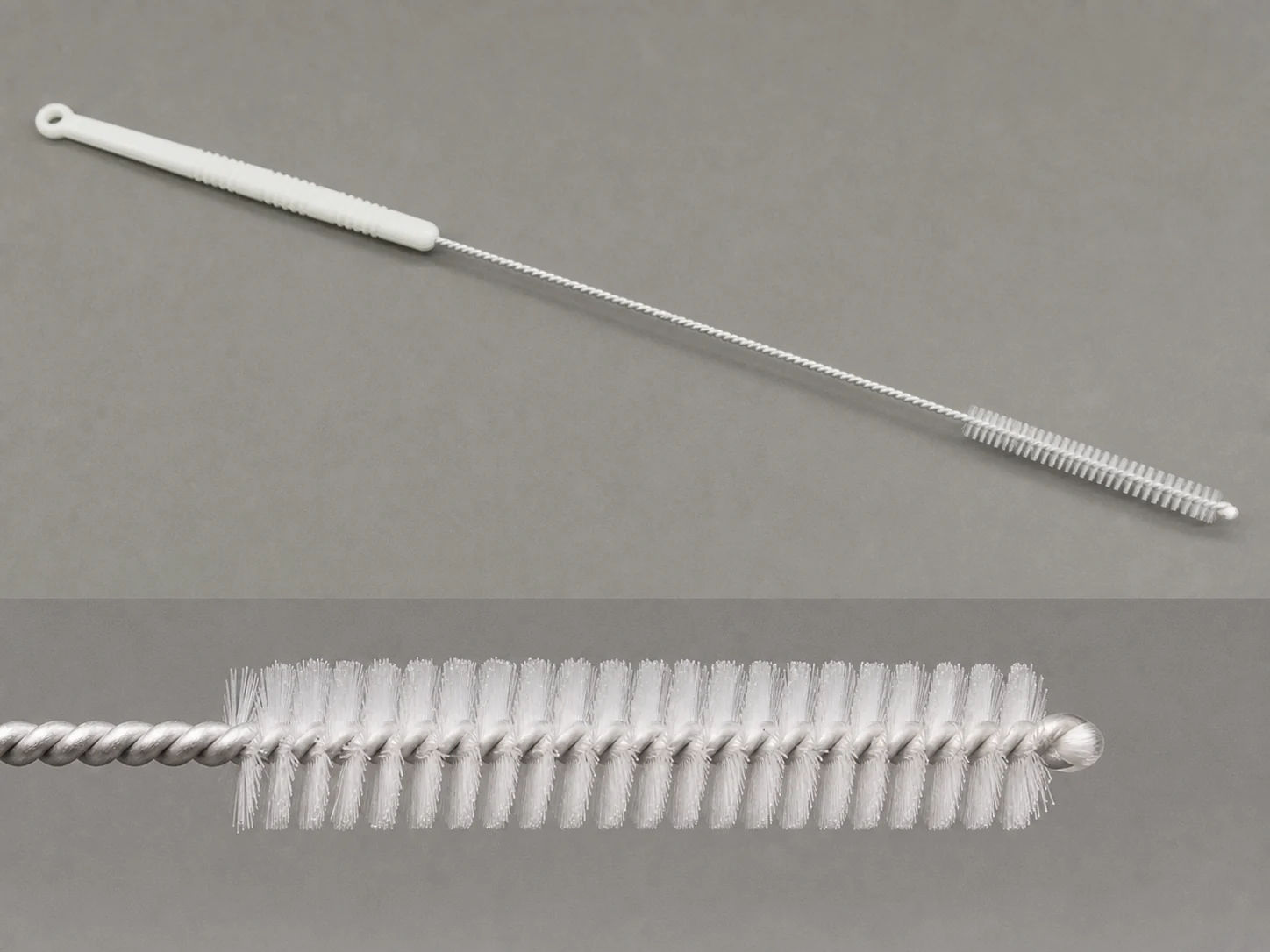
Manual PBT medical channel brush in 2 mm, 6 mm, and 10 mm diameters for cleaning ports, lumens, joints, and accessible endoscope channel openings.
Small brush
500 pcs
Minimum order
Held in one hand: tube, bottle, detail and swab brushes — including long-handled ones with a small head.
Production lead time, once the specification is confirmed
- Up to 500 pcsWithin 7 days
- 501–50,000 pcsWithin 14 days
- Over 50,000 pcsWithin 21 days
Peak season can extend these times; the shipping date is confirmed in writing with your quotation. Sampling and shipping are quoted separately.
A short-reach manual cleaning brush for narrow, accessible channels, ports, lumens, and joint areas in reusable medical devices. A round PBT bristle head on a fixed polypropylene handle scrubs internal walls where protein film, lubricant, detergent residue, and fine particles collect.
What can this brush do for you?
Fits Small Openings Without Forcing
Choose a 2 mm, 6 mm, or 10 mm nominal head diameter to match the channel opening. Because the round head and 40 mm bristled section are no wider than the channel, the brush enters without excessive force and still makes contact around the internal circumference. This is the access needed for ports, valve cavities, and short lumens where a finger, sponge, or full-size brush cannot enter.
Scrubs Off Organic Film and Processing Residue
PBT monofilament keeps its stiffness when wet and resists common enzymatic cleaners and neutral detergents, so the bristles continue working through the manual cleaning cycle instead of softening or collapsing. The bristle tips dislodge protein residue, lubricant, detergent film, and fine particles from channel walls, instrument joints, hinges, and serrations.
Transfers Operator Motion Directly to the Bristle Head
The head is fixed to the handle, with no swivel or loose joint. When you push, pull, or rotate the handle, the motion moves the full head immediately. In a short channel, that direct feel helps you know when the brush has bottomed out and when the bristles are contacting the wall rather than sliding.
Clears Rinsed Debris Instead of Holding It
The round bristle pattern has open space between filament rows, so loosened material moves along the channel and rinses away under running water. Debris does not pack between bristles and get dragged back through the opening on the return stroke.
What is a Medical Channel Brush?
A Medical Channel Brush is a hand-guided cleaning brush used during manual reprocessing of reusable medical devices. It has a round PBT bristle section fixed to a short polypropylene handle and is used to scrub channel openings, ports, short lumens, and mechanical joint areas that trap organic soiling.
In use, the operator inserts the bristled end into the accessible channel or joint, then works push-pull and rotating strokes so the bristle tips contact the internal circumference. The brush is designed around short accessible segments — the first 40 mm to 50 mm of a channel, a valve port, a suction connector, or a hinged joint — not as a full-length pass-through tool for long flexible endoscope working channels.
PBT is used for the bristles because it is dimensionally stable when wet, chemically resistant in detergent environments, and stiff enough to scrape soft residue from metal and polymer surfaces without introducing wire particles. The fixed PP handle keeps the tool light, easy to grip with a gloved hand, and simple to inspect before reuse.
This brush supports the manual pre-cleaning and accessible-channel scrubbing step. It does not replace flushing, ultrasonic cleaning, washer-disinfector processing, or final sterilization. It also does not replace a longer flexible channel brush where the soiling sits beyond the reachable depth.
Technical Specifications
| Parameter | Value / Options |
|---|---|
| Brush head diameter | 2 mm, 6 mm, or 10 mm (nominal) |
| Bristled head length | 40 mm |
| Head shape | Round cross-section with evenly distributed bristle fill |
| Bristle material | PBT monofilament |
| Bristle stiffness | Medium-firm; sized to remove soft organic film and lubricant residue |
| Core / shaft | Twisted stainless steel wire standard; polymer core option for metal-free requirements |
| Handle material | Polypropylene (PP) |
| Handle length | 80 mm |
| Grip diameter | 6 mm |
| Connection | Fixed head-to-handle joint |
| Overall length | Approx. 120 mm in the standard 40 mm head + 80 mm handle configuration |
| Cleaning environment | Manual reprocessing with enzymatic or neutral detergent solutions |
| Brush type | Custom Handheld Detail Brushes |
| How it is driven | Hand-guided |
| Cleaning target | endoscope control-body port, short rigid lumen, and joint face cleaning |
| Surface or part | channel, lumens, ports, joints, walls, instruments, valves, and connectors |
| Residue or debris | particles, fine particles, lubricant, protein, detergent residue, and protein film |
| Mounting / connection | Fixed head-to-handle joint |
Dimensions can be adjusted to the channel geometry for a project. The standard three diameters cover common port and lumen sizes; a custom diameter is available when the channel does not match 2 mm, 6 mm, or 10 mm.
Where does this brush work best?
- Endoscope control-body ports: air/water, suction, biopsy, and valve cylinders with a short internal run.
- Short rigid lumens, cannulas, and connectors on reusable instruments.
- Hinges, box locks, serrations, and joint faces on reusable surgical instruments.
- Reprocessing trays and soak stations where operators need a controlled short brush for channel openings before automated cleaning.
How do I choose the right one?
Match the head diameter to the channel ID
Measure the narrowest internal opening. For a channel measuring about 2 mm to 3 mm, start with the 2 mm head; for 6 mm to 8 mm, the 6 mm head; for 10 mm to 12 mm, the 10 mm head. Select a nominal diameter equal to or slightly above the channel ID so the bristles make firm contact without excessive buckling. If the bristles fold flat and the brush binds, drop a size; if it passes with no wall contact, move up.
| Channel ID (approx.) | Suggested head diameter |
|---|---|
| 2 mm to 3 mm | 2 mm |
| 6 mm to 8 mm | 6 mm |
| 10 mm to 12 mm | 10 mm |
Check the reach before choosing this brush
The usable bristled length is 40 mm, and the whole brush extends about 120 mm. Use it where the opening and the contaminated surface are within that reach. If the lumen is longer than the brush or has bends beyond the bristled section, pair it with a longer flexible channel brush or pull-through cleaner for the deep portion.
Match the filament to the residue and surface
PBT is appropriate for protein film, lubricant, detergent residue, and fine particles on metal and most rigid polymer channels. If the surface is highly scratch-sensitive or the channel wall is soft plastic, choose a softer nylon PA filament or a lower filament diameter. If the deposit is hardened mineral scale, corrosion, or baked residue, chemical pretreatment and a stainless wire or abrasive brush are more effective.
Confirm the chemical and reprocessing environment
Share the detergent chemistry, contact time, temperature, and whether the brush itself will be reused or discarded. PBT and PP grades can be supplied for the intended chemistry, but a material grade that works in one detergent may not suit another. This determines whether a reusable or single-use configuration is the right build.
Can I customize this brush?
Medical Channel Brushes are usually ordered around a specific port, lumen, or instrument family. To configure one, send the minimum channel ID, accessible depth, residue type, cleaning chemistry, reuse policy, and preferred handle dimensions. A dimensioned drawing, sample instrument, or channel cross-section speeds up the configuration.
- Head geometry — diameter from about 1 mm to 12 mm, bristled length from 20 mm to 80 mm, trim profile, tip shape, or multi-step diameter
- Bristle options — PBT filament diameter, fill density, stiffness, cut length, and color; softer nylon/PA options for scratch-sensitive internal surfaces
- Core / shaft — twisted stainless wire, straight core, or polymer core for metal-free requirements
- Handle — length, grip diameter, knurled or molded grip texture, hanging hole, color coding by size, and molded or pad-printed identification
- Configuration — reusable or single-use construction, sealed packaging for reprocessing areas, bulk packing, or individually bagged units
When the application also requires material declarations, documentation, or third-party testing support, we can assist with that as part of the project scope.
How do you confirm a medical channel brush has actually cleaned the surface?
How do I check that the brush diameter actually fits before using it on a real instrument?
Test in a clean, dry channel or gauge of the same minimum ID. The head should enter without forcing, and the bristles should bend slightly and recover when removed. If the brush must be forced or the bristles remain bent flat, the head is too large; if it slides freely with no wall contact, the head is too small.
Can this brush clean the entire working channel of a flexible endoscope?
No. The standard head is 40 mm long and the overall brush is about 120 mm. It cleans the channel inlet, valve port, or other accessible first segment. Use a longer flexible channel brush or pull-through cleaner for the rest of the working channel as part of the full reprocessing sequence.
What should I inspect before each use?
Look at the bristle rows under light: they should be evenly distributed, straight, and free of trapped debris from a previous cycle. Check the core for bends, kinks, or corrosion, and confirm the head is still firmly fixed to the handle. If bristles are bent, matted, torn, or the joint feels loose, take the brush out of service.
Can this brush remove hardened scale or corrosion from a channel?
It is not intended for that. PBT bristles are sized to remove protein film, lubricant, detergent film, and fine particles. Hard mineral scale or corrosion requires chemical pretreatment and usually a stainless wire or abrasive brush; otherwise the PBT bristles will wear out quickly without removing the deposit.
How do I verify the channel is clean after brushing?
Flush the channel with the designated rinse water and inspect the effluent under good light. Then use the facility’s usual lumen inspection method — borescope, magnifier, or white pad wipe at the accessible opening. Residual discoloration, film, or particles after a repeat cycle means the diameter, bristle stiffness, or motion pattern needs adjustment.
Can the brush itself be steam sterilized between uses?
Reusable configurations can be supplied with material grades selected for your sterilization process, but compatibility must be confirmed against the actual cycle parameters, chemistry, and number of cycles. If the brush will be exposed to repeated steam cycles or requires validated sterile presentation, specify that during configuration so the right core, handle, and bristle grade are chosen — or a single-use format can be selected.
Guides that go deeper on this
Custom Manufacturing RFQ
Describe Your Application
Send the key measurements, cleaning requirement, residue, material direction, mounting method, quantity, and drawing or photo.
Drawing or photo optional — it speeds things up, it does not gate the enquiry.
Custom Brush RFQ
Send Your Brush Project
Upload a drawing, product photo, or sample photo and provide the core dimensions and cleaning conditions.
“We need a brush to remove wet residue from a stainless steel conveyor, about 800mm wide. The current brush wears quickly. We can send photos.”
“We sell drinkware and need a cleaning brush to include with the product. Quantity around 5,000 pieces.”