
Custom Cleaning Brush
Outdoor Wall Cleaning Brush
Outdoor wall cleaning brush with a 100–300 mm head and extendable 300–2000 mm handle. Nylon, PP or PBT bristles for siding, brick, render and concrete.
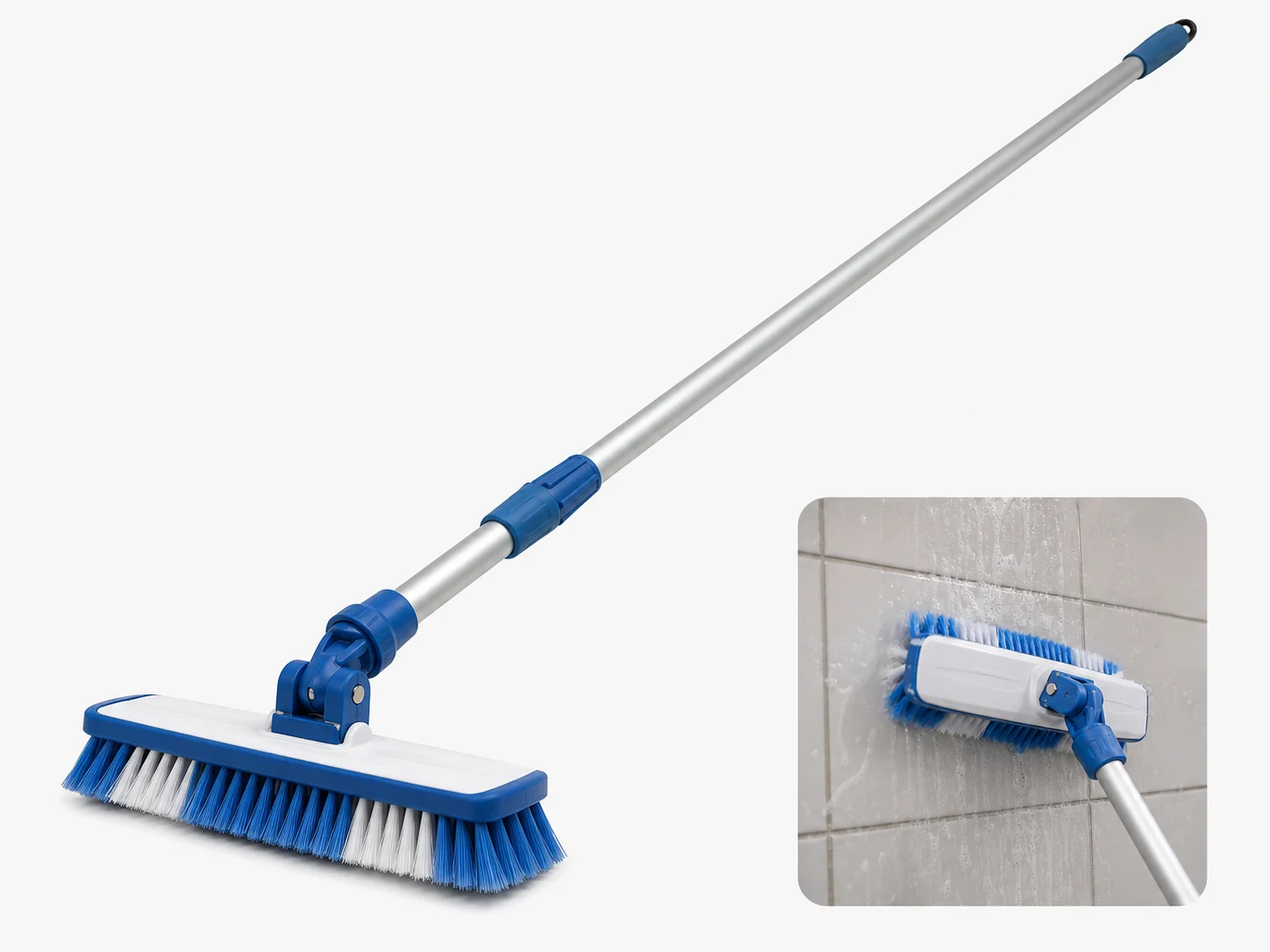
Medium brush
100 pcs
Minimum order
Worked with two hands or on a pole: chimney, gutter and pond-filter brushes, discs, cups and tank brushes.
Production lead time, once the specification is confirmed
- Up to 100 pcsWithin 7 days
- 101–5,000 pcsWithin 14 days
- 5,001–50,000 pcsWithin 21 days
- Over 50,000 pcsConfirmed with your quotation
Peak season can extend these times; the shipping date is confirmed in writing with your quotation. Sampling and shipping are quoted separately.
An outdoor wall cleaning brush with a wide scrubbing face and an extendable handle for washing down exterior vertical surfaces. It combines wet-tolerant synthetic bristles, a head width from 100 to 300 mm, and an adjustable handle length up to 2000 mm so maintenance crews can remove mud, moss, sand and loose surface film from siding, brick, render and concrete with fewer ladder moves.
What can this brush do for you?
Cover wide wall sections in a single pass
The flat bristle face spreads contact across a broad band, so each vertical or horizontal stroke cleans more surface area than a narrow brush. On long building elevations, retaining walls and fence lines, the wide head cuts the number of scrubbing passes and reduces operator fatigue.
Scrub embedded outdoor residue without softening in the water
Nylon PA, polypropylene and PBT filaments with trim lengths from 8 to 40 mm and diameters from 0.10 to 0.80 mm work into rough masonry texture, lap siding gaps and mortar joints. PP and PBT retain their stiffness in wet conditions, while nylon provides strong bend recovery and abrasion resistance. The brush keeps its scrubbing pressure even when the wall is soaked with cleaning solution.
Reach second-story walls, eaves and foundations from the ground
The extendable handle adjusts from 300 to 2000 mm, so an operator can clean high siding, fascia areas and overhead soffits without repositioning a ladder. Handle diameters from 8 to 35 mm can be matched to grip size and reach, keeping the tool controllable when the pole is extended.
Match the contact to the surface finish
Because the brush is produced to order, the fill material and filament diameter can be selected for the actual wall surface. Painted or coated siding gets softer PP or finer nylon, while raw brick and concrete can take stiffer PBT or heavier nylon. This avoids the scratches and gouges that occur when one stiff brush is used on every substrate.
Work with water, outdoor detergents, and hot or cold conditions
The brush is designed for wet exterior cleaning, including diluted bleach, oxygen-based cleaners and low-foam surface detergents. The material set tolerates a 5–100°C working range, which covers cold-weather moss removal and warm-weather washing schedules without brittle cracking or early bristle breakdown.
What is an Outdoor Wall Cleaning Brush?
An outdoor wall cleaning brush is a hand-guided scrubbing tool built around a wide brush block and a long handle. It is used to mechanically agitate vertical outdoor surfaces before rinsing or pressure washing. The bristle face applies friction to the wall, breaking up the layer of dirt, mud, algae film, moss and sand that water alone does not remove.
In practice, the wall is first wetted and a cleaning solution is applied. The operator then works the brush in vertical or overlapping strokes, keeping the face flat against the surface so the bristle tips contact the substrate evenly. The loosened residue is rinsed away, either with a garden hose or a low-to-medium pressure washer. For large facades, the brush is often used as a pre-treatment step that reduces the washing time and chemical load required downstream.
This is not a tool for stripping paint, removing hardened concrete scale, or cutting through thick mortar spills. It is a surface-cleaning brush for loose and lightly embedded outdoor residue, where the priority is consistent coverage without damaging the wall finish.
Technical Specifications
The table shows the standard production range for this brush. We adjust the dimensions, bristle fill and handle interface to match your wall surface and working height.
| Parameter | Value / Options |
|---|---|
| Head width | 100–300 mm, selected for wall coverage or tight access |
| Bristle trim length | 8–40 mm |
| Filament diameter | 0.10–0.80 mm |
| Fill materials | Nylon PA, polypropylene PP, PBT — single material or blended fill |
| Overall length | 300–2000 mm, extendable |
| Handle diameter | 8–35 mm |
| Handle connection | Fixed, threaded tip, or clamp-on extension as specified |
| Head angle | Fixed 0° or adjustable pivot head as an option |
| Use temperature | 5–100°C |
| Brush type | Custom Handheld Detail Brushes |
| How it is driven | Hand-guided |
| Cleaning target | block and concrete wall, painted or coated siding, and stucco and render cleaning |
| Surface or part | walls, concrete, aluminum, boards, traps, substrates, corners, and bends |
| Residue or debris | moss, sand, mud, mildew film, paint, scale, dust, and fiber |
| Mounting / connection | Fixed, threaded tip, or clamp-on extension as specified |
Brush block or backplate materials are selected for the project and can include PP, ABS, or timber where a specific weight or stiffness is required.
Where does this brush work best?
- Brick, block and concrete walls where wind-driven sand, mud and moss settle into pores and rough texture. A stiffer PBT or heavier nylon fill works into the surface without clogging.
- Painted or coated siding such as vinyl, fiber cement and aluminum, where a softer PP or finer nylon fill removes dust, pollen and mildew film without scratching the finish.
- Stucco and render with open or textured surfaces that trap dirt. A medium filament diameter and 8–20 mm trim length reaches into the texture while staying controllable.
- Retaining walls, fence boards, garage walls and foundation skirting before repainting, sealing or general seasonal maintenance.
- Pre-wash preparation before pressure washing to loosen the surface layer so crews can use lower pressure or less chemical and reduce the risk of etching soft masonry.
How do I choose the right one?
Start with the wall surface and finish
Identify whether the surface is raw or finished. Raw brick, concrete and unpainted render can accept stiffer PBT or larger-diameter nylon for more scrubbing force. Painted, coated or soft siding should use PP or lower-diameter nylon to avoid visible scratches. The trim length also matters: longer trim bends more and applies less edge pressure, while shorter trim transmits more force for embedded dirt.
Set the head width for coverage versus access
A 200–300 mm head cleans large flat elevations efficiently, while a 100–150 mm head fits into lap siding gaps, window reveals and corners. If the wall has both open areas and detailed trim, consider a medium width in the 150–200 mm range as a balance.
Match the handle to the working height
Choose the extended length based on the highest point the operator must reach from the ground or a work platform. A longer reach reduces ladder time, but at full extension the handle flexes more and applies less downward pressure. If the crew already uses an existing extension pole, specify the matching thread type so the head can be attached directly.
Consider moisture, chemicals and temperature
Nylon PA softens somewhat when saturated, while PP and PBT hold stiffness far better in constant wet use. For exterior washing with diluted bleach or alkaline detergents, PP or PBT is usually the safer base material. Confirm the operating temperature early: the material set is rated for 5–100°C, but the handle and block material must also be selected for the same conditions.
When this brush is not the right tool
Use a wire brush or abrasive tool for hardened scale, old paint, or thick mineral deposits. Use a long-handle scraper for moss with deep root structures in wide mortar joints. For very tall facades that require a continuous water feed, a water-through brush on a telescopic pole may be a better choice. And for sweeping loose leaves, sand or snow, a push broom or pavement broom works faster than a wall scrubbing brush.
Can I customize this brush?
Outdoor wall cleaning brushes are normally produced to the project rather than carried as one fixed stock item. To define the configuration, we need the wall surface or finish, maximum working height, cleaning solution, preferred head width, and whether the crew uses an existing extension pole. A drawing or sample handle improves the interface fit.
We can adjust:
- Head dimensions and profile — width, depth, rectangular or tapered shape, angled corners, and block material.
- Bristle fill — nylon PA, PP, PBT or a blended mix, filament diameter, trim length, staple density, and color.
- Handle — overall length, telescopic or sectional construction, aluminum, fiberglass or wood material, diameter, grip sleeve, end cap, and hanging hole.
- Interface and angle — fixed head, adjustable pivot head, threaded adapter, or clamp-on pole connection.
- Marking and packaging — customer logo, pad printing, label application, bulk cartons, retail sleeves, or project-specific packing.
Project-specific documentation, material declarations, inspection support or third-party testing can be arranged during the customization process when the customer’s specification requires it.
What pressure keeps an outdoor wall cleaning brush clean without wearing it early?
How do I know whether the brush will scratch my siding?
Test the selected filament material and diameter on an inconspicuous area before full production. As a rule, PP or lower-diameter nylon with a longer trim is the safer baseline for painted or coated siding. If the test shows visible marks, move down in filament diameter or change the fill material and re-test.
Can the brush be left soaking in cleaning solution between uses?
It is better to rinse the head and handle after each shift and hang the brush to dry. Prolonged soaking can soften some nylon grades, corrode metal pole connections, or weaken a wood backplate. Rinsing also reduces chemical carryover when the same brush is used on different wall materials.
Will this brush remove moss down to the roots?
The brush removes the loose surface layer of moss, but root structures embedded in mortar joints or rough texture often remain. For deep moss, combine the brush with a diluted moss treatment, allow the required dwell time, then scrub the dead material away. Do not rely on mechanical brushing alone for complete root removal.
How can I tell when the brush head should be replaced?
Inspect the bristles for permanent splay, flattened tips and noticeable shortening. Check the block for cracks and the handle connection for movement. When the brush no longer contacts the wall evenly, or the face looks worn on one side only, it is time to replace the head or the brush.
Does brushing replace pressure washing?
No. Brushing loosens and lifts surface residue, but the loosened dirt must still be rinsed away. The brush is often used before pressure washing to reduce the pressure or chemical strength required. It does not perform the rinse step and should not be used as a substitute for proper washing.
What pole thread should I specify if I already have extension poles?
Check the thread on your existing pole head. Common exterior maintenance poles use Euro thread, ACME thread, or a simple clamp receptacle. Send us a photo or drawing of the pole tip, and we will match the brush connection so the head installs without an adapter.
Guides that go deeper on this
We have not written a guide specific to this one yet. The material that covers selection, filament, dimensions, maintenance and sourcing is collected in the technical resources library.
Custom Manufacturing RFQ
Describe Your Application
For a custom quote, we need the key dimensions, surface or part, residue, material preference, quantity, and reference image or drawing.
Drawing or photo optional — it speeds things up, it does not gate the enquiry.
Custom Brush RFQ
Send Your Brush Project
Upload a drawing, product photo, or sample photo and provide the core dimensions and cleaning conditions.
“We need a brush to remove wet residue from a stainless steel conveyor, about 800mm wide. The current brush wears quickly. We can send photos.”
“We sell drinkware and need a cleaning brush to include with the product. Quantity around 5,000 pieces.”