
Custom Cleaning Brush
PPS/Cornex Brush
High-temperature PPS/Cornex industrial brushes for cleaning hot molds, die-casting equipment, release agent, aluminum powder.
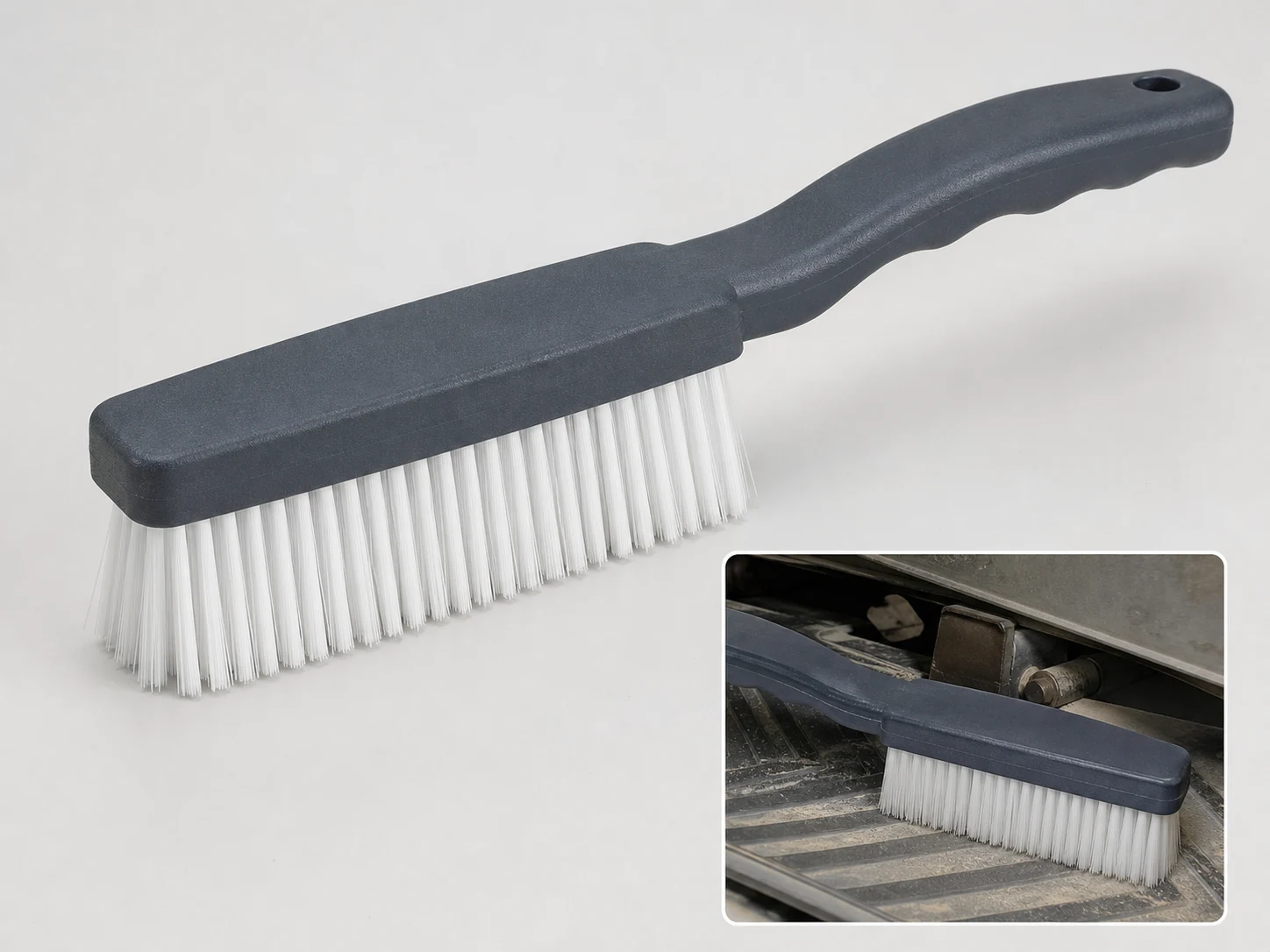
Medium brush
100 pcs
Minimum order
Worked with two hands or on a pole: chimney, gutter and pond-filter brushes, discs, cups and tank brushes.
Production lead time, once the specification is confirmed
- Up to 100 pcsWithin 7 days
- 101–5,000 pcsWithin 14 days
- 5,001–50,000 pcsWithin 21 days
- Over 50,000 pcsConfirmed with your quotation
Peak season can extend these times; the shipping date is confirmed in writing with your quotation. Sampling and shipping are quoted separately.
A high-temperature industrial brush filled with PPS or Cornex synthetic filament for cleaning hot molds, die-cast tooling, and heated machine surfaces. It removes release agent build-up, aluminum powder, resin residues, and fine dust while holding stiffness and filament recovery on surfaces up to 200°C with PPS or 270°C with Cornex.
What can this brush do for you?
Keeps working stiffness on hot surfaces where nylon softens
Standard nylon and polyester filament soften, curl, and ball up when a mold or die is cleaned at production temperature. PPS filament holds its set shape and stiffness in continuous contact up to about 200°C, while Cornex extends the same cleaning action to roughly 270°C. The brush stays aggressive instead of becoming a melted residue source on the parting line or ejector area.
Removes release agent and aluminum powder without spreading contamination
Release agent builds up in vents, ejector pins, and parting line edges. Aluminum powder packs into die faces and shot-end surfaces. PPS has low water absorption and good acid and alkali resistance, so the filament keeps its mechanical action even when wet with mold cleaner or exposed to residual release agent. The tuft tips shear and flick the powder and film rather than smearing it across the tool.
Filament diameter matched to the access point
0.15 mm filament reaches into narrow vents, ejector pinholes, and tight slide grooves. 0.30 mm is the general-purpose choice for parting lines and die faces. 0.50 mm delivers more aggressive contact for heavier accumulation on large open surfaces. The brush can be built in mixed diameters if the same tool has both fine detail and broad faces to clean.
Working width from 10 mm to 3,000 mm
Strip and roller configurations scale from a narrow hand-held parting-line brush to a full-width automated cleaning roller across a large mold or die face. Wide builds reduce stroke count and produce a more uniform cleaning pattern on multi-cavity tooling.
Cornex adds headroom for die-casting and hotter setups
When the die remains above 200°C during maintenance, or when surrounding equipment keeps the contact surface hot, Cornex filament prevents softening and deformation up to about 270°C. This gives one brush family usable range from everyday mold temperatures through hot die-casting service without switching to metal fill.
What is a PPS/Cornex Brush?
A PPS/Cornex Brush is a high-temperature industrial filament brush filled with PPS (polyphenylene sulfide) or Cornex synthetic filament, built to clean molds, dies, and machine surfaces that are still warm or hot when maintenance reaches them. The fill material, not the brush shape, defines this product line: it is specified when working temperature would ruin standard nylon or polyester filament and contaminate the tool with melted bristle fragments.
In use, the brush contacts the parting line, vent slots, slide faces, ejector pin area, die face, or shot-end surface with push, pull, or rotary strokes. The filament tips lift release agent film, aluminum powder, resin dust, and loose residue from the surface geometry. The brush can be used dry or with a compatible release-agent cleaner; PPS does not absorb enough moisture to swell or lose stiffness during wet cleaning.
The brush may be built as a hand-held strip, a machine-driven roller or disc, or an end/cup brush mounted on a drill or rotary tool. The backing and core are selected to survive the same temperature range as the filament. PPS/Cornex removes residue mechanically; it is not a substitute for solvent wiping, air blow-off, or removal of hard metal scale or weld spatter.
Technical Specifications
The table shows the standard build range for this product. Brush form and working dimensions are application-specific, so the dimensions below are configurable around the tool surface and cleaning motion.
| Parameter | Value / Options |
|---|---|
| Filament material | PPS high-temperature synthetic filament; Cornex high-temperature option |
| Maximum continuous use temperature | PPS: 200°C; Cornex: 270°C |
| Filament diameter | 0.15 mm, 0.30 mm, 0.50 mm, selected by access and residue |
| Trim length | 10–100 mm, matched to required reach and stiffness |
| Working width | 10–3,000 mm, custom per tool or machine face |
| Brush form | Strip, roller, disc, cup, end brush, or application-specific profile |
| Backing / core | Stainless steel, aluminum, or heat-resistant construction per mounting |
| Chemical behavior | High acid and alkali resistance; low water absorption |
| Mounting | Shaft, adapter, handle, bolt-on holder, or customer-specified interface |
| Brush type | Custom Cup Brushes |
| How it is driven | Hand-guided |
| Cleaning target | injection mold parting line and vent, die-casting die and shot-end component, and heated mold section and hot runner plate cleaning |
| Surface or part | molds, aluminum, tooling, roller, vents, parting lines, pins, and dies |
| Residue or debris | mold, powder, release agent, dust, resin, resin residue, fine dust, and scale |
| Mounting / connection | Shaft, adapter, handle, bolt-on holder, or customer-specified interface |
Where does this brush work best?
- Injection mold parting lines and vents — removes solidified resin residue, gas deposits, and release agent build-up from the split line, vent channels, and ejector pin areas while the mold is still warm.
- Die-casting dies and shot-end components — removes aluminum powder, release agent accumulation, and fine flash residue from die faces, slides, ejector pins, and shot sleeve areas at elevated temperatures.
- Heated mold sections and hot runner plates — cleans external surfaces where residual heat would soften lower-temperature polymer filament during manual or automated maintenance.
- On-machine maintenance stations — roller and strip builds that mount into automated or semi-automated cleaning lines for repeatable cleaning passes at production-support frequency.
- Warm tooling and surrounding machine surfaces — removes dust, powder, and process residues that settle near heated tooling and create contamination risk or part defects.
How do I choose the right one?
Confirm the temperature band first
Measure the hottest area the brush will contact during actual cleaning, not just the machine setpoint. Use an infrared thermometer or contact pyrometer at the cleaning start. If the measured contact temperature is 200°C or below, PPS fill is correct. From 200°C to about 270°C, specify Cornex. Above 270°C, this brush family is not suitable and a different high-temperature brushing solution is required.
Define the residue and access geometry
Fine aluminum powder and dust in narrow vents call for 0.15 mm filament and a shorter trim that can bend into the slot. Release agent film and resin residue on the parting line or die face respond well to 0.30 mm filament. Heavier packed accumulation on open surfaces benefits from 0.50 mm filament and a longer trim for more aggressive contact.
Select brush form and mounting
A hand-held strip brush suits operator maintenance around the parting line and ejector area. A disc or cup brush works with a drill or rotary tool for localized cleaning. A roller or wide strip build suits automated cleaning lines and multi-cavity tooling. Provide the shaft diameter, mounting pattern, or drive speed so the backing and core match the actual machine interface.
When PPS/Cornex is not the right tool
Use a wire brush or media blasting when the tool has hard metal scale, weld spatter, or baked-on carbon beyond the removal range of polymer filament. Use chemical pre-treatment if residue is heavily cured, then finish with PPS/Cornex for powder and loose film removal. If the surface stays above 270°C, or if the cleaning area is an inaccessible deep internal passage that the brush cannot physically enter, this brush is not the correct selection.
Can I customize this brush?
The PPS/Cornex Brush is configured to the mold or machine because working width, trim length, backing, and mounting almost always change from one tool to the next. To define the right build, provide the hottest contact temperature, tool surface dimensions, residue description, cleaning motion (hand or driven), shaft or holder interface, and any cleaner chemicals used. A photo or drawing of the cleaning target helps confirm access points.
We can adjust:
- Filament fill — PPS or Cornex grade, filament diameter 0.15 / 0.30 / 0.50 mm, color, heatset shape or flagged tips
- Brush geometry — strip, roller, disc, cup, end brush, or custom profile; working width 10–3,000 mm; trim length 10–100 mm
- Density and layout — tufted or continuous filament pattern, row spacing, and tuft density for the required cleaning force
- Backing and core — stainless steel, aluminum, or heat-resistant material cut to the mounting profile
- Mounting interface — shaft bore, keyway, adapter, set-screw fixing, handle, or bolt-on holder
- Packaging — bulk, individual wrap, maintenance sets, or project-specific packing
If your cleaning process requires material declarations, third-party testing, or inspection support, provide the requirement with the drawing and we can assist as part of the project scope.
When is a pps/cornex brush worn out rather than just dirty?
How do I know whether the tool surface is within the PPS or Cornex temperature limit?
Measure the surface with an infrared thermometer or contact pyrometer at the exact spot and time the brush will touch it. Use the machine setpoint only as a rough guide — a die can cool below its process temperature, while a heated section can remain hotter than the controller reading. If the measured contact temperature exceeds 200°C, specify Cornex; above 270°C, this brush is not suitable.
Can the same brush be used on both injection molds and die-casting dies?
Technically yes, if the temperatures and residues fall within the chosen grade. In practice, many plants keep separate brushes because release agents and additives differ between processes, and cross-transfer can contaminate a mold surface. If one brush must serve both processes, clean and inspect it between uses and confirm the filament diameter is aggressive enough for the heavier die-casting residue without damaging the mold detail.
How do I check that the brush is still safe to use after high-temperature cleaning?
Look for melted, curled, tacky, or fused filament tips; flattened or deformed tufts; cracked or broken bristles near the backing; and warping of the backing strip or core. Bend a few filaments and confirm they spring back. Any of these signs means the brush has lost its intended contact pattern and should be replaced before it leaves bristle debris on the tool.
Does brushing replace solvent wiping or air blow-off on molds and dies?
No. Brushing loosens and removes attached residue, but loosened powder and film still need to be wiped, vacuumed, or blown off. The brush is one mechanical step in the cleaning sequence, not a replacement for wiping, blow-off, or final inspection of vents and ejector areas.
What should I do if release agent or resin residue remains after brushing?
First check whether the filament diameter and trim length match the residue and recess. A stiffer fill, a longer trim, or a higher-density build may be needed. If the residue is baked or carbonized beyond the removal range of polymer filament, pre-treat with chemical cleaner or a wire brush, then finish with PPS/Cornex for powder and loose film removal.
Guides that go deeper on this
Custom Manufacturing RFQ
Describe Your Application
To prepare the correct quotation, provide the dimensions, cleaning task, residue, material, mounting details, quantity, and a drawing or photo.
Drawing or photo optional — it speeds things up, it does not gate the enquiry.
Custom Brush RFQ
Send Your Brush Project
Upload a drawing, product photo, or sample photo and provide the core dimensions and cleaning conditions.
“We need a brush to remove wet residue from a stainless steel conveyor, about 800mm wide. The current brush wears quickly. We can send photos.”
“We sell drinkware and need a cleaning brush to include with the product. Quantity around 5,000 pieces.”