
Custom Cleaning Brush
Prepreg Surface Cleaning Brush
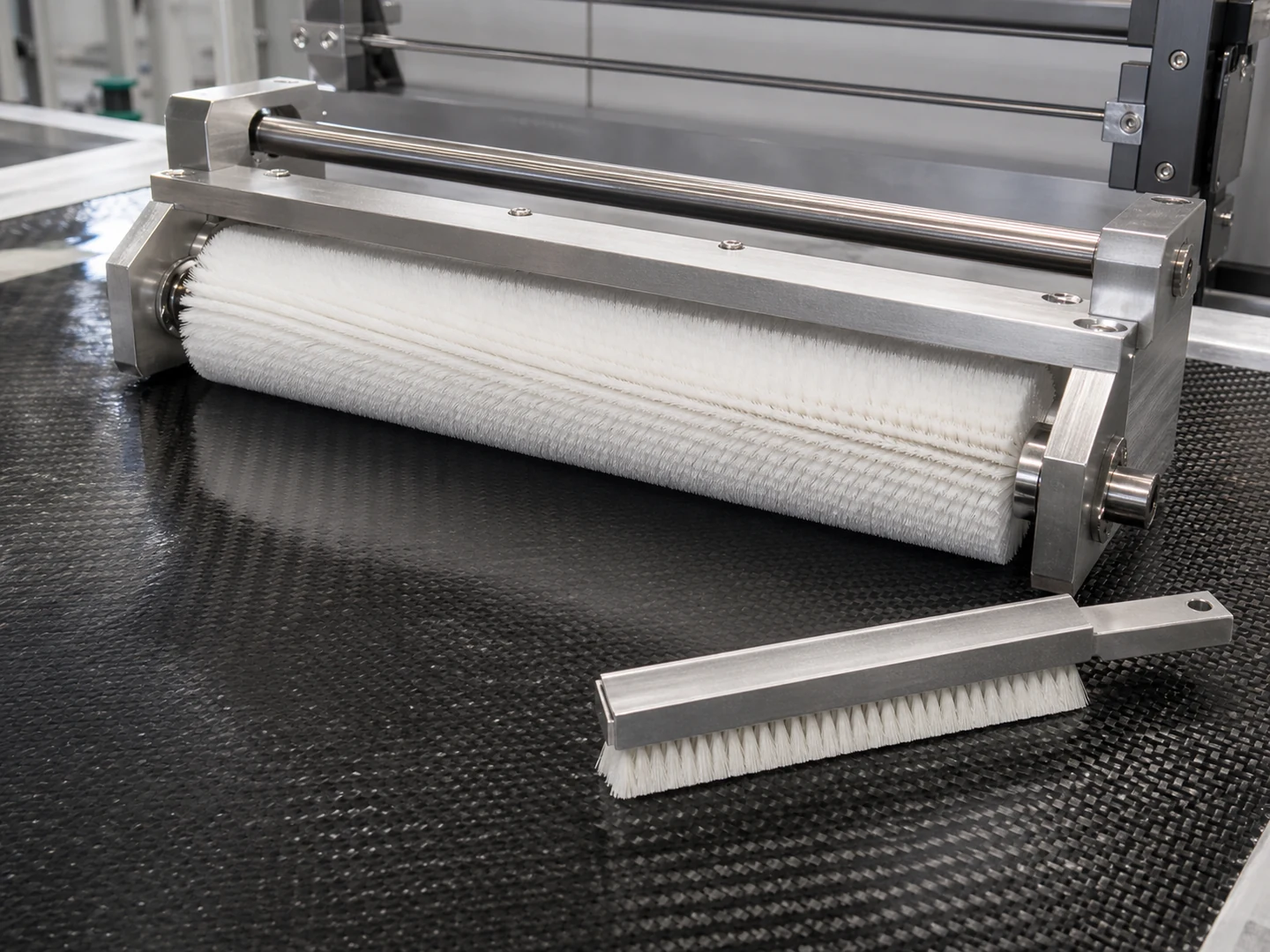
Ultra-soft prepreg surface cleaning brush removes loose dust and fibers from tacky B-stage prepreg sheets in PCB lamination.
Medium brush
100 pcs
Minimum order
Worked with two hands or on a pole: chimney, gutter and pond-filter brushes, discs, cups and tank brushes.
Production lead time, once the specification is confirmed
- Up to 100 pcsWithin 7 days
- 101–5,000 pcsWithin 14 days
- 5,001–50,000 pcsWithin 21 days
- Over 50,000 pcsConfirmed with your quotation
Peak season can extend these times; the shipping date is confirmed in writing with your quotation. Sampling and shipping are quoted separately.
An ultra-soft brush for removing loose dust, fibers, and handling debris from tacky prepreg sheets and layup surfaces in PCB lamination. Filament tips make light, controlled contact so particles release without smearing resin or damaging the fiber weave.
What can this brush do for you?
Lifts Surface Dust Without Scrubbing
The fine, low-bend-modulus nylon or microfiber filaments deflect on contact and touch only the highest points of loose particles. That keeps the working end from dragging through the B-stage resin, so the glass cloth stays undistorted and the surface shows no brush tracks.
Captures and Carries Particles Away
Microfiber fill options use split filaments with a high capture surface that traps fine dust inside the filament network instead of pushing it along the prepreg. Particles are removed from the surface and carried into the brush body rather than redeposited on the next sheet.
One Cleaning Principle Across Manual and Inline Operations
The same tip-contact construction comes in handheld, strip, and rotary roller forms. Hand operators, semi-automatic layup tables, and continuous web lines can use the matched format without changing the contact behavior the process was validated against.
Static Control Only When the Line Needs It
Carbon-loaded filament, conductive cores, and a grounding path are available for clean environments where static charge reattracts particles or endangers ESD-sensitive work. Standard non-conductive fill remains the lower-cost choice when static dissipation is not part of the process requirement.
Serviceable and Contamination-Aware
Wear elements such as roller covers and strip inserts are replaceable, and cores and holders are selected from materials compatible with cleanroom handling. The brush is supplied dry and protected so it does not introduce new contamination at the layup station.
What is a Prepreg Surface Cleaning Brush?
A Prepreg Surface Cleaning Brush is a contamination-control tool designed for B-stage prepreg sheets and the surfaces that contact them before lamination or pressing. Unlike general industrial cleaning brushes, it is built around very fine, flexible filaments and a tip-only contact mode. The brush is not intended to scrub, abrade, or rework resin.
In use, the filament ends pass lightly over the resin-rich surface and engage loose fibers, dust, and handling debris. A stationary handheld or strip brush works when the operator moves the sheet or the tool. A rotary roller works on moving prepreg webs, continuously presenting clean filament tips as the face turns. The contact depth is controlled by trim length, filament stiffness, and mounting standoff rather than by operator downward force.
Because prepreg is tacky and not fully cured, the brush must stay dry, clean, and free of saturated filament sections. Any filament that pulls out and transfers to the sheet becomes a lamination defect, so the contact geometry and replacement schedule matter as much as the filament material itself.
Technical Specifications
| Parameter | Standard / Options |
|---|---|
| Product form | Handheld touch-up, inline strip, or rotary roller |
| Filament material | Nylon PA6, micro-denier polyester/nylon microfiber, carbon-filled nylon for static dissipative use |
| Filament diameter | 0.02–0.12 mm depending on form; microfiber yarns prepared to project specification |
| Trim length (free tip) | 5–25 mm handheld/strip; 3–10 mm rotary roller |
| Filament density | High-density fill; adjusted for particle type, tack level, and desired particle release |
| Working width | 10–300 mm handheld; 200–1,800 mm strip/roller; custom to sheet or machine width |
| Core / holder | Anodized aluminum, stainless steel, conductive composite, or ESD polymer |
| Handle / mounting | Straight handle, side mount, end journals, quick-release plate, or equipment-specific adapter |
| Surface resistivity (conductive option) | 10^3 to 10^9 Ω/sq when static dissipation is specified |
| Operating temperature | Ambient to 40 °C (104 °F) for standard fill; higher-temperature filament options on request |
| Contact mode | Filament tip contact only; no compressed or abrasive contact face |
| Brush type | Custom Strip Seal Brushes |
| How it is driven | Fixed in place, no drive of its own |
| Cleaning target | prepreg sheet, automated layup line, and manual cleanroom touch-up cleaning |
| Surface or part | sheets, webs, roller, glass, edges, plates, carriers, and tracks |
| Residue or debris | resin, fiber, dust, particles, fine dust, loose dust, and loose fibers |
| Mounting / connection | Straight handle, side mount, end journals, quick-release plate, or equipment-specific adapter |
Working width, trim, and holder dimensions are set from the prepreg sheet size, web path, and mounting point so the brush clears the full surface without overhang or missed strips.
Where does this brush work best?
- Prepreg sheets before layup in multilayer PCB lamination, where cutting and handling leave fine dust and glass fibers on the resin surface.
- Automated layup lines where a strip brush or rotary roller cleans the moving prepreg web before registration and stacking.
- Manual cleanroom touch-up at sheet edges, splices, and localized contamination that the inline cleaner cannot reach.
- Layup tables, carrier plates, separator films, and release liners that contact prepreg and can transfer particles back to the resin.
- Glass fabric prepreg and similar B-stage materials that are sensitive to brushing pressure or fiber disturbance.
How do I choose the right one?
Match the form to the process
Manual inspection and rework stations usually need a handheld brush with a short reach and easy replacement. A fixed strip brush suits prepreg sheets moved under a bridge or frame. A rotary roller is the right format for continuous web cleaning, because the rotation constantly changes the contact zone and reduces dwell on any single tacky point.
Match the filament to the residue and tack
General dust and light glass fibers respond well to soft nylon. Very fine or sub-micron dust benefits from microfiber’s higher capture surface. If static charge is causing particles to jump back after cleaning, specify carbon-filled filament and a grounded core. Higher-tack resin systems generally require shorter trim, lower contact pressure, or intermittent contact so the brush does not stick.
Validate tip-only contact before release
Set the mounting standoff so only the outer filament tips engage the surface. Run a test on scrap prepreg under normal line speed, then inspect under raking light. No visible tracks, filament pull-out, or resin redistribution means the contact geometry is within the safe window.
Check coverage and service access
The working width should cover the full sheet or web without gaps at the edges. If the brush is inline, confirm the mounting point allows quick removal for cleaning and inspecting the filaments without stopping the line longer than planned.
When another cleaning method is the better fit
This brush is for loose, dry particles. Oily fingerprints, cured resin stains, embedded debris, and contamination that is chemically bonded to the surface require a solvent wipe, adhesive cleaning roll, ionizer, or process rework. For fully cured laminates or metal tooling with attached deposits, a harder filament or abrasive brush may be acceptable because the surface no longer has the same tack or fiber sensitivity. Do not use this brush on stacks already tacked or pressed.
| Condition | Configuration to start with |
|---|---|
| Manual touch-up at layup station | Handheld, 10–50 mm width, short trim |
| Continuous prepreg web cleaning | Rotary roller, full web width, replaceable cover |
| Very fine dust in Class 100 or cleaner | Microfiber fill, high density, static-dissipative option |
| High-tack or thin resin layer | Reduced trim, lower contact force, rotary form |
Can I customize this brush?
The brush is configured around the prepreg sheet size, the layup equipment, and the contamination you need to control. For a precise quotation, provide the sheet or web width, prepreg resin system and tack level, line speed or cycle rate, mounting interface, cleanroom class, and whether static dissipation is required. A drawing, photo of the station, or sample of the contaminant speeds up the definition.
Typical customization areas include:
- Form and geometry — handheld width and reach, strip length, roller diameter, and face length
- Filament material and construction — nylon, microfiber, carbon-filled nylon, density, and trim length
- Core, holder, and mounting — material, end journals, quick-release plates, and grounding connections
- Static control — conductive filament, conductive core, low-charging surface, and defined resistivity range
- Handle and operator features — ergonomic grips, hanging features, color identification, and length
- Cleanroom and packaging — low-particulate materials, individual bagging, cleanroom-compatible wrapping, and project-specific labeling
If your process requires material documentation, surface resistivity verification, particle testing, or project-specific inspection support, we can include those requirements in the customization scope.
What has to be checked before and after a prepreg surface cleaning brush is used?
How can I tell whether the brush is disturbing the prepreg resin?
Run the brush on a scrap sheet at the intended speed and pressure, then inspect under bright raking light. Displaced glass fibers, visible resin smears, filament pull-out, or shiny tramlines indicate contact is too deep or the filament is too stiff. Reduce trim length, standoff, or pressure before production use.
What does this brush not remove from a prepreg surface?
It is designed for loose dust, airborne fibers, and handling debris. It will not remove oily fingerprints, cured resin spots, embedded glass splinters below the resin surface, or contamination that has been pressed into the sheet. Those defects normally require a solvent wipe, an adhesive roll, or material rejection/rework.
Does the brush need to be grounded?
Grounding is needed only when the brush is built with a static-dissipative fill or a conductive core. Connect the core or handle ground path to the equipment earth. A standard non-conductive brush does not need a ground connection, and adding one will not change its behavior.
How should the brush be inspected and maintained between production runs?
Inspect the filaments for matting, clumping, embedded debris, or areas where the fill has pulled out. Remove loose contamination with dry ionized air or a cleanroom vacuum. Do not wash the brush with solvent unless the material specification for that filament explicitly allows it. Replace the contact element or roller cover at the first sign of filament loss.
Can the brush be used on both sides of the prepreg in one pass?
Yes, if the cleaning step requires both sides and the sheet is supported on a low-contact vacuum or air-flotation table. The brush must be configured so the working face contacts the upward side only, or paired faces clean top and bottom with matched pressure. Verify the support does not transfer particles back to the lower surface.
When should we consider an air knife or ionizing blower instead of a brush?
When the resin is too tacky for even tip-only contact, or when the particle load is so high that the brush would saturate quickly, a non-contact air knife with ionization may be the better first stage. The brush can then be used as a finishing step for particles that resist air removal.
Guides that go deeper on this
Custom Manufacturing RFQ
Describe Your Application
For an accurate quotation, please provide the main dimensions, material preference, working surface, residue, quantity, and a drawing or photo.
Drawing or photo optional — it speeds things up, it does not gate the enquiry.
Custom Brush RFQ
Send Your Brush Project
Upload a drawing, product photo, or sample photo and provide the core dimensions and cleaning conditions.
“We need a brush to remove wet residue from a stainless steel conveyor, about 800mm wide. The current brush wears quickly. We can send photos.”
“We sell drinkware and need a cleaning brush to include with the product. Quantity around 5,000 pieces.”