
Custom Cleaning Brush
Refrigerator Condenser Coil Cleaning Brush
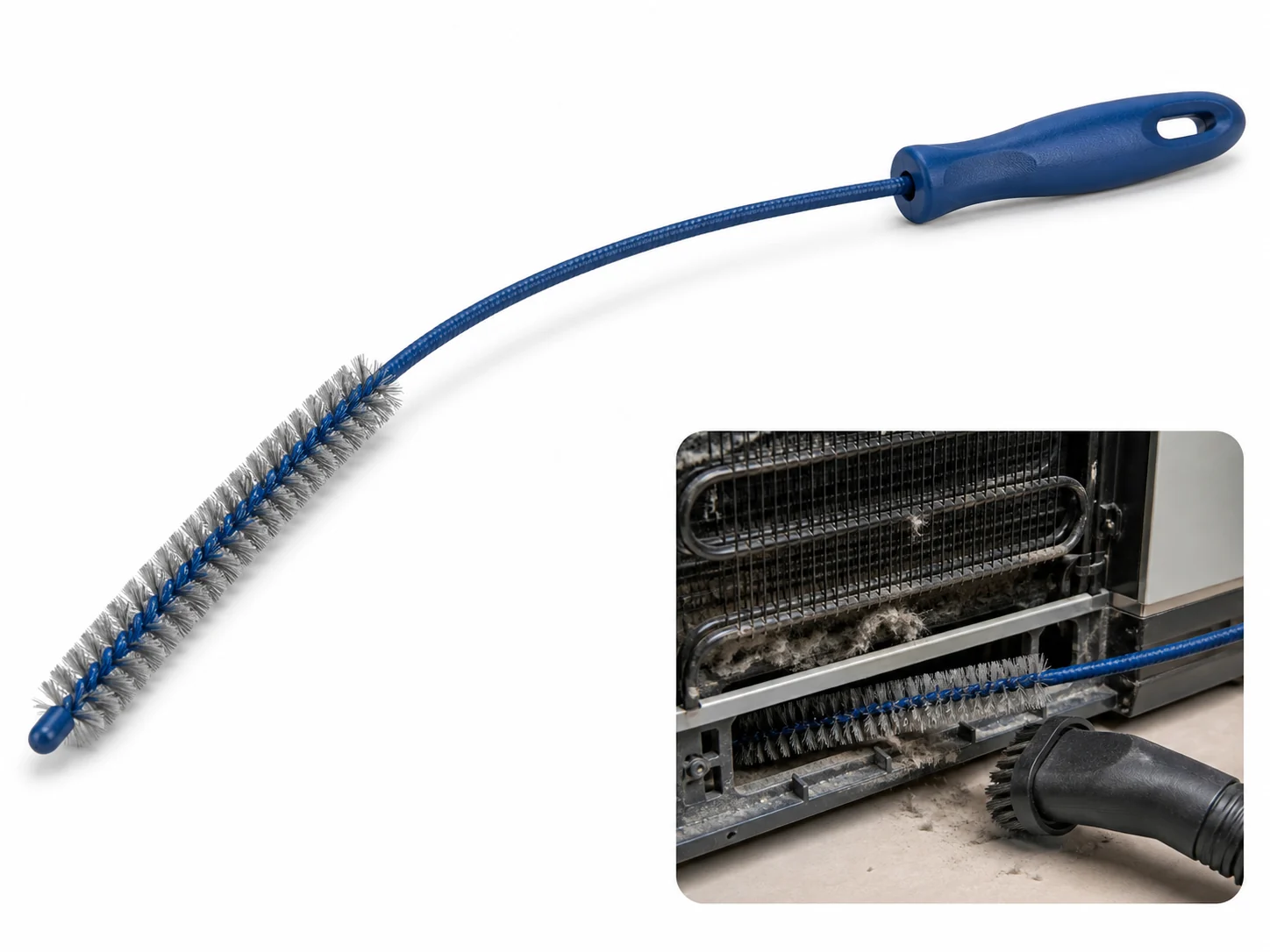
Custom refrigerator condenser cleaning brush with soft anti-static nylon/PBT filaments. Reaches behind units, cleans 1–6 mm fin gaps without bending fins.
Small brush
500 pcs
Minimum order
Held in one hand: tube, bottle, detail and swab brushes — including long-handled ones with a small head.
Production lead time, once the specification is confirmed
- Up to 500 pcsWithin 7 days
- 501–50,000 pcsWithin 14 days
- Over 50,000 pcsWithin 21 days
Peak season can extend these times; the shipping date is confirmed in writing with your quotation. Sampling and shipping are quoted separately.
A long-reach cleaning brush engineered for refrigerator condenser coils, finned heat exchangers, and surrounding air-path components. Soft anti-static nylon or PBT filaments sweep dust, lint, and light grease film out of 1–6 mm fin gaps without bending the metal, while the extended shaft reaches coils mounted behind kick panels, under counters, or inside service compartments.
What can this brush do for you?
Reaches condenser coils without pulling the unit away from the wall
With an overall length from 300 to 700 mm, the brush lets service technicians get behind kick plates, under-counter housings, and rear-mounted condenser compartments while the refrigerator stays in place. The shaft can be straight, angled, or curved to follow the line between the access opening and the coil face, so routine coil cleaning becomes a quick service task rather than a heavy equipment move.
Cleans between coil fins instead of crushing them
Filament diameter and trim length are matched to the fin spacing. For standard condenser coils with 1–6 mm gaps, filaments at 0.15–0.25 mm diameter enter the slot, flex under hand pressure, and lift out packed dust and lint without prying the thin aluminum fins apart. The result is a clean coil that still passes full airflow.
Anti-static filaments let dust release from the brush
Standard nylon can build static while sweeping dry particulate, causing the dust to cling back to the bristles and redeposit on the coil. Anti-static or conductive nylon options prevent that charge buildup. After each stroke, the filaments release the loose debris, keeping the brush cleaner longer and reducing the number of passes needed to finish the coil.
One tool covers the coil, fan housing, and vents
A dual-zone head can combine a wide coil-facing section with a tapered detail tip shaped for fan guards, intake vents, drain lines, and gasket channels. Depending on the condenser layout, the brush can be built with a single head carrying both zones or with two interchangeable heads on one shaft, so the technician does not switch tools between the main coil and the surrounding housing details.
Filaments chosen for the residue, not just the gap
Nylon PA6/PA66 and PBT are available in different stiffness and surface characteristics. Softer PBT is gentle on thin evaporator fins, while stiffer PA filament can break up matted lint and pet hair. For kitchens where airborne grease mixes with dust, a slightly stiffer filament with chemical-resistant properties removes the tacky film without leaving abrasive damage on the coil.
What is a Refrigerator Condenser Coil Cleaning Brush?
A refrigerator condenser cleaning brush is a hand-guided maintenance tool that uses a row or block of soft filaments mounted on an extended shaft to remove loose particulate from the air side of a refrigeration system. The brush head enters the fin pack of the condenser coil, works between the aluminum or copper fins, and sweeps out the dust, lint, fibers, and light grease film that reduce heat transfer and raise compressor run times.
The tool is designed around the way condenser coils fail: fins are thin, closely spaced, and often located in low-access areas behind or beneath the cabinet. The filaments are thin enough to enter the fin gap, short enough to stay straight under light pressure, and flexible enough to bend before the fin metal does. The shaft gives the operator reach and leverage, while the handle provides a clean grip for push-pull and side-to-side strokes.
Most configurations are built with a staple-set or epoxied filament block on a plastic or metal core, with a handle molded or fastened at the opposite end. Brush heads can be straight, angled, or double-ended depending on how the coil is oriented in the cabinet. This is a dry particulate removal tool first; for heavily greased or corroded coils, a chemical foaming cleaner and rinse step should still be part of the procedure.
Technical Specifications
| Parameter | Value / Options |
|---|---|
| Overall length | 300–700 mm, matched to access distance |
| Head width | 10–60 mm, selected to fit between coil side rails |
| Working length | 50–250 mm of filament contact along the coil face |
| Trim length | 15–60 mm from brush block to filament tip |
| Filament diameter | 0.08–0.35 mm; 0.15–0.25 mm typical for aluminum fins |
| Fin spacing compatibility | 1–6 mm gap between fins |
| Working depth | 10–150 mm penetration into the coil pack |
| Fill material | Nylon PA6, PA66, PBT; anti-static and conductive nylon options |
| Shaft / handle material | Polypropylene, fiberglass-filled nylon, aluminum, or stainless steel |
| Head configuration | Straight, angled, curved, or dual-zone tip for housing details |
| Brush type | Custom Handheld Detail Brushes |
| How it is driven | Hand-guided |
| Cleaning target | household and commercial reach-in refrigerator, walk-in cooler and freezer condensing unit, and ice machine and display case coil cleaning |
| Surface or part | coils, fins, gaps, panels, coil faces, metal, aluminum, vents, and pans |
| Residue or debris | dust, grease, lint, grease film, fiber, loose fibers, flour, sugar, and hair |
| Mounting / connection | Fixed |
All dimensions are project-configurable. The most critical parameters to confirm before ordering are the narrowest fin gap, the depth from the coil face to the back of the fin pack, and the clearance between the coil and its side rails.
Where does this brush work best?
- Commercial reach-in and under-counter refrigerators where the condenser is mounted on the rear or underside and cannot be moved easily for cleaning.
- Walk-in cooler and freezer condensing units in kitchens, bakeries, and food processing areas where airborne flour, sugar dust, or lint packs the coil face.
- Ice machines and display cases with compact condensers tucked behind removable panels or grilles.
- Residential and light commercial air conditioner condensers with open fin spacing similar to refrigeration coil geometry.
- Air intake filters, fan guards, louvers, and vent openings that collect the same loose fibers and dust before they reach the coil.
- Condenser coils in environments where light cooking grease mixes with dust, leaving a tacky film that needs mechanical loosening before coil cleaner is applied.
How do I choose the right one?
Start by measuring the heat exchanger you need to clean. The three numbers that matter most are the fin spacing in millimeters, the coil depth from the air-inlet face to the back of the fin block, and the clear width of the coil face between the side rails.
Match the filament to the fin spacing
Measure the gap between adjacent fins. If the coil has 1–3 mm spacing, select filaments toward the 0.15 mm diameter end and a shorter trim length so the bristles stay straight when pushed. For 4–6 mm spacing, larger filament diameters up to 0.35 mm can be used for more aggressive lint removal. If the spacing is under 1 mm, a brush cannot enter the gap without deforming the fins; use a fin comb or compressed air first.
Choose stiffness by fin material and residue type
Thin aluminum fins need soft, flexible filament: PBT or fine nylon diameter under 0.20 mm. Copper or aluminum coils with heavier lint matting can take stiffer nylon PA6 or PA66. For grease film, a medium-stiff filament with good chemical resistance works best, but always pair it with a compatible coil cleaner rather than expecting the brush to dissolve grease.
Set the head width and working depth
The head should be slightly narrower than the inside width between the coil side rails so it does not hang up at the edges. Working depth should be at least half the coil depth; for deep coil packs, a longer trim length or a two-pass approach (one from each side) prevents the bristle tips from bending against the back sheet.
Select the overall length for the service position
Measure the distance from where the technician will stand or kneel to the farthest corner of the coil face. The brush should reach that point with the operator still able to apply controlled pressure. Longer shafts reduce feel, so for very deep access panel openings, consider a curved shaft or a handle with a wider grip instead of simply extending the length.
When a different tool is more appropriate
Use a vacuum or compressed air when the coil is only lightly dusty and access is open. Use a fin comb when fins are already bent and need straightening before brushing. Use a chemical foaming cleaner and rinse for heavy grease or oil-based buildup. Use an ESD-safe conductive brush with a grounded handle if the cleaning occurs near sensitive control boards or in electronics service areas.
Can I customize this brush?
Most refrigerator condenser cleaning brushes are project-configurable because coil geometry and access conditions vary widely. To define the right configuration, provide the fin spacing, coil face width, coil depth, access panel dimensions, residue type, cleaning frequency, and any chemical or ESD requirements.
We can adjust:
- Filament material — Nylon PA6, PA66, PBT, anti-static nylon, or conductive nylon with specific surface resistivity
- Filament diameter and trim length — selected to enter your fin gap without bending fins
- Head width and working length — matched to coil face and coil depth
- Head shape — straight, angled, curved, dual-zone, or double-ended for coil and housing details
- Shaft length and material — plastic, aluminum, stainless steel, or fiberglass-filled polymer
- Handle form — straight, T-handle, ergonomic grip, hanging hole, or molded branding
- Color and marking — custom color, pad print, laser marking, or identification coding
- Packaging — bulk, individual bag, retail sleeve, or service-kit packaging
If your project requires material declarations, inspection reports, or third-party testing for specific residue or chemical exposure, we can assist with those requirements as part of the customization process.
Which filament survives the cleaning and still lasts on a refrigerator condenser coil cleaning brush?
How do I know whether the filament is gentle enough for my coil fins?
Test the brush on a small, less visible section of the fin pack. Press the bristles into the fin gap with the same force you would use during cleaning. If the fins move or deform before the bristles flex, the filament is too stiff or too thick. Replace the test with a finer filament and repeat.
Can this brush be used on both refrigerator condenser coils and air conditioner condenser coils?
Yes, as long as the fin spacing, coil depth, and access dimensions fall within the brush specifications. Many service teams order one configuration for refrigeration and a second, wider configuration for HVAC units, because the coil geometry and debris load differ.
Does the anti-static filament ever need to be replaced or retreated?
Anti-static properties are built into the filament material and do not wash out under normal use. However, heavy exposure to certain solvents or prolonged soaking in aggressive cleaners can degrade the additive package. If the brush starts to hold static or the filaments become sticky, replace the head.
What should I check before each use on a refrigeration unit?
Disconnect power to the unit and remove any access panels. Check that the fins are not already bent or dented, and clear loose debris with a vacuum if the coil is heavily packed. Inspect the brush for broken or matted filaments, a cracked block, or a bent shaft that could scrape the coil side rails.
Can I use this brush on coils that have been treated with coil cleaner?
Yes, but after applying a foaming or liquid coil cleaner, let the chemical work for the recommended dwell time, then use the brush to loosen the lifted residue before rinsing. Rinse thoroughly afterward; residual cleaner left on the fins can attract new dust.
How often should a refrigerator condenser cleaning brush be replaced?
Replace the brush when the filaments no longer spring back after flexing, when more than a few filaments are broke or bent at the base, or when the brush block shows cracks. In heavy commercial use, inspection is recommended monthly; replacement frequencies vary with coil condition and debris load.
Guides that go deeper on this
We have not written a guide specific to this one yet. The material that covers selection, filament, dimensions, maintenance and sourcing is collected in the technical resources library.
Custom Manufacturing RFQ
Describe Your Application
To quote this brush accurately, send the size, material, cleaning target, residue, quantity, and any available drawing or sample photo.
Drawing or photo optional — it speeds things up, it does not gate the enquiry.
Custom Brush RFQ
Send Your Brush Project
Upload a drawing, product photo, or sample photo and provide the core dimensions and cleaning conditions.
“We need a brush to remove wet residue from a stainless steel conveyor, about 800mm wide. The current brush wears quickly. We can send photos.”
“We sell drinkware and need a cleaning brush to include with the product. Quantity around 5,000 pieces.”