
Custom Cleaning Brush
Evaporator Coil Cleaning Brush
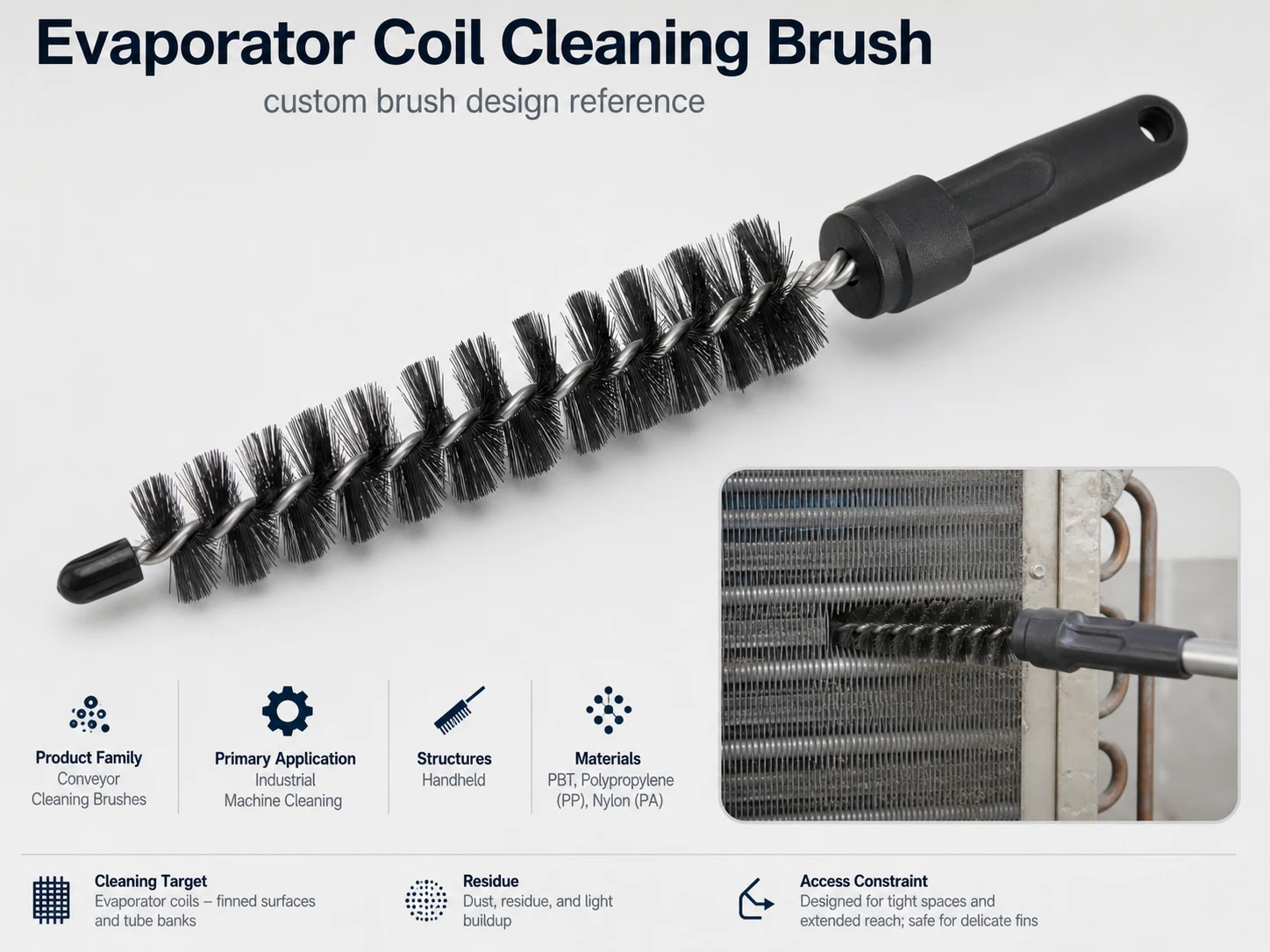
Clean evaporator and condenser coils without bending fins. Custom evaporator coil brush with soft bristles for 1–6mm fin spacing.
Small brush
500 pcs
Minimum order
Held in one hand: tube, bottle, detail and swab brushes — including long-handled ones with a small head.
Production lead time, once the specification is confirmed
- Up to 500 pcsWithin 7 days
- 501–50,000 pcsWithin 14 days
- Over 50,000 pcsWithin 21 days
Peak season can extend these times; the shipping date is confirmed in writing with your quotation. Sampling and shipping are quoted separately.
A fin-safe hand brush built to remove dust, lint, pollen, and compacted debris from evaporator coil fins without bending or damaging the soft aluminum. Designed for custom lengths, widths, and filament materials to match your coil geometry and maintenance program.
What can this brush do for you?
Cleans Between Coil Fins Without Bending Them
Thin, flexible bristles with filament diameters as low as 0.08 mm slide into fin gaps from 1–6 mm, lifting trapped debris rather than pushing against the soft aluminum. This prevents reduced airflow and keeps fins straight during routine coil cleaning.
Covers the Full Coil Face, Including Narrow Rows and Edges
Head widths from 10–60 mm and working lengths up to 250 mm let the brush sweep entire fin rows, reach between refrigerant tubes, and clean coil edges where dust packs hardest. The linear bristle row follows the fin direction for complete contact.
Handles Both Loose and Sticky Debris
Lint, pollen, and dry dust come off with a dry pass; light grease film releases when the brush is used with coil cleaner. Different filaments — PBT, PP, or nylon — can be specified for the residue type you encounter most often on your coils.
Reaches Deep Coils in Tight Spaces
Overall lengths to 700 mm allow access to recessed evaporator coils in air handlers, fan coil units, and ductless cassettes without removing panels or working from uncomfortable positions. The long handle keeps the operator’s hand away from sharp fin edges.
Stands Up to Wet or Chemical Cleaning
PBT and nylon filaments hold their shape after contact with water-based coil cleaners; the handle and ferrule can be specified in corrosion-resistant materials for wet-service use. The brush does not fall apart when cleaning turns from dry dusting to chemical application.
Works Fast Along Fin Rows
The bristle row is designed for pull strokes along the fin direction, not scrubbing. One pass removes surface debris and preps the coil for vacuuming or chemical cleaning, reducing the time spent on each maintenance visit.
What is an Evaporator Coil Cleaning Brush?
An evaporator coil cleaning brush is a hand-guided cleaning tool with a narrow bristle face set into a handle, built to sweep along the fins of an evaporator or condenser coil. Unlike a general utility brush, the bristle density, diameter, and trim length are matched to the fin spacing so the tool reaches the bottom of the fin gap without wedging or bending the aluminum.
In use, the brush contacts aluminum or copper fins, coil faces, narrow tube rows, drain pans, and frame edges. Typical operation is a dry pull stroke to remove loose debris, or a wet pass after applying foam or liquid coil cleaner. The linear bristle row follows the fin direction, so debris is pushed out of the gap rather than packed deeper.
This is not a fin straightener. If fins are already bent, a fin comb is needed first to open the airflow path. It is also not a substitute for chemical cleaning when the coil is heavily fouled with grease or tar. The brush is a maintenance tool that restores airflow between scheduled deep cleanings and prevents the buildup that forces early chemical washdowns.
Technical Specifications
All dimensions below can be adjusted for your specific coil. Provide your coil measurements and fin spacing to receive a configuration that fits without bending fins.
| Parameter | Specification / Range |
|---|---|
| Overall length | 300–700 mm, customized to coil depth and access space |
| Head width | 10–60 mm, matched to coil face width and fin row length |
| Working length (bristled portion) | 50–250 mm |
| Trim length (bristle length) | 15–60 mm |
| Filament diameter | 0.08–0.35 mm; finer diameters for tight fin spacing |
| Recommended fin spacing | 1–6 mm |
| Working depth (reach past coil face) | 10–150 mm |
| Fill materials | PBT, polypropylene (PP), nylon (PA); selection by stiffness and chemical exposure |
| Handle | Wood, polypropylene, or stainless steel with corrosion-resistant ferrule for wet use |
| Configuration | Flat or angled head, single or double row bristles, optional scraper tip |
| Brush type | Custom Handheld Detail Brushes |
| How it is driven | Hand-guided |
| Cleaning target | residential and light commercial split-system air conditioner, ductless mini-split indoor unit, and refrigeration evaporator cleaning |
| Surface or part | coils, fins, coil faces, aluminum, gaps, drain, frames, and drain pans |
| Residue or debris | dust, pollen, lint, compacted debris, grass clippings, grease, loose debris, and tar |
| Mounting / connection | Fixed |
Where does this brush work best?
- Residential and light commercial split-system air conditioners — evaporator coils in air handlers, where fins are closely spaced and easily bent.
- Ductless mini-split indoor units — coil face behind the blower wheel, often narrow and recessed.
- Refrigeration evaporators — walk-in coolers, reach-in display cases, and ice machines where frost and dust mix into a mat.
- Condenser coils — outdoor units where cottonwood, pollen, and grass clippings pack into fins.
- Fan coil units, heat pump coils, and dehumidifier coils.
- Drain pans and coil frames where debris accumulates and blocks condensate flow.
How do I choose the right one?
Measure fin spacing first
Use a fin gauge or caliper to measure the gap between adjacent fins. Finer filaments (0.08–0.15 mm) are needed for 1–2 mm gaps; stiffer, thicker filaments can be used for wider 4–6 mm gaps. If bristles do not slide easily between fins, they will bend the aluminum and reduce airflow.
Match head width to the coil face
A head width equal to or slightly less than the distance between tube rows keeps the brush tracking in line. Too wide and it scrapes the frame; too narrow and it takes more passes to cover the same area.
Set working depth and overall length
Working depth should reach the bottom of the fin gap without the handle hitting the cabinet. Overall length must allow the operator to reach the farthest coil face comfortably. For coils deeper than 150 mm, consider an extended handle or a two-piece configuration.
Select filament material for debris and chemical use
Use PBT for stiffer action on compacted or greasy deposits; use nylon for resilience and better chemical resistance when using coil cleaners; use PP for gentle dusting on delicate fins or where cost matters. Tell us what cleaning chemicals you use so the fill material is compatible.
Decide dry or wet use
If the brush will be used with foam or liquid coil cleaner, specify a handle and ferrule that resist water and chemical corrosion. Low-density open bristle fills drain faster and hold less foam.
Consider a fin comb for bent fins
If the coil already has a significant number of bent fins, straighten them with a fin comb before brushing. Brushing over bent fins will push them over further and make the airflow problem worse.
Can I customize this brush?
We build evaporator coil cleaning brushes to your coil, not the other way around. Provide the coil height, width, depth, fin spacing, tube row spacing, access gap, residue type, cleaning chemicals, and whether the brush will be used dry or wet. A photo or drawing of the coil face helps us get the geometry right faster.
Adjustable variables include:
- Overall length, head width, working length, and trim length
- Filament diameter, material, and stiffness
- Bristle fill density and row configuration (single row, double row, angled)
- Head angle (straight or offset) for tight access between cabinet and coil
- Handle shape, length, material, and grip; hanging hole or loop
- Ferrule material and finish for wet or chemical service
- Color, marking, branding, and packaging
If your project requires material documentation, inspection records, or third-party testing, we can support those requirements during the customization process.
Which filament survives the cleaning and still lasts on an evaporator coil cleaning brush?
Should I brush along the fins or across them?
Always brush in the direction of the fins, from the top of the coil to the bottom or along the fin rows. Brushing across the fins will bend them and block airflow.
How can I tell if the bristles are too stiff for my coil?
Make a gentle test pass on a small section. If you see fin edges deflect or fold over as the brush passes, the filament is too stiff or too thick for that fin spacing. Switch to a softer or finer filament.
Can I use this brush with a liquid coil cleaner?
Yes, if the handle and ferrule are specified for wet use. Apply the cleaner to the coil, let it dwell, then use the brush to agitate the residue before rinsing. Dry the brush after use to prevent mildew in natural-fiber handles.
What should I do if the coil is heavily clogged with grease or tar?
Pre-treat with a suitable coil cleaning chemical and allow the recommended dwell time. Use the brush for mechanical loosening, then rinse. For extreme buildup, a pressure washer with a fan nozzle may be needed after brushing; the brush alone will not dissolve hardened grease.
How often should I replace the brush?
Inspect after each heavy cleaning session. Replace when bristles become permanently matted, bent, or lose their resilience; when the brush no longer reaches the depth of the fin gap; or when the handle or ferrule shows signs of corrosion or cracking.
Is this brush safe for aluminum fins?
When properly matched to fin spacing and used with correct technique, yes. Softer filaments and finer diameters are deliberate choices to avoid scratching or bending. Never use a wire brush or stiff abrasive brush on aluminum evaporator coils.
Guides that go deeper on this
We have not written a guide specific to this one yet. The material that covers selection, filament, dimensions, maintenance and sourcing is collected in the technical resources library.
Custom Manufacturing RFQ
Describe Your Application
For a custom quote, we need the key dimensions, surface or part, residue, material preference, quantity, and reference image or drawing.
Drawing or photo optional — it speeds things up, it does not gate the enquiry.
Custom Brush RFQ
Send Your Brush Project
Upload a drawing, product photo, or sample photo and provide the core dimensions and cleaning conditions.
“We need a brush to remove wet residue from a stainless steel conveyor, about 800mm wide. The current brush wears quickly. We can send photos.”
“We sell drinkware and need a cleaning brush to include with the product. Quantity around 5,000 pieces.”