
Application
Air Conditioner Evaporator Fin Cleaning
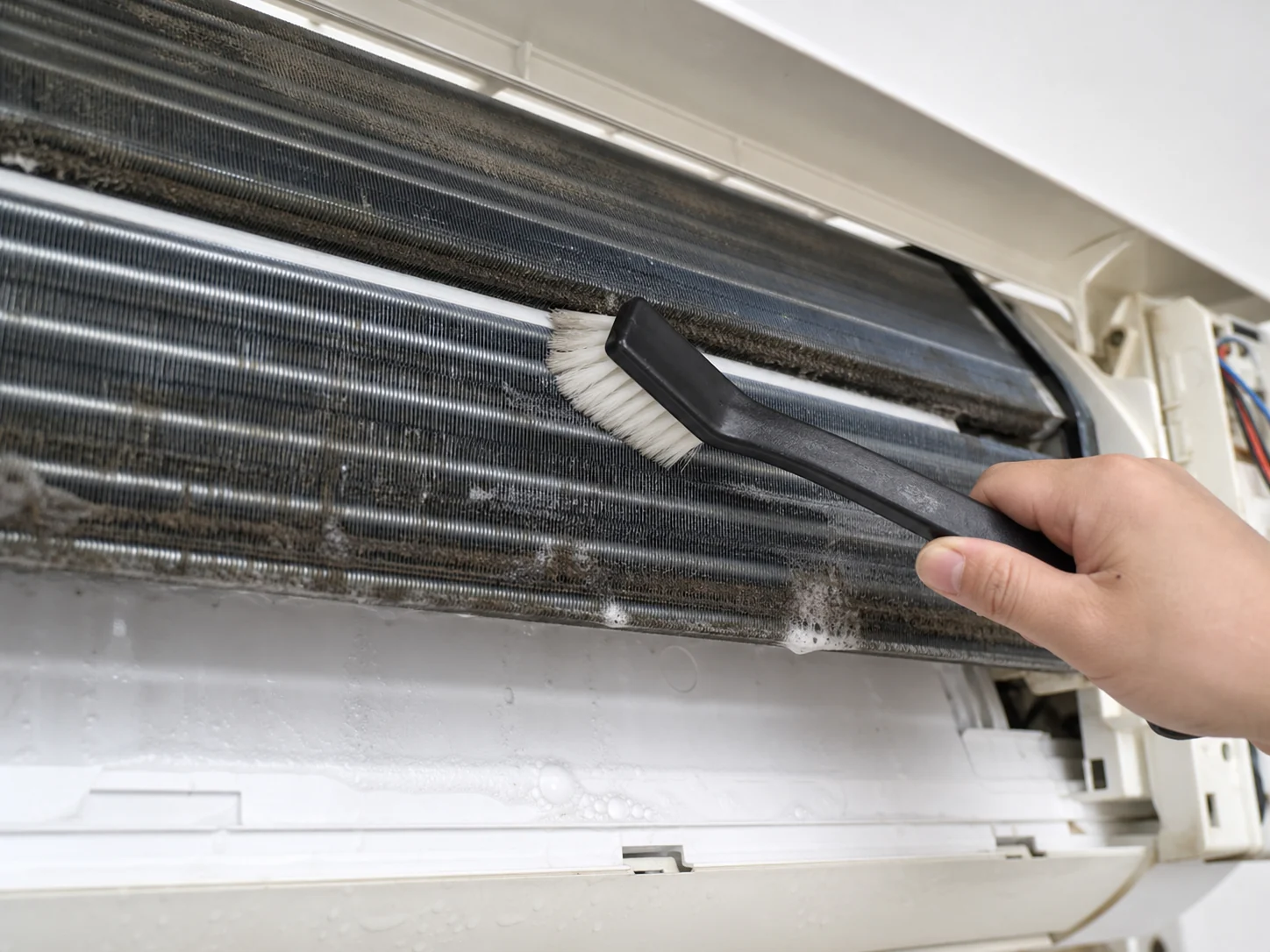
For Air Conditioner Evaporator Fin Cleaning, the brush must reach the working area, disturb or collect dust/oil film/mold/fibers, and release it without creating unacceptable surface damage or process interference. The available access and required motion should be reviewed together with the cleaning method.
At a glance
- Cleaning target
- Dust/Oil Film/Mold/Fibers
- Working environment
- Wet Indoor Area
- Cleaning method
- Dry Brushing / Wet Brushing
- Requirements to check
- Low-Deformation / Low-Corrosion Requirements for Aluminum Fins
Fin pitch decides everything on an evaporator: the brush has to enter between the fins along their direction, because anything worked across them closes the airway it was meant to open.
What makes Air Conditioner Evaporator Fin Cleaning different from other facility, floor and outdoor cleaning?
The task is to remove Dust/Oil Film/Mold/Fibers while controlling surface damage, residue carryover, brush shedding and chemical or temperature degradation.
The work happens in wet indoor area against dust, oil film, mold and fibers.
The part people get wrong: the surface, the residue and the access opening decide the brush together. Fix on any one of them alone and the geometry comes out wrong.
What are the most common cleaning targets in Air Conditioner Evaporator Fin Cleaning?
The work breaks into 4 targets. They look similar from outside the machine and behave nothing alike at the brush.
| Part or area | Residue type | Cleaning requirement |
|---|---|---|
| Residential Split-System Evaporator | Dust, Oil Film, Mold, Fibers | The head must reach the working face and apply even contact without marking the surface. |
| Automotive Evaporator | ||
| Commercial Air-Handler Coil | ||
| High-Density Fin-Pack |
What the equipment leaves you to work inside:
| Parameter | Typical range |
|---|---|
| Contaminant | Dust/Oil Film/Mold/Fibers |
| Required hardness | Soft–Medium |
| Maximum temperature | 80°C |
| Chemical exposure | Neutral-to-Alkaline Coil Cleaner pH 7–11 |
| Cleaning method | Dry Brushing/Wet Brushing |
| Environment | Wet Indoor Area |
Which brush types work for each cleaning target?
Select hand, tube, strip, roller, disc or machine-mounted geometry from access and motion.
| Cleaning target | Recommended brush type | Why it fits |
|---|---|---|
| Residential Split-System Evaporator | Handheld Detail Brushes | The indoor coil is reached through a narrow return opening, so a hand-guided head on a slim handle is what actually gets to the fin face. |
| Automotive Evaporator | The evaporator sits deep in the HVAC case behind the blower, so the head has to pass the case opening and still hold contact on the fin. | |
| Commercial Air-Handler Coil | An air-handler coil is several rows deep, so a longer hand-guided head works fin-parallel down the face without folding the outer row over. | |
| High-Density Fin-Pack | On a tight fin pack the filament has to be finer than the fin gap, and a hand-guided head lets the operator feel that before the fins flatten. |
All hand work with the unit powered down, drawn along the fin direction — a stroke across the fins closes the gaps it was meant to open.
In practical brush terms: match the construction to the access before anything else. A geometry that cannot reach the target will not be rescued by a better filament.
What filament materials work best for Air Conditioner Evaporator Fin Cleaning?
Soft PA66 or PP only. Aluminium fins bend under anything stiffer, and the fill has to come back straight after every pass or it starts closing the fin gaps it was meant to open.
| If the condition is… | Filament to start with | Why |
|---|---|---|
| Aluminium fins that bend | PA66 Nylon, soft grade | flexes before it deforms the fin |
| Oil film and mould between the fins | Polypropylene PP | resists the coil cleaner at pH 7–11 |
What the duty rules out before you start comparing grades:
| Constraint | Value for this application |
|---|---|
| Filament hardness | Soft–Medium |
| Maximum service temperature | 80°C |
| Chemical exposure | Neutral-to-Alkaline Coil Cleaner pH 7–11 |
| Cleaning method | Dry Brushing, Wet Brushing |
How do I choose the right brush for my air conditioner evaporator fin equipment?
Start with soft-to-medium fill, an 80°C ceiling and a coil cleaner at pH 7–11, then let fin pitch cap the thickness and fin depth set the reach.
The sequence that gets a usable sample first time:
- Identify the target part and measure the access opening or clearance
- Describe the residue: what it is, how thick it sits, and how strongly it holds
- Choose the construction that can physically reach that target
- Set the filament from surface risk, working temperature and cleaning chemistry
- Fix filament diameter, free trim length and density for the contact pressure you need
- Run one cycle and check the result before committing to a production quantity
Before you commit to a quantity, send the fin pitch, the fin-pack depth, and the coil face dimensions.
When is an air conditioner evaporator fin brush the wrong tool?
Coil cleaner with a rinse penetrates the full fin depth, where no brush reaches past the first few millimetres. A fin comb rather than a brush is what straightens bent fins, and heavy mould or a blocked pan needs a full coil clean instead of surface work.
What common mistakes should I avoid in Air Conditioner Evaporator Fin Cleaning?
- Giving coil face area instead of fin pitch and fin-pack depth
- Changing the filament while leaving excessive engagement, poor alignment or no discharge path unchanged
- Copying a worn brush without first recording its motion, direction, mounting and original working diameter
If the brush is already in service and the result is wrong, work from the symptom:
| Symptom | What to change |
|---|---|
| Residue remains | Increase discharge or relative motion before adding pressure |
| Surface marks | Reduce engagement and use finer/softer fill |
| Rapid wear | Check alignment, temperature and chemical attack |
| Redeposition | Add wash, vacuum or collection path |
Questions this page is asked
What controls the use of coil cleaner with an evaporator brush?
Follow the equipment and cleaner instructions for the exact coil metal, coating, deposit, concentration, dwell time and rinse requirement. Shield electrical parts, do not mix chemistries, and verify that loosened soil and liquid can reach the designed drain without overflowing into insulation or occupied space.
Which checks come before restarting an air conditioner after evaporator cleaning?
Clear the drain and pan, remove tools and covers, confirm that fins and sensors are intact, and dry any area that the unit instructions require to remain dry. Restore panels and power, then observe airflow, condensate drainage, odor, noise and fault indications during the authorized functional check.
Guides that go deeper on this
We have not written a guide specific to this one yet. The material that covers selection, filament, dimensions, maintenance and sourcing is collected in the technical resources library.
No catalogue item for this yet
Every brush here is made to order, and this one has no catalogue entry so far. Send the working surface, the residue, the access opening and the quantity, and it is quoted through the same specification route as the rest of the range.
Custom Manufacturing RFQ
Discuss This Application
Share the working surface, residue, dimensions, material direction, interface, quantity and drawing or sample photo.
Custom Brush RFQ
Request a Custom Cleaning Brush Quote
Upload a drawing, product photo, or sample photo and provide the core dimensions and cleaning conditions.
“We need a brush to remove wet residue from a stainless steel conveyor, about 800mm wide. The current brush wears quickly. We can send photos.”
“We sell drinkware and need a cleaning brush to include with the product. Quantity around 5,000 pieces.”