
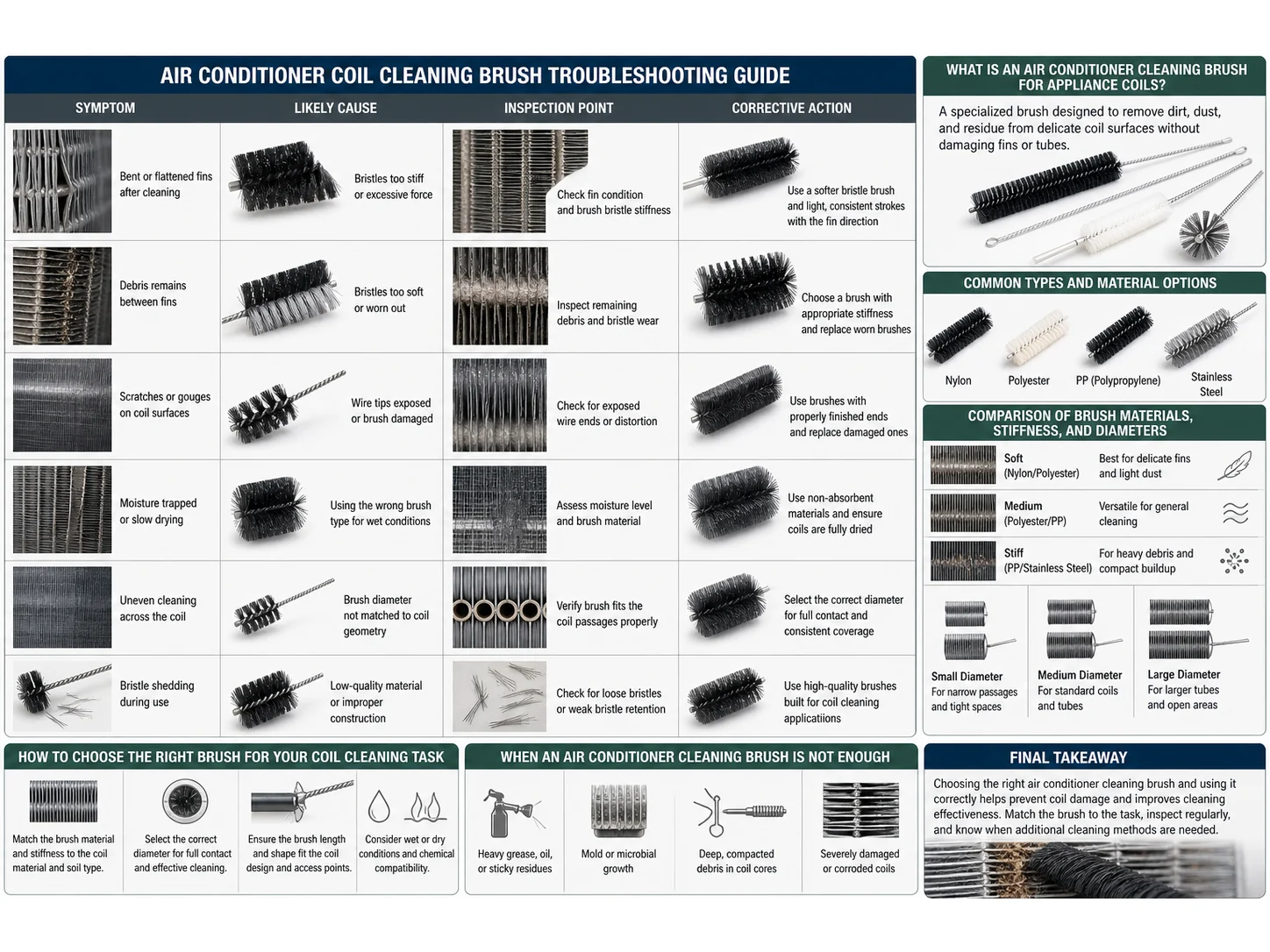
What Is an Air Conditioner Cleaning Brush for Appliance Coils?
An air conditioner cleaning brush is a slender, flexible tool designed to reach between evaporator or condenser coil fins without causing damage. Unlike general-purpose wire brushes, these brushes use soft to medium bristle materials such as nylon, polypropylene, or horsehair, and may have a long, ergonomic handle or be shaped to conform to coil geometry. Their primary goal is to dislodge dry or lightly adhered contaminants while preserving the thin aluminum or copper fins that are easily deformed.
Common Types and Material Options
Selecting the wrong material is the root cause of many coil cleaning failures. The most common brush types for appliance coils include:
- Nylon bristle brushes: Good all-rounders for light dust and lint; resist moisture and chemicals but may soften under high heat.
- Polypropylene bristles: Stiffer than nylon; better for caked-on dirt but can scratch if used aggressively.
- Horsehair or natural fiber brushes: Very soft, ideal for fragile fins; may shed and degrade with harsh cleaners.
- Stainless steel wire brushes: Should almost never be used on coil fins—reserved for heavy tube brushing or frame cleaning only.
- Combination brushes: Mixed bristle types for specific tasks, such as a soft outer layer with a stiffer core.
Comparison of Brush Materials, Stiffness, and Diameters
| Brush Type | Best Use Case | Risk Level for Coil Fins | Chemical Resistance | Typical Diameter Range |
|---|---|---|---|---|
| Nylon | General fin dusting, wet/dry | Low | Good | ⅛″ to 1″ |
| Polypropylene | Oily residue, moderate buildup | Medium | Excellent | ⅛″ to ¾″ |
| Horsehair | Historical or ultra-thin fins | Very Low | Poor (avoid strong alkalis) | ¼″ to 1½″ |
| Stainless Steel | Tube interiors, heavy rust | Very High (not for fins) | Excellent | Custom, small diameters |
| Tampico (plant fiber) | Wet cleaning with mild chemicals | Low | Moderate | ¼″ to 1″ |
How to Choose the Right Brush for Your Coil Cleaning Task
Decision-making should be driven by the real-world conditions of the coil, not by cost drivers or availability. Consider these factors:
- Residue type: Dry dust needs a soft brush; oily or baked-on dirt may require a stiffer polypropylene or combination brush, used gently.
- Surface sensitivity: Aluminum fins can bend under any metal bristle. Check fin thickness and spacing—tighter fins demand finer, softer bristles.
- Equipment interface: The brush must fit the access panel, reach deep coil rows, and match the required handle length. A brush with a flexible shaft or angled head can reach around pipes.
- Wet or chemical exposure: If using foaming cleaners or alkaline solutions, confirm bristle material compatibility. Nylon and polypropylene resist most coil cleaners; natural fibers may degrade.
- Hygiene expectations: For food processing or healthcare, consider antimicrobial bristles or dedicated, color-coded brushes to avoid cross-contamination.
- Maintenance frequency: High-use brushes wear quickly. Polypropylene lasts longer than horsehair; replace brushes when bristles become permanently bent or matted.
- Custom size requirements: If standard diameters or lengths don’t fit, many suppliers can produce custom brush rolls or spiral-wound brushes to exact specs. Request a drawing review before ordering.
Common Mistakes When Selecting and Using an Air Conditioner Cleaning Brush
Even experienced technicians make these errors. Avoid them to prevent coil damage and poor cleaning results.
- Using a wire brush on aluminum fins. This is the fastest way to destroy an evaporator coil. Even “soft” brass wire can deform thin aluminum.
- Choosing by brush size alone. A ¼″ diameter brush may fit between fins but could be too soft for heavy lint. Always match bristle material and stiffness to the soil load.
- Neglecting handle length and ergonomics. A short handle forces awkward angles and unnecessary pressure on fins. For deep units, use a brush with a 12–24 inch handle or an extension.
- Over-wetting with harsh chemicals before brushing. Aggressive cleaners can weaken fin metal and set debris into a paste that clogs fins. Pre-rinse loose debris with low-pressure water before applying chemicals.
- Scrubbing across fins rather than along them. Always brush parallel to the fin direction. Cross-brushing bends edges and reduces airflow.
- Reusing a dirty brush. A brush caked with old grease and grit becomes an abrasive tool. Clean brushes after each use with mild detergent and water, and dry thoroughly.
- Ignoring bristle retention. low-cost brushes shed bristles that can lodge in coils and become potential corrosion sites. Look for brushes with crimped or epoxy-set bristles.
- Assuming one brush fits all units. Split-system evaporators, packaged units, and microchannel coils all have different fin densities and access needs. Keep multiple brushes on hand.
When an Air Conditioner Cleaning Brush Is the Wrong Choice
An air conditioner cleaning brush is excellent for routine dry dusting and light surface debris, but it has limits. Recognize these boundaries:
- Deep mold or biofilm growth: Brushes cannot disinfect. Use an EPA-registered HVAC biocide and, in severe cases, professional chemical cleaning or coil removal.
- Bent or crushed fins beyond light combing: If more than 10% of the coil face is flattened, a fin comb and specialized straightening tools are required before brushing.
- Corroded or pitted fins: Brushing may accelerate metal loss. Consider a low-pressure wash followed by a corrosion protection coating.
- Microchannel coils: These have a flat, fragile surface. Traditional brushes can scrape off the protective coating. Always consult the manufacturer’s cleaning guidelines before using any mechanical contact.
- Custom or large-scale systems: If off-the-shelf brushes don’t fit, request a supplier drawing and sample for in-situ testing. A prototype run ensures the brush material, torque, and fit are correct before bulk ordering.
Final Takeaway
Selecting the right air conditioner cleaning brush is not about finding the lowest-cost option; it’s about matching bristle material, stiffness, and configuration to the specific coil type and soil condition. Avoid the common mistakes listed above, and you’ll extend equipment life, improve energy efficiency, and reduce unplanned downtime. When in doubt, test a small, inconspicuous area first, and never let a wire brush touch aluminum fins.
Frequently Asked Questions
Can I use a stiff brush to clean heavy grease off evaporator coils?
Stiff brushes can bend fins and embed grease deeper. Instead, apply a mild alkaline coil cleaner, let it dwell, rinse with low-pressure water, and then use a medium-soft polypropylene brush gently in the fin direction.
What diameter brush fits between standard air conditioner fins?
Most residential and light commercial coils have fin spacing of 8–14 fins per inch. A brush diameter of ¼″ to ⅜″ usually works, but measure the gap with feeler gauges first. For tighter packaged unit coils, a ⅛″ diameter may be needed.
How often should I replace my coil cleaning brush?
Inspect before each use. Replace when bristles are permanently bent, matted, or the brush loses more than 20% of its original fill. In a busy maintenance shop, every 3–6 months is typical.
Is a nylon brush safe for all coil cleaners?
Nylon resists most common alkaline and neutral cleaners but can degrade with strong acids or solvent-based degreasers. Check the chemical compatibility chart from the brush supplier if using aggressive formulas.
Can I use the same brush for evaporator and condenser coils?
Yes, if the brush is cleaned between uses. However, outdoor condenser coils often have heavier, oily deposits, so a dedicated, slightly stiffer brush may be more efficient. Always avoid cross-contaminating indoor units with outdoor grime.
Do antimicrobial brushes really help?
Brushes with embedded antimicrobial agents can inhibit bacterial growth on the tool itself, which is useful in hospitals or food plants. They do not disinfect the coil; you still need proper chemical cleaning.
What if my brush cannot reach deep coil rows?
Look for a brush with an extended flexible shaft or a coiled-wire handle that can snake around bends. Some suppliers offer custom-length brushes up to several feet long. Provide a drawing of the coil geometry for precise quoting.
How do I know if bristles are too stiff for microchannel coils?
Microchannel coils have a delicate surface coating. If you can easily bend a bristle with your finger, it’s generally safe. Any brush that feels springy or abrasive to the touch is too aggressive. Always confirm with the coil manufacturer’s cleaning instructions first.
Technical References
- U.S. Department of Energy — Air Conditioner Maintenance
- EPA — Should You Have the Air Ducts in Your Home Cleaned
- EPA — Particulate Matter Basics
- OSHA — 1910.147 Control of Hazardous Energy
- EPA — Mold Cleanup in Your Home
- NIST — Metric SI
Which bristle material fits this job — Nylon PA, Horsehair or AISI 304 Stainless Steel Wire?
| Material | Continuous temperature (°C) | Peak temperature (°C) | Water absorption | Hardness |
|---|---|---|---|---|
| Nylon PA | 93 | 121 | 0.3–9% by PA grade and conditioning | Medium to firm; filament diameter and trim length control bending force. |
| Horsehair | 60–80 | 100–120 | 8–15% | — |
| AISI 304 Stainless Steel Wire | 400 | 500 | 0% | Rockwell B 70–95 depending on temper and cold work |
| Brass Wire | 150–200 | 250–300 | 0% | Rockwell B 40–90 |
| PBT | 120–140 | 160–180 | 0.05–0.20% | Shore D 80–90 |
Figures as published by Brushtec / DuPont; Alleima; Perlon. Confirm the exact grade against the supplier datasheet before ordering.
What should replace Handheld Detail Brushes for appliance?
- Handheld Detail Brushes — Handheld detail brushes cover general precision cleaning; auto-detailing brushes impose tighter controls for painted, polished, leather, display, and trim surfaces.
- Nylon PA — Compare Nylon PA with PP, PBT, PET. Change material when wet stiffness, temperature, chemical resistance, conductivity, particle shedding, or surface marking becomes the limiting factor.
- Horsehair — Compare Horsehair with Boar bristle, goat hair, microfiber. Change material when wet stiffness, temperature, chemical resistance, conductivity, particle shedding, or surface marking becomes the limiting factor.
- AISI 304 Stainless Steel Wire — Use AISI 316 stainless steel wire for chloride, marine, dairy, beverage, chemical washdown, or higher pitting-resistance requirements. Use carbon steel for dry aggressive cutting and brass or abrasive nylon for lower marking risk.