
Custom Cleaning Brush
Radiator Fin Brush
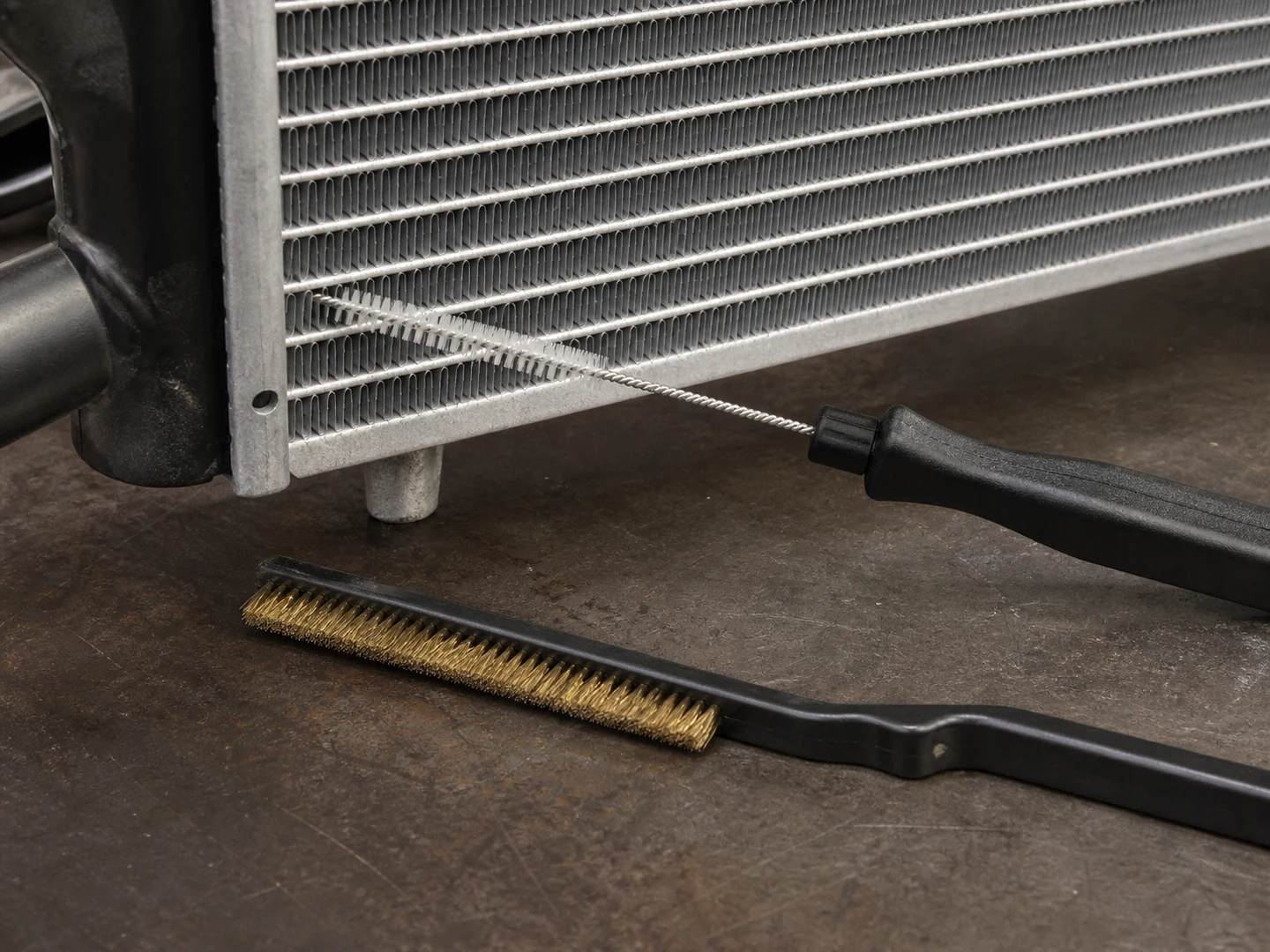
Custom radiator fin brush with brass wire or Nylon PA fill for HVAC coil and heat-exchanger cleaning.
Small brush
500 pcs
Minimum order
Held in one hand: tube, bottle, detail and swab brushes — including long-handled ones with a small head.
Production lead time, once the specification is confirmed
- Up to 500 pcsWithin 7 days
- 501–50,000 pcsWithin 14 days
- Over 50,000 pcsWithin 21 days
Peak season can extend these times; the shipping date is confirmed in writing with your quotation. Sampling and shipping are quoted separately.
A long-reach cleaning brush for fin-and-tube coils and heat exchangers, built to work into narrow fin rows on aluminum or copper surfaces without crushing the fin edges. Available with soft brass wire or non-scratch Nylon PA filament, it removes dust, lint, pollen, and light grease film from condenser, evaporator, and radiator coil faces.
What can this brush do for you?
Fits Into Fin Rows Without Folding the Metal
The filament fill is diameter-matched to 1–6 mm fin spacing. At 0.08–0.35 mm, individual filaments enter the row between fins, lift packed dust and lint, and pull it to the leading edge without pressing the thin aluminum or copper edges sideways. Standard heavy scrub brushes are too coarse for this gap; this brush works because the contact is sized to the opening.
Two Contact Materials for Different Coil Conditions
Brass wire removes dried insect bodies, compacted cottonwood fuzz, pollen crust, and oxidation film from bare copper or aluminum fins. It is softer than steel, so it resists gouging the base metal while still breaking up hardened deposits. Nylon PA handles routine dust, lint, and loose debris, and is the appropriate choice on coated or hydrophilic fins, painted coil frames, and thin-gauge materials where metal fill is too aggressive.
Narrow Head Covers the Coil Face Without Catching the Frame
Head width from 10 to 60 mm lets the brush follow a straight band of fins on the coil face. Because the backing is narrow, it passes between end plates, fan brackets, and adjacent coil rows instead of hanging up on surrounding sheet metal. Working depth from 10 to 150 mm reaches into the fin pack rather than only wiping the front edge.
Long Reach Keeps the Operator Clear of Sharp Coil Edges
Overall lengths from 300 to 700 mm and working lengths from 50 to 250 mm put the bristle section at the coil surface while the hand stays outside the service opening. Maintenance technicians can reach the back side of a two-row coil, the top of a condenser, or a recessed evaporator without extending arms across sharp sheet-metal edges.
Prepares Coils for Chemical Wash and Rinse
Dry brushing before applying coil cleaner removes the dry mat of cottonwood seed, pollen, lint, and dust that would otherwise turn into mud when wet. Lifting dry debris first reduces the amount of coil cleaner needed and improves rinse results.
What is a Radiator Fin Brush?
A Radiator Fin Brush is a hand-guided maintenance tool with a narrow, filament-filled head and an extended handle, designed to clean the air-entry face and shallow interior rows of fin-and-tube heat exchangers. It is most often used on HVAC condensers and evaporators, but the same tool applies to radiators, oil coolers, charge air coolers, and other finned cores where airborne debris reduces airflow.
During use, the technician draws or pushes the head along the fin direction in short, overlapping passes. The filament tips enter the narrow gaps between fins and lift accumulated dirt to the leading edge. Because the fins are thin, often 0.1 to 0.25 mm aluminum or copper foil, the brush relies on small filament diameter and controlled trim length rather than heavy scrubbing force. Pressure should stay light; the residue is usually dry and loosely bonded, not baked on.
The brush works dry before chemical cleaning or as a dry routine between service calls. It is not a fin straightening tool and it will not correct crushed or folded fins; that job requires a fin comb or similar tool. It is also not intended for the water side of a heat exchanger or for removing heavy corrosion.
Technical Specifications
The table shows the standard engineering envelope for this brush. Dimensions can be changed against your specific coil, access envelope, and handle preference.
| Parameter | Specification / Options |
|---|---|
| Overall length | 300–700 mm, configured to service reach and coil depth |
| Working length (filamented head) | 50–250 mm |
| Head width | 10–60 mm, selected to coil face width or pass width |
| Trim length | 15–60 mm of bristle exposure from the backing |
| Working depth | 10–150 mm into the fin pack, based on coil rows |
| Filament diameter | 0.08–0.35 mm, matched to fin spacing |
| Target fin spacing | 1–6 mm; finer diameters for 1–3 mm rows, coarser for wider rows |
| Fill material | Brass wire for compacted dirt and insect residue; Nylon PA for routine cleaning and coated surfaces |
| Backing / block | PP, ABS, or rust-resistant metal, selected for head shape and chemical exposure |
| Handle / shaft | PP or TPR grip with steel, stainless steel, or aluminum extension; custom length available |
| Operating condition | Dry brushing recommended before wet coil cleaning; use mild coil-safe cleaners only; not for strong acid or alkali immersion |
| Brush type | Custom Handheld Detail Brushes |
| How it is driven | Hand-guided |
| Cleaning target | split-system and rooftop condenser coil, hydronic and steam coil surface, and radiator and charge-air core cleaning |
| Surface or part | fins, coils, edges, coil faces, aluminum, frames, gaps, and metal |
| Residue or debris | dust, lint, pollen, grease, insects, grease film, seeds, and grass clippings |
| Mounting / connection | Fixed |
Where does this brush work best?
- Split-system and rooftop condenser coils — removes cottonwood seed, pollen, dust, grass clippings, and dried insect debris from outdoor coil faces before chemical wash.
- Evaporator coils in air handlers and fan-coil units — cleans enclosed rows where access is narrow and fins may have a protective coating; Nylon PA fill preserves the coating.
- Hydronic and steam coil surfaces — routine lint and dust removal in building maintenance programs.
- Radiator and charge-air cores — light soil removal on equipment radiator cores, generator sets, compressors, and hydraulic coolers where air-side fouling restricts heat transfer.
- Perimeter tasks around the coil — sweeping debris from drain pans, frame edges, and cabinet bases before reassembly.
How do I choose the right one?
Work through the coil dimensions, the fin condition, and the contamination type in that order. These checks will tell you whether this brush and which fill will do the job.
Match filament diameter to fin spacing
Measure the clear gap between fins, not the center-to-center spacing. If rows are 1–3 mm apart, select filament diameters between 0.08 and 0.15 mm and keep trim length on the shorter side. Wider rows 4–6 mm can use 0.20–0.35 mm filament. A filament that is too thick or too long will press fins sideways; one that is too thin will not contact the fouling.
Choose the fill by surface and residue
Bare aluminum or copper fins with dried insect bodies, packed fuzz, or oxidation film are the case for brass wire. Coated evaporator fins, hydrophilic surfaces, painted trays, and thin-gauge coils should use Nylon PA only. When the coil carries oil, cooking grease, or sticky tobacco residue, apply a suitable non-acidic coil cleaner first and allow dwell time; the brush then removes loosened residue, not raw grease.
Set the head geometry to the access envelope
Check how much vertical face you can reach and how far the head must enter the coil. The head width should cover a workable pass without catching on brackets or access covers. Working depth should not exceed the actual coil depth; extra protrusion can strike the opposite tube row or bend the brush.
Verify handle reach and operator clearance
The overall length needs to place the working head at the farthest reach point with the operator’s hand outside the cabinet. For back-row access on multi-row coils, choose the longer handle or a detachable extension rather than crowding the coil.
Know when this is not the right tool
If fins are already folded over, crushed, or matted, straighten them with a fin comb before brushing; this brush will not rebuild fin geometry. If the coil face has hard scale or deep corrosion, use an approved chemical treatment and a wider soft wash brush instead of metal filament. If contamination is oil-based or tar-like, brushing alone will smear it rather than remove it, so pre-treat first.
Can I customize this brush?
This brush is built around the coil, not the other way around. We can adjust every load-bearing dimension and the contact material. To define the configuration, provide the fin spacing, coil face width, fin pack depth, access clearance, coil surface material and coating, type of residue, cleaning chemical, and preferred overall reach.
- Filament system — brass wire or Nylon PA, filament diameter, trim length, fill density, single or double row, or mixed trim profiles for edge cleaning
- Head geometry — width, working length, backing profile, beveled nose, contoured backing to follow coil curvature
- Handle and extension — overall length, grip material such as PP, TPR, or wood, steel or aluminum shaft, threaded or quick-release extension
- Backing and hardware — PP, ABS, stainless steel, or another rust-resistant metal; screws or staples per process requirements
- Color and identification — custom handle color, printed logo, laser marking, or part-number marking for fleet or service-kit tracking
- Packaging — bulk carton, individual polybag, retail sleeve, service-kit packing, or customer-specific barcode labeling
If the project needs material documentation, inspection reports, or third-party test support for a customer-specific specification, we can include that in the project definition.
Which filament belongs on a radiator fin brush, and how is that verified?
Can this brush repair bent or folded fins?
No. A Radiator Fin Brush cleans between fins and removes debris. Fins that are bent or crushed need a fin comb or fin-straightening tool first. Running this brush across heavily bent fins can catch the damaged edges and make the condition worse. After straightening, this brush is appropriate for cleaning the restored rows.
Which direction should I brush the coil face?
Brush along the direction of the fins, not across them. On most coils, this means horizontal passes for vertical fins or vertical passes for horizontal fins. Short, overlapping strokes with light pressure allow the filament tips to enter each row; cross-fin scrubbing lifts the thin leading edges and folds them over.
Can the brass wire version be used on coated or pre-finished coils?
It should not. Brass is soft relative to steel, but it can still cut through thin anti-corrosion coatings, hydrophilic films, or painted surfaces. Use the Nylon PA version for coated, painted, or specially treated coil surfaces, and test on a low corner of the coil if you are unsure of the coating condition.
How would I tell if the filament diameter is too large for my fin spacing?
Make a light test stroke on a lower corner of the coil. If the brush snags, chatters, or you can see fin edges folding sideways behind the stroke, the filament is too thick, the trim is too long, or too much pressure is being used. The correct setup passes along the rows with slight resistance while leaving the fins upright and undistorted.
Will the brush remove oil or grease from a condenser or exhaust coil?
Not on its own. Heavy oil, cooking grease, or tar-like deposits need a suitable degreaser with the correct dwell time first. The brush then removes loosened material and carries it out of the fin rows. Brushing first only spreads the grease and packs it deeper.
What should be checked before putting the brush on the coil?
Verify the head is firmly attached to the handle, the filaments are straight, and no loose bristles can fall into the drain pan. Check that the brush length gives hand clearance and that the area is safe: power to the unit off and capacitors discharged when working inside the cabinet. Test one hidden lower corner to confirm the contact is right before cleaning the whole coil face.
Guides that go deeper on this
Custom Manufacturing RFQ
Describe Your Application
An accurate custom quote starts with the dimensions, working surface, residue, material choice, connection, quantity, and reference files.
Drawing or photo optional — it speeds things up, it does not gate the enquiry.
Custom Brush RFQ
Send Your Brush Project
Upload a drawing, product photo, or sample photo and provide the core dimensions and cleaning conditions.
“We need a brush to remove wet residue from a stainless steel conveyor, about 800mm wide. The current brush wears quickly. We can send photos.”
“We sell drinkware and need a cleaning brush to include with the product. Quantity around 5,000 pieces.”