
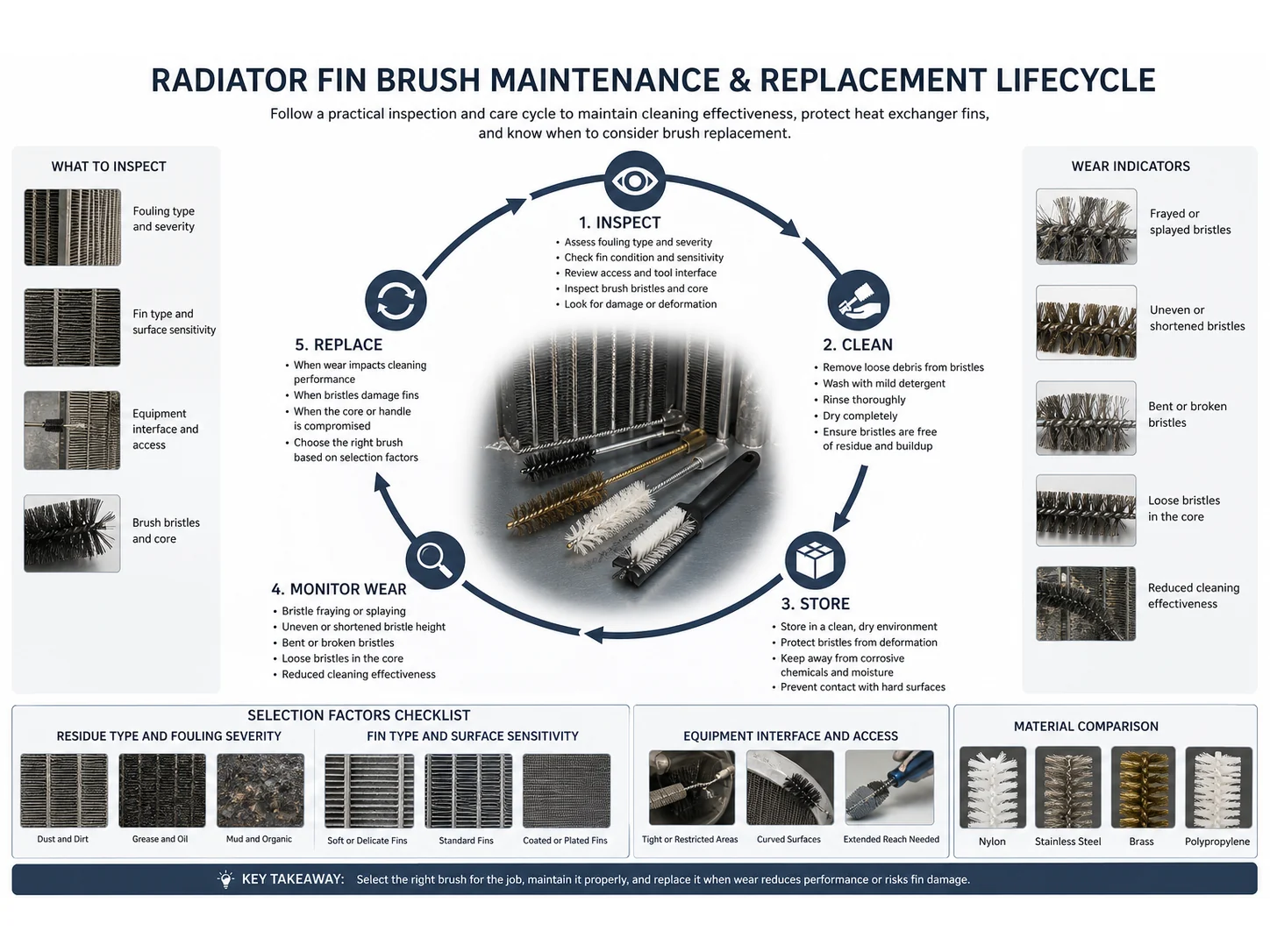
What Is a Radiator Fin Brush?
A radiator fin brush is a handheld or power-driven brush with bristles arranged to penetrate narrow fin gaps without causing damage. It is used in HVAC, industrial cooling, power generation, and automotive applications to clear airborne dirt, cottonwood, grease, or mild corrosion from finned surfaces while preserving the thin metal’s shape. Unlike general-purpose brushes, fin brushes balance stiffness and flexibility to comb between fins without flattening them.
For boilers, chillers, cooling towers, condenser systems, heat-exchanger maintenance, and O&M practices, this article cites U.S. Department of Energy FEMP — Operations & Maintenance Best Practices: A Guide to Achieving Operational Efficiency, Release 3.0; boiler, chiller, cooling tower, and heat-exchanger maintenance chapters.
Common Types of Radiator Fin Brushes
Radiator fin brushes vary by bristle material, shape, mounting style, and handle design. Common options include:
- Straight bristle brushes: flat or rectangular bristle patterns for open fin arrays.
- Spiral or twisted-wire brushes: bristles wound around a central wire core, useful for round tube bundles or coil interiors.
- Nylon or plastic brushes: non-scratch option for coated or sensitive aluminum fins.
- Brass or stainless steel wire brushes: for tough deposits but require careful use to avoid fin damage.
- Long-handle brushes: manual reach tools for deep coils or elevated units.
- Drill-mounted or flexible shaft brushes: power cleaning for large jobs or tight access.
Many brush suppliers also offer custom sizes for specific fin gaps and coil configurations.
Material Comparison: Radiator Fin Brush Options
| Bristle Material | Typical Use | Advantages | Limitations | Best For |
|---|---|---|---|---|
| Nylon | Light dust, coated fins | Soft, non-abrasive, chemical resistant | May not remove hardened buildup | Aluminum fins with protective epoxy coating |
| Brass wire | Moderate corrosion, dirt | Softer than steel, conductive but less scratching | Can still mark soft aluminum | Copper fins or uncoated aluminum with care |
| Stainless steel wire | Heavy deposits, high-heat systems | Durable, corrosion resistant | High risk of fin damage if misused | Industrial steel fins or severe fouling |
| Horsehair | Light dusting, delicate fins | Very soft, natural fiber | Poor chemical tolerance, wears quickly | Electronics cooling fins, historical units |
| Polypropylene | General wet/dry cleaning | Good chemical resistance, moderately stiff | Less durable than nylon in dry friction | Food processing or washdown environments |
How to Choose the Right Radiator Fin Brush
Selection should be based on operating conditions and maintenance goals, not cost drivers alone. Evaluate these factors:
Residue Type and Fouling Severity
Light airborne dust can be handled by soft nylon; oily or baked-on deposits may require brass or stainless steel. Always test on a hidden area first.
Fin Type and Surface Sensitivity
Epoxy-coated or pre-coated aluminum fins demand non-abrasive bristles. Bare aluminum can tolerate brass if used with light pressure. Copper is more forgiving but still susceptible to scratching.
Equipment Interface and Access
Deep coils with tight spacing may need a long-handle brush or a flexible drill extension. Confirm handle length, diameter, and max coil depth the brush can reach.
Chemical and Wet Exposure
If cleaning involves water, detergents, or acidic coil cleaners, choose nylon, polypropylene, or stainless steel bristles that won’t degrade. Natural fibers like horsehair can swell or rot.
Hygiene and Contamination Control
In food plants or cleanrooms, non-metallic brushes are often required to avoid metal contamination. Polypropylene or nylon meet many FDA and 3-A sanitary guidelines.
Maintenance Frequency and Brush Durability
Weekly cleaning calls for more durable bristle materials and secure core designs. For seasonal or one-time use, a quality basic brush may suffice. Evaluate cost per cleaning cycle, not just unit cost drivers.
Custom Size Requirements
Off-the-shelf brushes may not fit non-standard fin gaps. Work with suppliers to specify bristle diameter, length, trim length, and overall brush dimensions. Drawing review or sample testing ensures correct fit before bulk ordering.
Common Mistakes When Selecting a Radiator Fin Brush
- Ignoring fin gap measurement: bristles that are too thick can’t penetrate; too thin may miss debris. Always measure the gap and compare to bristle diameter.
- Using aggressive wire brushes on coated fins: this strips protective layers and promotes galvanic corrosion.
- Choosing by cost drivers alone: a low-cost brush that damages thousands of dollars of coil repair costs is never a bargain.
- Neglecting handle length: a brush that’s too short forces operators into awkward angles, leading to uneven cleaning or injuries.
- Assuming one brush fits all heat exchangers: a microchannel coil, a fin-tube boiler, and a plate-fin air handler all need different brush designs.
When a Standard Radiator Fin Brush Is the Wrong Choice
A fin brush can remove surface debris but cannot flatten bent fins, extract deep blockages, or dissolve chemical scale. For severely impacted coils:
- Use fin combs or straightening tools to restore fin spacing before brushing.
- Apply coil cleaning chemicals and rinse with low-pressure water prior to light brushing.
- If fins are crushed beyond repair or the coil core is delaminated, partial coil replacement or professional re-coring is required.
When cleaning critical process heat exchangers, a written procedure with supplier-drawings, sample validation, and a brush material compliance review is strongly recommended to prevent costly downtime.
Final Takeaway
Choosing a radiator fin brush is a balance between cleaning effectiveness and fin preservation. Match the bristle material to the fin type and fouling severity, measure the fin gap exactly, and make sure the handle or mounting fits your workspace. When standard options fall short, custom brush designs built around your exact coil specifications offer a safer path to long-term heat exchanger reliability.
Frequently Asked Questions
Can I use a wire brush on aluminum fins?
Only if the aluminum fins are bare and the wire is brass or a fine-gauge stainless steel used with very light pressure. Epoxy-coated aluminum fins should only be cleaned with non-metallic brushes to avoid coating damage.
How do I measure fin gap for brush bristle diameter?
Use a feeler gauge or dedicated fin comb to measure the spacing between two adjacent fins. Select a bristle diameter that is slightly smaller than half the gap to allow bristle flex without forcing fins apart.
What’s the difference between a fin brush and a tube brush?
A fin brush is designed for the exterior finned surface of a coil, while a tube brush cleans the inside of tubes. They have different bristle patterns, stiffness, and uses. A fin brush is usually wider and flatter; a tube brush is often cylindrical or spiral.
Can I attach a radiator fin brush to a drill?
Yes, many fin brushes come with a hex shank or threaded mount for drill use. Check the maximum RPM recommended by the supplier to avoid bristle loss or overheating the fins.
How often should heat exchanger fins be cleaned?
It depends on the operating environment. Air-cooled condensers in dusty areas may need monthly cleaning; indoor evaporator coils may need quarterly or semi-annual cleaning. Monitor pressure drop across the coil as an indicator of fouling.
Are there food-grade fin brushes for processing plants?
Some suppliers offer brushes made from FDA-compliant nylon or polypropylene with stainless steel cores for washdown environments. Always request documentation that confirms the brush meets your plant’s hygiene standards.
Technical References
- U.S. Department of Energy — Air Conditioner Maintenance
- ASME — Y14.5 Dimensioning and Tolerancing
- OSHA — 1910.147 Control of Hazardous Energy
- American Brush Manufacturers Association — Brush Lingo
Which bristle material fits this job — Nylon PA, AISI 304 Stainless Steel Wire or Horsehair?
| Material | Continuous temperature (°C) | Peak temperature (°C) | Water absorption | Hardness |
|---|---|---|---|---|
| Nylon PA | 93 | 121 | 0.3–9% by PA grade and conditioning | Medium to firm; filament diameter and trim length control bending force. |
| AISI 304 Stainless Steel Wire | 400 | 500 | 0% | Rockwell B 70–95 depending on temper and cold work |
| Horsehair | 60–80 | 100–120 | 8–15% | — |
| Brass Wire | 150–200 | 250–300 | 0% | Rockwell B 40–90 |
Figures as published by Brushtec / DuPont; Alleima. Confirm the exact grade against the supplier datasheet before ordering.
What should replace Handheld Detail Brushes for radiator fin brush?
- Handheld Detail Brushes — Handheld detail brushes cover general precision cleaning; auto-detailing brushes impose tighter controls for painted, polished, leather, display, and trim surfaces.
- Nylon PA — Compare Nylon PA with PP, PBT, PET. Change material when wet stiffness, temperature, chemical resistance, conductivity, particle shedding, or surface marking becomes the limiting factor.
- AISI 304 Stainless Steel Wire — Use AISI 316 stainless steel wire for chloride, marine, dairy, beverage, chemical washdown, or higher pitting-resistance requirements. Use carbon steel for dry aggressive cutting and brass or abrasive nylon for lower marking risk.
- Horsehair — Compare Horsehair with Boar bristle, goat hair, microfiber. Change material when wet stiffness, temperature, chemical resistance, conductivity, particle shedding, or surface marking becomes the limiting factor.