
Custom Cleaning Brush
Heat Sink Fin Brush
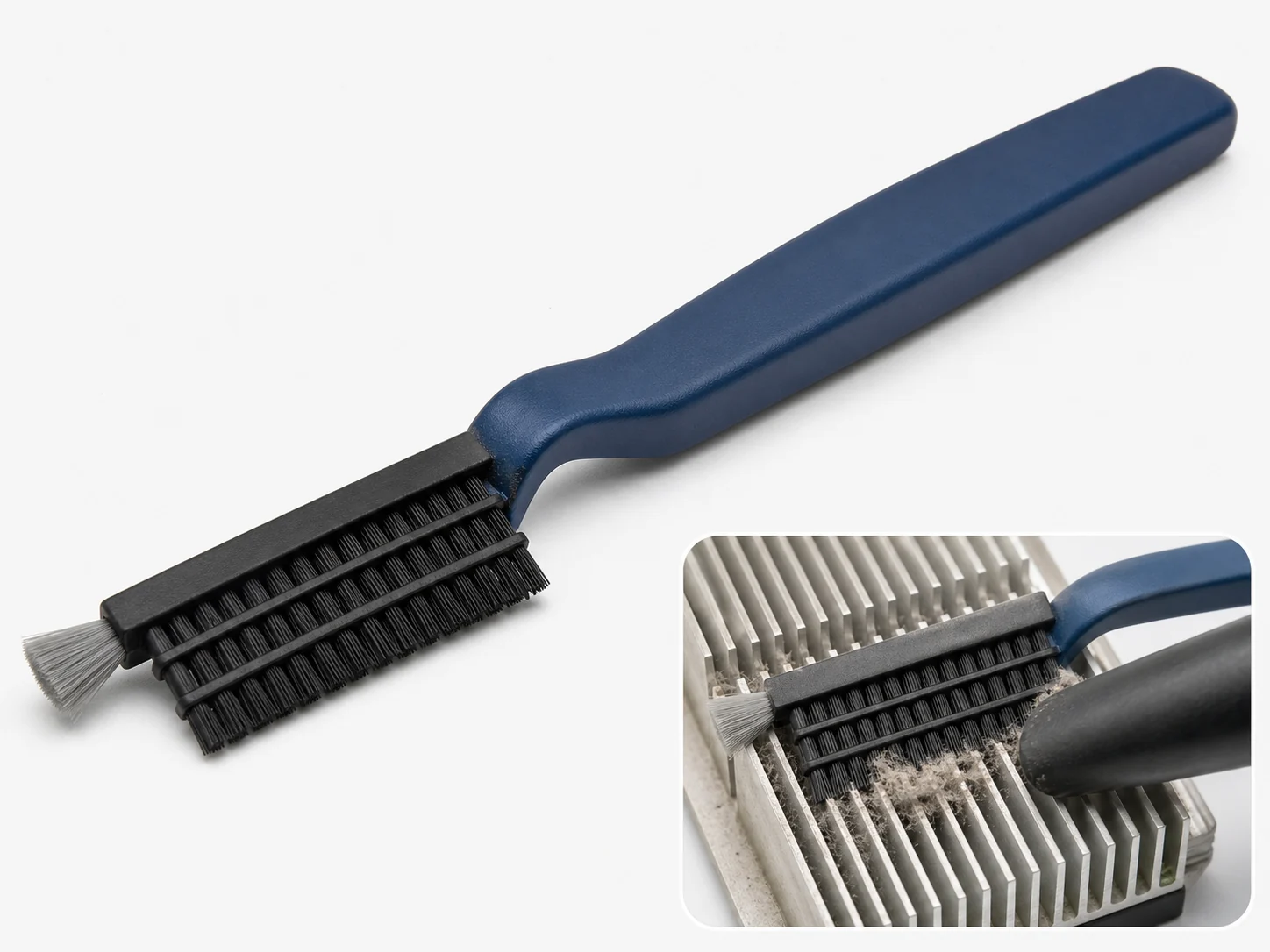
Fine nylon or PBT filaments slip between fins spaced 1 to 6 mm and lift oily particulate without bending the thin metal walls or scratching them.
Small brush
500 pcs
Minimum order
Held in one hand: tube, bottle, detail and swab brushes — including long-handled ones with a small head.
Production lead time, once the specification is confirmed
- Up to 500 pcsWithin 7 days
- 501–50,000 pcsWithin 14 days
- Over 50,000 pcsWithin 21 days
Peak season can extend these times; the shipping date is confirmed in writing with your quotation. Sampling and shipping are quoted separately.
A hand-guided brush designed to remove dust, lint, and oily particulate from the narrow channels between heat sink, evaporator, and condenser fins. The fine nylon or PBT filaments penetrate fin gaps down to 1 mm without bending the thin metal walls or leaving scratches.
What can this brush do for you?
Reaches Deep Into Tight Fin Channels
The narrow head and thin filaments slip between fins spaced 1–6 mm apart and reach working depths from 10 mm up to 150 mm. This covers the full airflow path, not just the leading edge, so cleaning restores heat transfer instead of leaving insulation behind.
Protects Fragile Aluminum and Copper Fins
Nylon PA and PBT filaments flex when they contact fin walls instead of forcing the metal sideways. Filament diameters from 0.08 mm to 0.35 mm keep contact pressure low, which prevents the bending, flattening, or edge damage common with wire brushes and rigid combs. Airflow stays unobstructed after cleaning.
Lifts Dust, Lint, and Oily Film
The dense fine filament bundle captures dry dust and lint and breaks up oily dust film when used with a mild coil cleaner or degreaser. Because the fill is uniform across the working length, the brush cleans consistently on push and pull strokes.
Reaches Equipment That Is Hard to Access
Overall lengths from 300 mm to 700 mm let operators clean installed coils, server-rack heat sinks, rooftop condenser units, and compact compressor compartments without removing covers, fans, or the heat sink itself. The handle length is matched to the installation, not just the coil.
ESD-Safe Option for Electronics
When the application involves circuit boards, power supplies, or static-sensitive components next to the heat sink, a conductive nylon fill dissipates static charge during brushing. This reduces the risk of electrostatic discharge damage while the dust is being removed.
Simple, Durable, and Easy to Inspect
No rotating parts, no abrasives, no metal contact. Filament wear is visible at a glance, and the brush can be cleaned and returned to service quickly between maintenance cycles.
What is a Heat Sink Fin Brush?
A Heat Sink Fin Brush is a hand-guided cleaning tool with one or more narrow rows of fine nylon or PBT filaments fixed into a handle or stock. It is designed to slide between the thin metal fins of heat sinks, evaporator coils, condenser coils, and radiators, then remove trapped dust, lint, and oily film with short push-pull strokes along the fin direction.
During use, the operator inserts the filament row at the open end of the fin channel and pulls the brush through the space between two fins. The filaments flex against both fin walls and reach the base of the channel without scraping or bending the metal. Dry brushing handles loose dust and lint; a light application of coil cleaner or degreaser helps lift oily dust film before the final rinse.
This is not a fin straightener, a wire brush, or an abrasive scrubber. It is built to preserve fin geometry while removing loose and lightly bonded residue. If the fins are already bent or crushed, straighten them with a fin comb first, then use the brush to clear the loosened debris.
Technical Specifications
Dimensions and filament selection are adjusted to the fin gap, fin depth, and access space. Values below represent the standard build range; final parameters are locked to the project drawings and the actual coil dimensions.
| Parameter | Standard Range / Options | Selection Notes |
|---|---|---|
| Overall length | 300–700 mm | Matched to installation depth and operator reach |
| Head width | 10–60 mm | Number of fin channels cleaned per stroke |
| Working length | 50–250 mm | Exposed filament section that enters the fin gap |
| Trim length | 15–60 mm | Free filament length beyond the stock |
| Filament diameter | 0.08–0.35 mm | Finer for delicate fins, coarser for oily film |
| Fill material | Nylon PA, PBT, or conductive nylon | PBT for higher chemical resistance; conductive nylon for ESD control |
| Recommended fin spacing | 1–6 mm | Measured between fin walls; gap must clear the bundle |
| Working depth | 10–150 mm | Distance from leading edge to fin base |
| Handle / stock material | PP, ABS, wood, stainless steel, or project-specific | Selected for grip, weight, and chemical exposure |
| Operating temperature | -20 °C to +90 °C | PBT preferred for continuous use above 70 °C |
| Chemical exposure | Mild detergents, degreasers, water-based coil cleaners | Not for prolonged immersion in concentrated strong acids, strong alkalis, or chlorinated solvents |
| Static dissipation option | Conductive nylon, surface resistance range 10^6–10^9 Ω | For ESD-sensitive electronic environments |
| Filament color | Natural, black, white, or custom | Used for identification and visual wear checks |
| Brush type | Custom Handheld Detail Brushes | |
| How it is driven | Hand-guided | |
| Cleaning target | air conditioner evaporator and condenser coil, server and telecom heat sink, and automotive radiator cleaning | |
| Surface or part | fins, channel, coils, metal, gaps, walls, comb, and aluminum | |
| Residue or debris | dust, lint, fiber, oil, and loose dust | |
| Mounting / connection | Fixed |
Where does this brush work best?
- Air conditioner evaporator and condenser coils — removes lint, cottonwood fibers, and dust that reduce airflow and cooling capacity on residential, commercial, and package units.
- Server and telecom heat sinks — cleans fin channels on CPU and GPU coolers, power supply heat sinks, and rack-mounted hardware while the ESD-safe option protects nearby electronics.
- Automotive radiators, intercoolers, and oil coolers — clears debris from front-facing fins before pressure washing without bending the thin aluminum core.
- HVAC maintenance programs — routine cleaning of fan coil units, mini-split evaporator coils, and rooftop package units where access behind covers and fans is limited.
- Industrial heat exchangers — light particulate removal between straight or gently curved fins during scheduled shutdowns.
How do I choose the right one?
Measure the gap and depth first
Measure the narrowest gap between fins and the depth from the leading edge to the fin base. The filament bundle should enter without forcing and reach the back of the channel. If the gap is below 1 mm or tapers below the bundle width, the brush will fold or push the fins apart. Choose trim length equal to or slightly greater than the measured depth so the filament tips reach the base without excessive overhang.
Match filament stiffness and diameter to the residue and fin thickness
Finer filaments in the 0.08–0.15 mm range flex easily and suit thin, fragile fins with dry dust and light lint. Coarser filaments from 0.20–0.35 mm add stiffness for oily film and heavier particulate. PBT is slightly stiffer and more chemical resistant than nylon PA, while PA is softer and more conforming. Conductive nylon should be specified when the heat sink sits on or near static-sensitive electronics.
Set the head width and profile to the access path
Head width from 10 mm to 60 mm determines how many fin channels are cleaned per stroke. A narrow head fits between fan guards, mounting brackets, and surrounding components; a wider head speeds up work on open coil faces. A straight row suits front-access coils. An angled or offset head reaches side-entry evaporator fins and heat sinks installed behind other parts.
Define the environment before ordering
Specify whether cleaning is dry or wet, which coil cleaner or degreaser will be used, the maximum operating temperature, and whether ESD control is required. These factors determine the choice between nylon PA and PBT, the handle material, and whether conductive fill is needed. A brush built for dry dust will not automatically survive aggressive solvent soaking.
When a different tool is more suitable
If the fins are already bent or crushed, straighten them with a fin comb before brushing. If the residue is hardened scale, corrosion, or baked carbon, the brush will not remove it; use chemical treatment or a soft-bristle rotary brush designed for that duty. If the gap is narrower than the smallest available filament bundle or the surface is extremely delicate, such as microchannel coil fins, use compressed air or low-pressure washing instead. This brush is for clearance fit and gentle mechanical removal, not for forcing or reshaping.
Can I customize this brush?
Because fin spacing, coil depth, access, and material vary from unit to unit, these brushes are built to the coil, not off the shelf. We typically need the fin material and thickness, the gap between fins, the depth from the leading edge to the base, the overall equipment depth and any access restrictions, the residue type, the cleaning chemicals and temperature, and whether ESD control is required. A drawing, CAD file, or sample coil helps confirm the dimensions.
- Head dimensions — width, head thickness, row configuration, and straight or angled profile
- Filament — nylon PA, PBT, or conductive nylon; diameter, trim length, density, and color
- Working length and depth — matched to the measured fin channel
- Handle / stock — length, material, ergonomic grip shape, hanging feature, or molded branding
- Assembly — fixed head, replaceable head, double-sided, or multi-row configurations
- Color and marking — custom filament or handle color, pad print, laser marking, or identification coding
- Packaging — bulk, individual bag, retail sleeve, or project-specific packing
If your project requires material declarations, ESD test data, batch inspection reports, or third-party documentation, we can support those requirements during the customization process.
Which filament survives the cleaning chemicals a heat sink fin brush meets?
How do I check whether the filament bundle is the right size for my fin gap?
Insert the brush head into the narrowest part of the fin channel without force. The bundle should slide through with light resistance and keep contact with both fin walls. If it catches, folds, or visibly spreads the fins apart, the bundle is too wide or too stiff. If it falls through without touching both sides, the bundle is too narrow for effective contact.
Can this brush be used with coil cleaning chemicals?
Yes, standard nylon PA and PBT filaments tolerate most water-based coil cleaners, mild degreasers, and diluted detergents. Apply the chemical, brush along the fin direction, then rinse. Do not soak the brush in concentrated acids, strong alkalis, or chlorinated solvents for extended periods; specify PBT and a chemical-resistant handle material for more aggressive products.
What is the difference between conductive nylon and regular nylon fill?
Regular nylon fill is non-conductive and suitable for general HVAC and radiator cleaning. Conductive nylon incorporates a dissipative additive that prevents static charge from building up while brushing near circuit boards and other static-sensitive devices. Choose the conductive version when the heat sink is attached to electronics; choose standard fill when electrostatic control is not needed.
Does this brush straighten bent fins?
No. The brush removes dust, lint, and loose or oily particulate from the channels between fins. It does not have the rigid comb structure needed to realign bent metal. Straighten damaged fins with a fin comb first, then use the brush to remove the loosened debris.
How can I tell when the brush needs replacement?
Inspect the filament bundle before each maintenance cycle. Replace the brush when the filaments are crushed, permanently bent, matted, or shortened so that the tips no longer reach the base of the fin channel. If the brush starts pushing debris deeper instead of pulling it out, or if more force is needed to achieve the same result, the fill is worn and should be renewed.
Can I clean microchannel coils with this brush?
Microchannel coils have very narrow, flat channels that are easily damaged by hand brushes. If the gap is smaller than the smallest available filament bundle or the fin material is too delicate, use compressed air or low-pressure water instead. We can supply a custom head for some microchannel layouts, but most require non-contact methods.
Guides that go deeper on this
We have not written a guide specific to this one yet. The material that covers selection, filament, dimensions, maintenance and sourcing is collected in the technical resources library.
Custom Manufacturing RFQ
Describe Your Application
To quote this brush accurately, send the size, material, cleaning target, residue, quantity, and any available drawing or sample photo.
Drawing or photo optional — it speeds things up, it does not gate the enquiry.
Custom Brush RFQ
Send Your Brush Project
Upload a drawing, product photo, or sample photo and provide the core dimensions and cleaning conditions.
“We need a brush to remove wet residue from a stainless steel conveyor, about 800mm wide. The current brush wears quickly. We can send photos.”
“We sell drinkware and need a cleaning brush to include with the product. Quantity around 5,000 pieces.”