
Custom Cleaning Brush
Sink Brush
Order a custom sink brush with nylon PA bristles for corner, drain, grout, and dishware cleaning. Adjustable stiffness, head geometry, and handle length.
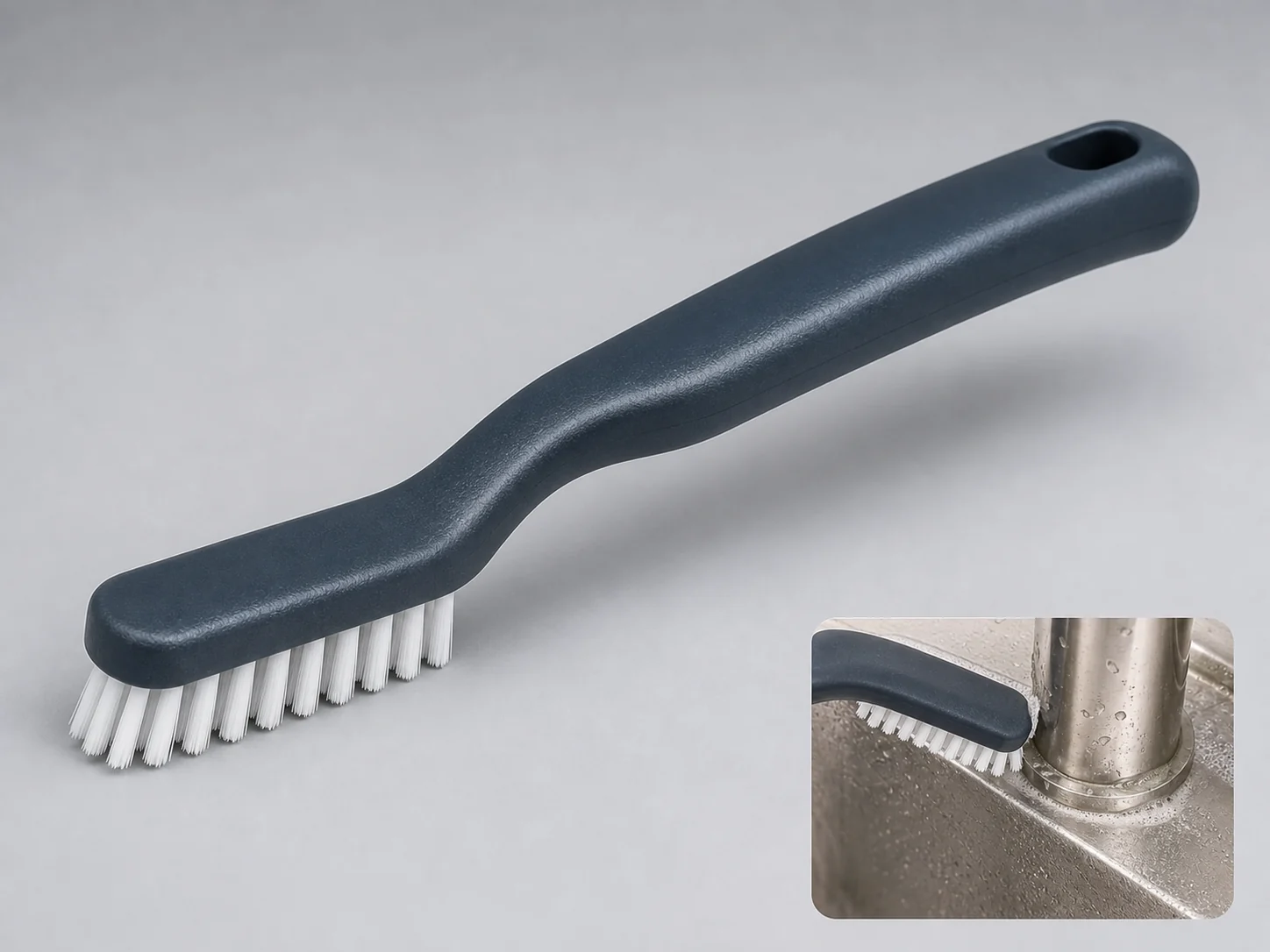
Small brush
500 pcs
Minimum order
Held in one hand: tube, bottle, detail and swab brushes — including long-handled ones with a small head.
Production lead time, once the specification is confirmed
- Up to 500 pcsWithin 7 days
- 501–50,000 pcsWithin 14 days
- Over 50,000 pcsWithin 21 days
Peak season can extend these times; the shipping date is confirmed in writing with your quotation. Sampling and shipping are quoted separately.
The Sink Brush is a hand-held nylon PA cleaning brush designed for wet, detail-oriented scrubbing in and around sinks, drains, grout lines, and dishware edges. It uses dense, heat-tolerant filament that can be specified soft and flagged for polished stainless and tile or stiff and un-flagged for textured grout and baked-on food.
What can this brush do for you?
Reaches the corners a sponge or dishcloth skips
The brush head can be built with a narrow taper, angled face, or dedicated corner tip, so the filament enters the small gaps around drain flanges, faucet bases, soap trays, and basin corners. Short trim lengths and dense tuft placement keep the bristles working in tight spaces instead of splaying over them.
Stands up to hot water and everyday kitchen chemicals
Nylon PA filament holds its shape and stiffness through repeated contact with hot dishwater, degreasers, and dilute cleaners at temperatures up to about 100°C. The handle and tuft anchoring are selected for the same wet environment, so the brush does not soften, loosen, or shed after sitting in a busy sink area.
Scrubs grease and film without scratching polished surfaces
Stiffness is controlled through filament diameter, trim length, and tip finish. For polished stainless, ceramic, or plastic fixtures, softer flagged nylon spreads contact force and removes soap film, grease, and light limescale without visible scratching. For grout and textured tile, a stiffer un-flagged configuration applies the pressure needed to dislodge residue from the pores.
Dries quickly between uses instead of harboring mold
The open tuft layout lets water run off and air circulate through the bristle base. Combined with a hanging feature on the handle, the brush dries rapidly when stored bristles-down, which reduces the trapped moisture, odor, and mold growth common with enclosed sponge or pad-style sink tools.
One brush covers the basin, the drain, and the cookware edge
A head can combine a broad scrubbing zone for flat basin surfaces with a narrower side edge or angled tip for drain grooves, pot rims, lid channels, and utensil joints. This reduces the number of tools your staff or customers need to switch between during a single cleaning pass.
What is a Sink Brush?
A Sink Brush is a hand-guided nylon PA cleaning tool used wet or with detergent for localized scrubbing in kitchen and utility sink areas. Unlike a sponge or cloth, it works through the tips of many short, individually anchored bristles, which lets it dig into grout lines, grooves, and corners that a flat cleaning pad cannot contact.
In use, the operator works with short back-and-forth strokes across the basin surface, then switches to circular scrubbing around the drain, faucet base, and counter joints. The brush removes soap film, grease, light limescale, mold spots, hair, and loose food particles from accessible surfaces. It is not a substitute for chemical descaling or scouring where heavy mineral deposits or carbonized residue have already bonded to the surface.
The typical construction is a rigid or contoured handle holding a tufted nylon PA head. Handle length, head width, trim length, and filament stiffness are all matched to the sink geometry and the surfaces being cleaned. Because the brush is used wet, every material choice matters: the filament must resist hot water and detergents, the handle must stay controllable with wet or gloved hands, and the tuft anchoring must not trap water where mold can form.
Technical Specifications
The values below are the practical working ranges for this product. Final dimensions are set per project.
| Parameter | Specification / Options |
|---|---|
| Overall length | 120–450 mm |
| Head width | 40–80 mm |
| Working length (tufted area) | 10–120 mm |
| Trim length | 8–40 mm |
| Filament diameter | 0.10–0.80 mm |
| Filament material | Nylon PA (PA6 or PA66) |
| Handle material | Polypropylene, TPE-overmolded PP, or project-specified polymer |
| Handle diameter | 8–35 mm |
| Bristle tip finish | Flagged, smooth (un-flagged), or custom |
| Head profile | Rectangular, oval, tapered, angled, or combined |
| Use temperature | 5–100°C |
| Brush type | Custom Handheld Detail Brushes |
| How it is driven | Hand-guided |
| Cleaning target | kitchen sink, tile and grout, and dishware and cookware cleaning |
| Surface or part | drain, corners, grout lines, tile, edges, grooves, joints, and cookware |
| Residue or debris | soap film, grease, food particles, baked-on food, mold, carbonized residue, limescale, and mineral deposits |
| Mounting / connection | Fixed |
All dimensions above are selected to fit the actual sink bowls, faucet bases, drain fittings, or dishware your customer needs to clean. The table is not a fixed off-the-shelf configuration.
Where does this brush work best?
- Kitchen sinks: basin corners, drain flanges, basket strainers, faucet bases, soap trays, and overflow openings where food particles and soap film collect.
- Tile and grout: backsplash corners, grout lines, caulk joints, and counter seams around wet areas.
- Dishware and cookware: pot rims, pan corners, lid grooves, utensil handles, and bakeware edges with stuck-on food or grease.
- Fixture and hardware details: sink clips, drain tracks, sliding window or track areas adjacent to wet zones, and other small metal or plastic details.
- Light commercial and janitorial use: service sinks, prep-sink surrounds, and drain covers in food preparation areas where a dedicated brush is kept at the sink station.
How do I choose the right one?
Match the filament to the surface and the residue
Soft flagged nylon, made from fine filament and a longer trim length, protects polished stainless, ceramic, glass, and plastic. Stiff un-flagged nylon, made from thicker filament and a shorter trim length, scrubs grout, textured tile, and cast-iron or heavy cookware. If the job involves both surface types, specify a dual-zone head with different stiffness areas.
Set the head geometry to the actual access points
Measure the narrowest gap the brush must enter, such as the space around a faucet base or the depth of a drain groove. A tapered or angled head with a short working length reaches these areas without forcing the operator to tilt the handle. A wider head is better for covering flat basin surface quickly.
Choose handle length and grip for the operator
Handle length should let the user reach the bottom of the sink without leaning or submerging the hand. For deep commercial sinks, choose a longer handle. For wet-hand control, a TPE overmold or textured polypropylene grip is more practical than a smooth, narrow handle.
Check the operating environment
Nylon PA performs well in hot water and common kitchen cleaning chemicals up to the listed temperature limit, but prolonged boiling or strong oxidizing chemicals can shorten filament life. If the brush will be sanitized frequently or left in contact with concentrated cleaners, specify this during the RFQ so we can confirm material compatibility.
When this brush is not the right tool
Use a wire brush, abrasive pad, or chemical descaler for hard mineral scale, rust, or carbonized residue that has bonded to a surface. For delicate nonstick cookware, only a soft flagged configuration is appropriate, and it should be tested on a small area first. For single-use or sterile food-contact applications, a disposable swab or separate dedicated tool is a better choice.
Can I customize this brush?
Sink brushes are configurable because no two sink designs or cleaning routines are identical. To define the custom configuration, provide the target surfaces, the smallest gaps or corners to be reached, the type of residue, the cleaning chemicals and water temperature, and any preferred handle form or brand requirements. A drawing, sample sink, or photo set speeds up the process.
We can adjust:
- Head geometry — rectangular, oval, tapered, angled, corner detail tip, or multi-zone head with different tuft stiffness.
- Filament configuration — PA6 or PA66, filament diameter from soft to firm, trim length, tuft density, tip finish (flagged or smooth), and filament color.
- Handle — length, diameter, polypropylene or TPE-overmolded construction, contoured grip, hanging hole, or ergonomic shape.
- Color and marking — custom handle color, filament color, pad printing, laser marking, or molded identification features.
- Packaging — bulk polybag, hang tag, retail card, private label packaging, or project-specific packing.
If your project requires material documentation, inspection, or third-party testing assistance, we can support those requirements during the customization process.
When is a sink brush worn out rather than just dirty?
Can this brush safely clean nonstick cookware?
Only with the right configuration. Use soft flagged nylon with a filament diameter of 0.10–0.30 mm and a trim length of at least 20 mm, and test on an inconspicuous area first. Stiff un-flagged bristles can scratch or wear coated surfaces.
How can I tell when the brush needs to be replaced?
Inspect the tufts for splayed, bent, or flattened filaments, check the handle for cracks, and look for tufts pulling loose from the base. If bristles no longer spring back after use or the brush leaves visible streaks and residue behind, it has passed its useful life.
Should the brush be stored in a cup of soapy water?
No. Constant soaking softens the filament over time and promotes mold growth inside the tuft base. Rinse the brush after use, shake out excess water, and store it bristles-down with the hanging hole so air can reach the head.
Does this brush remove hard water scale on its own?
It can break loose light scale from joints and grout, but heavy mineral deposits usually require an acid-based descaler or a stiffer brush. The sink brush provides mechanical loosening; it does not dissolve mineral build-up.
What should be removed from the sink before scrubbing?
Remove drain stoppers, strainer baskets, soap dispensers, and any detachable fittings. This gives the brush clear access to the surfaces underneath and around those parts, and it prevents loosened debris from being pushed further into the drain.
How can I verify that a grout line or corner is actually clean?
After scrubbing and rinsing, wipe the cleaned area with a white cloth or paper towel. If the cloth picks up visible film, residue, or discoloration, the brush is not making full contact or the stiffness and head geometry need to be adjusted for that area.
Guides that go deeper on this
We have not written a guide specific to this one yet. The material that covers selection, filament, dimensions, maintenance and sourcing is collected in the technical resources library.
Custom Manufacturing RFQ
Describe Your Application
To quote this brush accurately, send the size, material, cleaning target, residue, quantity, and any available drawing or sample photo.
Drawing or photo optional — it speeds things up, it does not gate the enquiry.
Custom Brush RFQ
Send Your Brush Project
Upload a drawing, product photo, or sample photo and provide the core dimensions and cleaning conditions.
“We need a brush to remove wet residue from a stainless steel conveyor, about 800mm wide. The current brush wears quickly. We can send photos.”
“We sell drinkware and need a cleaning brush to include with the product. Quantity around 5,000 pieces.”