
Custom Cleaning Brush
Sorting Pharmaceutical Brush
Custom pharmaceutical roller brush for tablet and capsule sorting, counting, and handling. PBT, PP, and nylon filaments in close or spiral windings.
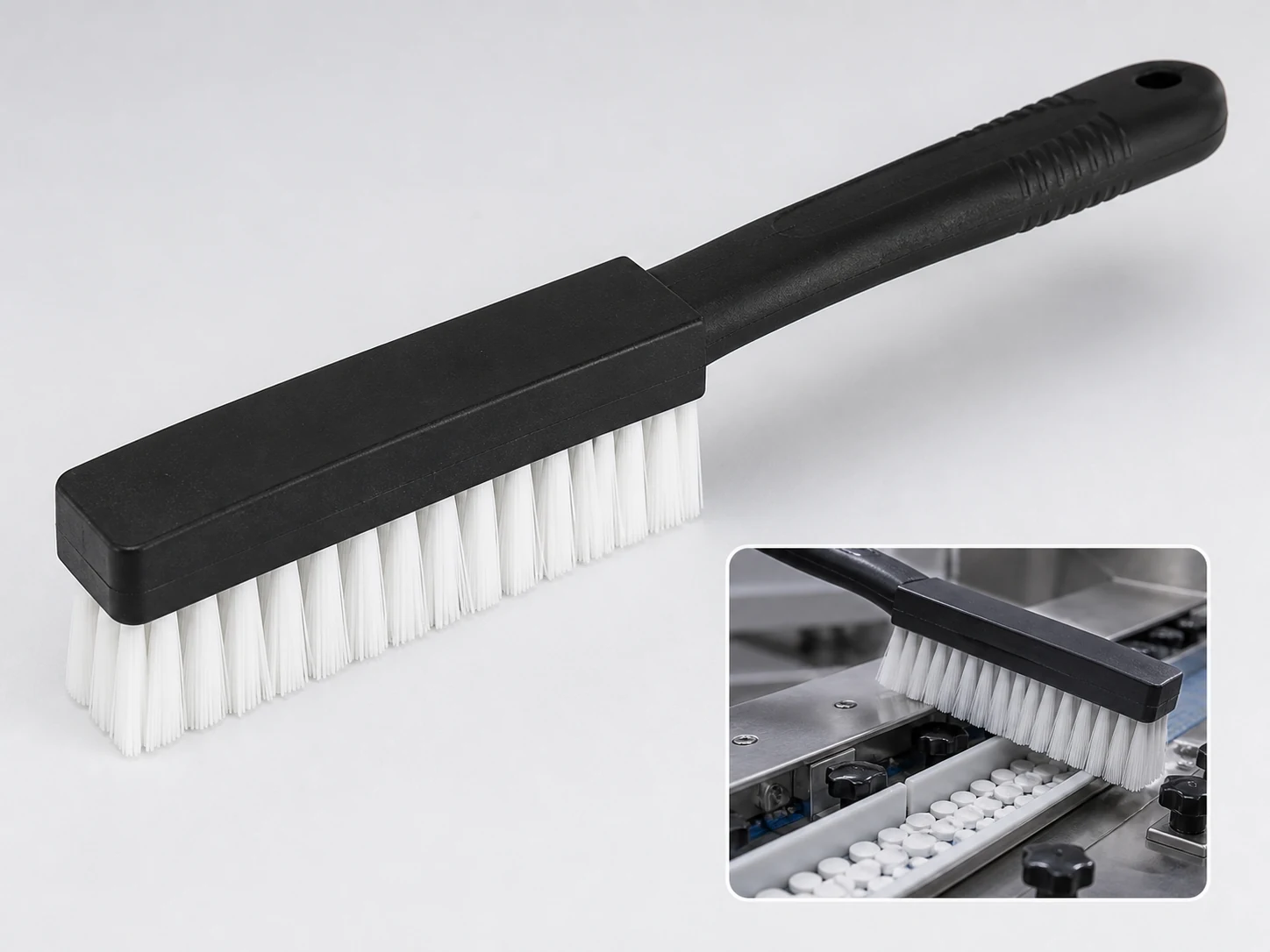
Large-format brush
100 pcs
Minimum order
Built one at a time on a core or channel: full-width rollers, sweeper brooms and long strip.
Production lead time, once the specification is confirmed
- Up to 100 pcsWithin 20 days
- 101–1,000 pcsWithin 30 days
- Over 1,000 pcsConfirmed with your quotation
Peak season can extend these times; the shipping date is confirmed in writing with your quotation. Sampling and shipping are quoted separately.
A cylindrical roller brush for tablet and capsule sorting, counting, and product-handling positions. It guides, separates, meters, and de-dusts product with controlled synthetic filament contact that protects coatings and fragile forms.
What can this brush do for you?
Keeps Sorting Channels Moving Without Doubles or Pile-ups
Fine, evenly filled filaments impose gentle pressure across the product stream, breaking apart touching tablets and preventing stack-ups at sorter entries, counting lanes, and packaging in-feed points. The contact force comes from filament diameter and fill density, so the product stays in line without being crushed against the guide rails.
Strips Loose Dust and Fines While the Product Is in Motion
As tablets or capsules pass under the rotating face, the filament tips release loosely attached powder and broken edges. Combined with a vacuum or collection tray, the brush holds the product stream cleaner before counting, weighing, or film inspection, which reduces false rejects from dust on sensor windows.
Protects Coated Surfaces and Soft Capsule Shells
PBT and polypropylene filaments are selected at controlled diameters so the tips flex instead of digging. Film-coated tablets, printed tablets, and gelatin or HPMC capsules move through the contact zone without scuffing, chipping, or imprint loss, even at high throughput.
Delivers Repeatable Contact Across the Full Working Width
The braided or twisted filament strip is wound on a machined core with continuous tension, so fill height and density stay consistent from edge to edge. Sorting machines respond the same way at both ends of the brush, and lane-to-lane variation stays low.
Drops Into Your Existing Drive With No Field Machining
Core bore, shaft ends, keyways, and journal surfaces are produced against the machine drawing. The brush mounts in the same position as the original component, with the correct direction of rotation and balance for the drive speed.
What is a Sorting Pharmaceutical Brush?
A Sorting Pharmaceutical Brush is a driven cylindrical roller with synthetic filament wound around a central core. It installs in a tablet/capsule sorter, counter, conveyor, or packaging machine where product must be spaced, oriented, redirected, or lightly cleaned as it moves. Unlike a hand brush used to clean machine surfaces, this brush is a product-contact process component: the filament face works against the tablet or capsule itself, so stiffness, trim, and winding are chosen around the product, not the equipment.
In most installations the brush is fixed across the product channel and can be driven clockwise or counterclockwise. The tips contact the passing tablets/capsules at a controlled engagement set from the sorter drawing and verified on the line. Depending on winding, the brush can meter product forward, break apart clusters, sweep dust to the side, or hold product lightly against a rail while sensors or cameras inspect it.
Because the brush runs in a pharmaceutical production environment, construction is limited to synthetic filaments and cores that will not shed metal particles or transfer lubricants into the batch. Working speed, engagement, product hardness, coating type, and the dust extraction around the station all influence which filament, fill, and winding will perform correctly.
Technical Specifications
The table below covers the parameters we typically set from the machine drawing, product sample, and process conditions. All listed values can be adjusted to the project; final dimensions come from your print or measured machine position.
| Parameter | Value / Options |
|---|---|
| Working length | 100–2000 mm, matched to channel or roller width |
| Brush outside diameter (OD) | 50–300 mm, selected from available mounting clearance |
| Core diameter | 20–120 mm; sized for stiffness and drive bore |
| Shaft / journal | Plain bore, keyed bore, stub shaft, or custom end machining per drawing |
| Filament material | PBT, polypropylene (PP), or nylon PA; selected for product surface and hardness |
| Filament diameter | 0.10–0.80 mm typical; common material ranges: PBT 0.15–0.20 mm, nylon 0.05–1.20 mm, PP 0.07–2.00 mm |
| Winding / construction | Close-wound, pitch-wound, or helical spiral strip on roller; end retention as required |
| Filament density / fill | Controlled per linear length or per cm² to set contact pressure and dust release |
| Engagement | Set from the process drawing and verified on the line; no universal overlap value applies |
| Direction of rotation | CW or CCW; filament lean matched to the desired sweep, feed, or hold function |
| Operating environment | Dry pharmaceutical handling; material grades selected for temperature, humidity, or washdown exposure when specified |
| Brush type | Custom Roller and Conveyor Brushes |
| How it is driven | Machine-driven, mounted in the equipment |
| Cleaning target | electronic tablet and capsule counter, sorting and inspection lane, and capsule polishing and dedusting position cleaning |
| Surface or part | channel, roller, guides, drums, rails, bores, conveyors, and metal |
| Residue or debris | dust, pitch, powder, metal particles, and lubricant |
| Mounting / connection | CW or CCW; filament lean matched to the desired sweep, feed, or hold function |
Where does this brush work best?
- Electronic tablet and capsule counters: mounted at channel exits or in-feed lanes to stop doubles and keep counting sensors clear.
- Sorting and inspection lanes: separates touching products before camera, checkweigher, or metal-detection stations so each unit is evaluated individually.
- Capsule polishing and dedusting positions: rotating brush works against a moving bed or drum to lift loose powder and shell fragments while capsules continue forward.
- Blister and bottle packaging in-feeds: aligns capsules and tablets into single lanes and matches product spacing to the downstream pick or filling pitch.
- Accept and reject gates: a short brush section can cushion product direction changes without the impact of a hard blade.
- Coated tablet and softgel lines: low-stiffness configurations keep printed coatings and soft shells intact while still controlling flow.
How do I choose the right one?
Start With the Function
Determine whether the brush is mainly orienting/separating, metering, or dust removal. Separating benefits from dense, fine filaments; metering benefits from spiral winding; dust removal benefits from higher tip speed and stiffer filaments with vacuum extraction. Write down the functions before choosing fill.
Match the Filament to the Product
Coated or soft products need thinner, softer filaments with lower engagement; hard uncoated tablets tolerate larger filament diameter and more contact force. PBT offers stiffness memory; PP is softer; nylon can be selected for wear. Do not copy a brush from a different product without checking.
Select Winding and Fill Together
Close-wound face holds product more consistently in short zones; pitch-wound or spiral strip moves product along and self-clears dust. Fill density changes the number of filament tips in contact, which changes both hold and dust removal.
Set Engagement on the Line
Engagement must be controlled across full width. A brush that touches at one end but not the other will steer product and cause jams. Use shims or adjustable end supports, and confirm left-center-right contact with a product sample or paper strip.
When Another Solution Fits Better
If the main problem is static-held dust, use an anti-static brush or ionizing air upstream. If product must not be touched at all, switch to air or vacuum handling. If the machine position is showing hard deposits baked onto equipment, use an equipment cleaning brush, not this product-contact sorter brush. And if a vision sorter needs to inspect every side, the brush may act as a singulation aid, not a replacement for the inspection system.
Can I customize this brush?
Almost every dimension and material on this brush is project-configurable. To quote a custom configuration, send the sorter/counter drawing or measured dimensions of the brush position, a product sample and target throughput, the drive speed and direction, and any dust extraction or washdown conditions. We will also confirm engagement, core end details, and any documentation your validation records require.
Variables we can set:
- Working length, brush OD, core diameter, and shaft/journal geometry to the machine drawing
- Filament type, diameter, trim length, fill density, and filament tip finish
- Winding pattern: close, pitch, multi-start helical, or segmented strip
- Rotation direction and filament lean for sweep or feed action
- Core material and end machining: bore, keyway, set-screw flats, stub shafts, or custom couplings
- Color coding: filament color bands, colored core ends, or laser marking for line identification
- Packaging: bulk, individually sleeved, or line-set kitting
If your project needs material declarations, inspection reports, or third-party testing support tied to your QA file, we can assist with those requirements during the customization process.
Which filament lasts longest on a sorting pharmaceutical brush?
How do we decide between close-wound and spiral-strip winding?
Close-wound construction gives continuous filament contact across the full roller face, which is better for holding product in short sorting zones and for uniform dedusting. Spiral-strip winding leaves a helix gap that lets product move directionally and lets dust clear from the face, so it is preferred for metering, feeding, and self-cleaning applications. If your product tends to jam under a full brush, try the spiral strip first.
Should the brush rotate with or against product flow?
Counter-rotation increases relative speed between filament tips and product, which improves dust removal but can flip lighter capsules or fragile tablets. Co-rotation meters more gently and is usually safer for soft or coated product. The right direction depends on product weight, coating, and the function required; we recommend a short on-line trial with both directions before releasing the final configuration.
What filament diameter is typical for coated tablets and soft capsules?
For film-coated, printed, or softgel product, start with fine filaments around 0.10–0.20 mm in PBT or PP and low engagement. This creates a soft, forgiving tip that removes loose dust without scratching the surface. For hard uncoated tablets or very dusty batches, 0.30–0.80 mm filament gives more contact force and longer service life.
How do we check that engagement is even after installing a new brush?
Rotate the brush slowly by hand and pass a strip of paper between the filament face and a reference rail at the left, center, and right positions. The drag should feel the same at all three points. If one side is light or heavy, adjust the end supports or shims until full-width contact is uniform; uneven engagement will steer product and cause repeated jams.
Will brushing remove static-held dust from capsules and tablets?
No. Brushing removes loosely attached surface dust and broken edges, but dust held by static charge may stay on the product. Combine the brush with ionizing air, vacuum extraction, or a separate dedusting step if static is the dominant cause. The brush should be specified as part of that sequence, not as a stand-alone static control device.
When should we plan to replace the brush?
Inspect the brush weekly in high-volume production. Look for flattened filament, clumped tips, missing fill sections, or visible runout at the core. If sorting performance drops, product begins double-feeding, or dust removal decreases even after speed and engagement adjustments, replace the brush. Keep a spare configured identically to avoid line downtime during validation runs.
Guides that go deeper on this
Custom Manufacturing RFQ
Describe Your Application
For a custom quote, we need the key dimensions, surface or part, residue, material preference, quantity, and reference image or drawing.
Drawing or photo optional — it speeds things up, it does not gate the enquiry.
Custom Brush RFQ
Send Your Brush Project
Upload a drawing, product photo, or sample photo and provide the core dimensions and cleaning conditions.
“We need a brush to remove wet residue from a stainless steel conveyor, about 800mm wide. The current brush wears quickly. We can send photos.”
“We sell drinkware and need a cleaning brush to include with the product. Quantity around 5,000 pieces.”