
Custom Cleaning Brush
Sorting Brush
Filament type, diameter and density set to lift chaff, husk and dust from grain, tobacco or web lines while controlling bed depth and contact pressure.
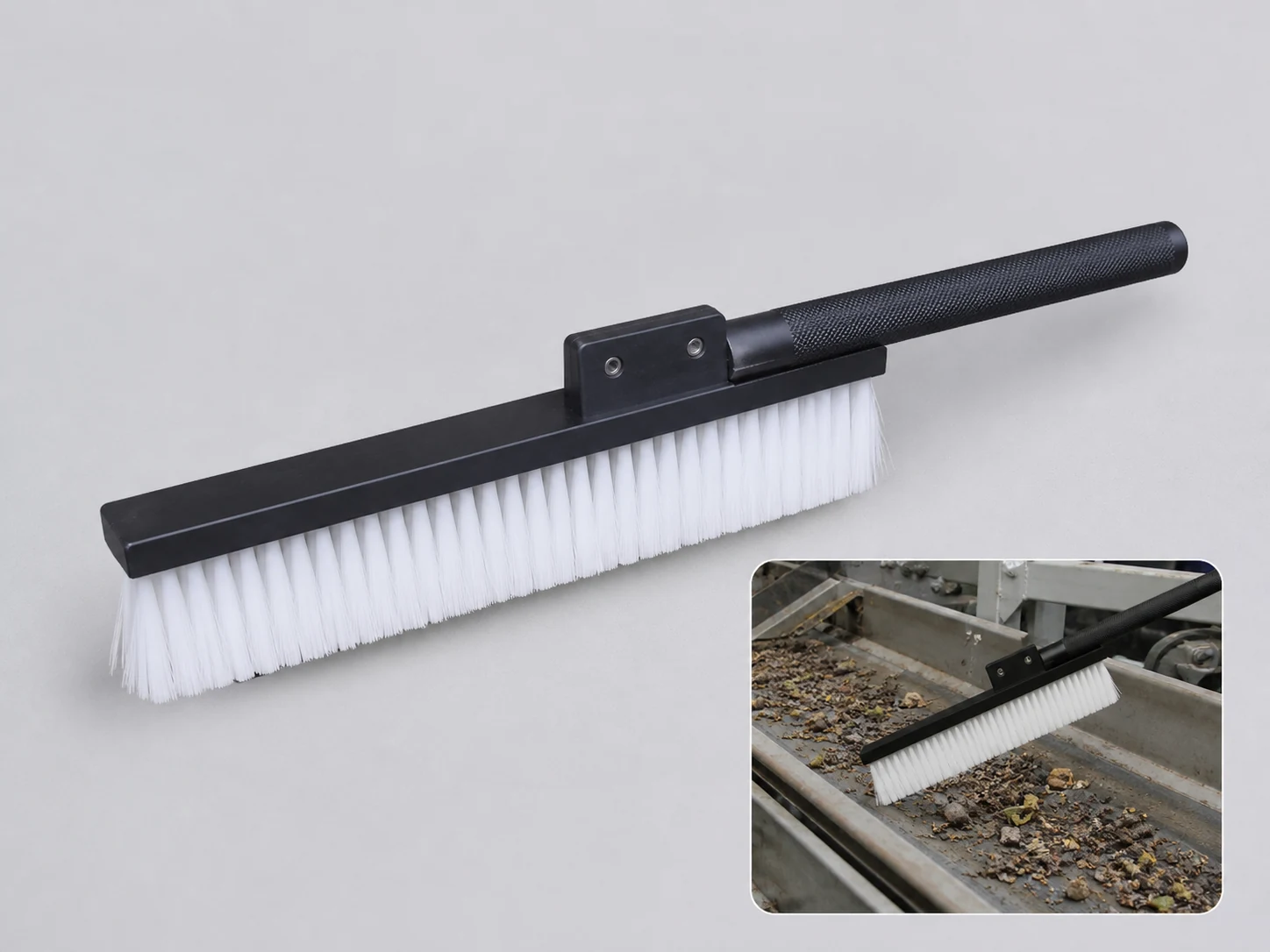
Large-format brush
100 pcs
Minimum order
Built one at a time on a core or channel: full-width rollers, sweeper brooms and long strip.
Production lead time, once the specification is confirmed
- Up to 100 pcsWithin 20 days
- 101–1,000 pcsWithin 30 days
- Over 1,000 pcsConfirmed with your quotation
Peak season can extend these times; the shipping date is confirmed in writing with your quotation. Sampling and shipping are quoted separately.
A machine-mounted cylindrical sorting brush for grain cleaning, tobacco processing, web handling, and bulk product lines. It removes chaff, dust, fibers, husk, and other loose process particles while controlling product flow, bed depth, and contact pressure across the working width.
What can this brush do for you?
Lift lightweight contaminants without damaging the product
The filament type, diameter, and density are selected to sweep away chaff, husk, paper fines, and loose dust without crushing, scuffing, or tearing the product underneath. Softer polypropylene filaments handle delicate kernels and thin sheets; stiffer nylon or PBT filaments remove fibers that cling to the surface. The brush does the sorting work mechanically, reducing the load on downstream air systems or optical sorters.
Maintain consistent contact across wide sorting beds
Working widths up to 3000 mm are built on a straight, rigid core so the filament tips engage the product bed evenly from edge to edge. Uneven contact creates dead zones where fines accumulate and product passes uncleaned. A properly supported core and controlled filament trim keep the cleaning action uniform along the entire sorting line.
Push, tumble, or convey product while it is being cleaned
The winding pattern is not cosmetic. Close winding produces dense scrubbing for dust removal on flat product beds. Pitch winding leaves gaps that let product roll, turn, or convey forward while the brush rotates. Helical strip winding moves material sideways or assists directional flow. Each pattern changes how the brush behaves, so the same roller can clean, meter, or convey depending on how it is wound.
Run continuously without filament loss or core fatigue
Filaments are anchored into the core rather than glued or stapled, so continuous rotation and repeated contact with product do not shed bristles into the stream. Core diameter and shaft/journal dimensions are matched to machine speed and torque, preventing deflection that would cause premature wear on one side of the brush.
Drop into your existing machine without modification
The sorting brush is built from your machine drawing, not from a catalog guess. Roller diameter, face length, core diameter, shaft ends, keyways, and overall length are all matched to the existing housing, bearings, and drive. Replacement brushes install on the same journals and run on the same rotation direction without re-engineering the line.
What is a Sorting Brush?
A sorting brush is a cylindrical roller brush mounted inside sorting, cleaning, or conveying machinery. It rotates against a product bed, screen, belt, or guide surface and uses filament tips to sweep, agitate, or separate material as it passes. The brush is engineered around three things: what it contacts, how much it should engage, and what the machine needs mechanically.
In grain cleaning, the brush rolls over the product bed and lifts hulls, dust, and broken kernels while whole grain passes through. In tobacco processing, it removes dust and stem fines from product moving along conveyors or through threshing stages. In web and sheet handling, the brush cleans paper fines from rollers, slitters, or coating lines before they build up and mark the sheet.
The brush is not a universal part. Filament material, filament diameter, winding density, core construction, and shaft ends are all determined by the machine and the material being sorted. A brush that works on dry grain will be wrong for wet tobacco or sticky paper dust. That is why the starting point is always the machine drawing and the process conditions.
This is a rotating contact-component. It is designed for continuous duty inside production equipment, and it needs to be specified with the same care as a roller, screen, or conveyor belt.
Technical Specifications
The table shows the typical working ranges for sorting brushes. Every dimension is confirmed against the machine drawing before production.
| Parameter | Value / Options |
|---|---|
| Roller diameter (over filaments) | 50–400 mm, selected to available housing space and required tip speed |
| Working width / face length | 100–3000 mm, matched to product bed or web width |
| Core diameter | 20–150 mm, sized for stiffness, brush OD, and shaft torque |
| Shaft / journal ends | Machined from drawing: plain, keyed, threaded, splined, or flanged hub |
| Filament diameter | 0.10–1.20 mm nylon; 0.07–2.0 mm PP; 0.15–0.2 mm PBT (other sizes on request) |
| Fill materials | Nylon PA6/PA66/PA612, PP, PBT, abrasive nylon for extra cleaning action |
| Winding pattern | Close wound, pitch wound, helical strip, or segmented sections |
| Contact engagement | Set from substrate and process; typical starting range 2–10 mm, confirmed on first article |
| Core material | Steel, stainless steel, aluminum, or composite tube |
| Operating environment | Material grade selected for moisture, temperature, chemical exposure, and hygiene requirements |
| Balancing | Optional dynamic balancing to specified grade for high-speed operation |
| Brush type | Custom Roller and Conveyor Brushes |
| How it is driven | Machine-driven, mounted in the equipment |
| Cleaning target | nut cleaning line, tobacco threshing and processing, and web converting cleaning |
| Surface or part | roller, tobacco, webs, product beds, sheets, screens, conveyors, and transfer points |
| Residue or debris | dust, chaff, husk, fines, fiber, paper fines, particles, and loose process particles |
| Mounting / connection | Shaft-Mounted / Fixed |
Where does this brush work best?
Grain, seed, and nut cleaning lines
Pre-cleaners, gravity tables, and sorting beds where the brush sweeps chaff, husk, dust, and broken kernels from the product stream. Soft PP or medium nylon filaments lift debris without cracking the grain.
Tobacco threshing and processing
Conveyors, stem separation, and product transfer points where the brush removes dust, stem fines, and loose fibers from lamina and cut tobacco. Nylon or PBT resists the heat and moisture present in conditioning lines.
Paper, film, and web converting
Roller cleaning, slitter stations, and coating lines where the brush removes paper fines and powder from guide rollers and sheet surfaces. Static-prone environments benefit from conductive filament options.
Food processing and bulk handling
Product beds, screens, and transfer conveyors where loose skins, powder, or small particles must be removed from sorted product without aggressive scrubbing.
How do I choose the right one?
Start with the machine, not the brush
Measure the available space, the shaft ends, the bearing centers, and the rotation direction. The roller diameter must fit the housing, the core must accept the shaft load, and the journals must match the existing drive and support. If you have a worn brush, send a sample or drawing so the replacement lands on the same centerline.
Match the filament to the residue and the product
For dry, lightweight debris such as chaff, husk, or paper fines, softer PP filaments in a 0.2–0.5 mm diameter give enough lift without damaging the surface. For sticky or fibrous residue, nylon or PBT in 0.3–0.8 mm holds its shape and scrubs more aggressively. If the product surface is delicate or coated, stay with a softer filament and lower engagement. If the residue is abrasive, choose PBT for longer wear. Always test on a sample bed before committing the full width.
Select the winding pattern based on what the brush must do to the product
Close winding is for dense cleaning: maximum filament density, most scrubbing points, best for dust removal on flat beds. Pitch winding leaves clean channels through which product can move, tumble, or convey while the brush cleans. Helical strip winding is used when the brush must move material laterally or help break up clumps. If the brush also meters or feeds product downstream, a pitch or helical pattern is usually better than close winding.
Set engagement from the substrate, not from habit
A 2–10 mm engagement is a common starting range, but it must be confirmed on the actual product bed. Too much engagement bends the filament, overheats the tips, and wears the brush prematurely. Too little engagement means the tips only dust the surface without removing attached fines. Run a short trial section and inspect the cleaning result on both edges and the center before locking the final dimension.
Consider moisture, chemicals, and temperature
Nylon absorbs moisture and loses stiffness in wet environments; PP resists water and most chemicals but softens at lower temperatures; PBT handles higher heat and many solvents. If the sorting line runs continuously in a humid or washdown area, say so. The core and shaft materials must also be compatible with the environment, not just the filaments.
When another brush or method may be more suitable
If the material is heavy lumps, large stones, or thick deposits that require aggressive scraping, a wire brush or steel-tipped roller may be a better choice. If the only requirement is to remove light surface dust from a smooth sheet, an air knife or vacuum may be simpler and cheaper. If the product must be sorted by size or weight rather than cleaned, the brush alone will not do that job — it must work with screens, air, or optical equipment.
Can I customize this brush?
Every sorting brush is built around the machine it goes into. To define a custom configuration, provide the machine drawing, shaft/journals, housing dimensions, product being sorted, residue type, operating speed, and environment. If you only have a worn sample, send the sample and we will reverse-engineer the dimensions.
What can be adjusted:
- Roller geometry — outer diameter, face length, core diameter, overall length, and any end-step or stepped diameter sections.
- Filament system — material (PP, nylon, PBT, abrasive nylon), filament diameter, trim length, color, and density per linear meter.
- Winding pattern — close wound, pitch wound, helical, strip, segmented, or a combination across different zones of the same roller.
- Core and shaft — steel, stainless steel, aluminum, or composite core; shaft ends with keyways, threads, splines, or welded flanges; bearing seats and snap-ring grooves.
- Balance and finish — dynamic balancing to a specified grade for high-speed operation, filament end treatment, or edge trimming.
- Packaging and marking — bulk, individually boxed, palletized, or project-specific packaging; engraved or labeled identification codes.
If your project requires material documentation, inspection reports, or third-party testing, those can be arranged as part of the customization scope.
Which filament lasts longest on a sorting brush?
How do I measure a worn sorting brush for replacement?
Measure the overall length end-to-end, the brush face length, the outside diameter over the filaments, and the core inside/outside diameter. Then measure the shaft ends: length, diameter, keyway size, thread pitch, or any stepped features. Photograph the winding pattern and note the filament material if known. A sample brush is even better — dimensions taken from the worn part are often more reliable than a drawing that has been revised over the years.
What is the difference between close-wound and pitch-wound brushes?
Close-wound brushes place filament rows against each other with no gaps, giving maximum filament density for heavy scrubbing and dust removal. Pitch-wound brushes leave a defined gap between rows, which lets product move through or tumble while being cleaned. Choose close wound when the brush is the main cleaning element on a stationary bed. Choose pitch wound when the brush must also convey, meter, or allow air to pass through.
How do I know if the filament stiffness is right for my product?
Run a small hand sample across the product and inspect the surface. If the product is scratched, cracked, or leaves residue on the filament, the filament is too stiff or the engagement is too high. If residue remains embedded in the product after several passes, the filament is too soft or the density too low. A good starting point is to use the softest filament that still removes the target residue, then increase stiffness only if cleaning is insufficient.
Does this brush work in wet or humid sorting lines?
It can, but the material must be specified for it. Polypropylene resists water absorption and most chemicals. Nylon absorbs moisture, becomes softer, and can lose stiffness in continuous wet conditions. PBT sits between them. The core, shaft, and bearing seats must also be corrosion-resistant in wet environments. Always state whether the process is dry, humid, washdown, or chemically exposed when requesting a specification.
How often should a sorting brush be replaced?
There is no fixed interval. Monitor cleaning effectiveness, filament tip length, and filament loss. If the product bed begins to show clean lanes or uneven cleaning, the filament set has worn unevenly. If you see broken or missing filaments in the product stream, replace immediately. A brush that no longer engages the product bed by at least the minimum specified depth is past its service life, even if it still looks intact.
Why does the brush need to be balanced?
At high rotational speeds, an unbalanced roller causes vibration that wears bearings, damages the shaft, and reduces cleaning uniformity. For sorting machines running above roughly 300–500 rpm, dynamic balancing to a defined ISO grade is recommended. For slow-turning rollers, static balance is usually enough. If you don’t know the machine speed, provide the motor rpm and pulley ratio so we can confirm the right balance specification.
Guides that go deeper on this
Custom Manufacturing RFQ
Describe Your Application
For an accurate quotation, please provide the main dimensions, material preference, working surface, residue, quantity, and a drawing or photo.
Drawing or photo optional — it speeds things up, it does not gate the enquiry.
Custom Brush RFQ
Send Your Brush Project
Upload a drawing, product photo, or sample photo and provide the core dimensions and cleaning conditions.
“We need a brush to remove wet residue from a stainless steel conveyor, about 800mm wide. The current brush wears quickly. We can send photos.”
“We sell drinkware and need a cleaning brush to include with the product. Quantity around 5,000 pieces.”