
Application
Grain Conveying and Silo Cleaning
For Grain Conveying and Silo Cleaning, the brush must reach the working area, disturb or collect grain dust/husk debris/broken grain, and release it without creating unacceptable surface damage or process interference. The right structure is set by how the brush reaches the area, how it moves, and how the cleaning is performed.
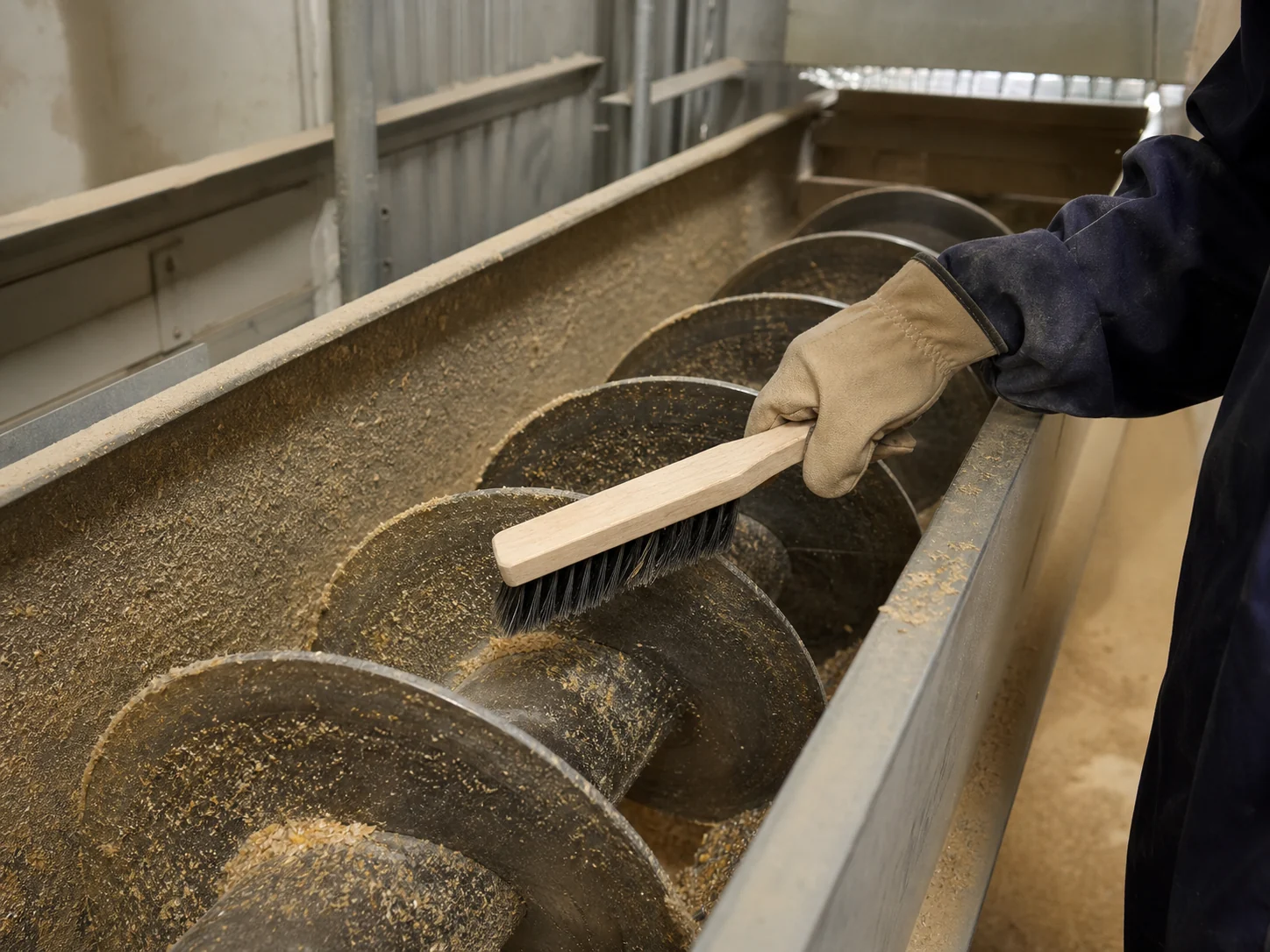
At a glance
- Cleaning target
- Grain Dust/Husk Debris/Broken Grain
- Working environment
- Dry Indoor Area / Hazardous Area
- Cleaning method
- Dry Brushing / Wet Brushing
- Requirements to check
- Food-Contact Material Requirements; Combustible-Dust Explosion Protection; HACCP
Grain residue in an elevator boot or silo hopper is an infestation risk and a dust-explosion risk at the same time, so cleaning targets the enclosed low points where it accumulates.
What makes Grain Conveying and Silo Cleaning different from other food and beverage cleaning?
The task is to remove Grain Dust/Husk Debris/Broken Grain while controlling surface damage, residue carryover, brush shedding and chemical or temperature degradation.
The work happens in dry indoor area and hazardous area against grain dust, husk debris and broken grain.
The part people get wrong: this is not one job. The same equipment carries several targets, each with a different opening and a different residue, and one brush rarely covers them all.
What are the most common cleaning targets in Grain Conveying and Silo Cleaning?
There are 5 distinct targets here, and the brush that suits one will usually not reach another.
| Part or area | Residue type | Cleaning requirement |
|---|---|---|
| Bucket-Elevator | Grain Dust, Husk Debris, Broken Grain | The head must reach the working face and apply even contact without marking the surface. |
| Auger and Screw-Conveyor | The brush must span the working width and hold even contact along the whole face while the surface moves under it. | |
| Silo Wall and Hopper | The head must enter the cavity and work its inner faces, with a handle long enough to keep the operator clear. | |
| Pneumatic-Line | The brush must pass the full length of the passage and hold contact with the wall without folding over at the far end. | |
| Grain Dust and Residue Removal | Dust, powder and compacted fines | The head must reach the working face and apply even contact without marking the surface. |
What the equipment leaves you to work inside:
| Parameter | Typical range |
|---|---|
| Contaminant | Grain Dust/Husk Debris/Broken Grain |
| Required hardness | Medium |
| Maximum temperature | 80°C |
| Chemical exposure | No Added Medium or Neutral Detergent |
| Cleaning method | Dry Brushing/Wet Brushing |
| Environment | Dry Indoor Area/Hazardous Area |
Which brush types work for each cleaning target?
Select hand, tube, strip, roller, disc or machine-mounted geometry from access and motion.
| Cleaning target | Recommended brush type | Why it fits |
|---|---|---|
| Bucket-Elevator | Handheld Detail Brushes | Buckets and the boot hold residual grain that spoils and seeds infestation, so a hand-guided head is used to clear each bucket and the boot corner. |
| Auger and Screw-Conveyor | Roller and Conveyor Brushes | A screw flight is a continuous helix running at a fixed clearance, so a brush on the shaft line wipes the flight and the trough as it turns. |
| Silo Wall and Hopper | Handheld Detail Brushes | A silo is entered from above and worked at reach, so a head on an extended handle contacts the wall and the hopper cone from outside the flow path. |
| Pneumatic-Line | Tube & Pipe Bore Brushes | Conveying line builds a dust layer on its inside wall, so a hand brush pushed through the accessible sections is what puts contact on that wall. |
| Grain Dust and Residue Removal | Handheld Detail Brushes | Grain dust is both an explosion and an infestation risk, so it is swept off surfaces by hand where a blower would only put it back into the air. |
Mostly hand brushes on extension poles into the silo and the elevator boot; the one driven brush sits on the belt return, where build-up is continuous.
In practical brush terms: match the construction to the access before anything else. A geometry that cannot reach the target will not be rescued by a better filament.
What filament materials work best for Grain Conveying and Silo Cleaning?
Nylon or PP for the dry sweeping fill, and 316 stainless anywhere a wire section is unavoidable — in a combustible-dust area the metal choice is a spark question before it is a wear question.
| If the condition is… | Filament to start with | Why |
|---|---|---|
| Dry sweeping of grain dust and husk | Nylon PA | recovers its bend on every pass across a screw or belt |
| Washdown of the same equipment | Polypropylene PP | takes up no water, so it does not cake between cleans |
| Any wire section inside a dust zone | Stainless Steel 316 Wire | chosen for spark behaviour before wear |
What the duty rules out before you start comparing grades:
| Constraint | Value for this application |
|---|---|
| Filament hardness | Medium |
| Maximum service temperature | 80°C |
| Chemical exposure | No Added Medium or Neutral Detergent |
| Cleaning method | Dry Brushing, Wet Brushing |
How do I choose the right brush for my grain conveying and silo equipment?
Start with medium fill, an 80°C ceiling and no medium or a neutral detergent, then let the zone classification decide whether dry brushing is permitted.
The order that avoids rework:
- Identify the target part and measure the access opening or clearance
- Describe the residue: what it is, how thick it sits, and how strongly it holds
- Choose the construction that can physically reach that target
- Set the filament from surface risk, working temperature and cleaning chemistry
- Fix filament diameter, free trim length and density for the contact pressure you need
- Run one cycle and check the result before committing to a production quantity
Before you commit to a quantity, send the equipment dimensions, the zone classification, and the access route into the enclosed space.
When is a grain conveying and silo brush the wrong tool?
Aspiration and vacuum systems remove grain dust safely and capture it, which brushing does not. In an explosive-atmosphere zone, dry brushing without bonding and grounding is an ignition risk, and confined-space rules govern silo entry before any tool is chosen.
What common mistakes should I avoid in Grain Conveying and Silo Cleaning?
- Naming the equipment without the zone classification, which governs whether dry brushing is permitted
- Changing the filament while leaving excessive engagement, poor alignment or no discharge path unchanged
- Copying a worn brush without first recording its motion, direction, mounting and original working diameter
If the brush is already in service and the result is wrong, work from the symptom:
| Symptom | What to change |
|---|---|
| Residue remains | Increase discharge or relative motion before adding pressure |
| Surface marks | Reduce engagement and use finer/softer fill |
| Rapid wear | Check alignment, temperature and chemical attack |
| Redeposition | Add wash, vacuum or collection path |
Questions this page is asked
How can brushing be used without dispersing grain dust into the air?
Use the facility's dust-hazard housekeeping method, capture material at the point of release and work in small controlled areas instead of vigorous dry sweeping. Do not use compressed air or any method that creates a visible dust cloud unless a documented and compliant procedure specifically controls ignition sources and dispersion.
What determines whether a powered brush or vacuum may be used around grain dust?
The facility dust-hazard analysis and electrical area classification must authorize the complete equipment for the location and dust, including its motor, controls, hoses, grounding and collection system. A conductive brush component does not by itself make an ordinary powered cleaner acceptable in a hazardous area.
When does silo brushing become a grain-entry task rather than external housekeeping?
Treat any need to enter or place a worker where engulfment, mechanical motion, bridging grain or atmospheric hazards can reach them as controlled grain-entry work. Isolate filling and discharge equipment, follow the applicable permit, attendant and rescue provisions, and use remote external methods whenever the risk assessment allows.
Guides that go deeper on this
We have not written a guide specific to this one yet. The material that covers selection, filament, dimensions, maintenance and sourcing is collected in the technical resources library.
No catalogue item for this yet
Every brush here is made to order, and this one has no catalogue entry so far. Send the working surface, the residue, the access opening and the quantity, and it is quoted through the same specification route as the rest of the range.
Custom Manufacturing RFQ
Discuss This Application
Share the working surface, residue, dimensions, material direction, interface, quantity and drawing or sample photo.
Custom Brush RFQ
Request a Custom Cleaning Brush Quote
Upload a drawing, product photo, or sample photo and provide the core dimensions and cleaning conditions.
“We need a brush to remove wet residue from a stainless steel conveyor, about 800mm wide. The current brush wears quickly. We can send photos.”
“We sell drinkware and need a cleaning brush to include with the product. Quantity around 5,000 pieces.”