
Custom Cleaning Brush
Silo Dust Removal Brush
Anti-static nylon PA silo dust removal brush for feed chutes, dosing wheels, hoppers, screens and rails. Custom lengths, trim, backing and resistivity.
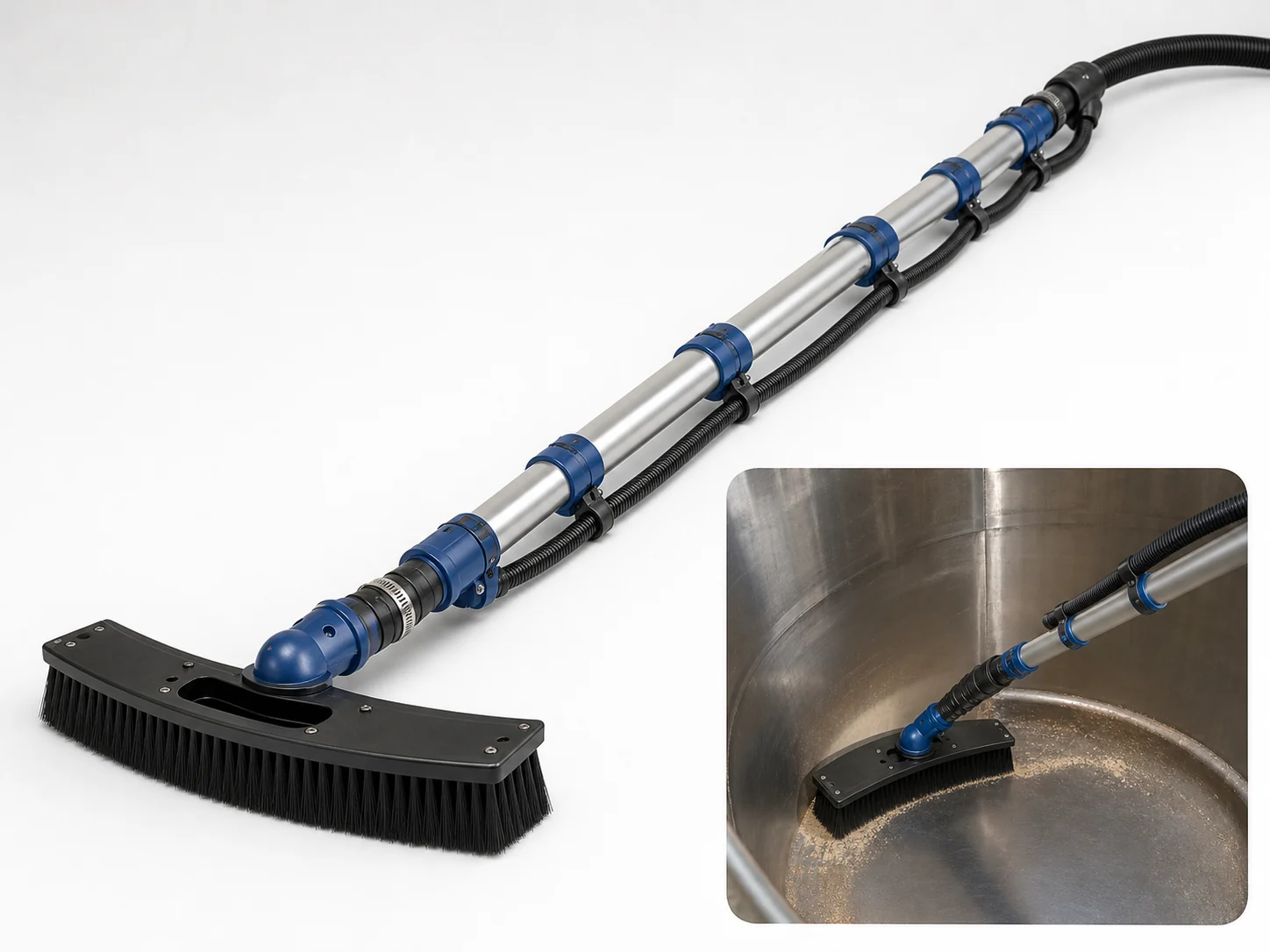
Medium brush
100 pcs
Minimum order
Worked with two hands or on a pole: chimney, gutter and pond-filter brushes, discs, cups and tank brushes.
Production lead time, once the specification is confirmed
- Up to 100 pcsWithin 7 days
- 101–5,000 pcsWithin 14 days
- 5,001–50,000 pcsWithin 21 days
- Over 50,000 pcsConfirmed with your quotation
Peak season can extend these times; the shipping date is confirmed in writing with your quotation. Sampling and shipping are quoted separately.
A mounted anti-static nylon PA strip brush that wipes fine powder, dust cake, fibers, and product carryover from feed chutes, dosing wheels, hopper edges, screen frames, and linear rails inside bulk solids handling equipment. The strip length, backing material, filament diameter, trim length, and static-dissipative fill are all configurable to fit existing mounts, contact clearances, and dust-control requirements.
What can this brush do for you?
Removes dust before it becomes a blockage
The filament tips contact rail faces, gate edges, and rotating parts while they move, lifting fine powder and fibers before the material compresses into a hard layer. On feed chutes and hopper lips, that early removal prevents the buildup that eventually narrows the opening and causes bridging or flow interruptions.
Reduces product carryover that clogs dosing wheels and airlocks
On rotary dosing wheels and airlock end plates, the brush wipes the clearances where powder packs between the rotor and housing. Fewer packed deposits mean less stalling, less torque variation, and less air leakage past the rotor.
Drains static charge so removed dust does not re-settle on the same surface
The nylon PA fill is available as a static-dissipative or conductive grade with a surface resistivity between 10³ and 10⁹ Ω. When the backing or mounting rail is grounded, the filament path gives the charge a controlled discharge route. Dust that the brush lifts is less likely to be re-attracted to the same area after the sweep.
Follows curved rails and uneven contact lines
The flexible backing and the option of segmented lengths allow the strip to conform to curved hopper edges, dosing wheel profiles, and rail corners. Trim length can be graduated along the strip so filament contact stays even where the surface height changes.
Fits existing channels for fast removal and refit
Aluminum, stainless steel, polypropylene, and wood backings can be punched, slotted, or clipped to match the equipment’s current mounting points. When a section wears, the operator can replace only the affected segment instead of rebuilding the entire dust-control line.
What is a Silo Dust Removal Brush?
A Silo Dust Removal Brush is a mounted strip brush, not a hand brush. It is built as a continuous or segmented strip in which nylon PA filaments are held by a formed metal or polymer backing. The brush is fixed to a stationary or moving element inside powder handling equipment — a feed chute wall, a dosing wheel support, a hopper gate edge, a screen frame rail, or an enclosure gap — so the filaments sweep the adjacent surface every cycle or every product movement.
Its cleaning job is mechanical and continuous: filament tips carry away loose fine powder, product carryover, dust cake, fibers, and static deposits before they can compact. The anti-static nylon PA fill adds an electrostatic control function. Instead of allowing powdery residue to cling to the filaments and the contact surface, the dissipative fill provides a defined resistance path from the filament tip to a grounded mounting rail, so the brush stays cleaner during use and the swept surface stays cleaner after the pass.
In most installations the brush also works as a compliant dust seal. Along rails, door edges, and enclosure gaps, the filament line fills the clearance that would otherwise let dust escape or allow airborne fibers to enter. The same strip can therefore function as both a cleaning edge and a containment edge in one component.
Operating conditions matter. The backing must be mechanically grounded for the static-dissipative fill to function. Filament contact should be checked after installation so the tips touch the target surface but are not bent over. Environments with heavy water spray, strong solvents, sticky residues, or continuous temperatures above 100 °C need separate evaluation because nylon PA is not the right fill for every process.
Technical Specifications
| Parameter | Standard range / options |
|---|---|
| Filament material | Anti-static / static-dissipative nylon PA (PA6 or PA6.6); conductive additive for target resistivity |
| Filament diameter | 0.10–0.50 mm, selected for powder fineness and required contact pressure |
| Trim length (projection from holder) | 10–100 mm |
| Brush face height / head width | 30–400 mm, depending on contact area and mounting height |
| Backing / holder material | Aluminum, 304/316 stainless steel, polypropylene (PP), or wood for light-duty interior use |
| Strip length | 500–3,000 mm standard; longer runs assembled from connected sections |
| Surface resistivity of fill | 10³–10⁹ Ω, conductive or antistatic grade per process requirement |
| Operating temperature | −20 to +100 °C continuous |
| Mounting interface | Bolt-on channel with punched holes, clip-in channel, or customer-specified slot / screw pattern |
| Typical residue | Fine powder, granules, fibers, dust cake, static deposits, product carryover |
| Brush type | Custom Strip Seal Brushes |
| How it is driven | Fixed in place, no drive of its own |
| Cleaning target | feed chute and transfer point, dosing wheel and rotary airlock, and hopper and discharge gate cleaning |
| Surface or part | rails, edges, hoppers, dosing wheels, feed chutes, screens, frames, and gaps |
| Residue or debris | dust, powder, product carryover, fiber, fine powder, dust cake, air leakage, and fines |
| Mounting / connection | Bolt-on channel with punched holes, clip-in channel, or customer-specified slot / screw pattern |
Trim length, filament diameter, and backing height are the three dimensions that determine whether the brush contacts the surface with the right pressure. Send the available mounting channel dimensions or a photo of the existing strip and the exact production profile will be confirmed before manufacturing.
Where does this brush work best?
- Feed chutes and transfer points: side rails and gate edges where product carryover collects before it bridges or clogs the opening.
- Dosing wheels and rotary airlocks: rotor vane tips and end plates where product packs into clearance gaps; the brush strips accumulations that cause jamming and air leakage.
- Hoppers and discharge gates: gate faces, slide rails, and hopper lip edges where dust settles during cycling.
- Screens and sifters: edges of screen frames, tension rails, and inspection covers where fines collect without interfering with the mesh openings.
- Rails, guides, and enclosure gaps: linear rails and door seals where dust escapes or causes sticking, and where a compliant edge reduces open gaps.
- Filter and dust collector housings: seal tracks and non-critical housing surfaces near bag or cartridge inlets where static dust accumulates. The brush is not intended to scrub filter media itself.
How do I choose the right one?
Four decisions define a working silo dust removal brush: where it mounts, how it contacts, whether it must dissipate static, and what the process environment does to the materials. Work through them in that order.
1. Confirm the mounting geometry first
Measure the available mounting slot or rail width, channel height, overall length, hole spacing, and whether the path is straight or curved. If an existing strip or brush is being replaced, send a drawing, sample, or photo. Curved runs and tight radii are usually handled with shorter connected sections rather than one long rigid backing.
2. Match filament diameter and trim length to the residue and surface
Fine dry powders and sensitive surfaces generally need finer filament, around 0.10–0.20 mm, with enough trim length to maintain contact over uneven spots. Granular material, fibers, and heavier dust cake call for coarser filament in the 0.30–0.50 mm range and a firmer, longer trim. If the filaments fold over permanently or lose contact with the surface, reduce the trim length or increase the filament diameter. If the brush scrapes or removes surface material, move to a finer filament or a softer contact configuration.
3. Choose static dissipation when powder sticks or drifts
If fine powder clings to vertical surfaces, migrates during transfer, or produces dust clouds after product flow stops, static charge is involved. Select the anti-static or conductive nylon PA fill and specify the required surface resistivity. For most powder-handling applications, a dissipative range around 10⁶–10⁹ Ω is sufficient; faster discharge systems where charge builds rapidly may need the 10³–10⁶ Ω range. The backing or rail must be grounded for any of these fills to work.
4. Select the backing material for the environment
Aluminum is lightweight, rigid, and provides easy grounding. Stainless steel is used where corrosion, washdown, or higher mechanical strength is needed. Polypropylene offers chemical resistance and a lighter non-metallic option, but grounding must be handled separately. Wood backings are limited to light-duty, dry, non-critical interior installations. The full assembly is rated for −20 to +100 °C continuous; if the process runs hotter or uses aggressive solvents or oils on the filaments, a different filament system should be evaluated.
5. Know what this brush will not do
This strip brush is a mechanical cleaning and sealing component. It does not replace dust extraction, venting, or process air filtration. It will not remove hardened, fused, baked-on, or chemically bound deposits. It is not the right tool for wet, sticky, or highly abrasive product films, and it is not designed for continuous service above 100 °C.
Can I customize this brush?
Every silo dust removal brush is built around the equipment’s actual mounting face, contact clearance, and powder behavior. To define a custom configuration, provide the mounting channel dimensions, overall length, curvature, existing hole pattern, contact surface material, residue type, operating temperature, washdown or chemical exposure, and whether static dissipation is required. A drawing, existing sample, or short video of the equipment makes the fit review faster and more reliable.
- Strip dimensions: length, section segmentation, backing height, brush face width, and end cut style.
- Backing / holder: aluminum, 304/316 stainless steel, polypropylene, or wood; U-channel, flat bar, angle, or formed profile; punched, slotted, or clip-in mounting.
- Filament fill: nylon PA grade, filament diameter, trim length, fill density, beveled or graduated trim, and static-resistive formulation.
- Color and marking: process identification colors, part-number markings, date coding, or line-position coding.
- Mounting interface: customer hole pattern, screw size, end connectors, joining plates, or pre-installed fasteners.
- Packaging: bulk, labeled bundles by segment or line position, export packing, or install-kit packaging.
If the project requires material declarations, inspection documentation, surface-resistivity verification, or third-party testing support, these requirements can be addressed during the customization process.
Which filament belongs on a silo dust removal brush, and how is that verified?
Does the brush have to be grounded for the anti-static fill to work?
Yes. Dissipative and conductive filaments only remove charge if the backing or mounting rail is connected to a reliable ground. Check continuity from the filament tips through the backing to the ground point, and verify the assembly with a surface resistivity meter where possible. Without a ground path, static can still accumulate.
Can a single strip follow a curved rail or wrap around a dosing wheel?
Yes, when the backing is flexible enough for the radius and the run is divided into appropriate sections. Tight radii are usually produced as separate formed segments with end connectors. Provide the radius or a template of the curve so the filament trim and backing stiffness can be matched to the path.
How do I know whether my powder is static-prone enough to need dissipative filament?
Look at the equipment during and after product flow. If fine powder clings to vertical surfaces, forms dust clouds after the flow stops, or migrates to non-flow areas, static is likely contributing. When in doubt, choose the anti-static nylon PA fill. It costs little compared with recurring manual cleaning and works safely when the rail is grounded.
What should be checked during routine maintenance?
Inspect the filament line at each scheduled shutdown. Look for permanent leaning or flattening, missing or broken tufts, product packed into the filament base, and loss of contact with the target surface. Also re-check the ground connection and surface resistivity if the brush operates in a static-sensitive area. Replace worn sections rather than the entire line where the backing is still sound.
Can this brush be used on food powder contact surfaces?
The brush can be configured with materials and documentation that support food-contact evaluation for the specific application, but suitability must be confirmed against the actual powder contact time, cleaning chemicals, and regulatory requirements. Share the full material-contact and cleaning details early so the correct filament, backing, and supporting documentation are selected.
When is a different dust-control method the better choice?
If the residue is hardened, baked-on, wet, or highly abrasive, mechanical brushing with nylon PA will wear quickly or fail to remove the layer. In those cases consider a metallic filament brush, scraper system, or dry pneumatic cleaning. If the dust problem is primarily airborne rather than surface buildup, focus on extraction, venting, and filtration before adding contact brushes.
Guides that go deeper on this
Conveyor Belt Cleaning Brush Design
Read this guideGuideConveyor Brush Pressure: Residue Removal Without Belt Damage
Read this guideGuideCustom Brush Sampling and Validation Plan
Read this guideGuideElectrode Powder Removal Brushes: Types and Selection
Read this guideGuideIndustrial Brush Wear Patterns and Corrective Actions
Read this guideCustom Manufacturing RFQ
Describe Your Application
To prepare the correct quotation, provide the dimensions, cleaning task, residue, material, mounting details, quantity, and a drawing or photo.
Drawing or photo optional — it speeds things up, it does not gate the enquiry.
Custom Brush RFQ
Send Your Brush Project
Upload a drawing, product photo, or sample photo and provide the core dimensions and cleaning conditions.
“We need a brush to remove wet residue from a stainless steel conveyor, about 800mm wide. The current brush wears quickly. We can send photos.”
“We sell drinkware and need a cleaning brush to include with the product. Quantity around 5,000 pieces.”