
Custom Cleaning Brush
Dust Removal Lithium Battery Brush
Dry-contact brush for lithium battery electrode manufacturing. Removes powder, metal fines, and coating particles from foil and cell parts.
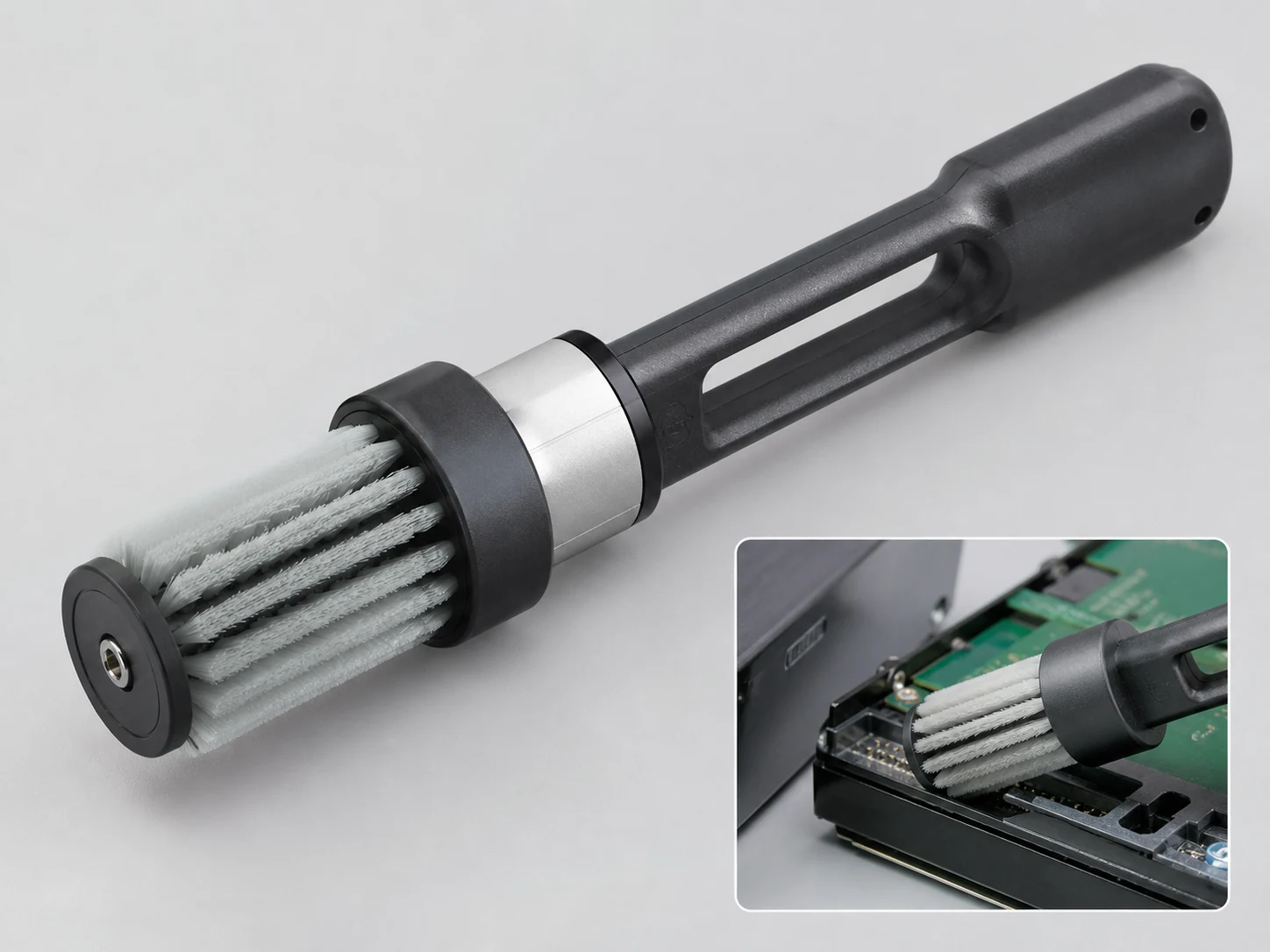
Large-format brush
100 pcs
Minimum order
Built one at a time on a core or channel: full-width rollers, sweeper brooms and long strip.
Production lead time, once the specification is confirmed
- Up to 100 pcsWithin 20 days
- 101–1,000 pcsWithin 30 days
- Over 1,000 pcsConfirmed with your quotation
Peak season can extend these times; the shipping date is confirmed in writing with your quotation. Sampling and shipping are quoted separately.
A dry-contact cleaning brush for lithium battery electrode manufacturing that removes loose electrode powder, metal fines, and coating particles from coated foil webs and particle-critical cell surfaces. Available as a roller, strip, or hand tool, it is built from soft nylon or conductive nylon filament to clean without damaging the active coating or introducing new contamination.
What can this brush do for you?
Remove loose particles before they become cell defects
Loose electrode powder, slitter fines, and coating debris left on the foil can become inclusions that cause short circuits, coating voids, or electrode defects later. The brush sweeps the moving foil or part with thousands of fine nylon filament tips, lifting particles into the extraction airflow rather than pressing them into the coating.
Clean without scratching or thinning the electrode coating
Soft nylon filament tips contact the coated surface with controlled pressure. Because the fill is non-abrasive and selected to our trim length and density specifications, the brush removes loose debris while preserving the coating thickness and surface roughness required for downstream calendering, slitting, and winding.
Hold static charge in check on ESD-sensitive lines
For dry-room and static-sensitive operations, the brush can be filled with conductive nylon and grounded through the machine holder. This drains static from the filament tips as they contact the web, so particles are less likely to re-adhere and there is no spark risk near flammable electrolyte later in the process.
Match the line exactly, not approximately
Working width, outer diameter, core/holder interface, and clearance are built to the production line drawing. The brush fits existing mounting points, covers the full web width without dead zones, and rotates or oscillates exactly as the station requires.
Protect cleanroom particle budgets with low-shed construction
In battery dry rooms, every particle counts. The filament is anchored so the brush removes more particles than it adds. Regular wear produces short filament fragments that are captured by the extraction system; the brush is not a source of continuous fiber contamination.
What is a Dust Removal Lithium Battery Brush?
A Dust Removal Lithium Battery Brush is a dry-contact cleaning tool used during electrode manufacturing and cell assembly to remove loose particles from coated foil, tab surfaces, separator zones, and process tooling. It works by physical sweeping action, not by vacuum, blowing, or washing. The brush is usually installed as part of a cleaning station that pairs it with vacuum extraction and sometimes ionization.
The brush may take one of three forms depending on the production station. A motor-driven roller brush rotates against the moving electrode foil for continuous web cleaning. A fixed strip brush is mounted across the web path for a controlled wipe at a specific location. A hand or detail brush is used for manual cleaning of fixtures, jigs, trays, and cell components in assembly areas.
The fill is typically soft nylon PA because it provides dry particle removal without damaging the active material coating. Conductive nylon or PBT options are available where static control or higher mechanical resistance is required. The brush is designed for dry processes only; it does not introduce solvents, moisture, or other liquids onto the electrode surface.
Technical Specifications
| Parameter | Value / Options |
|---|---|
| Product form | Roller brush, strip brush, or hand/detail brush per production station |
| Working width | Custom, matched to line or part width |
| Brush OD / head size | Custom per line drawing and available clearance |
| Core / holder | Grounded metal core, static-dissipative hub, or custom holder per mounting |
| Filament material | Soft nylon PA6/PA66 (standard); PBT for higher wear resistance; conductive nylon for ESD control |
| Filament diameter | 0.10–0.30 mm, selected for particle size and contact pressure |
| Filament density / trim length | Custom, soldered or epoxied fill as appropriate |
| ESD resistance (conductive option) | 10⁶–10⁹ Ω surface resistance, grounded through machine holder |
| Operating temperature | Typically -20°C to 80°C in dry process environments |
| Contact pressure / penetration | Controlled by mounting gap and web tension; set during commissioning |
| Rotation / oscillation | Matched to existing drive; roller brushes can run with or against web direction |
| Brush type | Custom Strip Seal Brushes |
| How it is driven | Supplied hand-guided or machine-mounted |
| Cleaning target | electrode slitting or notching, coating line, and winding and stacking station cleaning |
| Surface or part | webs, roller, metal, fixtures, tooling, tabs, trays, and edges |
| Residue or debris | particles, fines, dust, powder, adhesive, slurry, and loose particles |
| Mounting / connection | Matched to existing drive; roller brushes can run with or against web direction |
All critical dimensions follow the line drawing. We confirm outer diameter, core, and clearance against the actual machine before build.
Where does this brush work best?
- After electrode slitting or notching: removes copper and aluminum sliver fines that remain on foil edges and surfaces.
- On coating lines after drying and before calendering: sweeps away loose coating particles, agglomerates, and edge dust from the moving electrode foil.
- On winding and stacking stations: cleans electrode roll surfaces, separator zones, and contact tooling before cell assembly.
- In dry rooms and assembly fixtures: hand/detail brushes wipe down fixtures, jigs, trays, and cell components that must stay particle-free.
- On tab welding or punching areas: removes metal debris from tab surfaces and surrounding electrode material before welding.
This brush is not intended for liquid residue, wet slurry, adhesive transfer, or heavy baked-on deposits. Those conditions require a different cleaning process.
How do I choose the right one?
Choose the brush form by station type
Use a roller brush for continuous web cleaning with rotation. Use a strip brush for fixed-width contact across a moving sheet. Use a hand or detail brush for localized manual cleaning of parts, fixtures, or tooling.
Set the working width, OD, and mount first
Provide the line drawing, web width, available space, shaft diameter, and drive method. Without this, you risk a brush that does not cover the full foil width or interferes with adjacent rollers.
Select filament material for your particles and ESD sensitivity
Soft nylon PA is the standard choice for general dry dust, metal fines, and coating particles. Conductive nylon is required when the line is ESD-sensitive or when static re-attraction reduces cleaning efficiency. PBT offers slightly higher mechanical resistance but must still be verified against coating damage. Avoid abrasive or metal fill unless the process has been specifically qualified, because those filaments can damage coating and shed conductive debris.
Match filament diameter and density to particle size and coating
Fine filaments (0.10–0.15 mm) with high density lift fine powder with less contact pressure, protecting thin coatings. Larger filaments (0.20–0.30 mm) with lower density provide more mechanical removal for larger flakes but require verification of coating adhesion.
Consider process conditions, not just geometry
Web speed, tension, temperature, cleaning direction, and available extraction all affect performance. Excessive penetration or speed can dislodge weakly adhered coating, while insufficient contact leaves particles behind. Commissioning should include a particle-count check before full production.
When to use a different cleaning method
If the residue is liquid, oily, adhesive, or chemically bonded, this dry brush is not appropriate—use solvent cleaning, ultrasonic cleaning, or a wet process. If particles are strongly adhered or fused to the foil, a stiffer brush or qualified mechanical scraping step may be needed. If static re-adhesion is severe even with conductive fill, pair the brush with an ionization bar rather than expecting the brush alone to solve the problem.
Can I customize this brush?
The brush is configurable because every electrode line and assembly station is different. We can adjust:
- Brush form: roller, strip, hand/detail, or multi-section assembly.
- Working width: any width matched to line or part dimensions.
- Outer diameter and core/holder interface: shaft bore, bearing journals, flanges, and mounting keyways.
- Filament material: nylon PA6, PA66, PBT, conductive nylon, or custom blends as required.
- Filament diameter, density, trim length, and pattern: straight, spiral, segmented, or edge-banded fill.
- Grounding: conductive core and grounding path through the holder for ESD-safe operation.
- Color, marking, and identification: custom filament color, core marking, laser engraving, or packaging labels.
- Packaging: bulk, individually sleeved, cleanroom-bagged, or kitted per line station.
To define the custom configuration, provide the production line drawing or mounting dimensions, web or part width, particle type and size range, web speed and tension, ESD requirements, operating temperature, and the number of stations. We can also support project-specific documentation, material declarations, inspection, or third-party testing as part of the customization process.
Which filament lasts longest on a dust removal lithium battery brush?
How do we verify that the brush removes enough particles without damaging the electrode coating?
Run a trial at the intended speed and penetration. Measure particle counts before and after the cleaning station using a particle counter or optical inspection. Then check coating thickness and adhesion at the cleaning location. If particle counts drop but coating thins or delaminates, reduce penetration or switch to a finer, softer filament.
Will the brush itself shed filaments into the electrode?
A correctly specified brush with proper filament anchoring and appropriate trim should not shed under normal operating conditions. However, all brushes wear over time. Inspect filament tips weekly for splitting or breakage and replace the brush before visible filament loss begins. Never run a brush with damaged or crushed fill.
How often does the brush need to be replaced?
Replacement depends on line speed, particle load, filament material, and penetration. A practical indicator is a visible reduction in filament density or uneven contact across the width, or a measurable drop in particle removal efficiency. Establish a scheduled replacement interval based on your own cleaning performance data rather than waiting for mechanical failure.
Can this brush be used on wet electrode surfaces or with solvents?
No. This is a dry-contact cleaning brush. Moisture or solvent can swell nylon filaments, reduce cleaning performance, transfer liquid onto the electrode, and create additional drying requirements. For wet or solvent-based cleaning, a different process and brush material are required.
What is the difference between the standard and conductive nylon fill?
Standard nylon provides good dry particle removal but can build up static charge, which may cause particles to re-adhere or create discharge risks. Conductive nylon has a controlled surface resistance of 10⁶–10⁹ Ω and, when grounded through the holder, drains static as the brush contacts the web. Use the conductive option when your line is ESD-sensitive or when static re-adhesion is demonstrably reducing cleaning efficiency.
Do we still need a vacuum extraction system if we use this brush?
Yes. The brush lifts and moves particles into the airflow, but it does not contain them. Vacuum extraction positioned near the contact point is necessary to remove loosened debris from the machine. Without extraction, the brush simply redistributes particles along the web instead of eliminating them.
Guides that go deeper on this
Which Dust Removal Brushes Keep Battery Lines Particle-Free?
Read this guideGuideBattery Separator Brushes: Cleaning and Static Elimination
Read this guideGuideConveyor Belt Cleaning Brush Design
Read this guideGuideConveyor Brush Pressure: Residue Removal Without Belt Damage
Read this guideGuideCustom Brush Sampling and Validation Plan
Read this guideCustom Manufacturing RFQ
Describe Your Application
To quote this brush accurately, send the size, material, cleaning target, residue, quantity, and any available drawing or sample photo.
Drawing or photo optional — it speeds things up, it does not gate the enquiry.
Custom Brush RFQ
Send Your Brush Project
Upload a drawing, product photo, or sample photo and provide the core dimensions and cleaning conditions.
“We need a brush to remove wet residue from a stainless steel conveyor, about 800mm wide. The current brush wears quickly. We can send photos.”
“We sell drinkware and need a cleaning brush to include with the product. Quantity around 5,000 pieces.”