
Custom Cleaning Brush
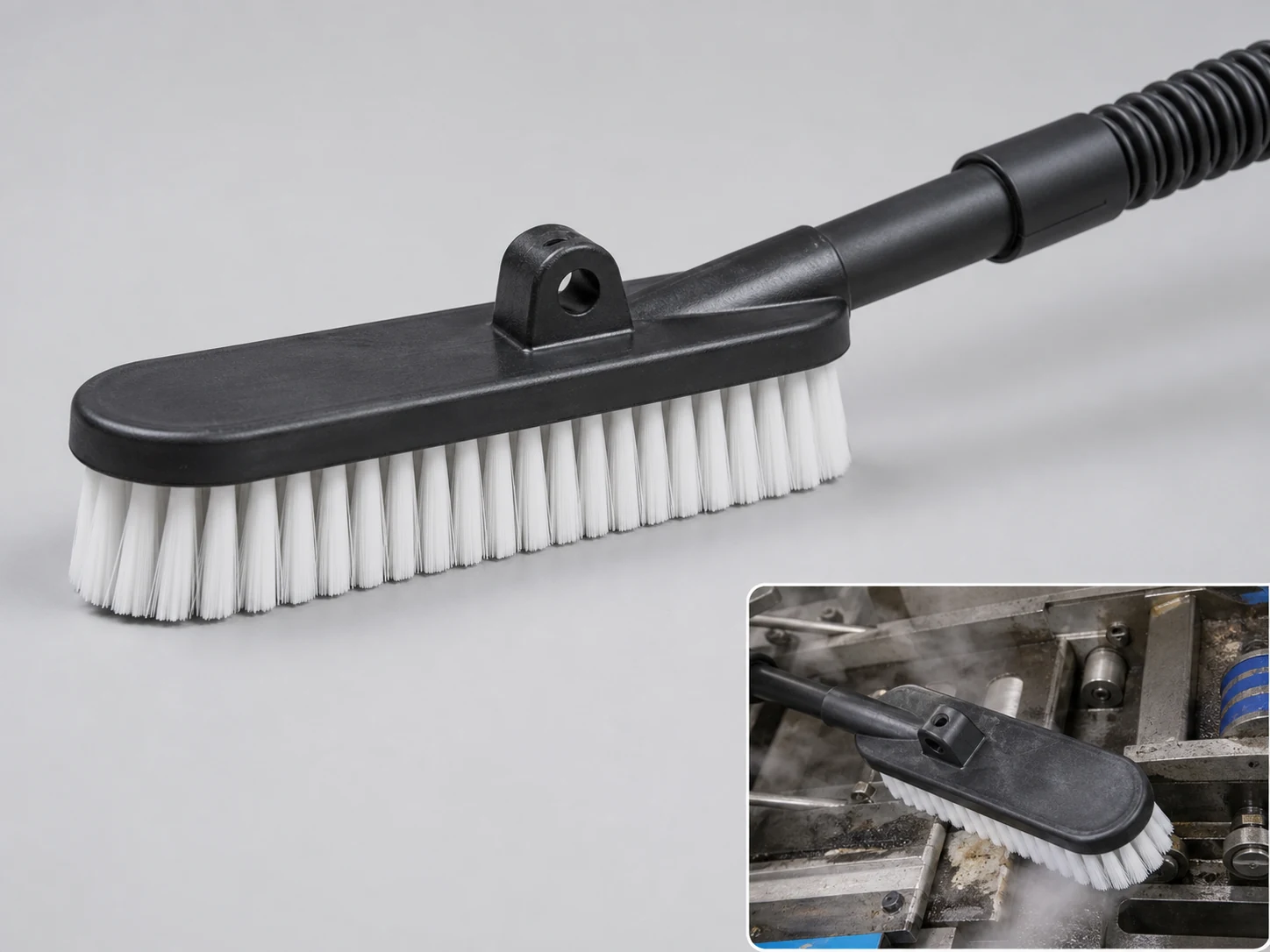
Steam Cleaner Brush
Heat-resistant steam cleaner brush with Nylon PA, PBT, or brass wire fill. Fits bayonet, thread, or push-fit steam cleaner connections.
Small brush
500 pcs
Minimum order
Held in one hand: tube, bottle, detail and swab brushes — including long-handled ones with a small head.
Production lead time, once the specification is confirmed
- Up to 500 pcsWithin 7 days
- 501–50,000 pcsWithin 14 days
- Over 50,000 pcsWithin 21 days
Peak season can extend these times; the shipping date is confirmed in writing with your quotation. Sampling and shipping are quoted separately.
A heat-resistant scrub brush that mounts onto steam cleaner wands, floor heads, and handheld nozzles to agitate and lift grease, soap film, scale, and baked-on residue while steam softens it. Designed for OEM fit or replacement use across residential and commercial steam cleaning equipment.
What can this brush do for you?
Steam softens, bristles remove
Steam alone loosens many deposits but leaves them on the surface. This brush adds the mechanical action needed to break the bond and lift the residue into the steam flow. Nylon PA and PBT bristles are rated for continuous exposure up to 120°C, so they hold their stiffness and shape while hot, wet steam is applied directly to the work area.
Reaches grout lines and uneven surfaces
Flat mop pads glide over grout joints, textured tile, corners, and recessed areas. Bristles conform into those gaps and scrub the full contact area. A longer trim length follows deep grout lines; a shorter trim provides firmer pressure on flat surfaces. The brush works through the same hand motion as the steam cleaner, so the operator keeps control while the bristles do the reaching.
Locks onto your existing steam cleaner connection
The connector is machined or molded to match the steam cleaner’s nozzle mount, not to a generic adapter. Bayonet, screw thread, and push-fit interfaces are available, with connector diameters from 12 mm to 35 mm. The brush seats securely and does not rotate or pop off under steam pressure or scrubbing force.
Wire fill for deposits plastic bristles can’t break
Baked-on carbon, mineral scale, and rust often resist nylon and PBT. Brass wire fill provides a harder cutting edge that scrapes those deposits off metal surfaces without the sparking risk of steel wire. For appliance interiors, stainless housings, and tool frames, this is the step up from plastic bristles when heavy residue is the problem.
Serviceable design keeps your steam cleaner working longer
A replaceable brush head means you change only the worn component, not the entire steam cleaning head or wand. OEMs and service providers can stock a single brush that fits their machine line, simplifying spare parts and reducing the cost of keeping equipment in service.
What is a Steam Cleaner Brush?
A steam cleaner brush is a bristled attachment that mounts directly onto the steam outlet of a steam mop, handheld steamer, canister machine, or commercial steam cleaning tool. The brush head is typically round or cup-shaped, with bristles arranged around the perimeter or across the face, and a central connector that locks onto the steam wand or floor nozzle.
In use, the operator directs steam onto the soiled surface, then scrubs the same area with the brush. The steam lowers the deposit’s adhesion and viscosity while the bristles mechanically separate it from the surface. Some configurations allow steam to pass through a central port directly into the bristle field; others let steam exit around the brush. Both designs work, but the choice depends on how the steam cleaner delivers output and where the user needs the steam to go.
The brush is hand-guided; it has no motor of its own. That makes the bristle material, trim length, stiffness, and connector geometry the primary performance variables. Because the brush lives in a hot, wet environment, every component—bristles, backing, ferrule, and connector—must withstand repeated thermal cycling and moisture exposure without softening, warping, or loosening.
Technical Specifications
Values shown are common project ranges. We match the exact machine interface, cleaning surface, and application during the sampling phase.
| Parameter | Value / Options |
|---|---|
| Head diameter | 20–100 mm, selected for coverage and access |
| Trim length (bristle length) | 10–35 mm; longer trim for deep grout and recesses, shorter trim for firmer scrubbing |
| Connector diameter | 12–35 mm, matched to the steam cleaner nozzle or mount |
| Connector interface | Bayonet, screw thread, push-fit, or custom OEM geometry |
| Overall length | 40–180 mm, measured from connector base to bristle face |
| Fill material | Nylon PA (general purpose), PBT (stiffer, hydrolysis-resistant), Brass Wire (heavy deposits on metal) |
| Bristle diameter | 0.10–0.50 mm, depending on stiffness and fill material |
| Backing / ferrule material | Heat-resistant PP, nylon, stainless steel, or project-specific polymer |
| Operating temperature | Up to 120°C continuous steam exposure |
| Steam compatibility | Suitable for wet or dry steam; bristles do not absorb water |
| Optional features | Color coding, center steam port, angled head, embedded abrasive, custom bristle pattern |
| Brush type | Custom Handheld Detail Brushes |
| How it is driven | Machine-driven, mounted in the equipment |
| Cleaning target | tile and grout floor, oven interior and cooktop, and bathroom fixture and shower corner cleaning |
| Surface or part | floors, nozzles, connectors, housings, metal, corners, pads, and tile |
| Residue or debris | scale, grease, soap film, mineral scale, carbonized residue, embedded dirt, process residue, and soap scum |
| Mounting / connection | 12–35 mm, matched to the steam cleaner nozzle or mount; Bayonet, screw thread, push-fit, or custom OEM geometry |
Where does this brush work best?
- Tile and grout floors on steam mops – The brush scrubs the grout joints that flat pads skip, lifting soap film, scuff marks, and embedded dirt from high-traffic areas.
- Oven interiors and cooktops with handheld steamers – Baked-on grease and carbonized residue soften under steam, then the brush completes the removal from metal racks, enamel interiors, and burner surrounds.
- Bathroom fixtures and shower corners – Soap scum and mineral scale accumulate where walls meet trays and around faucet bases. A nylon or PBT fill works well here; brass wire is used only on uncoated metal parts.
- Commercial kitchen equipment and food production line exteriors – Degrease stainless housings, door seals, vent covers, and splash zones without dismantling the equipment. PBT or brass wire handles the heavy buildup.
- Automotive detailing with steam machines – Engine bay components, wheel wells, and trim respond well to steam plus scrubbing. The brush reaches areas a microfiber cloth cannot conform to.
- Industrial steam cleaning attachments for recessed housings and machine frames – Dust, oxide, and process residue collect in flanges and cavities. A small-diameter brush cleans where larger heads cannot enter.
How do I choose the right one?
Start with the connector and interface
Measure the connector diameter on your steam cleaner—outer diameter for a push-fit, thread pitch and major diameter for a screw connection, and lug dimensions for a bayonet mount. If you have the original brush or nozzle, send a photo or sample. The brush must seat firmly without forcing and stay locked during lateral scrubbing.
Match bristle material to the surface and residue
Nylon PA is the general-purpose choice for tile, plastic, coated surfaces, and everyday grease and soap film. PBT is stiffer and holds its shape better in hot, wet conditions, making it suitable for grout, textured surfaces, and moderate deposits. Brass wire is reserved for heavy grease, scale, rust, and carbon on metal surfaces only—it will scratch enamel, glass, soft stone, plastic, and painted finishes.
Set trim length based on crevice depth and contact pressure
Longer trim (25–35 mm) reaches into deep grout lines and recesses but flexes more, so it applies less direct pressure. Shorter trim (10–15 mm) is stiffer and concentrates force on flat areas. If you need both deep reach and firm contact, a combination density pattern or a customized trim profile can be developed.
Choose head diameter for coverage versus access
A larger head cleans open floor areas faster, but too large a head on a handheld steamer reduces maneuverability and can block the steam path around corners. A smaller head concentrates pressure and fits oven interiors, appliance crevices, and narrow machine housings.
Confirm the steam environment
All bristle options are specified to 120°C, but direct contact with the steam generator body or prolonged dry heating above that limit will shorten life. Note the machine model, steam output, and typical working distance between the brush and the heating element when ordering.
When to use a different tool
If the surface only needs light dusting or wiping, a brush adds unnecessary abrasion. If the deposit is extremely thick industrial scale or cured epoxy, a motor-driven scrubber or chemical pre-treatment may be more efficient. And if the surface is scratch-sensitive with no tolerance for bristle marks, a steam-only nozzle or a microfiber pad is the safer option.
Can I customize this brush?
Most steam cleaner brushes are project-specific because connectors, head geometry, and bristle requirements vary by machine and application. We work from your measurements, a sample brush, or a drawing.
- Connector geometry – Thread pitch, bayonet lug shape and position, push-fit diameter, or a fully custom OEM profile.
- Head shape – Round cup, flat face, cylindrical, tapered, angled, or a multi-diameter form for combined cleaning zones.
- Bristle configuration – Material (Nylon PA, PBT, Brass Wire, or blends), diameter, density, trim length, crimped or straight filament, flagged tips.
- Backing and ferrule – Heat-resistant polymer or stainless steel, colored for zone identification or matching your equipment brand.
- Marking and packaging – Custom colors, pad-printed or laser-marked logos, bulk packing, individual bags, or retail-ready packaging.
If your project requires material documentation, project-specific certification support, inspection reports, or third-party testing, we can assist with those requirements during the customization process.
Which filament survives the cleaning and still lasts on a steam cleaner brush?
How do I verify this brush fits my steam cleaner before ordering?
Measure the connector outside diameter and note whether it is a bayonet, screw thread, or push-fit. If possible, send a photo or sample of the original brush connector or nozzle. We match the geometry and diameter to your machine, not to a generic fitting.
Can I use brass wire bristles on enamel, glass, or plastic surfaces?
No. Brass wire is intended for metal surfaces with heavy deposits. It will scratch or dull enamel, glass, soft stone, plastic, and painted finishes. Use Nylon PA or PBT for those materials.
Will steam melt or weaken the brush over time?
Bristle materials are rated for continuous exposure up to 120°C, but direct contact with the steam generator’s heating element or repeated dry heating above that limit can degrade the plastic. Use the brush in the steam path as intended, not pressed against the hot body of the machine.
How should I clean and store the steam cleaner brush after use?
Rinse the bristles with hot water to remove loosened residue, shake out excess water, and air-dry. Do not leave the brush attached to a hot steam nozzle, and avoid soaking it in aggressive solvents that may attack the bristle or backing material.
How do I know when to replace the brush?
Replace it when bristles become flattened, melted, or break off, when the connector loosens and no longer locks firmly, or when scrubbing performance drops noticeably. Worn bristles bend away from the surface instead of scraping it, leaving residue behind.
Does the steam exit through the brush or around it?
It depends on the design. Some brushes have a central steam port that delivers steam directly into the bristle field; others mount around the nozzle so steam exits around the brush. If you need steam-through-brush action, specify that during customization.
Guides that go deeper on this
Custom Manufacturing RFQ
Describe Your Application
Please share the brush dimensions, working area, residue type, material direction, quantity, and a drawing or photo for quotation.
Drawing or photo optional — it speeds things up, it does not gate the enquiry.
Custom Brush RFQ
Send Your Brush Project
Upload a drawing, product photo, or sample photo and provide the core dimensions and cleaning conditions.
“We need a brush to remove wet residue from a stainless steel conveyor, about 800mm wide. The current brush wears quickly. We can send photos.”
“We sell drinkware and need a cleaning brush to include with the product. Quantity around 5,000 pieces.”