
Custom Cleaning Brush
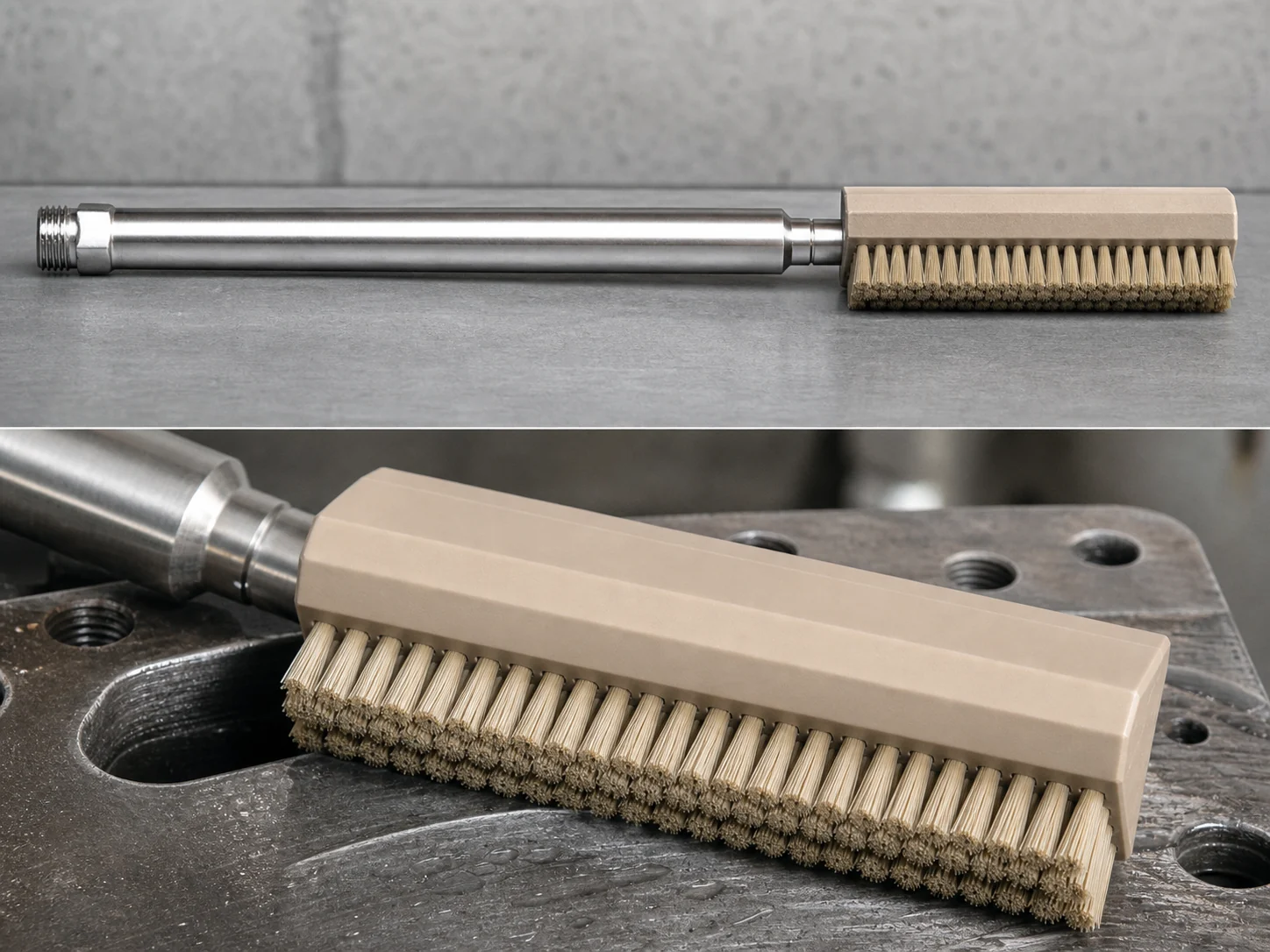
150mm PEEK Steam Cleaning Brush
High-temperature 150mm PEEK filament steam cleaning brush for steam and chemical cleaning to 260°C. Threaded 316 stainless handle, removable head.
Small brush
500 pcs
Minimum order
Held in one hand: tube, bottle, detail and swab brushes — including long-handled ones with a small head.
Production lead time, once the specification is confirmed
- Up to 500 pcsWithin 7 days
- 501–50,000 pcsWithin 14 days
- Over 50,000 pcsWithin 21 days
Peak season can extend these times; the shipping date is confirmed in writing with your quotation. Sampling and shipping are quoted separately.
A 150 mm PEEK filament steam cleaning brush built for hot, wet, and chemically aggressive industrial cleaning. The PEEK filament keeps its stiffness and shape to 260°C, and the threaded 316 stainless steel handle lets operators work close to hot machine surfaces without losing control.
What can this brush do for you?
Keeps working after nylon and PP have softened
Standard polymer brushes lose stiffness and bend out of the way when the steam line or workpiece is above 150–180°C. PEEK filament retains a usable stiffness through 260°C continuous exposure, so the 150mm face stays engaged with the surface instead of flattening under heat. This keeps the cleaning pass consistent on heated rollers, molds, dies, and machine frames.
Stands up to steam condensate and industrial washdown chemicals
PEEK absorbs almost no moisture and resists most acids, alkalis, organic solvents, and steam condensate. The filament does not swell, soften, or lose recovery when the brush is moved between hot dry zones and wet steam zones. AISI 316 stainless steel in the base and handle resists the same wet, corrosive environment.
The 150mm rectangular face cleans a wider path per stroke
At 150mm long by 60mm wide, the rectangular PEEK face covers flat machine surfaces, frames, and tooling areas faster than a narrow strip brush. Operators complete a pass with fewer strokes, which matters when working against hot surfaces where standing time must be controlled.
Removable head shortens replacement and keeps handles in service
The brush head threads onto the 500mm handle. When the filament wears, the head is replaced without discarding the handle, and one handle can be used with different head widths or stiffnesses if the thread is standardized across the set. This keeps spare part inventory lower and reduces waste in high-usage cleaning stations.
Removes loose chips, oil film, and process residue without wire-brush damage
PEEK is stiff enough to scrape away chips, dust, oil deposits, loose scale, and process residue, but it does not gouge or scratch precision surfaces the way a steel wire brush would. On polished metal, glass, coated parts, and mating surfaces that need to stay dimensionally clean, the filament gives controlled contact.
What is a 150mm PEEK Steam Cleaning Brush?
A 150mm PEEK Steam Cleaning Brush is a hand-guided industrial cleaning tool with a replaceable rectangular brush head made from PEEK (polyether ether ketone) filament. The 150mm head is set into a 316 stainless steel base and threads onto a 500mm-long stainless steel handle. The brush is designed for cleaning hot equipment with steam, hot water, or chemical solutions, where ordinary polymer filaments would soften and metallic brushes would be too aggressive.
In use, steam or cleaning solution loosens the deposit, and the PEEK filament scrubs the loosened material from the surface while the operator controls the handle from a safe standoff distance. The brush works on both wet and dry high-temperature surfaces, and the filament geometry can be configured for flat trim, angled edge, or contour following depending on the surface shape.
This is not a burnishing or heavy derusting tool. It is intended for loose contamination, films, process residue, and scale that has already been partially loosened by steam or chemical action. For hard bonded scale, carbon, or weld spatter, a steel wire or abrasive brush remains the more appropriate contact material.
The 150mm length refers to the brush head’s working face, not the total tool length. Total working length is about 650mm when the standard 500mm handle is assembled. Heating of the handle is limited by the stainless steel material and the length of the handle; the operator should still use an insulated grip or glove for continuous contact with hot workpieces.
Technical Specifications
| Parameter | Value / Options |
|---|---|
| Brush head length | 150 mm |
| Brush face width | 60 mm |
| Head shape | Rectangular block brush |
| Filament material | PEEK (polyether ether ketone) |
| Filament diameter | 0.3–0.5 mm, selectable by application |
| Filament trim | Flat face standard; angled or contoured trim available |
| Base / head plate material | AISI 316 stainless steel |
| Handle material | AISI 316 stainless steel |
| Handle length | 500 mm |
| Grip diameter | 25 mm |
| Connection | Threaded removable head, thread size specified per project |
| Continuous operating temperature | Up to 260°C (500°F) for PEEK filament |
| Suitable cleaning media | Steam, hot water, industrial detergents, mild chemical solutions |
| Typical residues removed | Chips, oil, dust, process residue, loose scale, soft films |
| Brush type | Custom Handheld Detail Brushes |
| How it is driven | Hand-guided |
| Cleaning target | machine frame, injection mold, and dairy processing line cleaning |
| Surface or part | glass, thread, frames, dies, molds, roller, tooling, and welds |
| Residue or debris | scale, oil, chips, mold, spatter, plastic residue, release agent, and process residue |
| Mounting / connection | Threaded removable head, thread size specified per project |
The operating temperature rating applies to the filament. Handle and connection materials must be reviewed for the actual process environment, especially chloride-containing steam or acid vapors, before locking the specification.
Where does this brush work best?
- Machine frames, housings, and guarding that are steam cleaned at the end of a production shift and carry oil, cutting chips, and residue.
- Injection molds, dies, and tooling that are cleaned while still hot, where plastic residue and release agents must be removed without scratching the cavity surface.
- Food, beverage, and dairy processing lines that use hot water and steam washdown; PEEK filament tolerates repeated hot wet cycles and cleaning chemicals.
- Printing, coating, and converting machines where ink, adhesive, and oil accumulate on rollers, doctor blade areas, and heated surfaces.
- Glass handling and precision component cleaning where the contact must be firmer than a nylon brush but less aggressive than a wire brush.
- Boiler or heat exchanger access openings where loose soot and scale must be brushed from accessible surfaces.
How do I choose the right one?
Four checks decide whether this 150mm PEEK steam cleaning brush fits the job: temperature, residue, surface sensitivity, and access.
- Temperature. Confirm the actual surface and steam temperature, not just the machine set point. The PEEK filament is rated to 260°C continuous. Above that, or in direct flame, choose a metallic or ceramic alternative.
- Residue. PEEK removes loose chips, oil, dust, soft films, and scale that steam has already loosened. Hard rust, heavy scale, burned-on carbon, and weld spatter require a steel wire or abrasive brush.
- Surface sensitivity. On polished metal, glass, or coated surfaces, select finer PEEK filament or a softer trim. On rough castings or structural surfaces, thicker, stiffer filament and higher density improve cleaning speed.
- Access. The standard face is 150mm x 60mm rectangular. If the area is narrower than 60mm or includes deep recesses, a narrower or contoured head should be specified. If the surface is wider, multiple brushes in a holder may be more efficient than a single hand brush.
Handle length and connection come next. The 500mm handle keeps the operator away from the hot surface, but longer handles reduce control. For extended reach, a custom handle length or a machine-mounted holder with the same threaded head may be the better configuration.
| Condition | Recommended configuration |
|---|---|
| Continuous temperature ≤ 260°C, wet steam environment | Standard 150mm PEEK brush with 316 SS handle |
| Delicate polished or coated surface, residue is soft film | Finer PEEK filament, lower density, rounded trim |
| Heavy loose chips and oil on rough steel | Thicker PEEK filament, higher density, flat trim |
| Hard scale, rust, or weld spatter | Use steel wire or abrasive brush instead |
| Temperature above 260°C or direct flame | Metallic or ceramic brush required |
Can I customize this brush?
The 150mm x 60mm head and 500mm handle are the default configuration, but the brush is normally adjusted to your cleaning station. To define the custom version, provide the actual surface temperature, cleaning chemical or steam specification, access dimensions, surface material, residue type, and preferred handle length and thread.
- Head geometry — face length and width, head profile, trim angle, contoured face, multi-row arrangement
- Filament — diameter, density, trim length, PEEK grade, carbon-reinforced option for added stiffness, filament shape
- Base and connection — 316 SS standard, alternative stainless or alloy grades, thread size and pitch, quick-release, bayonet, fixed welded head, machine mounting flange
- Handle — length, grip diameter, straight or ergonomic shape, knurling, hanging loop, insulated or overmolded grip section
- Marking and identification — engraved part number, logo, color-coded collar or band on handle, laser marking
- Packaging — bulk cartons, individual poly bags, labeled industrial packs, VCI paper for corrosion protection during transit
If your cleaning process requires material declarations, inspection records, or third-party testing for the PEEK filament or stainless components, we can support those project requirements during customization.
Which filament survives the cleaning and still lasts on a 150mm PEEK steam cleaning brush?
How do I confirm the PEEK brush will handle my actual steam temperature?
Compare the maximum measured surface or steam temperature to the 260°C continuous rating of the PEEK filament. For short peak temperatures above 260°C or significant radiant heat, run a trial on a scrap surface or provide the temperature profile for review. Above that range, a metallic or ceramic brush is the safer choice.
How can I tell when the filament head is worn out?
Check for flattened, permanently bent, broken, or melted filament tips. If the face no longer returns to shape after flexing, if cleaning time increases noticeably, or if the base threads show corrosion or damage, replace the head. Even a partially worn face leaves uncleaned streaks on the surface.
Will the PEEK filament scratch a polished or coated surface?
PEEK is less aggressive than steel wire, but stiff, coarse filament can still mark delicate surfaces. For polished metal, coated parts, or glass, select finer filament diameter and lower density, and test on a non-critical area first. Rounded or angled trim further reduces marking risk.
Does this brush replace chemical cleaning or high-pressure washing?
No. Brushing loosens and removes attached residue, but loosened debris still needs to be rinsed away. If the process also requires chemical cleaning, sanitizing, or high-pressure water removal, those steps remain separate. Steam brushing is one part of the cleaning sequence, not the entire sequence.
Can the brush head be used without the handle?
The head has a threaded 316 stainless steel base, so it can be mounted into a machine or holder using the same thread if specified as a custom configuration. As supplied, it is a hand-guided tool with a 500mm handle. If you need machine mounting, define the mounting interface during the design phase.
What should I check before using the brush on a hot surface?
Verify the thread is tight, the filament shows no broken or bent tips, and the handle is clean and dry. Confirm the surface temperature is within the rated range. If the handle becomes too hot during use, reduce the dwell time against the surface or use an insulated grip extension.
Guides that go deeper on this
We have not written a guide specific to this one yet. The material that covers selection, filament, dimensions, maintenance and sourcing is collected in the technical resources library.
Custom Manufacturing RFQ
Describe Your Application
For a custom quote, we need the key dimensions, surface or part, residue, material preference, quantity, and reference image or drawing.
Drawing or photo optional — it speeds things up, it does not gate the enquiry.
Custom Brush RFQ
Send Your Brush Project
Upload a drawing, product photo, or sample photo and provide the core dimensions and cleaning conditions.
“We need a brush to remove wet residue from a stainless steel conveyor, about 800mm wide. The current brush wears quickly. We can send photos.”
“We sell drinkware and need a cleaning brush to include with the product. Quantity around 5,000 pieces.”