
Custom Cleaning Brush
Toilet Brush
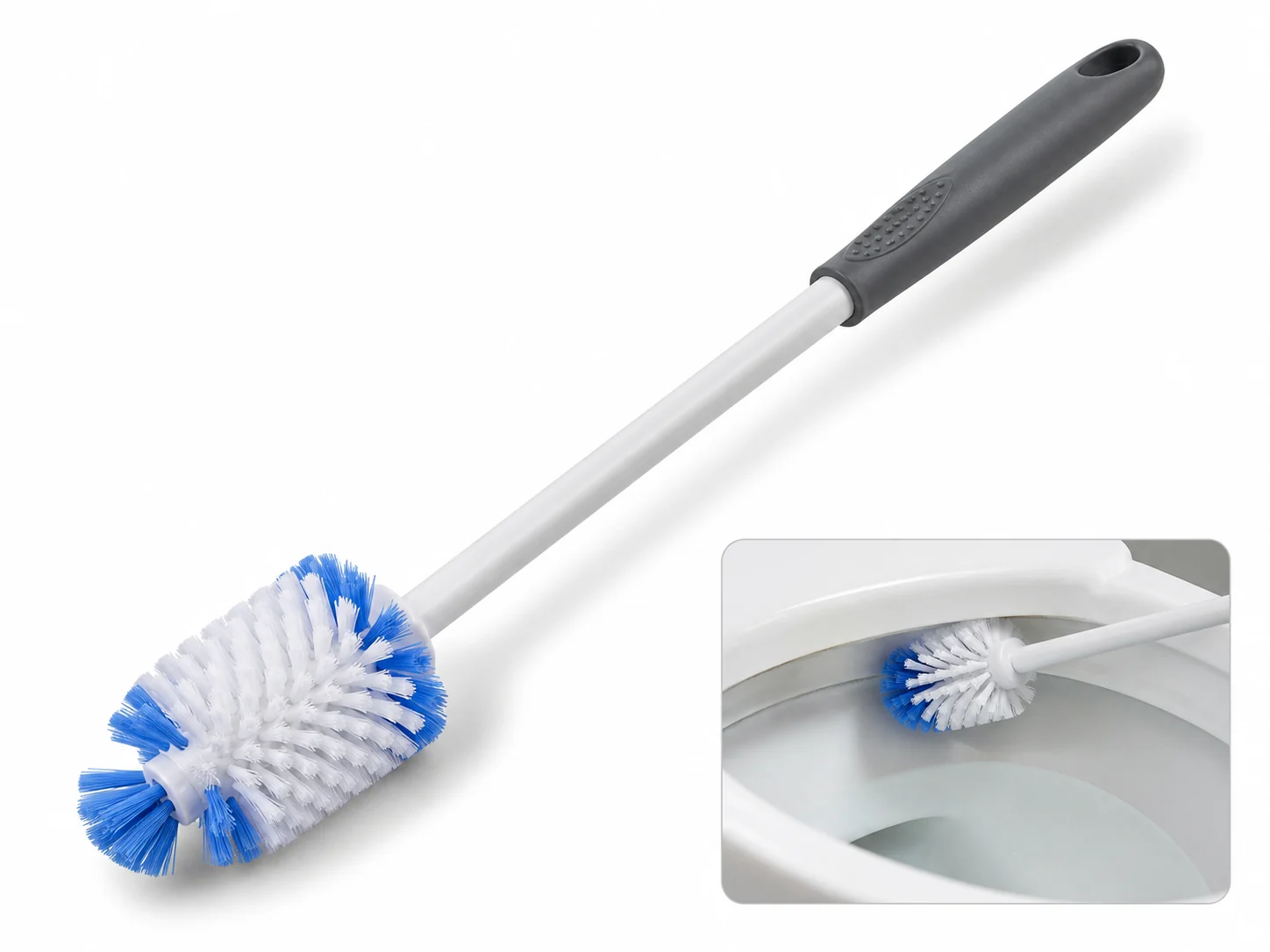
Professional toilet bowl cleaning brush with Nylon PA filaments, 316 stainless steel core, and PP handle.
Small brush
500 pcs
Minimum order
Held in one hand: tube, bottle, detail and swab brushes — including long-handled ones with a small head.
Production lead time, once the specification is confirmed
- Up to 500 pcsWithin 7 days
- 501–50,000 pcsWithin 14 days
- Over 50,000 pcsWithin 21 days
Peak season can extend these times; the shipping date is confirmed in writing with your quotation. Sampling and shipping are quoted separately.
A professional toilet bowl cleaning brush built for repeated use in commercial restrooms, janitorial programs, and hospitality facilities. The angled head and stiff Nylon PA filaments reach under the rim and into the trap entrance while the 316 stainless steel stem and polypropylene handle resist moisture, bleach, and daily cleaning chemicals.
What can this brush do for you?
Reaches the under-rim area and trap entrance
The working head profile can be made with an angled forward section that slips under the rim and down toward the trap entry. This lets one cleaning pass cover the three areas where limescale and organic soil collect: the waterline, the concealed rim channel, and the lower bowl where the trap begins.
Removes limescale and biofilm without glaze damage
Nylon PA filaments are cut and filled at a density that applies enough side load to loosen mineral film and softened deposits, but the filament tips are not hard enough to score vitreous china or standard porcelain glazes under normal hand pressure. The result is a cleaner bowl without the micro-scratches that make future soiling stick faster.
Handles bleach, acid descalers, and repeated wash cycles
The twisted core is made from 316 stainless steel wire, a grade chosen for resistance to pitting and corrosion in chlorinated cleaning solutions and acid-based descalers. The polypropylene handle does not absorb water, swell, or split after repeated exposure to disinfectant, so the brush remains usable through the daily cleaning cycle instead of becoming a replacement consumable every few weeks.
Supports color-coded, zone-by-zone cleaning
Handles and filaments can be molded and filled in distinct colors to match facility hygiene plans that separate restroom, kitchen, and public-area tools. Color coding reduces the chance of using the same brush across zones and makes tool assignment visible during line audits.
What is a Toilet Brush?
A toilet brush is a hand-guided cleaning tool with a radial or angled filament head mounted on a rigid stem and handle. In this configuration, Nylon PA filaments are mechanically twisted into a 316 stainless steel wire core to form a dense round, oval, or rim-cleaning head, and the stem is overmolded or assembled into a polypropylene handle.
In use, the operator inserts the head into the bowl, applies cleaning solution or descaler as required, and uses short push, twist, and pull strokes to work the waterline, rim channel, bowl sidewall, and trap entrance. The brush does not need to remove thick scale by force alone; it is most effective when the selected chemical is allowed to dwell, and the brush then removes the loosened film and carries it into the rinse water.
This is a reusable cleaning tool, not a drain-clearing device and not a substitute for chemical descaling or sanitation. It is designed for surfaces that can tolerate nylon filament contact and for repeated wet and chemical exposure without rapid corrosion or filament collapse.
Technical Specifications
The table below lists a common commercial configuration. We adjust dimensions, fill density, and materials to your bowl geometry and cleaning program.
| Parameter | Standard / Available Range | Selection Notes |
|---|---|---|
| Overall length | 380 mm / 120–450 mm | Matched to user reach and bowl depth |
| Head diameter | 50 mm / 45–90 mm | Round or oval profile for bowl shape |
| Working head length | 90 mm / 10–120 mm | Defines coverage inside bowl and trap |
| Trim length | 18 mm / 8–40 mm | Shorter for stiffer scrubbing, longer for waterline coverage |
| Filament material | Nylon PA6 / PA612 | Stiffness and chemical resistance options |
| Filament diameter | 0.30 mm / 0.20–0.80 mm | Heavier film uses thicker filaments |
| Handle material | Polypropylene | Resists moisture, cleaning chemicals, impact |
| Handle diameter | 25 mm / 8–35 mm | Comfort grip or tool fit |
| Stem / core | Stainless steel 316 wire | Corrosion-resistant for bleach, acidic cleaners |
| Use temperature | 5–100°C | Suitable for hot water and standard chemical cleaning |
| Brush type | Custom Handheld Detail Brushes | |
| How it is driven | Hand-guided | |
| Cleaning target | high-traffic commercial restroom, hospitality and housekeeping program, and janitorial service provider cleaning | |
| Surface or part | rims, bowls, traps, profiles, channel, sidewalls, and terminals | |
| Residue or debris | rust, scale, corrosion, limescale, glaze, and biofilm | |
| Mounting / connection | Fixed |
Where does this brush work best?
A toilet brush specified for commercial use is typically placed where restrooms are cleaned repeatedly with the same tools and where downtime for replacement creates a problem. Common deployment settings include:
- High-traffic commercial restrooms in offices, retail centers, airports, and event venues where waterline film and rim deposit form quickly between cleanings.
- Hospitality and housekeeping programs in hotels, resorts, and serviced apartments where consistent appearance and tool standardization matter across many units.
- Janitorial service providers that need a uniform brush across customer sites and can rotate tools by color zone.
- Institutional facilities such as schools, municipal buildings, and transport terminals where cleaning frequency is high and chemicals include quaternary disinfectants and bleach solutions.
- Retail and private-label product programs that sell branded or color-coordinated bathroom cleaning tools to consumers.
For very hard water areas, the brush pairs well with acid descaler dwell cycles; the stainless core allows the combination without rust staining.
How do I choose the right one?
Start with the bowl, not the brush catalog. Measure the rim clearance, bowl depth, trap access, and the type of deposit that appears daily. These four factors determine head shape, trim length, filament diameter, and handle length.
Select the head shape from the bowl geometry
Round heads cover sidewalls quickly; oval or closed-end heads reach deeper into the trap entry; angled profiles or integrated rim lips address concealed rim channels. If the bowl has a narrow gap under the rim, choose a lower-profile head so the brush enters without jamming.
Match filament diameter and density to the deposit
Thin filaments, around 0.20–0.30 mm, with medium density work well for light daily soil and soft water scale. For hard water limescale, biofilm, and mineral film, move to 0.40–0.80 mm filaments with dense fill and a shorter trim length, which increases stiffness and scrubbing pressure.
Choose the stem and handle for the chemical program
If the cleaning process includes chlorine bleach, acid descalers, or high-temperature water, keep the 316 stainless steel wire core. It resists stress-corrosion cracking and rust products that would stain the bowl. Polypropylene handle material remains stiff and splash-resistant in wet storage.
Use color and length to make the program repeatable
Standard lengths around 380–420 mm keep the operator’s hand above the rim during scrubbing. Longer tools may be useful for floor-standing use or taller users; shorter tools fit compact commercial washrooms and retail packaging requirements.
| Cleaning condition | Recommended configuration |
|---|---|
| Daily light soil and waterline film | 0.20–0.30 mm nylon, medium density, 18–22 mm trim |
| Hard water limescale and mineral build-up | 0.40–0.80 mm nylon, dense fill, 8–16 mm trim |
| Concealed rim and trap-access issues | Angled head profile or extended forward section |
| Color-coded cleaning zones | Molded handle and filament colors matched to zone plan |
| Bleach or acid-based daily chemicals | 316 SS core, PP handle, nylon PA filaments |
When a different tool or method is better
Do not use the brush to clear drain blockages; that requires a toilet auger or plumbing intervention. If the job requires single-use or zero cross-contamination cleaning, a disposable cleaning system is more appropriate than a reusable brush. For extremely thick, hardened scale, chemical descaling should come first, followed by brushing rather than using abrasive force alone. If the bowl has delicate antique or specialty glazes, use the finest recommended filament and test a small area first.
Can I customize this brush?
Yes. A toilet brush is not a one-size tool when it is part of a commercial program. We build to your bowl dimensions, chemical exposure, and branding requirements. We generally need the following to define the project:
- Rim clearance and bowl profile
- Target areas: waterline, under-rim, trap entrance
- Main deposit type and cleaning chemical
- Expected cleaning frequency and replacement cycle
- Handle length, color, and any logo or marking
Variables we can adjust include:
- Head geometry — round, oval, angled rim profile, forward trap-reach projection, or a combined profile.
- Filament configuration — Nylon PA6 or PA612 grade, diameter, cut length, fill density, and filament color.
- Stem and core — 316 stainless steel wire diameter and twist configuration; polymer-coated or alternate stem assemblies when required.
- Handle — polypropylene or overmolded grip, length, diameter, texture, hang hole, thumb rest, and color.
- Storage and packaging — optional vented caddy, bulk polybag, retail box, private label, and display-ready packing.
- Marking — pad printing, laser marking, molded logo, or labeling on the handle or caddy.
If your program requires material documentation, inspection support, or project-specific third-party testing, we can assist during the customization process according to your purchasing requirements.
Which filament lasts longest on a toilet brush?
Will nylon filaments scratch a glazed toilet bowl?
Under normal hand pressure, nylon PA filaments in the specified diameter range do not scratch vitreous china or standard porcelain glazes. Marks are more likely when the wire core is exposed or abrasive cleaner particles are trapped in the filament. Inspect the head regularly and replace the brush if core wire becomes visible.
Can I use this brush with bleach or acid descalers?
Yes for typical janitorial use. The 316 stainless steel core and polypropylene handle tolerate diluted chlorine bleach, quaternary ammonium disinfectants, and common acid descalers. Rinse the brush after use, and avoid soaking it for hours in concentrated acid or undiluted bleach; check the chemical supplier’s compatibility note for your specific concentration.
How do I know when to replace the brush?
Replace when the filaments are splayed or flattened, when the wire core is visible, when the handle shows cracks or fatigue, or when the brush develops a persistent odor that rinsing does not remove. In high-traffic commercial restrooms, a visual check at each restocking and a fixed replacement cycle, commonly 1–3 months under heavy use, prevents the brush from becoming a source of soil retention.
Is this brush different from a household toilet brush?
Yes. Commercial configurations typically use denser filament fill, corrosion-resistant 316 stainless steel core wire, longer handles matched to operator posture, and materials chosen for daily disinfectant exposure and color-coded programs. The same geometry can be offered in retail versions, but the fill and core specification determine whether it survives commercial cycles.
Should the brush be stored wet or in a disinfectant bath?
Store it dry in a vented caddy. Closed, wet storage promotes biofilm and odor inside the filament pack. If your program uses a disinfectant bath, keep the solution at the prescribed concentration, change it on schedule, and allow the brush to drain before returning it to the caddy.
Can the brush remove hard water scale by itself?
It removes light mineral film and daily build-up, but thick, hardened limescale usually needs an acid descaler dwell first. Use the brush after the dwell to remove loosened deposits. In hard water areas, brushing alone will not replace periodic chemical descaling.
Guides that go deeper on this
We have not written a guide specific to this one yet. The material that covers selection, filament, dimensions, maintenance and sourcing is collected in the technical resources library.
Custom Manufacturing RFQ
Describe Your Application
Send the key measurements, cleaning requirement, residue, material direction, mounting method, quantity, and drawing or photo.
Drawing or photo optional — it speeds things up, it does not gate the enquiry.
Custom Brush RFQ
Send Your Brush Project
Upload a drawing, product photo, or sample photo and provide the core dimensions and cleaning conditions.
“We need a brush to remove wet residue from a stainless steel conveyor, about 800mm wide. The current brush wears quickly. We can send photos.”
“We sell drinkware and need a cleaning brush to include with the product. Quantity around 5,000 pieces.”