
Custom Cleaning Brush
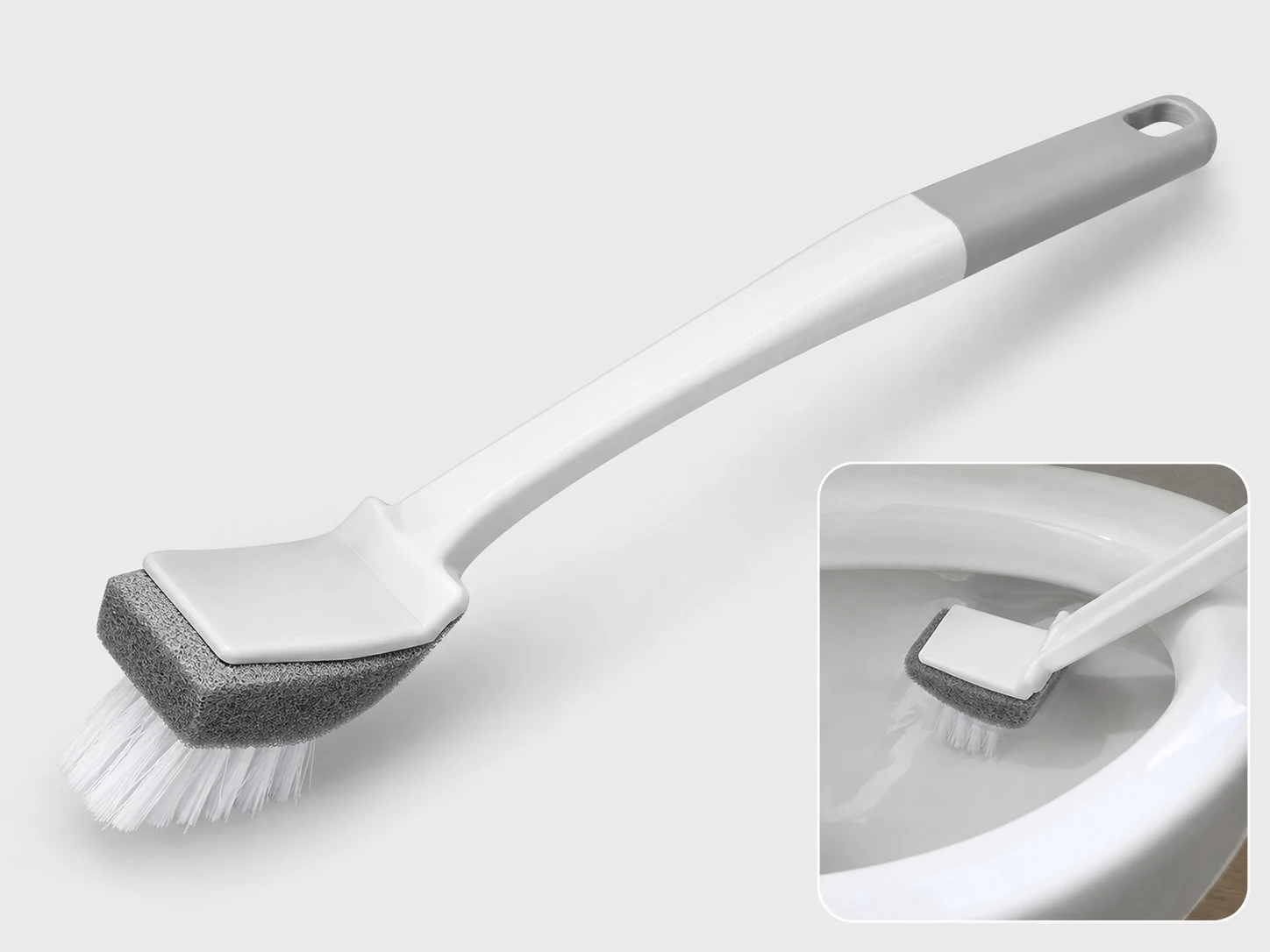
Toilet Ceramic Body Cleaning Brush
Non-scratch ceramic toilet brush with SiC abrasive nylon bristles and PU sponge for hard-water scale, limescale rings, and under-rim buildup.
Small brush
500 pcs
Minimum order
Held in one hand: tube, bottle, detail and swab brushes — including long-handled ones with a small head.
Production lead time, once the specification is confirmed
- Up to 500 pcsWithin 7 days
- 501–50,000 pcsWithin 14 days
- Over 50,000 pcsWithin 21 days
Peak season can extend these times; the shipping date is confirmed in writing with your quotation. Sampling and shipping are quoted separately.
A non-scratch ceramic toilet brush that uses silicon-carbide abrasive nylon bristles to lift hard-water scale and limescale rings, with a PU sponge section that wipes loosened residue away. The chemical-resistant PP stem and long reach make it a practical daily tool for high-mineral commercial and residential toilets.
What can this brush do for you?
Lifts limescale and hard-water rings without heavy acid dependence
The silicon carbide is embedded throughout each nylon filament rather than coated on the surface. As the bristle flexes, fresh abrasive edges keep cutting the mineral film, so a normal toilet cleaner or plain water can remove waterline rings. This reduces how often you need aggressive acid descalers.
Wipes suspended debris off the glaze
An open-cell PU sponge section holds water or cleaning solution, drags loosened scale and biofilm off the curved ceramic surface, and releases it toward the waterline or trap. The dual action means one tool both scrubs and wipes instead of switching between a brush and a cloth.
Enters the under-rim channel and siphon jet
The working end is kept narrow so it can pass into the under-rim gap and the siphon jet opening where mineral deposits, odor, and biofilm collect. A front-tapered profile reaches areas a full round toilet brush head cannot enter.
Survives routine toilet cleaning chemicals
The polypropylene stem and handle, nylon filaments, and PU sponge resist diluted bleach, acidic descalers, and alkaline cleaners used in normal toilet maintenance. There is no wire core to corrode, and the materials can be rinsed clean after each use.
What is a Toilet Ceramic Body Cleaning Brush?
A Toilet Ceramic Body Cleaning Brush is a hand-guided tool built for vitreous china and ceramic toilet bowls. It combines two working zones: a bristle bed of silicon-carbide abrasive nylon that mechanically removes mineral scale, and a PU sponge zone that wipes and rinses the glazed surface. The two sections are mounted on a chemical-resistant PP stem with a long handle so the operator can scrub under the rim, along the bowl wall, and into the trap opening without placing a hand inside the bowl.
In service, the operator applies toilet bowl cleaner or water, scrubs the stained areas with the abrasive side, then uses the sponge to flush the loosened debris into the water and down the drain. The brush is intended for regular maintenance and scale prevention. It is not a replacement for chemical disinfection or for a full acid soak when heavy encrustation has already built up; in those cases it is the mechanical agitation step that makes those treatments effective.
Technical Specifications
The following parameters are typical for toilet ceramic body cleaning brushes. Dimensions and fill ratios are matched to the bowl geometry during ordering.
| Parameter | Value / Options |
|---|---|
| Overall length | 300–450 mm, selected for bowl depth and operator height |
| Head width | 45–70 mm, matched to under-rim clearance |
| Working head length | 80–150 mm, set by the contact area along the bowl wall |
| Trim length | 15–35 mm |
| Filament material | Silicon-carbide (SiC) abrasive nylon for scale removal; non-abrasive nylon PA for soft-scrub zones |
| Filament diameter | 0.30–0.60 mm abrasive; 0.20–0.50 mm standard nylon |
| Sponge section | Open-cell PU sponge, 8–25 mm thick, positioned at tip or back of head |
| Handle / stem material | Chemical-resistant polypropylene (PP), optional TPE overmold grip |
| Handle diameter | 25–35 mm |
| Use temperature | 5–100°C, suitable for hot water and standard cleaning chemicals |
| Head profile | Tapered front for under-rim and siphon jet access; rounded back for bowl wall coverage |
| Brush type | Custom Handheld Detail Brushes |
| How it is driven | Hand-guided |
| Cleaning target | commercial washroom, janitorial service company, and residential home cleaning |
| Surface or part | ceramic, bowls, rims, traps, channel, gaps, fixtures, and working zones |
| Residue or debris | limescale, scale, mineral scale, and glaze |
| Mounting / connection | Fixed |
Head width, working length, and filament blend are project-specific. Supply the bowl model or under-rim gap so we can set these to your application.
Where does this brush work best?
- Commercial washrooms, hotels, hospitals, schools, and public facilities in hard-water areas where toilet waterline rings form daily.
- Janitorial service companies that need a non-metal scrub-and-wipe tool for ceramic toilets and urinals.
- Residential homes with high-mineral water and recurring limescale at the waterline or under the rim.
- Siphonic and washdown toilet bowls, round-front and elongated models, where the under-rim channel and siphon jet need mechanical agitation.
- Ceramic urinals and low-profile vitreous china fixtures where a stiff round brush is too aggressive or too wide.
How do I choose the right one?
Start with the bowl geometry.
- Measure the narrowest gap under the rim and the siphon jet opening diameter. The head must enter the smaller of the two without forcing.
- Confirm the bowl depth so the overall length lets the operator reach the trap opening while standing normally. For most toilet bowls, 350–450 mm overall length is comfortable.
Then match the filament blend to the soil.
- Heavy hard-water scale and limescale: use a higher proportion of silicon-carbide abrasive nylon with a firmer filament diameter and a shorter trim length for more cutting pressure.
- Daily maintenance or glossy decorative ceramic: increase the share of non-abrasive nylon PA and enlarge the sponge area to preserve the glaze’s shine.
- Mixed cleaning: specify a split head with abrasive bristles on one side and softer nylon plus PU sponge on the other.
Finally, consider the chemical and moisture environment. PP, nylon, and PU tolerate most diluted toilet cleaners, but high-concentration acids or solvent-based products should be tested before full deployment. If the bowl has severe aged encrustation, use a descaler soak first and then the brush for removal of softened residue. For brand-new, high-gloss toilets where no abrasion is acceptable, choose a 100% non-abrasive nylon/sponge configuration instead of the silicon-carbide blend.
Can I customize this brush?
Toilet ceramic body cleaning brushes are built around the bowl, not the other way around. Provide the toilet model or the measured under-rim gap, siphon jet opening, bowl depth, residue type, cleaning chemicals, and handle preference. A photo or drawing helps confirm the geometry quickly.
- Head geometry — width, length, front taper, angled neck, rounded back, or split bristle/sponge layout.
- Filament — SiC grit size and loading, filament diameter, trim length, proportion of non-abrasive nylon PA, and color coding.
- Sponge — PU density, cell structure, thickness, and location on the head.
- Handle and stem — length, diameter, straight or ergonomic grip, TPE overmold, hanging hole, and branding.
- Color and marking — custom stock color, pad print, laser marking, or molded logo.
- Packaging — bulk carton, individual polybag, retail hang card, or private-label packaging.
If the project needs material documentation, third-party testing, or inspection support, those requirements can be addressed during customization.
Which filament lasts longest on a toilet ceramic body cleaning brush?
How do I know the abrasive filaments will not damage the ceramic glaze?
The silicon carbide is dispersed inside flexible nylon filaments rather than attached to a rigid surface. Under normal hand pressure, the bristles bend while the embedded grit cuts the mineral film, which limits gouging of the glaze. For colored or high-gloss decorative toilets, test in an inconspicuous area or request a lower-grit blend.
Can this brush remove thick hard-water crust by itself?
It removes visible waterline rings and surface mineral film, but thick aged encrustation usually needs an acid or citric acid soak first. Use the brush after the chemical dwell time to lift and flush away the softened deposits.
What should I measure before requesting a custom head?
Measure the narrowest gap under the rim, the siphon jet opening diameter, the bowl depth, and the trap entrance width. Note whether the toilet is round-front or elongated. These four dimensions determine the head profile, working length, and overall length.
How should the brush be stored between uses?
Rinse the bristles and sponge under clean water, squeeze excess liquid from the sponge, and store the brush head-up in a ventilated holder. Sealing a wet brush in a closed container traps moisture and can cause odor and premature degradation of the sponge and filaments.
Does the brush replace disinfecting the toilet?
No. Brushing and wiping remove visible soil, biofilm, and mineral deposits, but disinfection depends on the chemical’s required contact time. The brush supports the cleaning sequence; it is not a substitute for dwell-time disinfection when that step is required.
Guides that go deeper on this
We have not written a guide specific to this one yet. The material that covers selection, filament, dimensions, maintenance and sourcing is collected in the technical resources library.
Custom Manufacturing RFQ
Describe Your Application
For a custom quote, we need the key dimensions, surface or part, residue, material preference, quantity, and reference image or drawing.
Drawing or photo optional — it speeds things up, it does not gate the enquiry.
Custom Brush RFQ
Send Your Brush Project
Upload a drawing, product photo, or sample photo and provide the core dimensions and cleaning conditions.
“We need a brush to remove wet residue from a stainless steel conveyor, about 800mm wide. The current brush wears quickly. We can send photos.”
“We sell drinkware and need a cleaning brush to include with the product. Quantity around 5,000 pieces.”