
Custom Cleaning Brush
Watch Brush
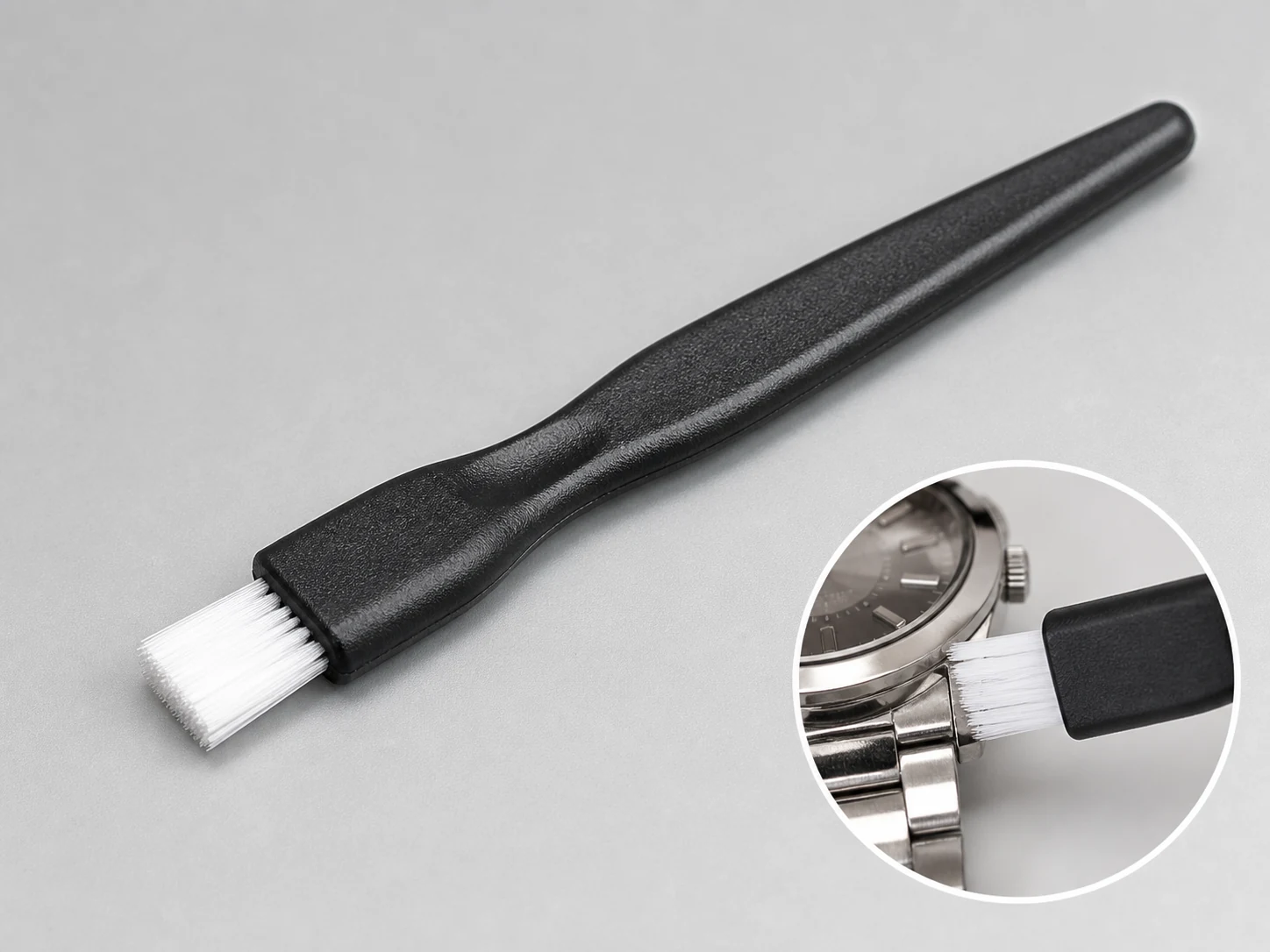
Custom watch brush for dry dust and light residue on cases, bracelets, links, and engravings. Goat-hair or nylon PA fill, matched dimensions and handles.
Small brush
500 pcs
Minimum order
Held in one hand: tube, bottle, detail and swab brushes — including long-handled ones with a small head.
Production lead time, once the specification is confirmed
- Up to 500 pcsWithin 7 days
- 501–50,000 pcsWithin 14 days
- Over 50,000 pcsWithin 21 days
Peak season can extend these times; the shipping date is confirmed in writing with your quotation. Sampling and shipping are quoted separately.
A narrow, short-trim precision hand brush for watch service, repair, and polishing benches. It lifts dry dust, skin oils, and light polishing residue from bracelet links, case grooves, engravings, and other accessible surfaces without aggressive scrubbing.
What can this brush do for you?
Fits Between Bracelet Links and Along Clasp Seams
Head widths from 8–25 mm and one- to four-row fills allow the brush to enter end-link gaps, link edges, and clasp seams where wider bench brushes roll over the surface. Dust and skin oils that collect around pins, screws, and joints are lifted from the actual contact points instead of being pushed aside.
Lifts Dry Dust Without Endangering Polished or Coated Surfaces
Fine goat-hair fill has soft, flexible filament tips that follow the surface instead of dragging hard cut ends across it. On high-polish steel, plated surfaces, and lacquered or coated case parts, this limits the risk of micro-scratches while still removing loose particles.
Separate Nylon Option for Oily and Paste-Type Residue
Nylon PA fill is available for watch benches that deal with skin oils, light polishing compound, or tacky film around links and caseback threads. The stiffer filament transfers more pressure to the residue, and the short trim lets the brush reach the bottom of engraving lines and flutes.
Predictable Tip Position for Loupe-Level Work
A trim length of 8–20 mm keeps filament flex short, so the tip stays where the operator expects it under magnification. That control matters when the brush is used near dial markers, small engravings, and other features where a long, floppy fill would mask the contact line.
Low-Profile Handle Reduces Hand Fatigue During Repetitive Inspection
Overall lengths from 100–260 mm and plastic or wood handle bodies keep the tool light and easy to index in the hand. For operators who inspect or clean dozens of watches per shift, the short throw and balanced head weight reduce the effort involved in repeated brushing passes.
What is a Watch Brush?
A watch brush is a flat, fine-filament hand brush produced for dry bench cleaning in watchmaking, watch repair, and precision-instrument work. It typically uses one to four rows of finely set filament in a narrow head, attached to a short handle that the operator controls with the same precision as tweezers or a screwdriver.
In use, the operator moves the brush with light sweeping or drawing strokes across the part. The filament tips collect loose dust, fibers, polishing dust, skin oils, and light film from accessible surfaces. The brush is not designed to scrub. It does not cut through hardened deposits, rust, adhesives, or dried lubricant.
The most important operating consideration is where the brush is allowed to go. On a watch case, bracelet, and engravings, the brush can work freely. Around dials, hands, and movement plates, it should be used only for loose dust in accessible, non-lubricated areas. Keep the brush away from hairsprings, balance pivots, and oiled jewels, where filament tips can catch or drag.
We offer the watch brush in goat-hair and nylon PA fills, with the dimensions, row count, trim, and handle built around the customer’s bench use or production line. This makes it a repeatable small-parts cleaning tool rather than an off-the-shelf cosmetic brush.
Technical Specifications
| Parameter | Value / Options |
|---|---|
| Overall length | 100–260 mm, selected to bench or line reach |
| Head length | 25–50 mm |
| Head width | 8–25 mm, matched to link width or groove clearance |
| Trim length | 8–20 mm; shorter for precision, longer for contour following |
| Fill rows | 1–4 rows |
| Fill materials | Natural goat hair; nylon PA; mixed configuration when specified |
| Filament diameter | 0.06–0.20 mm, material-dependent for dust pickup and scratch control |
| Handle material | Plastic (PP/ABS) or wood; grip profile plain, knurled, or fluted |
| Head retention | Crimped or molded retention with no exposed sharp edge; fill anchored to resist shedding |
| Operating temperature | -20 to 100°C, dry bench use |
| Use condition | Dry dust removal; not intended for immersion or aggressive chemical exposure |
| Brush type | Custom Handheld Detail Brushes |
| How it is driven | Hand-guided |
| Cleaning target | bracelet and clasp service, case and bezel detailing, and polishing and refinishing station cleaning |
| Surface or part | grooves, seams, plates, pins, gaps, plastic, wood, and instruments |
| Residue or debris | dust, skin oil, loose dust, polishing residue, particles, fine particles, adhesive, and fiber |
| Mounting / connection | Fixed |
All dimensions can be matched to your component and fixture. When the brush must enter a specific gap, specify the minimum clearance so the head width and rows are set below that limit.
Where does this brush work best?
- Bracelet and clasp service: between links, end links, clasp seams, and around pin or screw recesses where skin oils and fine particles collect.
- Case and bezel detailing: engraving lines, knurling, crown flutes, and caseback lettering that hold polishing dust and lint.
- Polishing and refinishing stations: post-polishing compound dust removal from recessed areas before final inspection.
- Dial and movement-adjacent inspection: loose dust from plates, bridges, and dial surfaces before casing, limited to dry, non-lubricated areas.
- Jewelry and precision instrument repair: settings, grooves, and small calibrated components where floating dust can affect fit or function.
How do I choose the right one?
- Measure the smallest gap the brush must enter. Check bracelet link clearance, lug spacing, and engraving line width. The head width should be narrower than the smallest opening; single-row construction is the starting point for link seams.
- Match the fill to the residue. Use goat hair for dry dust, fibers, and delicate polished or coated surfaces. Use nylon PA when skin oils, light polishing compound, or tacky film need more mechanical lift from the filament tips.
- Set the trim length for control or contour. A trim of 8–12 mm gives precise tip placement in engravings and grooves. A trim of 15–20 mm follows curved bracelet surfaces and holds more loose dust for broader passes.
- Choose rows for access versus coverage. One or two rows fit narrow gaps and reduce the chance of bridging over features. Three or four rows cover larger flat areas faster, such as a caseback or bracelet exterior, but require more frequent cleaning of the fill.
- Match the handle to the work position. A 100–150 mm handle suits close bench work under a loupe. A 200–260 mm handle provides more reach for standing inspection or line stations. Plastic handles can be color-coded by area; wood handles offer the traditional bench feel.
This brush is the wrong choice when the residue is hardened polishing compound, rust, adhesive, or dried lubricant. Those conditions need solvent, ultrasonic cleaning, pegwood, or a more aggressive mechanical tool first. Do not use a watch brush on hairsprings, balance pivots, or oiled jewels.
Can I customize this brush?
Watch bench requirements vary by component gap, surface finish, residue type, and operator position, so this brush is configured per project rather than sold in one fixed size. We can adjust:
- Fill material and softness: goat hair, nylon PA, or a specified mix; filament diameter and density tuned for dust pickup versus residue lift.
- Head geometry: width 8–25 mm, head length 25–50 mm, rows 1–4, trim 8–20 mm, working edge square, rounded, or angled.
- Handle: length 100–260 mm, plastic or wood, grip treatment, hang hole, color, and marking.
- Retention and safety: ferrule or molded head with no sharp edge; fill anchoring set to limit shedding on the bench.
- Packaging: bulk, individual polybag, branded sleeve, or line-ready packing.
To define a custom configuration, provide the narrowest gap or groove the brush must enter, the surface finish, the residue type, handle preference, and the quantity per line or station. If your project requires material declarations, inspection documentation, or third-party testing support, include those requirements when you send the specification.
When is a watch brush worn out rather than just dirty?
Should the same watch brush be used for the case exterior and for dial or movement work?
We recommend separating them. Exterior work collects skin oils, polishing compound, and metal particles that should not be carried near dials or movement plates. Use one brush for case and bracelet surfaces and a separate, clean one for interior or movement-adjacent work. Color-coded handles make the split easy to enforce on a busy bench.
What residues is a watch brush not designed to remove?
A fine watch brush lifts dry dust, light skin oil, and soft polishing residue. It is not designed for hardened polishing compound, rust, adhesive residue, or dried lubricants. Those residues need solvent, ultrasonic cleaning, pegwood, or another mechanical method before the brush becomes useful as a final dust-control step.
How can I tell whether the brush is picking up dust instead of pushing it around?
Clean the tips first, then make one pass under side light and inspect the surface. If the tips hold the dust rather than leaving a trail, pickup is working. If dust is simply moved to the edges or pushed into a corner, reduce pressure, clean the brush, or switch to a softer or longer trim configuration.
What should I check before using a new watch brush on polished or coated components?
Inspect the head under magnification for protruding or loose filaments, sharp ferrule edges, and uneven trim. Run the tips lightly over a clean white surface to confirm the brush does not shed. On production lines, these checks should be part of first-article inspection for each batch.
When should I use a blower or tacky roller instead of a watch brush?
Use a blower for loose particles on dials, movements, and other delicate areas where filament tips could snag. Use a tacky roller or lint-free wipe for large flat polished surfaces where dragging tips may redistribute dust. The watch brush is best for settled dust in grooves, links, and engravings that a blower cannot dislodge.
Does brushing replace ultrasonic cleaning for bracelets and cases?
No. Brushing removes surface-level dust and light oil, but it does not clean inside folded links, spring bars, or hidden crevices the way an ultrasonic tank does. Many service benches use the watch brush as a dry pre- or post-cleaning step alongside ultrasonic equipment rather than as a replacement.
Guides that go deeper on this
Custom Manufacturing RFQ
Describe Your Application
To quote this brush accurately, send the size, material, cleaning target, residue, quantity, and any available drawing or sample photo.
Drawing or photo optional — it speeds things up, it does not gate the enquiry.
Custom Brush RFQ
Send Your Brush Project
Upload a drawing, product photo, or sample photo and provide the core dimensions and cleaning conditions.
“We need a brush to remove wet residue from a stainless steel conveyor, about 800mm wide. The current brush wears quickly. We can send photos.”
“We sell drinkware and need a cleaning brush to include with the product. Quantity around 5,000 pieces.”