
Custom Cleaning Brush
250mm Galvanized Industrial Flue Brush
A 250mm galvanized steel industrial flue brush for heavy soot, tar, and carbon removal in boiler flues, chimney liners, and vent passages.
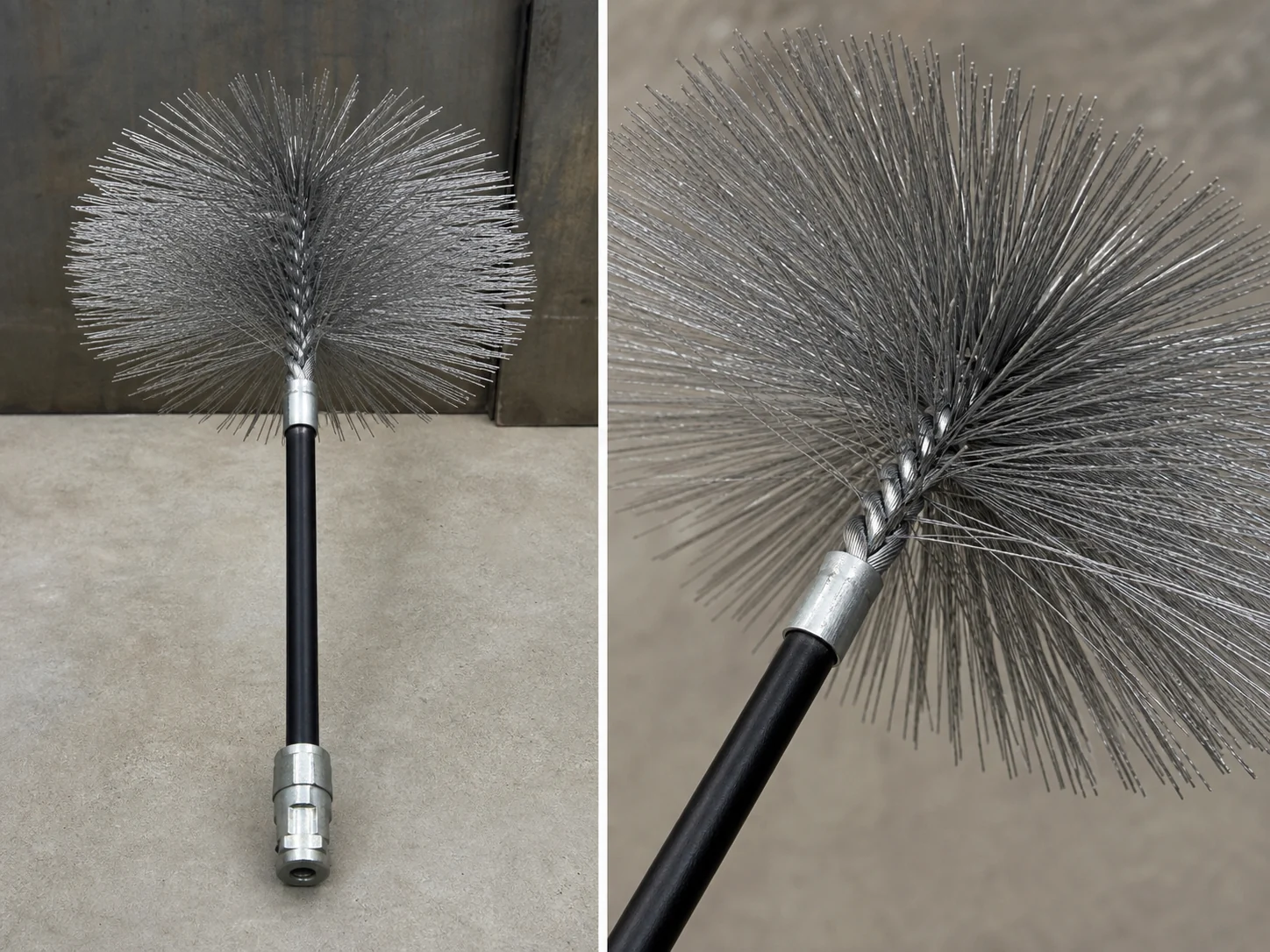
Medium brush
100 pcs
Minimum order
Worked with two hands or on a pole: chimney, gutter and pond-filter brushes, discs, cups and tank brushes.
Production lead time, once the specification is confirmed
- Up to 100 pcsWithin 7 days
- 101–5,000 pcsWithin 14 days
- 5,001–50,000 pcsWithin 21 days
- Over 50,000 pcsConfirmed with your quotation
Peak season can extend these times; the shipping date is confirmed in writing with your quotation. Sampling and shipping are quoted separately.
The 250mm Galvanized Industrial Flue Brush is a round, radial-wire cleaning head built for heavy soot, tar, carbonized deposits, and loose scale in chimney liners, boiler flues, and vent passages. Its 250 mm fill diameter and 450 mm brush head cover the full wall section in one pass, while the twisted galvanized steel core holds the wire fill under push-pull and rotary cleaning action.
What can this brush do for you?
Removes Heavy, Carbonized Deposits
The galvanized steel wire fill is stiffer and more aggressive than polypropylene or nylon brush fill, so it scrapes and knocks away baked-on soot, carbonized scale, and tar that softer chimney brushes polish without removing. The result is a cleaner flue wall for draft restoration and a better view of the liner during inspection.
Contacts the Full 250 mm Wall Section
The round radial fill measures 250 mm across and compresses slightly inside a matching flue so the wire tips stay loaded around the full circumference. This removes the need to work one side wall at a time and helps prevent thin soot ridges or missed bands between strokes.
Covers 450 mm Per Stroke
The 450 mm fill length places more working wire against the flue wall during each push or pull. For tall chimneys, boiler passages, and long vent runs, this reduces the number of up-and-down passes and spreads wear across a larger wire area instead of concentrating it on a short band.
Twisted Galvanized Core Resists Splaying
The brush is built on a twisted wire core rather than a plastic block or cup. The wire fill is trapped between two twisted galvanized steel strands, which keeps the bristles aligned and allows the head to be pulled back through a dirty passage without the fill opening up or folding backward.
Quick-Change Coupling Speeds Rod and Extension Changes
The head mounts through a quick-change coupling, so an operator can switch the brush to another rod, add an extension, or pull a worn head off the line without unthreading a tight or corroded connection. That is useful when the same drive rod is used with multiple brush diameters on a service route.
What is a 250mm Galvanized Industrial Flue Brush?
A 250mm Galvanized Industrial Flue Brush is a round radial-wire cleaning head used to scrub the inside of round flue passages that are around 250 mm (about 10 in) in diameter. The working section is a cylinder of galvanized steel wire fill secured between twisted galvanized steel core strands, with a 900 mm handle and a quick-change coupling for drive rods or rotary adapters.
During cleaning, the brush is inserted into the cooled flue from the top or cleanout opening. The operator pushes, pulls, or rotates the head so the wire tips scrape the flue wall. For soot and loose ash a straight pull may be enough; for tar and carbonized scale, slow rotation adds a scraping motion that breaks deposits free. The 450 mm working length keeps contact over a taller band than a short cup brush.
It is a consumable tool for masonry, clay tile, metal flue, and boiler passage maintenance. The galvanized coating helps protect the wire during storage and wet handling, but the brush is not intended for hot surfaces, combustible atmospheres, or stainless steel liner polishing. Brushing loosens deposits; the material still has to be removed through the cleanout or vacuum.
Technical Specifications
| Parameter | Specification / Options |
|---|---|
| Fill diameter | 250 mm (approximately 9.8 in) standard; adjustable to flue ID |
| Brush head shape | Round radial fill, cylindrical working section |
| Brush head length | 450 mm standard |
| Wire material | Galvanized steel wire fill, twisted galvanized steel core |
| Wire profile | Straight or crimped wire; crimped adds scraping density on heavy deposits |
| Wire gauge | Selected for deposit hardness and required stiffness; project-specific |
| Handle length | 900 mm standard, extendable with coupled drive rods |
| Grip diameter | 35 mm |
| Connection | Quick-change coupling; thread/size matched to your rod or motor adapter |
| Working motion | Push-pull or low-speed rotary; do not reverse a quick-change coupling under load |
| Recommended use | Cooled flues, chimney liners, boiler passages, and vent sections; dry or lightly damp conditions |
| Operating temperature | Room-temperature/cooled surfaces only; do not brush hot flue surfaces |
| Brush type | Custom Tube & Pipe Bore Brushes |
| How it is driven | Hand-driven on rods or a flexible shaft |
| Cleaning target | round masonry, biomass boiler flue passage, and oil or solid-fuel furnace connector and vent cleaning |
| Surface or part | flues, passages, chimney liners, walls, vents, elbows, tile, and bands |
| Residue or debris | scale, soot, tar, loose scale, ash, clay, carbonized deposits, and hard scale |
| Mounting / connection | Quick-change coupling; thread/size matched to your rod or motor adapter |
Standard values listed above are the starting configuration. Fill diameter, head length, wire gauge, and coupling type are set for the flue cross-section, deposit hardness, and drive system; we adjust these for each project.
Where does this brush work best?
- Round masonry, clay tile, and terra cotta chimney liners with a nominal 250 mm / 10 in inside diameter where soot, ash, and loose scale accumulate.
- Wood, coal, and biomass boiler flue passages that build carbonized soot and hard scale between scheduled services.
- Oil or solid-fuel furnace connectors and vent sections where deposits restrict draft and hot spots hide beneath the residue.
- Industrial stacks and duct risers where the flue is accessible from a roof or cleanout and the brush can be run directionally rather than around short elbows.
- Post-fire inspection prep, where heavy deposits must be removed so the liner and mortar joints can be inspected or repaired.
For routine light dusting, a polypropylene flue brush with the same diameter is a better match; this galvanized head earns its place on heavier deposits.
How do I choose the right one?
Match the brush diameter to the tightest flue opening
Measure the inside diameter at every point the brush will travel — including dampers, offsets, elbows, and the liner throat. A 250 mm head is selected for a flue that is close to 250 mm inside diameter. The fill should be slightly larger than the flue so the wire tips remain loaded against the wall; if the flue is smaller, the brush will bind or fold, and if it is much larger, the head will not remove center-to-wall deposits. For flues outside 240–260 mm, adjust the fill diameter rather than forcing the standard size.
Match the fill stiffness to the deposit
Choose galvanized steel wire when the flue carries heavy soot, tar, carbonized scale, or tightly bonded ash that polypropylene fill cannot loosen. Galvanized wire is stiff enough to scratch through hard deposits but will mark or score softer liner surfaces. If the job is annual light dusting or the liner is polished stainless steel, a polypropylene or specially selected gentler brush is the safer fit.
Check the drive and rotation direction
The quick-change coupling must match the rod or drill adapter already in the operator’s kit. Keep the drive direction consistent with the coupling and the twist of the core; reversing rotation under load can loosen the connection or open the fill. If the team uses reversible drills, select a locking coupling configuration.
Choose stainless steel when the environment eats zinc
Galvanized fill is cost-effective for dry flue systems and seasonal storage, but the zinc coating is not inert in acid flue condensate, chemical vapor, or constant wet conditions. When the flue produces corrosive condensate, when cleaning is done with acidic chemicals, or when the brush is stored outdoors, select stainless steel wire and stainless core instead.
Do not use it where sparks or liner damage are not acceptable
Steel wire brushes can produce sparks on contact with steel or masonry and are not suitable for potentially explosive atmospheres or live gas lines. They also cut into flexible stainless steel chimney liner surfaces. In those cases, use a non-sparking or non-metallic brush and confirm the material against the liner manufacturer’s recommendations.
| Your condition | Better choice |
|---|---|
| Heavy tar, carbon, scale; cooled masonry/steel flue | 250 mm galvanized steel flue brush |
| Light dust or routine maintenance | Polypropylene flue brush in the same diameter |
| Stainless steel liner or polished surface | Gentler non-metallic or fine stainless brush per liner manufacturer |
| Corrosive condensate or chemical cleaning | Stainless steel wire and core |
| Potentially explosive atmosphere | Non-sparking brush type approved for the area |
Can I customize this brush?
Every flue system is different, so the 250 mm head is a starting configuration rather than a fixed retail item. To define the correct custom brush, provide: flue ID at the tightest point, total run length, number and shape of elbows, deposit type and thickness, liner material, drive rod and coupling type, rotation direction, and whether the team uses manual push-pull or powered rotation.
- Fill diameter and head length — set to flue ID, accessible length, and deposit band.
- Wire material and finish — galvanized steel, stainless steel, zinc-plated, or coated wire as the environment requires.
- Wire gauge and profile — finer or heavier wire, straight or crimped fill, and fill density for lighter or more aggressive action.
- Core and twist — single- or double-twist construction, core diameter, and twist pitch matched to torque and rotation direction.
- Handle and grip — length, grip diameter or pattern, D-grip or T-grip, and additional coupling points for extension rods.
- Coupling interface — quick-change style, thread size, locking collar, or motor adapter matched to existing equipment.
- Marking and packaging — size marking, color coding, logo, individual bag, bulk crate, or job-site labeling.
If the project requires material traceability, inspection records, or independent testing for a particular site or tender, share the requirement with us; we can support project-specific documentation and testing through the customization process.
How do you tell when a 250mm galvanized industrial flue brush is worn out?
How can I check whether a 250 mm brush will pass through my flue?
Measure the inside diameter at the damper, offset, elbow, and liner throat — not just at the cleanout opening. The brush needs to travel through the narrowest point without jamming, and the fill tips should still bear against the wall in the straight sections. A 250 mm head suits a flue with a consistent 250 mm near-round cross-section. If the cross-section is oval, corbeled, or varies more than 10–15 mm, ask for a custom diameter or tapered fill before ordering.
Should the brush be used on a cold or hot flue?
Never brush a hot flue or boiler passage. Creosote, soot, and tar can ignite at elevated temperatures, and hot metal exposes operators to burns. Allow the system to cool to ambient temperature, isolate the draft, and have a fire extinguisher and dust barriers in place before starting.
What direction should I rotate a quick-change flue brush?
Rotate in the direction that tightens the coupling and the core twist. Reversing rotation under load can unthread the head from the rod or start unwinding the twisted wire core. Before powered use, mark the head and coupling, drive a few rotations by hand, and confirm the connection stays tight. If your crew often reverses drills, request a locking quick-change configuration.
How do I know when the brush head is worn out?
Pull the brush through a straight section and watch wall contact. If wire tips no longer leave visible cleaning marks, if the fill has splayed or flattened, if core strands have begun to separate, or if the coupling wobbles, the head is done. A worn brush increases passes, misses residue near the liner, and can snap wires into the flue. Replace before the fill diameter compresses below the flue ID.
Does brushing alone remove all creosote from a flue?
No. Brushing removes loose soot, ash, and most granular or soft tar. Hard, shiny third-degree creosote or glazed carbon often needs a chemical treatment, a rotary chain whip, or combined mechanical and chemical cleaning before the brush can finish the wall. Use the brush as part of a planned sequence, then inspect for missed bands before the job is closed.
Can I use this brush with a power drill?
Only if the coupling and core are configured for rotary drive and the drill speed is kept low. High rpm overheats the wire, throws broken fill, and can unwind a standard twisted core. Manual push-pull is generally safer for standard heads; if powered cleaning is required, specify the rotation speed and direction so the core and coupling are built for that duty.
Guides that go deeper on this
Custom Manufacturing RFQ
Describe Your Application
An accurate custom quote starts with the dimensions, working surface, residue, material choice, connection, quantity, and reference files.
Drawing or photo optional — it speeds things up, it does not gate the enquiry.
Custom Brush RFQ
Send Your Brush Project
Upload a drawing, product photo, or sample photo and provide the core dimensions and cleaning conditions.
“We need a brush to remove wet residue from a stainless steel conveyor, about 800mm wide. The current brush wears quickly. We can send photos.”
“We sell drinkware and need a cleaning brush to include with the product. Quantity around 5,000 pieces.”