
Application
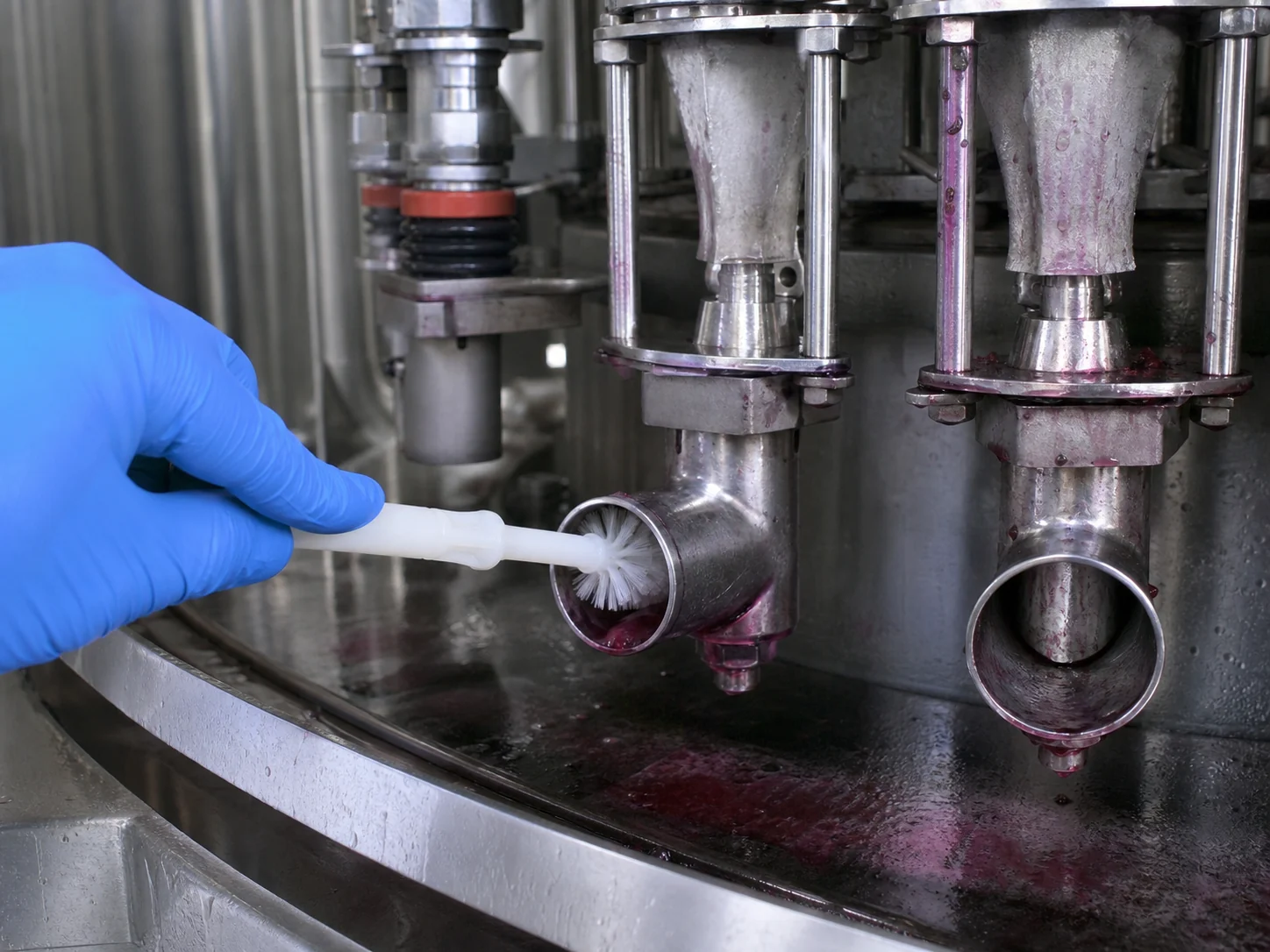
Beverage Filling Valve Cleaning
For Beverage Filling Valve Cleaning, the brush must reach the working area, disturb or collect syrup/fruit pulp/pigment/biofilm, and release it without creating unacceptable surface damage or process interference. The suitable brush structure depends on access, the required contact motion, and the cleaning method.
At a glance
- Cleaning target
- Syrup/Fruit Pulp/Pigment/Biofilm
- Working environment
- Wet Indoor Area / Beverage Filling Area
- Cleaning method
- Wet Brushing / Soaking / Steam Cleaning
- Requirements to check
- FDA 21 CFR Food-Contact Requirements; EU 10/2011; HACCP; Hygienic Filling-Line Cleaning Procedure
A filling valve has a seal groove and a spring cavity that syrup and pulp settle into, so valve brushes are small enough to enter those features and soft enough to leave the seal face intact.
What makes Beverage Filling Valve Cleaning different from other food and beverage cleaning?
The task is to remove Syrup/Fruit Pulp/Pigment/Biofilm while controlling surface damage, residue carryover, brush shedding and chemical or temperature degradation.
The work happens in wet indoor area and beverage filling area against syrup, fruit pulp, pigment and biofilm.
The part people get wrong: the residue tells you the filament, but the access opening tells you the construction. Get them in that order and the shortlist is short.
What are the most common cleaning targets in Beverage Filling Valve Cleaning?
5 targets, each with its own opening, residue and contact requirement.
| Part or area | Residue type | Cleaning requirement |
|---|---|---|
| Rotary Bottle-Filler Valve | Syrup, Fruit Pulp, Pigment, Biofilm | The brush must pass the full length of the passage and hold contact with the wall without folding over at the far end. |
| Can-Filler Valve | The head must reach the working face and apply even contact without marking the surface. | |
| Beer and Carbonated Beverage Valve | ||
| Juice and Aseptic Filling Valve | ||
| Filling-Nozzle and Seal-Groove | The head must be narrower than the opening and stiff enough to lift residue without splaying at the mouth. |
What the equipment leaves you to work inside:
| Parameter | Typical range |
|---|---|
| Contaminant | Syrup/Fruit Pulp/Pigment/Biofilm |
| Required hardness | Soft–Medium |
| Maximum temperature | 140°C |
| Chemical exposure | Acidic Cleaner pH 2–5; Alkaline Cleaner pH 10–13; Peracetic Acid |
| Cleaning method | Wet Brushing/Soaking/Steam Cleaning |
| Environment | Wet Indoor Area/Beverage Filling Area |
Which brush types work for each cleaning target?
Select hand, tube, strip, roller, disc or machine-mounted geometry from access and motion.
| Cleaning target | Recommended brush type | Why it fits |
|---|---|---|
| Rotary Bottle-Filler Valve | Tube & Pipe Bore Brushes | A filler valve is a short internal bore ending at a seat, so a bore brush entered through the spout cleans the seat face that flushing alone leaves coated. |
| Can-Filler Valve | Handheld Detail Brushes | A can-filler valve is cleaned in place on the machine, so a hand-guided head is used to reach the spout and the drip zone around it between runs. |
| Beer and Carbonated Beverage Valve | Beer valves carry a foam-control seat and gasket stack that traps yeast, so a hand-guided head works each part after strip-down without marking the seal face. | |
| Juice and Aseptic Filling Valve | Pulp settles in the valve body and dries there, so a hand-guided head lets the operator confirm by feel that the fibrous residue is gone before the aseptic sequence runs. | |
| Filling-Nozzle and Seal-Groove | The seal groove is a narrow ring sitting directly on the product path, so a fine head is worked around the groove to lift residue out of the corner. |
Hand brushes for the valve exteriors and the filler bowl with the machine drained, plus one small bore brush for the valve body itself.
In practical brush terms: match the construction to the access before anything else. A geometry that cannot reach the target will not be rescued by a better filament.
What filament materials work best for Beverage Filling Valve Cleaning?
PBT for the fill that goes inside the valve body, PP where the same brush is left soaking between shifts; both stay dimensionally stable through steam, which is what keeps the head sized to the valve bore.
| If the condition is… | Filament to start with | Why |
|---|---|---|
| Inside the valve body | PBT | stays at its trimmed diameter, so the head keeps fitting the bore |
| Left soaking in cleaner between shifts | Polypropylene PP | no swelling over long contact from pH 2 to pH 13 |
What the duty rules out before you start comparing grades:
| Constraint | Value for this application |
|---|---|
| Filament hardness | Soft–Medium |
| Maximum service temperature | 140°C |
| Chemical exposure | Acidic Cleaner pH 2–5; Alkaline Cleaner pH 10–13; Peracetic Acid |
| Cleaning method | Wet Brushing, Soaking, Steam Cleaning |
How do I choose the right brush for my beverage filling valve equipment?
Start with soft-to-medium fill, a 140°C ceiling and an acidic cleaner at pH 2–5, then size to the seal groove and the spring cavity.
Work through it in this order:
- Identify the target part and measure the access opening or clearance
- Describe the residue: what it is, how thick it sits, and how strongly it holds
- Choose the construction that can physically reach that target
- Set the filament from surface risk, working temperature and cleaning chemistry
- Fix filament diameter, free trim length and density for the contact pressure you need
- Run one cycle and check the result before committing to a production quantity
Before you commit to a quantity, send the valve bore, the seal-groove profile, the spring-cavity depth, and the product being filled.
When is a beverage filling valve brush the wrong tool?
Valves are normally cleaned in place by the CIP circuit, or stripped and run through a COP tank where every surface is reached. A seal or gasket that has hardened or scored is replaced, because brushing a worn seal face makes the leak worse.
What common mistakes should I avoid in Beverage Filling Valve Cleaning?
- Naming the filler without the valve’s seal-groove and spring-cavity dimensions
- Changing the filament while leaving excessive engagement, poor alignment or no discharge path unchanged
- Copying a worn brush without first recording its motion, direction, mounting and original working diameter
If the brush is already in service and the result is wrong, work from the symptom:
| Symptom | What to change |
|---|---|
| Residue remains | Increase discharge or relative motion before adding pressure |
| Surface marks | Reduce engagement and use finer/softer fill |
| Rapid wear | Check alignment, temperature and chemical attack |
| Redeposition | Add wash, vacuum or collection path |
Questions this page is asked
When may a beverage filling valve be cleaned with a manual brush?
Use manual contact only after the filler and valve are placed in the manufacturer-authorized safe maintenance state and the identified component is accessible or removed under the hygienic procedure. Do not insert a brush into an operating valve or treat manual reach as a substitute for the validated CIP flow, actuation, chemistry, temperature and time.
What controls a brush used on beverage-valve product-contact parts?
The complete tool must be cleanable, inspectable, compatible with the actual cleaner and temperature, and identifiable for its approved area without inaccessible joints that retain product. Clean, rinse, dry and protect it after use, and retire it for loose fill, damaged cores, trapped residue, chemical attack or any missing component.
How is a filling valve released after brush-assisted cleaning?
Inspect the seat, seal, passages and threads for residue and brush parts, reassemble with accepted components, and complete the prescribed rinse, sanitation or sterilization sequence. Return the filler to production only when the valve actuation, drainage and cleaning-verification results meet the line's documented release criteria.
Guides that go deeper on this
No catalogue item for this yet
Every brush here is made to order, and this one has no catalogue entry so far. Send the working surface, the residue, the access opening and the quantity, and it is quoted through the same specification route as the rest of the range.
Custom Manufacturing RFQ
Discuss This Application
Share the working surface, residue, dimensions, material direction, interface, quantity and drawing or sample photo.
Custom Brush RFQ
Request a Custom Cleaning Brush Quote
Upload a drawing, product photo, or sample photo and provide the core dimensions and cleaning conditions.
“We need a brush to remove wet residue from a stainless steel conveyor, about 800mm wide. The current brush wears quickly. We can send photos.”
“We sell drinkware and need a cleaning brush to include with the product. Quantity around 5,000 pieces.”