
Custom Cleaning Brush
Container Filling Nozzle Brush
Small-diameter PBT and nylon nozzle brushes for cleaning filling nozzles, valve ports, and narrow product-contact bores. Custom diameters from 0.5 mm.
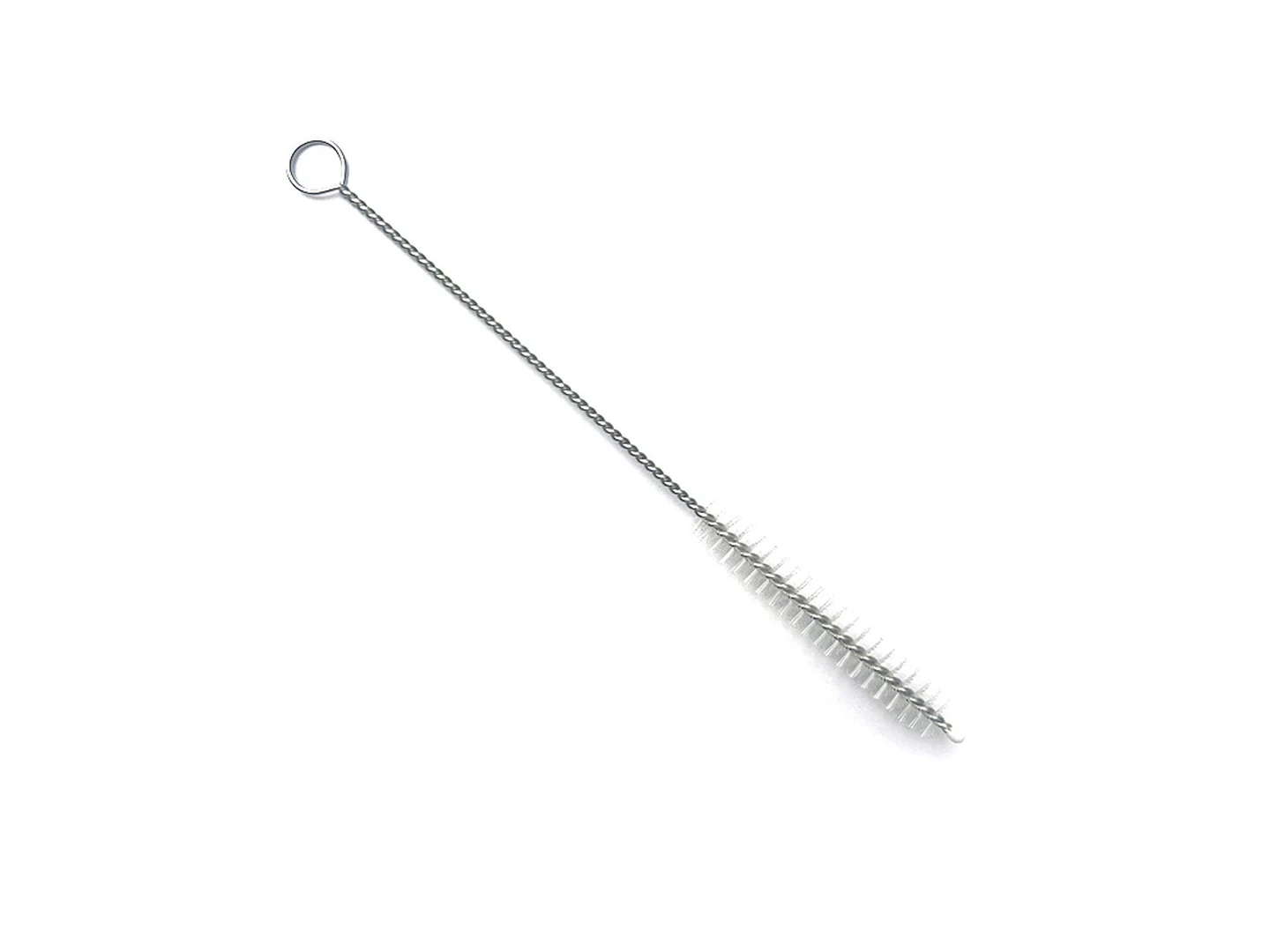
Small brush
500 pcs
Minimum order
Held in one hand: tube, bottle, detail and swab brushes — including long-handled ones with a small head.
Production lead time, once the specification is confirmed
- Up to 500 pcsWithin 7 days
- 501–50,000 pcsWithin 14 days
- Over 50,000 pcsWithin 21 days
Peak season can extend these times; the shipping date is confirmed in writing with your quotation. Sampling and shipping are quoted separately.
A small-diameter twisted-in-wire brush designed to scrub the internal bores, ports, threads, and product-contact passages of container filling nozzles and valve outlets. It removes product film, beverage residue, biofilm, powder, and odor-causing deposits from surfaces that spray balls, wipes, and swabs cannot reach.
What can this brush do for you?
Reaches narrow product-contact passages that cloths and spray systems miss
With brush diameters starting at 0.5 mm and filament diameters down to 0.03 mm, this brush enters filling nozzle bores, valve ports, and small orifices where wipes cannot follow the inside contour. The twisted stainless steel wire core holds the filament radially, so rotating push-pull strokes scrub the full circumference of the bore instead of wiping only the entry area.
Contact pressure is set by size, not by operator force
We match the brush diameter to the nozzle ID rather than using one generic diameter. Near-size contact wipes light liquid film without scraping; a fill 5–20 percent larger than the bore provides flexible polymer scrub pressure for dried or viscous residue. The result is repeatable cleaning with less risk of the operator over-pressing and marking the surface.
PBT or nylon PA filament matches the residue and the surface finish
PBT filament holds its stiffness when wet and after repeated exposure to many cleaning chemicals, making it suited to hardened product film and bores that need consistent scrub action. Nylon PA filament is softer and more compliant, so it is selected when the nozzle or valve has a polished finish or a coating that must not be marked. Both filaments release product residues easily during rinsing.
Stainless steel core holds shape without making metal contact
The SUS304 wire core resists corrosion in wet filling-room conditions and provides enough rigidity to guide the brush through a straight or angled bore. It can be formed straight or with a preset bend for angled nozzles. Because the filament fill projects beyond the core, product-contact surfaces are cleaned by polymer, not by the metal stem.
Works as a hand tool or mounts to a rotary driver
Loop ends, ferrules, 6 mm shanks, and molded grips let the same cleaning head be used manually, hung at the filling station, or mounted in a rotary actuator. Specify the interface when ordering so the brush fits the operator’s existing cleaning routine.
What is a Container Filling Nozzle Brush?
A container filling nozzle brush is a cylindrical twisted-in-wire cleaning tool built for the inside of filling heads, discharge nozzles, valve outlets, and other narrow product pathways on liquid or powder filling lines. Its core is a stainless steel wire twisted around PBT or nylon PA filament, producing a radial brush section that reaches the bore walls as the tool is rotated and moved in and out.
The brush is not a general bottle brush. It is sized so the filament fill is only slightly larger than the orifice being cleaned, which keeps contact against the wall without jamming or exposing the metal core to the nozzle surface. During cleaning, the operator inserts the brush to the full working length, rotates it, and withdraws with a light twisting motion. The open helix of the twisted wire lets water or cleaning solution pass through, flushing loosened residue out of the nozzle instead of trapping it behind a solid head.
This is a mechanical hygiene tool for product-contact surfaces, not a replacement for chemical cleaning, sanitization, or descaling. It removes attached film and loose residue; hard mineral scale or baked-on product may require a chemical step before or in combination with brushing.
Technical Specifications
| Parameter | Value / Options |
|---|---|
| Brush diameter | 0.5–20 mm, selected to match nozzle ID; multiple sizes available |
| Working length | 5–50 mm, set to cover the bore depth |
| Overall length | 80–250 mm, including handle or shank |
| Stem diameter | 0.3–2.0 mm, stainless steel wire core |
| Filament diameter | 0.03–0.25 mm, controls stiffness and contact pressure |
| Filament material | PBT or Nylon PA, selected for residue and surface |
| Core material | Stainless steel wire (SUS304; 316 available for aggressive media) |
| Handle / shank | Loop, ferrule, 6 mm shank, molded grip, or custom interface |
| Contact fit | Near-size for wiping; 5–20% oversize for flexible polymer scrubbing; lower interference when the core must stay recessed |
| Filament trim / pattern | Straight trim, spiral, tapered, or partial fill to suit the nozzle geometry |
| Brush type | Custom Tube & Pipe Bore Brushes |
| How it is driven | Hand-guided |
| Cleaning target | beverage filling line, food and sauce filling equipment, and pharmaceutical and cosmetic filling cleaning |
| Surface or part | nozzles, bores, filling nozzles, valves, passages, thread, ports, and containers |
| Residue or debris | powder, product film, biofilm, beverage residue, scale, mineral scale, fine powder, and granules |
| Mounting / connection | Loop, ferrule, 6 mm shank, molded grip, or custom interface |
The two dimensions that decide whether the brush works are the brush diameter and working length. If the nozzle has an internal step, shoulder, or thread section, provide those dimensions so we can set the brush profile to match each section.
Where does this brush work best?
- Beverage filling lines — water, juice, carbonated drinks, dairy, and beer filling nozzles where product film and odor build up inside the bore and on the threads between production runs.
- Food and sauce filling equipment — valve outlets and small ports where viscous product dries, hardens, or supports biofilm growth, affecting fill accuracy and hygiene.
- Pharmaceutical and cosmetic filling — product-contact orifices and dosing nozzles that need manual cleaning between batches, where fiber-shedding swabs or oversized brushes are not acceptable.
- Powder and granule filling machines — fill tubes and dispensing nozzles where fine powder packs against the wall or absorbs moisture and forms deposits.
- Spray and dosing nozzles — internal passages that create the spray pattern, where partial blockage changes flow rate and coverage.
How do I choose the right one?
Start by measuring the nozzle’s minimum internal diameter and bore depth. The brush diameter should be near the ID for a wiping action or up to 20 percent larger for flexible polymer scrubbing; the working length should cover the full bore without extending far past the outlet. If the nozzle has an internal step or a narrower throat, use the narrowest section to set the diameter and vary the fill along the length.
Next, choose the filament material. Use PBT when the residue is sticky, dried, or needs continuous scrub pressure and the cleaning solution is compatible with PBT. Use Nylon PA when the surface is polished, coated, or softer than the residue’s hardness demands. If the cleaning chemical is strongly alkaline, acidic, or solvent-based, give us the chemical name and concentration so we can verify the filament grade.
Then decide how the brush will be used. For hand cleaning, a loop handle is easy to hang and control, while a molded grip reduces fatigue during repetitive station cleaning. For motorized or automated cleaning, specify a ferrule or 6 mm shank with the correct length and a diameter that fits the driver collet. For angled nozzles, request a preset bend in the core.
Consider another tool when the bore is below 0.5 mm, the residue is hard mineral scale that requires acid or ultrasonic cleaning, or the surface cannot tolerate any abrasive contact. This brush is a polymer-filament cleaning tool for product-contact passages; it is not a wire brush for heavy scale removal, nor a chemical cleaner, nor a swab for single-use validation.
Can I customize this brush?
Most container filling nozzle brush orders are custom because nozzle IDs, bore lengths, thread profiles, and cleaning chemicals differ between filling lines. To define the configuration, send the nozzle ID, bore depth, internal features, residue type, cleaning solution, wash temperature, and whether the brush will be used by hand or on a driver. A drawing or existing brush sample speeds up the process.
We can adjust:
- Brush dimensions — diameter, working length, overall length, and stepped or tapered profiles for bores with multiple diameters.
- Filament — PBT or Nylon PA, filament diameter from 0.03–0.25 mm, trim pattern, and fill density.
- Core — SUS304 or 316 stainless steel, stem diameter, straight or preset bend, single or double-wire construction.
- Handle / interface — loop, ferrule, shank diameter and length, molded grip, hanging feature, or quick-change adapter for automation.
- Identification — custom colors, pad print, laser engraving, or color coding by filling station.
- Packaging — bulk cartons, individually bagged, labeled per nozzle location, or kit boxes.
If your project requires material declarations, third-party testing, inspection support, or documentation for validation, we can assist with those requirements during customization.
Which filament survives the cleaning and still lasts on a container filling nozzle brush?
How can I verify the brush cleaned the entire nozzle bore?
Clean the nozzle using normal rotation and full-length strokes, then inspect the bore with a bore light or borescope. Wipe the inside with a clean white lint-free swab; any visible residue, discoloration, or odor means the brush diameter, working length, or filament stiffness needs adjustment.
Will the stainless steel core scratch the inside of a plastic or stainless nozzle?
When the brush is sized correctly, the filaments project beyond the core and make the contact. If the bore is very narrow or the brush is inserted at an angle, the core can touch the wall. Use a near-size fill, softer nylon filament, or a preset bend for angled entry. For extremely narrow or sensitive bores, ask us about a reduced-interference configuration.
Should I use a metal wire brush for stubborn scale inside a filling nozzle?
Generally no. Metal wire brushes risk leaving metal particles in product-contact areas and can scratch or gall the bore. Remove hard scale with chemical cleaning, ultrasonic treatment, or a descaling step first, then use this polymer-filament brush to wipe the loosened residue. Metal brushing should be reserved for non-product surfaces where metal contamination is not a concern.
Can the brush stay in the nozzle between production runs?
No. This brush is a cleaning tool, not a process component. Remove it after cleaning, rinse the brush, and store it dry. Leaving it inside a nozzle can trap moisture and product, block flow, or shed filaments into the next batch.
How often should filling nozzle brushes be replaced?
There is no fixed number, but schedule replacement by cycle count or daily visual inspection. Replace the brush when the diameter no longer makes firm contact with the bore, filaments show shedding or matting, the core is bent or corroded, or the handle connection is loose. In high-frequency filling lines, consistent replacement timing is more reliable than waiting for visible failure.
Guides that go deeper on this
We have not written a guide specific to this one yet. The material that covers selection, filament, dimensions, maintenance and sourcing is collected in the technical resources library.
Custom Manufacturing RFQ
Describe Your Application
To prepare the correct quotation, provide the dimensions, cleaning task, residue, material, mounting details, quantity, and a drawing or photo.
Drawing or photo optional — it speeds things up, it does not gate the enquiry.
Custom Brush RFQ
Send Your Brush Project
Upload a drawing, product photo, or sample photo and provide the core dimensions and cleaning conditions.
“We need a brush to remove wet residue from a stainless steel conveyor, about 800mm wide. The current brush wears quickly. We can send photos.”
“We sell drinkware and need a cleaning brush to include with the product. Quantity around 5,000 pieces.”