
Custom Cleaning Brush
Nozzle Cleaning Brush
Custom nozzle cleaning brushes with 1.5–7 mm diameter, nylon PA/PBT filaments, and loop, ferrule, or molded handles.
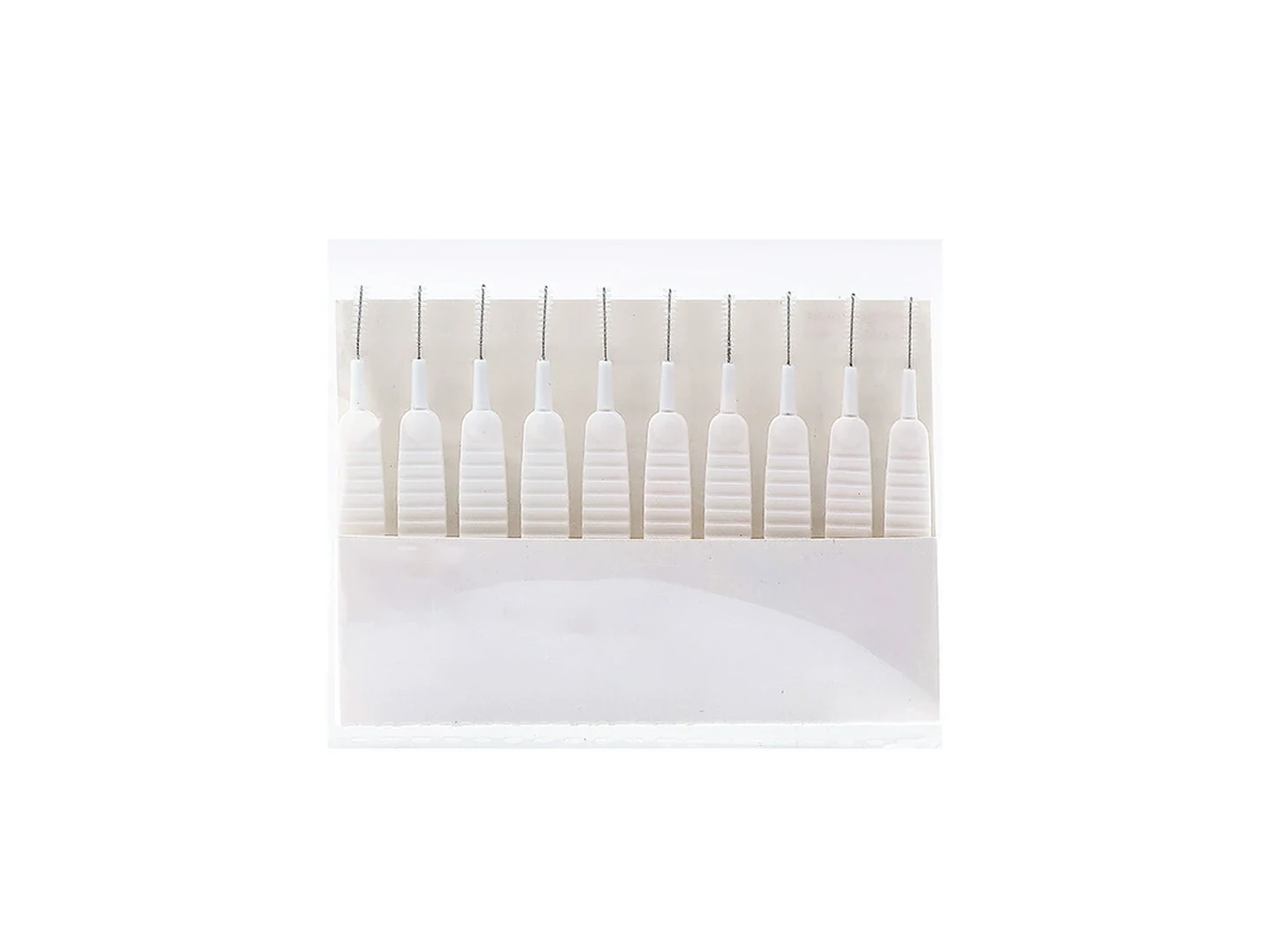
Small brush
500 pcs
Minimum order
Held in one hand: tube, bottle, detail and swab brushes — including long-handled ones with a small head.
Production lead time, once the specification is confirmed
- Up to 500 pcsWithin 7 days
- 501–50,000 pcsWithin 14 days
- Over 50,000 pcsWithin 21 days
Peak season can extend these times; the shipping date is confirmed in writing with your quotation. Sampling and shipping are quoted separately.
A small-diameter twisted-in-wire brush built to enter nozzle tips, orifice passages, and narrow bores that regular brushes cannot reach. Nylon PA or PBT filaments clean carbon, filament residue, and dried material from internal contact surfaces without scratching the surrounding metal.
What can this brush do for you?
Accesses Orifices Down to 1.5 mm Without Disassembly
Brush diameters start at just 1.5 mm and stems as fine as 0.3 mm, so the brush enters the actual hole, not just the area around it. For 3D printer nozzles, dispensing tips, and precision orifices, this means you can remove residue from the passage itself instead of soaking the entire assembly or pushing debris further in.
Filament Contact Protects Precision Surfaces
The nylon PA or PBT filaments are captured around a twisted stainless steel core, keeping the wire recessed during normal use. The contact surface is the filament, not the metal core, so brass, plated, and machined bores stay free of wire scratches and scoring while light deposits are wiped away.
Follows Short Curved and Angled Passages
The twisted wire core flexes enough to follow slight bends and angled entries in hoses, fittings, and internal channels. The short 5–50 mm working length focuses the cleaning action on the blocked zone rather than dragging filament across regions that do not need contact.
Withstands Solvent-Assisted and Warm Nozzle Cleaning
Nylon PA and PBT both tolerate many common cleaning solvents and detergents, and the filament material can be selected for the temperature range of the nozzle or process. Specify PBT when the cleaning environment involves stronger chemical exposure or sustained heat above what nylon handles comfortably.
Simple Handling for Repeated Manual Use
Loop handles, straight ferrules, 6 mm shanks, and molded grips let the operator hold, rotate, and reciprocate the brush with controlled pressure. In high-contamination settings, the brush is economical enough to be treated as a consumable and replaced before filament wear transfers load to the wire core.
What is a Nozzle Cleaning Brush?
A Nozzle Cleaning Brush is a small hand-guided brush made by capturing filament between twisted stainless steel wires, forming a radial cleaning surface around a semi-flexible core. It is designed for the internal cleaning of nozzle tips, orifice passages, dispensing needles, sockets, short hoses, and similar small openings where standard brushes or cloths cannot enter.
In use, the operator inserts the brush into the passage and applies short rotating and reciprocating strokes. The filaments sweep carbon, plastic residue, dried adhesive, dirt, and other contaminants from the internal wall; the twisted core keeps the brush straight enough to push, but flexible enough to follow minor bends.
This is a wiping and light scrubbing tool for accessible bores, not a reamer or a powered drill attachment. It removes lodged material best when the bore can accept the filament with light interference. Using excessive force, or a brush that is too large for the hole, only bends the core and reduces cleaning contact.
Technical Specifications
The dimensions below are typical for our standard production. We adjust brush diameter, working length, stem size, and handle configuration to your nozzle or orifice drawing.
| Parameter | Typical Range / Options |
|---|---|
| Brush diameter | 1.5–7 mm, selected to match the bore or orifice ID |
| Working length | 5–50 mm, matched to the depth of the blocked zone |
| Overall length | 80–250 mm including handle or shank |
| Stem / core diameter | 0.3–2.0 mm twisted stainless steel wire |
| Filament diameter | 0.03–0.25 mm; finer for light films, coarser for tenacious buildup |
| Filament material | Nylon PA (PA6 or PA612) or PBT |
| Handle / shank | Loop handle, straight ferrule, 6 mm shank, or molded grip |
| Contact recommendation | Near-size fit for wiping; 5–20% oversize with nylon/PBT for flexible scrubbing |
| Core material | SUS304 stainless steel wire; other grades or coated wire on request |
| Brush type | Custom Handheld Detail Brushes |
| How it is driven | Hand-guided |
| Cleaning target | fdm 3d printer nozzle and hot-end bore, sealant dispensing tip and needle, and carburetor jet and small-engine fuel passage cleaning |
| Surface or part | passages, nozzles, bores, plastic, nozzle tip, holes, metal, and internal passages |
| Residue or debris | carbon, plastic residue, adhesive, filament residue, coffee, coffee oil, milk film, and grease |
| Mounting / connection | Loop handle, straight ferrule, 6 mm shank, or molded grip |
If your passage is tapered, stepped, or has a specific residue profile, send the bore drawing and we will propose a brush that matches the narrowest section and the area that must be cleaned.
Where does this brush work best?
- FDM 3D printer nozzles and hot-end bores — removing hardened plastic residue and carbon from the exit orifice and internal melt chamber where a scraper cannot reach.
- Adhesive, grease, and sealant dispensing tips and needles — clearing dried product from small-diameter tips before it cures and blocks the opening.
- Carburetor jets and small-engine fuel passages — wiping varnish and dirt from tiny metering orifices without enlarging them.
- Welding torch contact tips and gas nozzle openings — cleaning spatter-free passages and removing light oxide buildup.
- Laboratory tubing, fittings, and pipette tips — clearing dried media and residue from short internal passages that must remain scratch-free.
- Coffee machine steam wands and group head nozzles — removing milk film and coffee oils from narrow dispensing holes between use cycles.
How do I choose the right one?
Measure the narrowest internal diameter first
The brush diameter should be near the bore ID for a wiping action, or slightly larger — normally 5–20% oversize with flexible nylon/PBT filament — when you need light scrubbing. If the brush binds, folds over, or requires excessive push force, it is too large for the passage.
Set the working length to the actual blocked zone
The working length only needs to cover the area where deposits accumulate. Too long and the unsupported filament section can fold or drag against surfaces that should not be touched. For deep passages beyond 50 mm, consider a longer-reach tube or stem brush instead.
Match the filament material to residue and chemistry
| Cleaning condition | Recommended filament |
|---|---|
| Soft carbon, plastic residue, mild detergent | Nylon PA |
| Stronger solvent exposure or higher sustained temperature | PBT |
| Hard scale, corrosion, or fused metal deposits | Use a wire or abrasive brush — this polymer brush will not remove it |
Choose filament diameter for the residue type
Fine filaments in the 0.03–0.10 mm range are best for light films and delicate orifices where surface finish matters. Coarser filaments up to 0.25 mm give more aggressive wiping for tenacious but soft material. Avoid coarse polymer filament in precision fuel or gas orifices where bore geometry must not change.
Select the handle or shank for your process
Choose a loop handle for operator fingertip rotation, a straight ferrule for low-clearance hand use, or a 6 mm shank when the brush mounts into a holder or rotary tool. A molded grip improves ergonomics for repeated manual cycles.
When to use a different cleaning tool
If the bore is below about 1.5 mm, use a cleaning wire or pin rather than a filament brush. If the residue is hard scale, corrosion, or weld spatter, a stainless or brass wire brush is the better choice. If cross-contamination is the main concern, use a single-use swab or applicator. If the passage is long and narrow, use a tube brush with a longer working section.
Can I customize this brush?
Nozzle cleaning brushes are configurable because every orifice is different. Send the bore ID, passage depth, surface material, residue type, cleaning chemical and temperature, and the handle interface you need. A drawing, photo, or used nozzle sample speeds up the dimensional match.
We can adjust:
- Dimensions — brush diameter, working length, overall length, stem diameter, and filament trim profile
- Filament — nylon PA or PBT, filament diameter, filament length/density, color, and optional anti-static or metal-detectable grades
- Core — SUS304 or other stainless grades, coated wire, or a metal-free polymer stem for specialized requirements
- Handle / shank — loop, ferrule, 6 mm shank, molded grip, hanging feature, or molded branding
- Marking — pad print, laser marking, or color coding for size identification
- Packaging — bulk, individually bagged, retail sleeve, kit, or project-specific packing
If your project requires material declarations, inspection documentation, or third-party testing support, we can assist with those requirements during the customization process.
What size should a nozzle cleaning brush be, and how long does it last?
How can I tell whether the brush diameter is right before using it?
Insert the dry brush into the bore with light hand pressure. It should slide in with slight resistance and recover its shape when withdrawn. If the wire core kinks or the brush cannot enter, it is too large. If it falls through without touching the wall, it is too small and will not clean the surface.
Should I clean the nozzle dry or use a solvent?
For loose powder and soft film, dry brushing is usually enough. For cured adhesive, thickened oil, or heat-degraded plastic, pair the brush with a compatible solvent or cleaner. Confirm solvent compatibility with the filament material — PBT is generally the safer option for aggressive chemical exposure.
How do I know when the brush should be replaced?
Check for flattened, missing, or splayed filaments, exposed wire core, and permanent core bends. When the brush no longer provides even contact pressure, or the wire begins touching the bore wall, replace it. Using a worn brush transfers load to the metal core and risks scratching the surface.
Can this brush be autoclaved or used in high-heat cleaning?
Nylon PA withstands intermittent warm water and moderate process temperatures, but PBT is the better choice for sustained heat or steam-assisted cleaning cycles. Specify the actual temperature and exposure time, and we will confirm the suitable material or recommend an alternative.
Does brushing replace a purge cycle or solvent soak?
No. Brushing removes lodged, attached residue from the passage wall, but loosened material still needs to be flushed, purged, or rinsed out. For blocked nozzles, use the brush as part of the full cleaning sequence: mechanical removal first, then purge or flush, then verify flow.
What is the smallest passage this brush can clean?
The smallest standard brush diameter is 1.5 mm, which suits bores from approximately 1.5 mm and larger depending on interference. For passages below 1.5 mm, a cleaning wire or pin tool is the appropriate choice.
Guides that go deeper on this
Custom Manufacturing RFQ
Describe Your Application
Please share the brush dimensions, working area, residue type, material direction, quantity, and a drawing or photo for quotation.
Drawing or photo optional — it speeds things up, it does not gate the enquiry.
Custom Brush RFQ
Send Your Brush Project
Upload a drawing, product photo, or sample photo and provide the core dimensions and cleaning conditions.
“We need a brush to remove wet residue from a stainless steel conveyor, about 800mm wide. The current brush wears quickly. We can send photos.”
“We sell drinkware and need a cleaning brush to include with the product. Quantity around 5,000 pieces.”