
Application
Dairy CIP Pipeline Cleaning
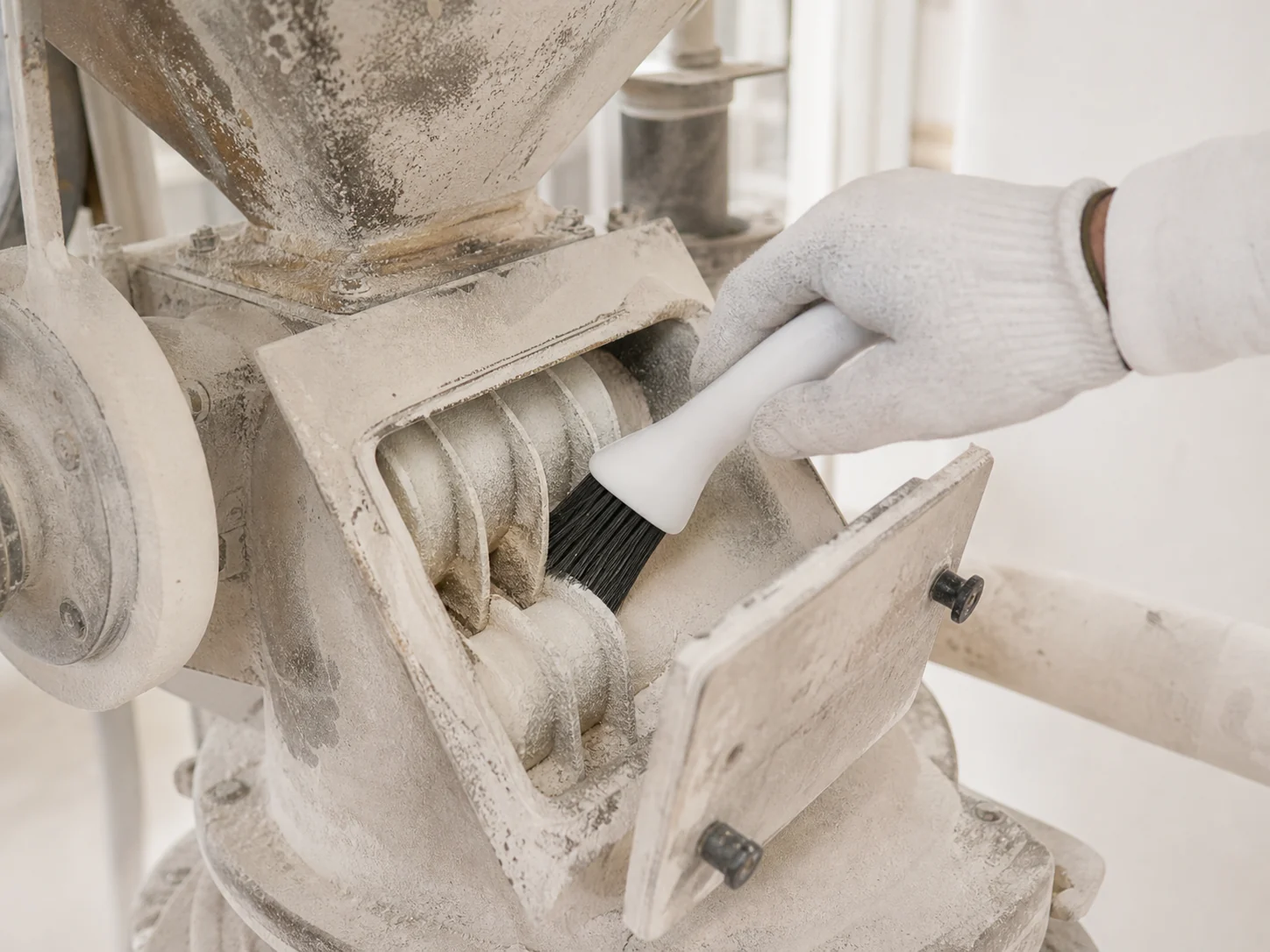
For Dairy CIP Pipeline Cleaning, the brush must reach the working area, disturb or collect milk fat/protein/milkstone/biofilm, and release it without creating unacceptable surface damage or process interference. Access space, brush movement, and cleaning method are the main factors in selecting the structure.
At a glance
- Cleaning target
- Milk Fat/Protein/Milkstone/Biofilm
- Working environment
- Wet Indoor Area / Hygienic Piping
- Cleaning method
- Wet Brushing / Soaking / Steam Cleaning
- Requirements to check
- 3-A Sanitary Standards; EHEDG Hygienic-Design Principles; FDA 21 CFR; EU 10/2011
CIP flow scours straight pipe reliably and bends, valves and dead legs unreliably, so pipeline brushes exist for exactly the parts of the circuit the flow does not reach.
What makes Dairy CIP Pipeline Cleaning different from other food and beverage cleaning?
The task is to remove Milk Fat/Protein/Milkstone/Biofilm while controlling surface damage, residue carryover, brush shedding and chemical or temperature degradation.
The work happens in wet indoor area and hygienic piping against milk fat, protein, milkstone and biofilm.
The part people get wrong: the surface, the residue and the access opening decide the brush together. Fix on any one of them alone and the geometry comes out wrong.
What are the most common cleaning targets in Dairy CIP Pipeline Cleaning?
The work breaks into 5 targets. They look similar from outside the machine and behave nothing alike at the brush.
| Part or area | Residue type | Cleaning requirement |
|---|---|---|
| Milk Transfer-Line | Milk protein, dried film and fat deposits | The brush must pass the full length of the passage and hold contact with the wall without folding over at the far end. |
| Milking-System Pipeline | Milk Fat, Protein, Milkstone, Biofilm | The head must reach the working face and apply even contact without marking the surface. |
| Filler and Valve Circuit | ||
| CIP Supply and Return Line | The brush must pass the full length of the passage and hold contact with the wall without folding over at the far end. | |
| Dairy Heat-Exchanger Tube | Milk protein, dried film and fat deposits |
What the equipment leaves you to work inside:
| Parameter | Typical range |
|---|---|
| Contaminant | Milk Fat/Protein/Milkstone/Biofilm |
| Required hardness | Medium |
| Maximum temperature | 140°C |
| Chemical exposure | Nitric Acid/Phosphoric Acid pH 1–3; Caustic Soda pH 11–14; Peracetic Acid |
| Cleaning method | Wet Brushing/Soaking/Steam Cleaning |
| Environment | Wet Indoor Area/Hygienic Piping |
Which brush types work for each cleaning target?
Select hand, tube, strip, roller, disc or machine-mounted geometry from access and motion.
| Cleaning target | Recommended brush type | Why it fits |
|---|---|---|
| Milk Transfer-Line | Tube & Pipe Bore Brushes | A transfer line is a long closed bore where protein bakes onto the wall, so a bore brush pushed its full length removes what the wash chemistry leaves behind. |
| Milking-System Pipeline | Handheld Detail Brushes | The milking line breaks down into clusters, jars and short bends, so a hand-guided head cleans each piece and its seal face after strip-down. |
| Filler and Valve Circuit | A valve circuit is a stack of seats and gaskets, so a hand-guided head cleans each seal face without changing its geometry. | |
| CIP Supply and Return Line | Tube & Pipe Bore Brushes | The CIP line itself carries scale and biofilm that its own wash cannot remove, so a bore brush is run through it during scheduled strip-down. |
| Dairy Heat-Exchanger Tube | An exchanger tube is narrow, long and heated, so protein sets fast on the wall and only a close-fitting bore brush touches all of it. |
The three bore brushes go where CIP flow alone will not reach — dead legs, valve bodies, heat-exchanger tubes; the two hand brushes are for gaskets and clamp faces once the circuit is broken.
In practical brush terms: match the construction to the access before anything else. A geometry that cannot reach the target will not be rescued by a better filament.
What filament materials work best for Dairy CIP Pipeline Cleaning?
PBT and PP survive the full CIP swing from nitric acid at pH 1–3 to caustic at pH 11–14; 316 stainless is used for fittings and any wire section, because milkstone removal is a daily cycle and 304 will pit.
| If the condition is… | Filament to start with | Why |
|---|---|---|
| Nitric or phosphoric acid at pH 1–3 | PBT | no attack at the acid end of the cycle |
| Caustic at pH 11–14 in the same cycle | Polypropylene PP | holds up where nylon hydrolyses |
| Fittings and any wire section | Stainless Steel 316 Wire | 304 pits under daily milkstone removal |
What the duty rules out before you start comparing grades:
| Constraint | Value for this application |
|---|---|
| Filament hardness | Medium |
| Maximum service temperature | 140°C |
| Chemical exposure | Nitric Acid/Phosphoric Acid pH 1–3; Caustic Soda pH 11–14; Peracetic Acid |
| Cleaning method | Wet Brushing, Soaking, Steam Cleaning |
How do I choose the right brush for my dairy cip pipeline equipment?
Start with medium fill, a 140°C ceiling and nitric or phosphoric acid at pH 1–3, then size to the bends, valves and dead legs the flow misses.
The sequence that gets a usable sample first time:
- Identify the target part and measure the access opening or clearance
- Describe the residue: what it is, how thick it sits, and how strongly it holds
- Choose the construction that can physically reach that target
- Set the filament from surface risk, working temperature and cleaning chemistry
- Fix filament diameter, free trim length and density for the contact pressure you need
- Run one cycle and check the result before committing to a production quantity
Before you commit to a quantity, send the line bore, the bend and valve positions, the dead-leg lengths, and the CIP chemistry.
When is a dairy cip pipeline brush the wrong tool?
The CIP cycle with its acid and caustic steps is the validated method, and milkstone is dissolved rather than scrubbed. Brushing is reserved for fittings and dead legs the flow demonstrably does not scour, and a line that cannot be cleaned in place is dismantled.
What common mistakes should I avoid in Dairy CIP Pipeline Cleaning?
- Giving line length without the bends, valves and dead legs the brush is actually for
- Changing the filament while leaving excessive engagement, poor alignment or no discharge path unchanged
- Copying a worn brush without first recording its motion, direction, mounting and original working diameter
If the brush is already in service and the result is wrong, work from the symptom:
| Symptom | What to change |
|---|---|
| Residue remains | Increase discharge or relative motion before adding pressure |
| Surface marks | Reduce engagement and use finer/softer fill |
| Rapid wear | Check alignment, temperature and chemical attack |
| Redeposition | Add wash, vacuum or collection path |
Questions this page is asked
Where does manual brushing belong in a dairy pipeline CIP program?
Use it only for an authorized accessible or removed component that the validated CIP flow cannot clean adequately, with the line isolated and opened under the hygienic-maintenance procedure. Do not insert an unsecured brush into an operating closed circuit or treat manual reach as a substitute for verified flow, chemistry, time and temperature.
What makes a manual dairy-pipeline brush suitable for hygienic use?
The complete tool must be cleanable, inspectable, corrosion and chemistry compatible, free of inaccessible soil traps, and identifiable for its approved product-contact area. Control it through cleaning, drying, protected storage and replacement for loose fill, damaged cores, staining, chemical attack or any loss of cleanability.
How is a dairy line released after a manual brush intervention?
Reassemble the component hygienically, complete the approved rinse and sanitation sequence, and verify absence of retained brush parts, cleaner and target residue by the plant's defined inspection or test. Restore production only after CIP parameters, rinse acceptance, seals and flow path meet the documented release criteria.
Guides that go deeper on this
We have not written a guide specific to this one yet. The material that covers selection, filament, dimensions, maintenance and sourcing is collected in the technical resources library.
No catalogue item for this yet
Every brush here is made to order, and this one has no catalogue entry so far. Send the working surface, the residue, the access opening and the quantity, and it is quoted through the same specification route as the rest of the range.
Custom Manufacturing RFQ
Discuss This Application
Share the working surface, residue, dimensions, material direction, interface, quantity and drawing or sample photo.
Custom Brush RFQ
Request a Custom Cleaning Brush Quote
Upload a drawing, product photo, or sample photo and provide the core dimensions and cleaning conditions.
“We need a brush to remove wet residue from a stainless steel conveyor, about 800mm wide. The current brush wears quickly. We can send photos.”
“We sell drinkware and need a cleaning brush to include with the product. Quantity around 5,000 pieces.”