
Custom Cleaning Brush
Stainless Steel Sanitary Equipment Cleaning Brush
Stainless steel sanitary equipment cleaning brush with synthetic bristles for food, beverage, dairy, pharma and cosmetic lines.
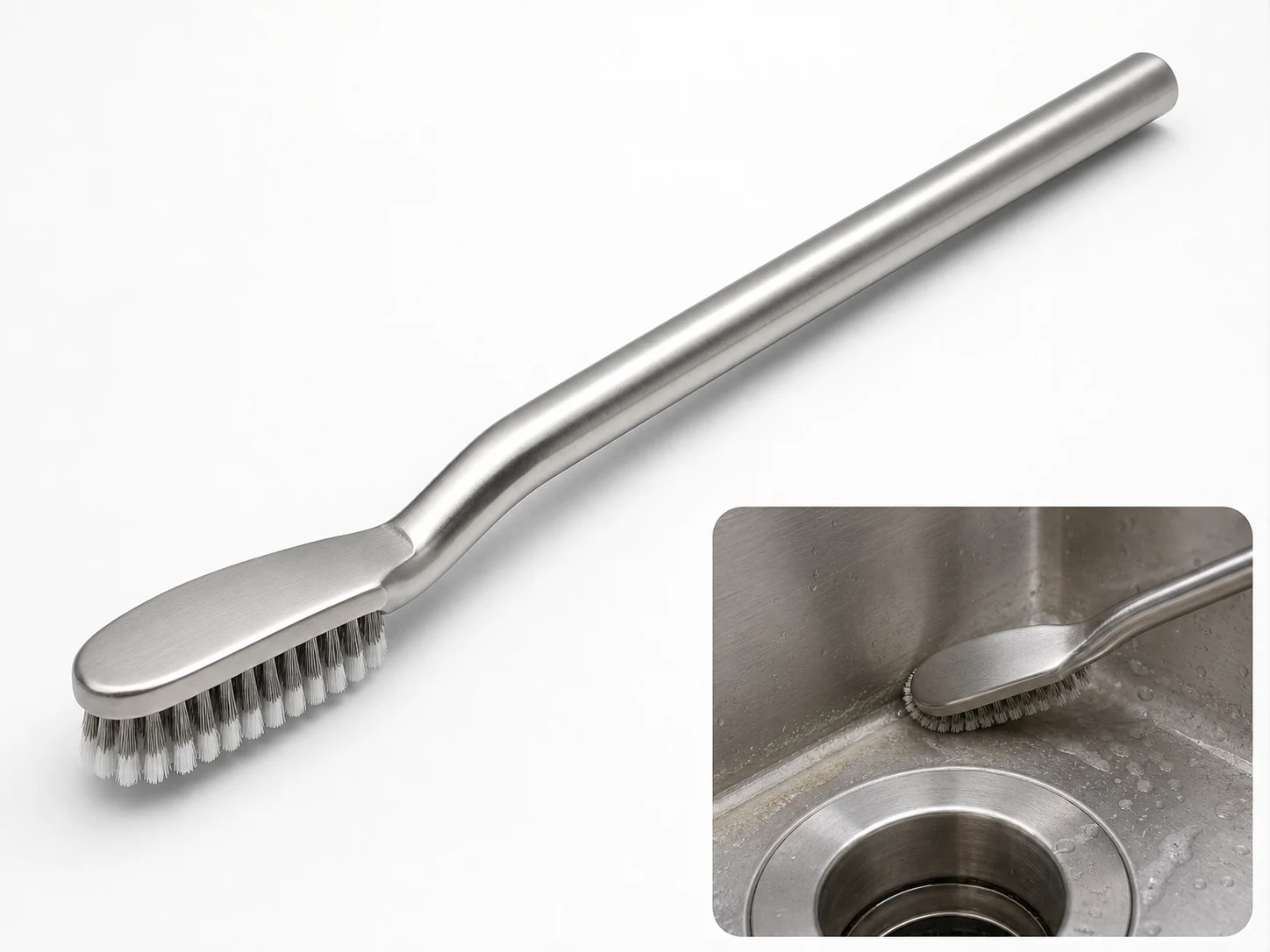
Small brush
500 pcs
Minimum order
Held in one hand: tube, bottle, detail and swab brushes — including long-handled ones with a small head.
Production lead time, once the specification is confirmed
- Up to 500 pcsWithin 7 days
- 501–50,000 pcsWithin 14 days
- Over 50,000 pcsWithin 21 days
Peak season can extend these times; the shipping date is confirmed in writing with your quotation. Sampling and shipping are quoted separately.
A stainless steel-handled cleaning brush with synthetic bristles for hygienic equipment surfaces. Built for food, beverage, dairy, pharmaceutical, and cosmetic lines, it removes grease, soap film, product residue, and loose fouling from pipe exteriors, fittings, railings, and stainless steel panels without introducing metal fragments into the production area.
What can this brush do for you?
Keeps metal fragments out of the production area
The bristle fill is polyester or polypropylene, not stainless steel wire. That choice matters in food and pharmaceutical plants where a broken wire bristle can become a foreign-matter contamination event. The brush still requires routine inspection, but it removes the risk of ferrous slivers lodging in pump seals, valve seats, or finished product.
Reaches the seams, ferrules, and fittings where residue hides
Pipe exteriors, Tri-Clamp joints, threaded connections, valve bodies, and equipment feet trap grease, soap film, and product build-up. A narrow angled block, contoured head, or pointed detail tip lets an operator work into these confined areas instead of only wiping the easy flat panel.
Survives aggressive washdown and repeated sanitizing
The 304 or 316 stainless steel handle and body resist corrosion from hot water, alkaline detergents, and quaternary ammonium sanitizers. The synthetic bristles keep their shape and stiffness through repeated wet-dry cycles better than natural fiber fills, so the brush remains effective after months of daily use.
Cleans without scarring polished or passivated stainless
Synthetic bristles can be selected with rounded tips and controlled stiffness to remove film, grease, and soft residue from 2B, brushed, or polished stainless surfaces without leaving wire-type scratches. This keeps equipment looking clean and preserves the smooth finish that makes future cleaning easier.
Supports zone-based color coding
Food plants often separate raw and ready-to-eat zones by tool color. Bristle, block, and handle colors can be configured so the brush shows at a glance which hygiene zone it belongs to. That supports segregation programs without adding a separate labeling step.
What is a Stainless Steel Sanitary Equipment Cleaning Brush?
A stainless steel sanitary equipment cleaning brush is a hand tool where the structural components—handle, block or body, and ferrules—are made from 304 or 316 stainless steel, while the working contact surface is a fill of synthetic bristles. It is not a wire brush. The stainless steel provides corrosion resistance and rigidity; the bristles do the cleaning.
The brush is used in food, beverage, dairy, pharmaceutical, and cosmetic facilities to remove residue from equipment exteriors, pipe runs, valve bodies, hose connections, and framework. Operators apply it with detergent or sanitizer, using push, pull, and rotating strokes to loosen attached residue so it can be rinsed away. Because the brush is hand-guided, it is designed for localized detail cleaning rather than large open areas where scrapers, squeegees, or foam systems do the bulk work.
The right configuration depends on the residue type—grease, soap film, limescale, mold, dust, hair, crumbs, or soft burned material—and the geometry of the contact surface. A stiff short-trim fill removes heavy grease from a flat tank exterior; a softer, longer-trim fill clears loose dust and crumbs from a recessed rail without damaging gaskets or seams.
A stainless steel handle does not make the brush suitable for every deposit. If the residue is hard mineral scale, rust, weld slag, or carbonized material, a different cleaning method or a stainless steel wire brush with proper bristle-loss controls may be required.
Technical Specifications
Standard SKU configurations vary by head style, so treat the table as a selection range. All dimensions and fill parameters can be adjusted for the project.
| Parameter | Standard Range / Options |
|---|---|
| Handle and body material | 304 or 316 stainless steel; optional polypropylene (PP) or TPE overmold on the grip |
| Bristle material | Polyester (PET/PBT) or polypropylene (PP); no metal wire |
| Bristle diameter | 0.15–0.50 mm, selected by required stiffness |
| Trim length | 10–35 mm from the block face |
| Head configuration | Rectangular block, angled block, round/ferrule, pointed detail, tube-style, or custom geometry |
| Head width / diameter | 25–100 mm, matched to access space |
| Overall length | 150–450 mm, matched to reach and operator control |
| Handle interface | Fixed handle, threaded end, hanging hole, or color-coded cap |
| Temperature exposure | Polyester fill tolerates short hot-water and steam exposure; PP fill is limited to lower washdown temperatures. Confirm with the polymer datasheet for your process. |
| Chemical compatibility | Designed for typical alkaline detergents, quat sanitizers, and hot washdown agents; confirm specific chemistry before long-term exposure |
| Color options | Bristle, block, and handle color for hygiene-zone identification |
| Brush type | Custom Handheld Detail Brushes |
| How it is driven | Hand-guided |
| Cleaning target | food processing line, dairy and beverage plant, and pharmaceutical and cosmetic suite cleaning |
| Surface or part | pipes, equipment surfaces, tanks, valves, panels, rails, seams, and frames |
| Residue or debris | grease, soap film, dust, scale, product residue, corrosion, heavy grease, and weld slag |
| Mounting / connection | Fixed handle, threaded end, hanging hole, or color-coded cap |
Where does this brush work best?
- Food processing lines: exteriors of mixers, conveyors, fillers, depositors, pipe runs, valve actuators, and frame rails where grease and product film collect.
- Dairy and beverage plants: tank legs, pump bases, hose reels, CIP hookup points, and gasket recesses that need routine detail cleaning.
- Pharmaceutical and cosmetic suites: tablet press frames, granulator exteriors, coating pans, stainless transfer tables, and floor stands where dust, powder, and soap film accumulate.
- Commercial kitchens and commissaries: equipment feet, hood seams, under-counter rails, and surfaces around electrical conduit where grease film builds.
- General sanitary plant maintenance: floor scrubber frames, cart frames, air handler housings, and other stainless steel structures that require a hand brush during periodic washdown.
How do I choose the right one?
Confirm this is the correct cleaning class
This brush is designed for synthetic-bristle cleaning of sanitary equipment surfaces. If you need to remove rust, weld slag, mill scale, or heavy mineral deposits, use a dedicated stainless steel wire brush with a written procedure for inspecting bristle loss. If you need to clean the interior of small-diameter pipe, bores, or tubing, choose a tube brush or spiral brush sized to the ID instead.
Map the contact surfaces
Measure the gaps, radii, and access clearances around the equipment. The head geometry must let the bristles actually contact the residue, not just the easy open areas.
| Access Condition | Suggested Head Geometry |
|---|---|
| Flat panels, tank exteriors | Wide rectangular block, medium trim |
| Pipe exteriors, round fittings | Angled or contoured block, slightly longer trim |
| Ferrules, threads, crevices | Pointed or narrow beveled tip |
| Corners and under-ledges | Angled block with extended reach |
| Light dust or loose debris on delicate areas | Soft fill, longer trim |
| Heavy grease or dried soap film | Stiff fill, shorter trim |
Select the bristle material for the residue and environment
Polypropylene fill is a general-purpose choice with excellent resistance to acids, alkalis, and most cleaning chemicals; it flexes more and costs less. Polyester fill holds stiffness at higher temperatures and provides more aggressive scrubbing on grease and baked-on soft residue while still being non-metallic. If your cleaning process includes hot water above 60°C or steam, polyester is usually the safer fill choice. Always validate the bristle on a hidden piece of equipment before committing to a plant-wide rollout.
Match the handle and construction to the washdown environment
Choose 304 stainless steel for standard food plant washdown. If the site uses chlorinated cleaners, acidic passivation chemicals, or high-salinity water, choose 316 for better pitting resistance. An overmolded PP or TPE grip improves control with wet gloves and reduces heat transfer from hot equipment. Adding a hanging hole lets the brush dry off the floor and stay visible for inspection.
Plan for inspection and replacement
Every brush in a hygiene-critical area should have a defined inspection frequency. Retire the brush when bristles become shortened, splayed, or loose; when the handle shows corrosion, cracks, or separation from the block; or when color coding can no longer be read. Tracking brush condition in the sanitation log makes missing or damaged tools obvious.
Can I customize this brush?
The dimensions, fill, and handle are set for each application. To configure the correct brush, provide the equipment surfaces to be cleaned, the residue type and thickness, cleaning chemistry and temperature, access dimensions such as gap widths and radii, and the preferred handle length and grip style. A drawing or photo with a scale reference is enough for us to work from.
We can adjust:
- Head geometry: block width, thickness, angle, pointed tip, contoured face, or full custom shape
- Bristle fill: polyester or polypropylene, diameter, trim length, stiffness, tip treatment, and color
- Handle and body: 304 or 316 stainless steel, length, overmold grip, hanging hole, threaded interface, or replaceable head design
- Color and marking: hygiene-zone color on bristles, block, or handle; embossed or laser-marked logo; batch or line identification
- Packaging: bulk, individually bagged, labeled by zone, or project-specific packing
If your project requires material documentation, chemical compatibility statements, or third-party inspection of incoming brushes, we can support those requirements during the customization process.
Which filament survives the cleaning chemicals a stainless steel sanitary equipment cleaning brush meets?
Is this brush a stainless steel wire brush?
No. The stainless steel in the product name refers to the handle, block, and structural components. The working fill is polyester or polypropylene. If your process requires metal bristles, select a stainless steel wire brush and implement a bristle-loss control procedure instead.
Why use a synthetic-fill brush instead of a stainless steel wire brush in a food plant?
Synthetic fill avoids ferrous slivers that can embed in seals, pumps, valves, or finished product. It is also less likely to scratch polished or passivated stainless surfaces. The trade-off is that synthetic bristles cannot remove hard scale, rust, or weld defects; those deposits need a different cleaning method.
How do I test whether the bristle stiffness is right before ordering a full run?
Run a sample brush against a scrap part or a hidden area of the actual equipment using the plant’s normal detergent, pressure, and stroke count. If residue remains after the same effort, increase fill stiffness or reduce trim length. If the surface shows visible scratches, haze, or dulling after several cycles, soften the fill or increase trim length.
What should operators inspect before each use?
Check for missing or splayed bristles, cracks in the block, loose handle fasteners, corrosion on the steel parts, and trapped residue. Remove any brush with visible damage from service. In hygiene-critical zones, record brush condition at each sanitation shift so worn tools are replaced before they shed fill.
Can this brush be left soaking in sanitizer or detergent overnight?
The stainless steel components can handle continuous chemical exposure, but prolonged soaking can affect the bristle polymer and any adhesive or mechanical fastening system. The brush is designed for wet use and rinse-off, not permanent immersion. Rinse after use and store hanging in a dry location.
Does using this brush replace chemical cleaning or sanitizing?
No. The brush removes attached residue so detergents and sanitizers can reach the surface. It does not disinfect or sterilize. Your site’s wash, rinse, and sanitize sequence should be run as specified, with the brush used only in the mechanical cleaning step.
Guides that go deeper on this
We have not written a guide specific to this one yet. The material that covers selection, filament, dimensions, maintenance and sourcing is collected in the technical resources library.
Custom Manufacturing RFQ
Describe Your Application
Please include the main sizes, application, residue, preferred material, interface, quantity, and any drawing or sample available.
Drawing or photo optional — it speeds things up, it does not gate the enquiry.
Custom Brush RFQ
Send Your Brush Project
Upload a drawing, product photo, or sample photo and provide the core dimensions and cleaning conditions.
“We need a brush to remove wet residue from a stainless steel conveyor, about 800mm wide. The current brush wears quickly. We can send photos.”
“We sell drinkware and need a cleaning brush to include with the product. Quantity around 5,000 pieces.”