
Custom Cleaning Brush
Stainless Steel Brass Mold Tire Brush
316 stainless steel and brass wire mold tire brush in cup, wheel, or end form for tire mold cleaning. Removes cured rubber and release agents.
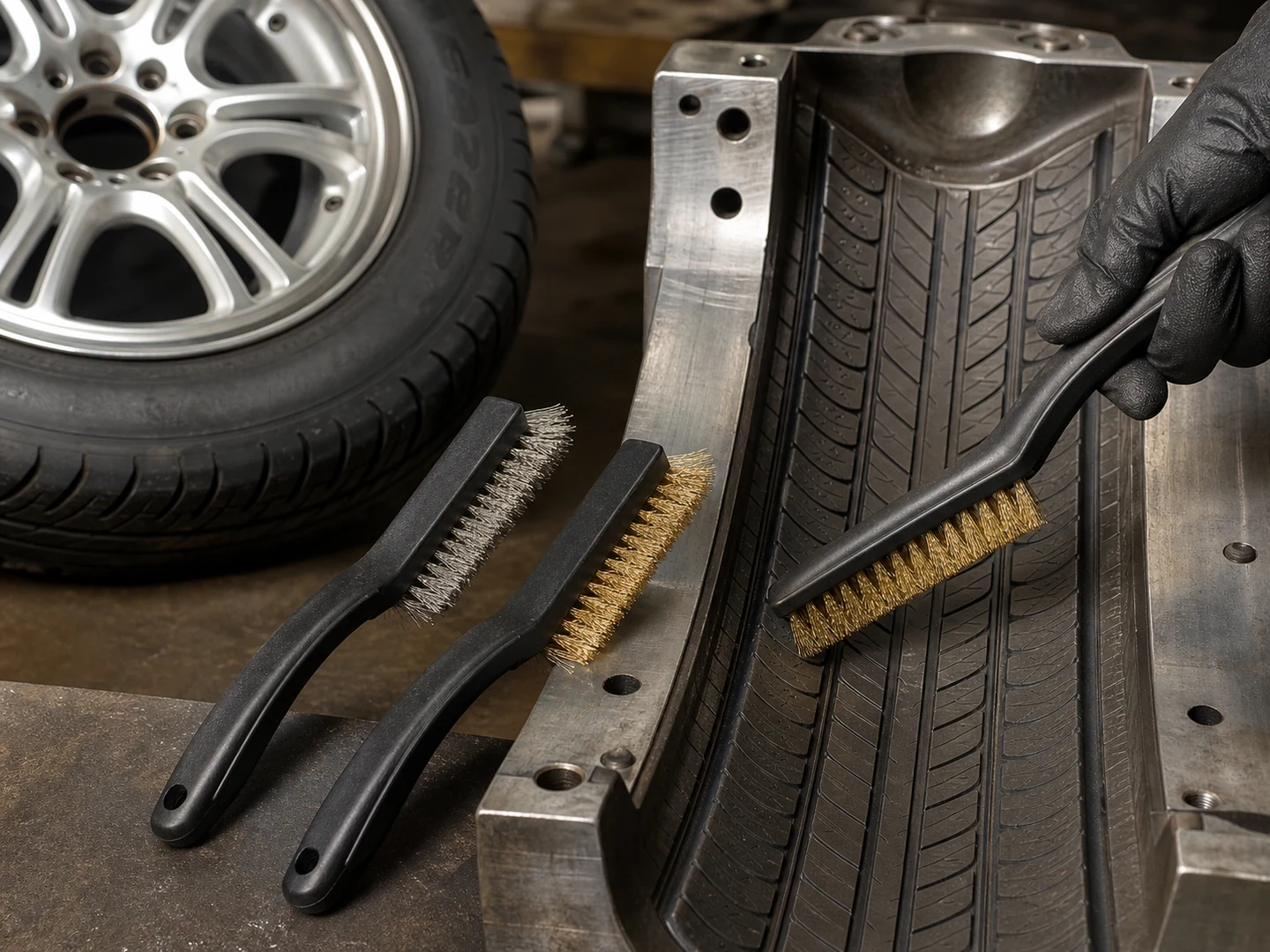
Small brush
500 pcs
Minimum order
Held in one hand: tube, bottle, detail and swab brushes — including long-handled ones with a small head.
Production lead time, once the specification is confirmed
- Up to 500 pcsWithin 7 days
- 501–50,000 pcsWithin 14 days
- Over 50,000 pcsWithin 21 days
Peak season can extend these times; the shipping date is confirmed in writing with your quotation. Sampling and shipping are quoted separately.
The Stainless Steel Brass Mold Tire Brush is a powered wire brush for tire mold maintenance, supplied in 316 stainless steel and brass fill options and built as a cup, wheel, or end brush. It removes cured rubber, release-agent buildup, carbonized residue, and light oxide from tread grooves, sidewall lettering, vents, and parting lines while preserving fine mold detail.
What can this brush do for you?
Clean recessed mold geometry without losing feature definition
Crimped wire filaments flex independently and follow the bottom of tread grooves, sipe channels, and raised lettering instead of bridging across them. With wire diameter selected to the feature width, the brush scrubs the full surface without rounding sharp edges or smearing material into adjacent details. The mold returns to production with its venting and letter geometry intact.
Two fill materials cover aggressive and surface-critical cleaning in one product line
316 stainless steel wire handles the harder jobs—carbonized rubber, oxide, and scale on hardened steel molds. Brass wire offers a softer, non-ferrous contact for aluminum molds or polished surfaces where scratching and ferrous contamination are unacceptable. You order the same brush form with the fill that matches the mold alloy and deposit type.
End-brush form reaches vent holes, sipes, and parting-line crevices
The narrow twisted-wire end brush works into vent holes and narrow channels where cup and wheel brushes cannot reach. Its small working face keeps wire contact localized, so a blocked vent can be cleared without brushing and enlarging the surrounding hole.
Crimped construction keeps the brush face working instead of shedding
Crimped wire interlocks to hold its shape under side load on curved mold surfaces. That means fewer loose filament ends breaking off into the mold cavity, which reduces the risk of stray wire remaining in a cured tire or contaminating the next production cycle.
Faster mold turnaround without hand scraping or abrasive damage
The brush mounts to standard angle grinders, die grinders, and CNC or robotic spindles, so it fits the existing maintenance workflow. Mechanical wire action removes deposits in minutes on curved and embossed surfaces that would otherwise require careful hand scraping.
Stainless fill resists corrosion from release agents and wash solutions
316 stainless steel wire tolerates the moisture, mold-release compounds, and aqueous cleaning solutions common in tire plants. The brush can be used in wet wash cycles and stored without rusting or contaminating the mold on the next use.
What is a Stainless Steel Brass Mold Tire Brush?
A Stainless Steel Brass Mold Tire Brush is a powered wire brush specifically configured for tire mold maintenance. It is built in three standard forms—cup, wheel, and end—so the working face can match the geometry of the mold segment being cleaned. Fill material is 316 stainless steel wire, brass wire, or a specified combination, selected at order time.
In use, the brush is mounted on an angle grinder, die grinder, or automated spindle and rotated against the mold surface. The wire tips remove cured rubber, release-agent residue, carbon black deposits, and light oxide through mechanical contact. No chemical stripper is needed, though a solvent pre-soak can soften heavy rubber before brushing.
The brush is designed for routine preventive maintenance and mold changeover cleaning, not for deep-texture restoration after a mold has been contaminated for long periods. If the mold has baked-on rubber inside deep sipes that wire cannot reach, or if the surface must remain optically flawless, a different cleaning method may be required. Within those boundaries, this brush family covers the majority of manual and automated tire mold cleaning tasks.
Technical Specifications
The table below lists the parameters most buyers check before ordering. Dimensions, wire diameters, and mountings are adjusted to the mold and the power tool.
| Parameter | Standard options / range | Notes |
|---|---|---|
| Brush form | Wheel, cup, or end brush | Selected from the mold access geometry and tool interface |
| Fill material | 316 stainless steel wire; brass wire | Single-fill or combined-fill available on request |
| Wire diameter | 0.006–0.020 in (0.15–0.51 mm) | Finer wire follows fine details; heavier wire cuts thick deposits |
| Wire type | Crimped (standard); knot/twisted for wheel forms | Knot type for heavier deposits; crimped for uniform finish |
| Cup outer diameter | 2–6 in (50–150 mm) | Selected to cover the mold segment width |
| Wheel outer diameter | 6–10 in (150–250 mm) | Larger diameters for open cavity areas |
| Cup trim length | 5/8–1-1/2 in (16–38 mm) | Longer trim for contoured or deeply textured surfaces |
| Wheel face width | 3/4–2 in (19–50 mm) | Matched to mold segment width |
| End brush shank | 1/4 in or 6 mm | Working face diameter 1/4–1 in (6–25 mm) typical |
| Mounting | 5/8-11 UNC thread, arbor hole, or straight shank | Thread for angle grinders; shank for die grinders and drills |
| Max operating RPM | Stamped on each brush; typical 4,500–12,000 depending on diameter | Never exceed the marked rating; speed decreases as diameter increases |
| Fill density | Standard, medium, or high | Higher density removes deposits faster; lower density conforms better to contours |
| Operating environment | Wet or dry; compatible with common mold-release solvents and aqueous wash solutions | 316 SS resists corrosion; brass is non-ferrous and reduces sparking |
| Brush type | Custom Handheld Detail Brushes | |
| How it is driven | Hand-guided | |
| Cleaning target | tire mold production and maintenance departments, tire retreading plant, and mold repair shops preparing surface cleaning | |
| Surface or part | molds, vents, lettering, sidewalls, holes, parting lines, grooves, and tread blocks | |
| Residue or debris | mold, oxide, scale, release agent, carbon black, carbonized residue, and light scale | |
| Mounting / connection | 1/4 in or 6 mm; 5/8-11 UNC thread, arbor hole, or straight shank |
Where does this brush work best?
- Tire mold production and maintenance departments cleaning mold segments, sidewall rings, bead rings, and vent plates.
- Tire retreading plants where cured rubber and buffing debris build up in tread molds.
- Mold repair shops preparing surfaces before inspection, welding, or retexturing.
- Automated mold cleaning cells using robotic arms or CNC spindles on high-volume tire lines.
- Cleaning of tread blocks, sidewall lettering, sipes, parting lines, and vent holes where residues include cured rubber, mold release agent, carbon black, oxide, and light scale.
How do I choose the right one?
Start with the mold material
Aluminum and other non-ferrous molds call for brass wire; it will not dig into soft surfaces or leave ferrous particles that can oxidize. Hardened steel molds with carbonized rubber or oxide scale can use 316 stainless wire for the removal rate required.
Match the fill to the deposit
Soft release agent and uncured rubber respond to brass. Carbonized rubber, oxide, and scale require stainless steel. If deposits vary across the mold, order a combined fill or use stainless steel on open areas and brass on polished or lettered surfaces.
Select the brush form by access geometry
Wheel brushes cover large open cavity faces. Cup brushes reach shoulders, sidewalls, and segmented mold edges. End brushes go into vent holes, narrow grooves, lettering interiors, and parting-line crevices. Many tire plants use all three forms in sequence during one mold turnaround.
Set wire diameter to feature size
For fine lettering and vent-adjacent edges, choose 0.006–0.010 in wire so the filaments enter the feature instead of bridging across it. For thick cured rubber, 0.014–0.020 in wire cuts faster but can round sharp corners under high pressure. Use the finest diameter that still removes the deposit.
Match the mount and speed to the power tool
Order the thread, arbor hole, or shank that matches your angle grinder, die grinder, or robotic spindle. Confirm that the tool’s free speed is below the brush’s stamped maximum RPM; if not, use a lower speed setting or a smaller brush. Always use the proper guard and a face shield.
When another cleaning method is the better choice
If the mold has extremely fine, mirror-polished engraving that cannot accept any scratch, use non-woven, ultrasonic, laser, or dry-ice cleaning instead. If vent holes are below about 0.5 mm, wire cannot clean them effectively. If contamination is baked into deep sipes, pre-soak with solvent or use ultrasonic cleaning before brushing.
Can I customize this brush?
Because tire molds vary by size, brand, and feature detail, this brush is configured to order. Provide the mold material, residue type, tool speed and mount, access dimensions (groove width, vent hole diameter, lettering height), and photos or drawings of the areas being cleaned.
We can adjust:
- Brush form: cup, wheel, end, or a special geometry for unusual access.
- Fill: 316 stainless steel, brass, combined fill, wire diameter, crimp or knot construction.
- Trim and profile: cup trim length, wheel face width, end brush working length, angled trim, tuft pattern.
- Mounting: 5/8-11 UNC, metric thread, arbor hole, shank with flat, quick-change adapter.
- Fill density: standard to high density for different removal rates and conformability.
- Hub and center plate: material, thickness, and optional balancing features for automation.
- Identification: color coding on the hub, labeling, or packaging for inventory control.
- Packaging: bulk, individual, or project-specific packing.
For projects that require material certification, first article inspection, or third-party testing, we can support the documentation package during the customization process.
Which filament survives the cleaning and still lasts on a stainless steel brass mold tire brush?
How do I decide between stainless steel and brass wire on a tire mold?
Check the mold material first. Aluminum and non-ferrous molds should use brass to avoid scratching and ferrous contamination. Hardened steel molds with carbonized rubber or oxide can use 316 stainless. If the deposit is soft release agent, brass may be sufficient even on steel. Run brass at moderate pressure on a test area; if residue remains, switch to stainless.
What is the maximum speed I should run this brush?
Use the speed stamped on the brush or hub and never exceed it. As a guide, a 2-inch cup may be rated up to 12,000 RPM, while a 6-inch wheel is often under 6,000 RPM. Check that your power tool’s free speed is below the brush rating; if it is higher, use a lower speed setting or a smaller brush. Exceeding the rated speed can throw wires and damage the mold.
Can I clean vent holes with these brushes?
Yes, with the end-brush form. Select a wire diameter clearly smaller than the vent hole, typically 0.006–0.010 in for standard tire mold vents. Do not force a larger brush into the hole—it can enlarge or bell the opening. For vents below about 0.5 mm, wire brushing is not practical; use solvent soak, ultrasonic cleaning, or high-pressure air.
How do I know when the brush should be replaced?
Replace the brush when the working face has lost about 50% of its original trim length, when the wire density is visibly uneven, or when wires break off in the mold. Also replace immediately if the hub shows cracks, thread wear, or imbalance vibration. A worn brush requires more pressure, which increases the risk of mold surface damage.
Does the brass wire leave residue on the mold that could affect rubber bonding?
Under high pressure and speed, brass can smear a small amount onto steel mold surfaces. Use moderate pressure and a lower RPM for brass fill. After brushing, wipe the mold with a clean solvent-dampened cloth and inspect for visible transfer. If contamination is a concern for your rubber compound, select stainless fill for steel molds or wash the mold after brass cleaning.
Can this brush be used in an automated robotic mold cleaning cell?
Yes, provided the brush is balanced and the adapter matches the robot spindle. For automation, knot-type or high-density fill often lasts longer under constant force. Provide the spindle speed range, force or pressure settings, and cycle time so we can recommend a wire diameter and fill density that will not shed excessively.
Guides that go deeper on this
Custom Manufacturing RFQ
Describe Your Application
For an accurate quotation, please provide the main dimensions, material preference, working surface, residue, quantity, and a drawing or photo.
Drawing or photo optional — it speeds things up, it does not gate the enquiry.
Custom Brush RFQ
Send Your Brush Project
Upload a drawing, product photo, or sample photo and provide the core dimensions and cleaning conditions.
“We need a brush to remove wet residue from a stainless steel conveyor, about 800mm wide. The current brush wears quickly. We can send photos.”
“We sell drinkware and need a cleaning brush to include with the product. Quantity around 5,000 pieces.”