
Custom Cleaning Brush
Cleaning Brush Fruit and Vegetable
Custom food-grade cleaning brushes for washing fruit and vegetables and cleaning produce-handling equipment.
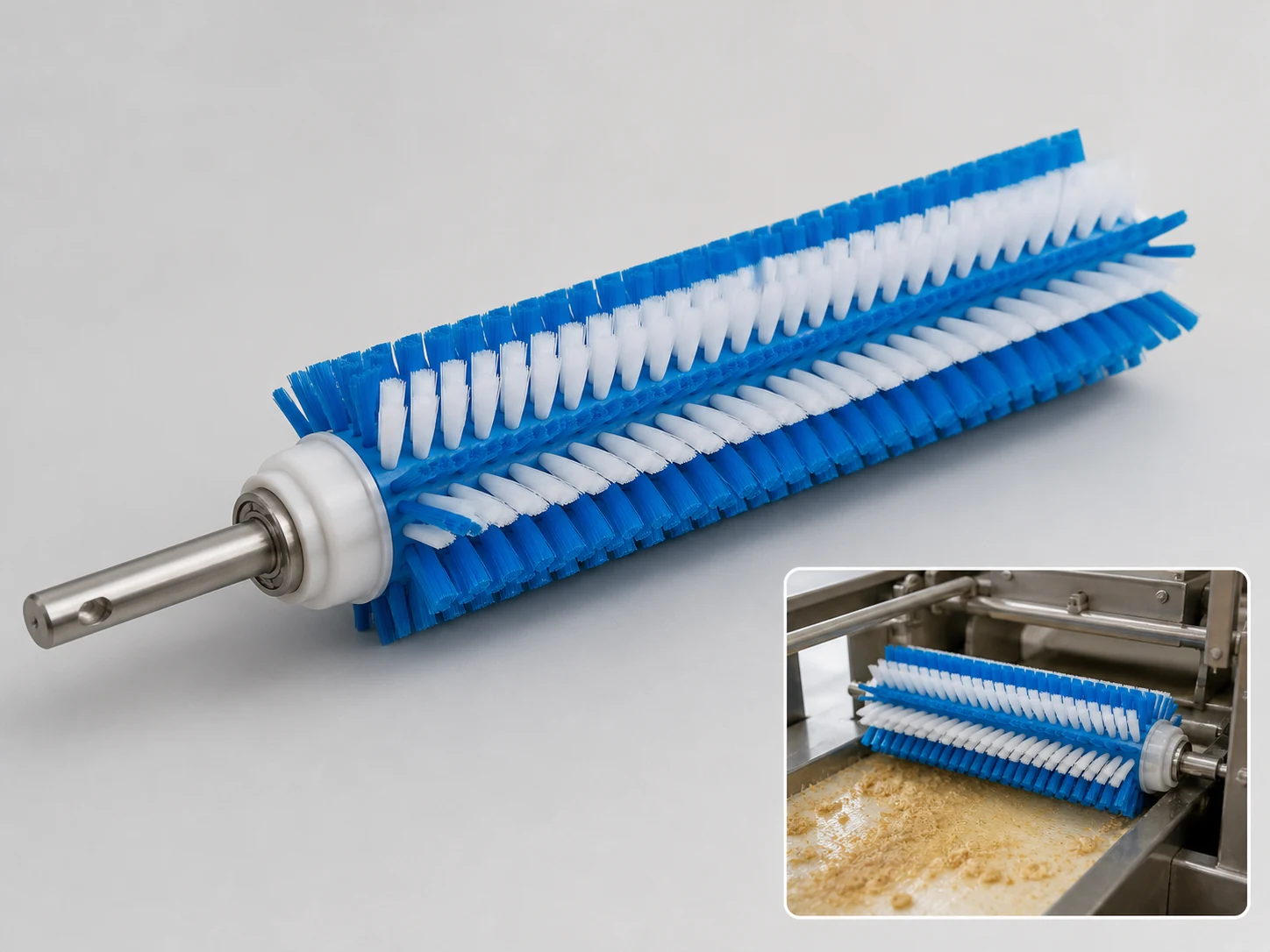
Medium brush
100 pcs
Minimum order
Worked with two hands or on a pole: chimney, gutter and pond-filter brushes, discs, cups and tank brushes.
Production lead time, once the specification is confirmed
- Up to 100 pcsWithin 7 days
- 101–5,000 pcsWithin 14 days
- 5,001–50,000 pcsWithin 21 days
- Over 50,000 pcsConfirmed with your quotation
Peak season can extend these times; the shipping date is confirmed in writing with your quotation. Sampling and shipping are quoted separately.
A food-contact-safe cleaning brush for washing and scrubbing fruits, vegetables, and the produce-contact surfaces of wash lines, tanks, trays, and processing equipment. Food-grade nylon, PBT, or PP filaments remove field soil, starch, pulp, wax, and residue without puncturing delicate skins or shedding metal contamination.
What can this brush do for you?
Gentle scrubbing that protects produce skin
Filament diameters from 0.07 to 0.20 mm and trimmed or radiused tips let the brush work soil and film loose without cutting into tomato, berry, apple, or leafy surfaces. Stiffer settings are available for root vegetables and thicker-skinned produce, so one platform can cover multiple product lines without changing holder hardware.
Reaches into corners and perforations equipment sanitation misses
Trim lengths from 25 to 50 mm and controlled filament density push bristles into tray ribs, tank welds, flume baffles, and perforated conveyor returns where pulp, starch, and fiber collect. Manual washing with a cloth or sponge cannot reach these recesses; the brush clears them during the same washdown pass.
Wet-washdown durability without natural-fiber rot
Monofilament nylon, PBT, and PP do not absorb water the way natural fibers do, so bristles keep their stiffness and shape through repeated hot-water and detergent washdowns. They also dry faster and hold less organic residue between shifts.
Metal-free construction where detectors and food safety require it
The holder, staple set, and handle can be specified entirely in polymer — polypropylene or HDPE block with set filaments — so no bristle wire, staple, or shaft material can enter the produce stream. This supports metal detection programs and reduces contamination hold points.
One specification across hand and machine stations
The same filament material and trim can be built into hand brushes, tank brushes, roller brushes, and strip brushes for different stations on the same line. Overall lengths of 200 to 500 mm and head widths of 50 to 150 mm cover operator reach and machine mounting without developing a new design for every position.
What is a Cleaning Brush Fruit and Vegetable?
A Cleaning Brush Fruit and Vegetable is a food-processing brush whose working face contacts raw produce or food-contact machine surfaces during washing, scrubbing, and sanitation. It is supplied as a hand brush with a long handle, a tank brush for vessel interiors, a roller brush for rotating wash drums, or a strip brush for fixed conveyor and chute positions.
In produce washing, the brush supplies the mechanical action that water and detergent alone cannot. Fingers of food-grade monofilament scrape, flex, and sweep across the skin of fruit or vegetable and across tank walls, tray returns, roller paths, and flume surfaces. The loosened soil, starch, pulp, or film is carried away by rinse water; the brush itself does not absorb what it removes.
Operating conditions matter more than brush size alone. Filament material must tolerate the water temperature, sanitizer chemistry, and contact time on the line. Holder and mounting materials must survive repeated washdown and thermal shock. This brush is not a peeling or abrasive tool and is not intended to remove hard, baked-on, or mineralized scale — those conditions require abrasive filament or a different cleaning process.
Technical Specifications
| Parameter | Options / Range | Selection Note |
|---|---|---|
| Brush form | Hand brush, tank brush, roller brush, strip brush, detail brush | Chosen from the cleaning motion and mounting position on the line |
| Filament material | Food-grade nylon PA6.6, PBT, PP | Selected for produce sensitivity, temperature, and chemical exposure |
| Filament diameter | 0.07–0.20 mm | Finer diameters for delicate fruit; 0.15–0.20 mm for root vegetables and equipment |
| Trim length | 25–50 mm from holder face | Shorter trim for stiffer scrubbing; longer trim for groove and contour reach |
| Overall length (hand forms) | 200–500 mm including handle | Matched to operator reach and tank depth |
| Head width / roller length | 50–150 mm | Set to the tank, tray, or conveyor contact width |
| Holder material | Polypropylene, HDPE, or 304 stainless steel | All-polymer option available for no-metal produce zones |
| Mounting | Threaded handle, keyed shaft, clamp bracket, custom adapter | Determined by machine interface |
| Operating temperature | PP up to 60°C; PBT up to 100–120°C; nylon PA6.6 up to approximately 100°C continuous wet | Verify actual water temperature, not just ambient |
| Color | White, blue, green, black, or custom | Use for zone or product-line color coding |
| Brush type | Custom Strip Seal Brushes | |
| How it is driven | Supplied hand-guided or machine-mounted | |
| Cleaning target | produce wash line, leafy green and berry wash tank, and lug washing cleaning | |
| Surface or part | tanks, roller, trays, conveyors, drums, metal, corners, and chutes | |
| Residue or debris | pulp, starch, fiber, wax, adhesive residue, label adhesive, particles, and scale | |
| Mounting / connection | Threaded handle, keyed shaft, clamp bracket, custom adapter |
Dimensions and material combinations are set per project. The table above shows the most common ranges; all entries can be adjusted to the produce type, line speed, and washdown chemistry you specify.
Where does this brush work best?
- Produce wash lines — scrubbing potatoes, carrots, apples, citrus, and other root or tree fruit in flume washers, drum washers, and brush-bed machines to remove field soil and surface film.
- Leafy green and berry wash tanks — tank and detail brushes clear sidewalls, baffles, weirs, and corners where starch and pulp accumulate during continuous wash cycles.
- Tray, crate, and lug washing — roller and hand brushes clean return-side produce containers before they are refilled, removing dried juice, leaf particles, and label adhesive residue.
- Conveyor, roller, and chute surfaces — strip brushes wipe product-contact belts, rollers, and drop points during production to reduce buildup that can attract pests and slow sanitation.
- Produce prep and food-service sinks — hand brushes scrub fruits and vegetables at wash stations without scraping skins or leaving fibers on the product.
- Cooling and flake-ice equipment — brushes clean drum surfaces and discharge paths in ice-making equipment used to hold or transport produce and seafood.
How do I choose the right one?
Start with what the brush actually touches. Direct produce contact requires a softer, finer filament and a holder configuration with no exposed metal. Equipment-only cleaning can use stiffer filament and longer trim where recesses are deeper.
Select the filament material by temperature and chemistry
- PP (polypropylene) — soft, economical, and naturally flexible. Use it for delicate fruits and leafy items, cool-water wash, and mild acid conditions. Limit continuous temperature to 60°C.
- PBT (polyester) — stiffer, abrasion-resistant, and retains shape in wet, warm washdowns. Use for root vegetables, tank and conveyor cleaning, and hot-water sanitation up to 100–120°C.
- Nylon PA6.6 — flexible with good chemical resistance and recovery after bending. Use for irregular equipment surfaces and corners where the brush must follow contours. Check temperature above 100°C.
Match filament diameter, trim, and density to the residue and surface
Finer filaments (0.07–0.15 mm) flex on soft produce and reduce skin marking. Thicker filaments (0.15–0.20 mm) carry more stiffness for field soil and equipment residue. Shorter trim raises scrubbing pressure; longer trim reaches into grooves. Lower density gives gentler contact; higher density gives more complete wiping on flat surfaces.
Measure the interface before ordering
For hand brushes, overall length needs to reach the bottom of the deepest tank without the operator leaning into the wash zone. For machine brushes, provide the shaft diameter, bracket spacing, roller OD, and contact width. A drawing or photo of the existing brush seat prevents remounting delays.
Verify the washdown environment
Collect the actual water temperature, sanitizer or detergent SDS, pH, and contact time. Some oxidizers attack PP quickly; hot alkaline solutions can degrade nylon over months. Specify the worst-case exposure, not the average.
When this brush is not the right tool
Do not use this brush to peel, de-scale, or remove baked-on carbon, hardened sugar, or mineral deposits. Use abrasive filament, wire, or chemical treatment for those conditions. For very fine or internal tube passages below brush face width, a tube brush or swab may be required.
Can I customize this brush?
Yes. Brush form, holder dimensions, filament material, diameter, trim length, density, color, handle, and mounting are all adjustable to the wash line and produce type.
- Brush form — hand, tank, roller, strip, or detail shape with the working face cut or molded to the contact geometry.
- Head and overall dimensions — width, length, trim, and handle size matched to the wash tank, conveyor, or roller seat.
- Filament package — material, diameter, trim length, staple pattern, density, and tip treatment selected for skin contact or equipment scrubbing.
- Holder and mounting — PP, HDPE, or 304 stainless with threaded, keyed, clamp, or custom machine adapter.
- Color and marking — solid color, zone color coding, molded logo, or lot identification for sanitation schedules and replacement tracking.
- Packaging — bulk, individually bagged, labeled per station, or retail-ready if the brush is distributed through food-service channels.
To build the right configuration, provide the produce or surface type, equipment drawings or photos, current brush dimensions if any, water temperature, sanitizer/chemical SDS, residue description, and desired stiffness or line experience. We can also assist with material declarations, resin documentation, or third-party testing support for your project’s food-contact approval process.
When is a cleaning brush fruit and vegetable worn out rather than just dirty?
How do I confirm the brush is acceptable for direct fruit and vegetable contact?
Request the material declarations for the exact filament, holder, and staple set you are quoting — not a general catalog claim. For your own regulatory file, we can support migration or sensory testing on your finished brush configuration, but final acceptance must come from your QA or food-safety team.
What should I inspect when the brushes arrive at the plant?
Check trim length uniformity across the face, absence of bent, melted, or cut filament tips, holder or block cracks, secure staple set, mounting thread or shaft fit, and absence of any metal particles. Confirm the color and lot marking against the receiving specification before moving into production.
How should the brushes be cleaned and stored between shifts?
Rinse with clean water after use to remove loosened debris, then store bristle-side down or hang in a dry, ventilated area to drain. Avoid stacking equipment on top of brushes, which can permanently bend filaments. Follow plant sanitation SOPs, but do not autoclave PP, PBT, or nylon brushes above their rated temperature without checking first.
How can I tell when a brush should be replaced?
Measure filament length at several points on the face. Replace when filaments lose roughly 20–30% of their original trim or begin to mat and no longer spring back after use. Also replace immediately if the holder cracks, the staple set loosens, or the mounting no longer holds securely.
Should the same brush be used on produce and then on equipment?
No. Keep brushes used on direct produce contact separate from those used on tank, floor, or machine surfaces. Separate brush sets support HACCP zone control and reduce the chance of moving equipment residues onto food.
Does this brush replace peeling or abrasive skin removal?
No. It removes field soil, film, starch, pulp, and loose residue. If your process requires deliberate peel removal, scale breakup, or aggressive mechanical action, use an abrasive filament or a separate peeling step.
Guides that go deeper on this
Custom Manufacturing RFQ
Describe Your Application
For an accurate quotation, please provide the main dimensions, material preference, working surface, residue, quantity, and a drawing or photo.
Drawing or photo optional — it speeds things up, it does not gate the enquiry.
Custom Brush RFQ
Send Your Brush Project
Upload a drawing, product photo, or sample photo and provide the core dimensions and cleaning conditions.
“We need a brush to remove wet residue from a stainless steel conveyor, about 800mm wide. The current brush wears quickly. We can send photos.”
“We sell drinkware and need a cleaning brush to include with the product. Quantity around 5,000 pieces.”