
Application
Fruit and Vegetable Washing Line Soil Removal
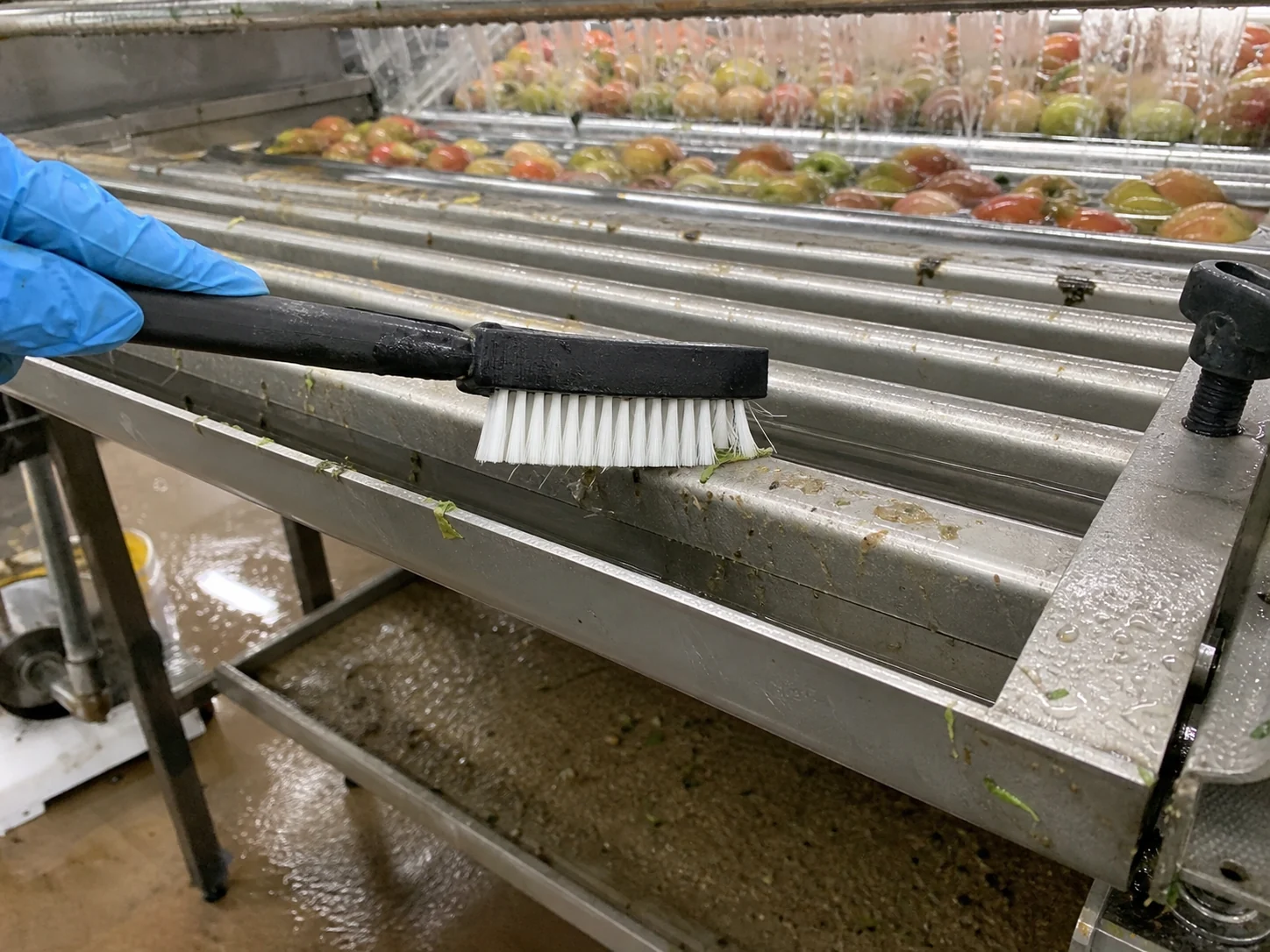
For Fruit and Vegetable Washing Line Soil Removal, the brush must reach the working area, disturb or collect silt and sand/plant debris/waxy residue, and release it without creating unacceptable surface damage or process interference. Brush selection starts with access, contact motion, and the cleaning method used in the process.
At a glance
- Cleaning target
- Silt and Sand/Plant Debris/Waxy Residue
- Working environment
- Wet Indoor Area
- Cleaning method
- Wet Brushing
- Requirements to check
- FDA 21 CFR; EU 10/2011; HACCP
On a washing line the brush is the process rather than the clean-up: roller sets lift field soil off roots and polish fruit, while the line’s own nozzles and screens are serviced separately.
What makes Fruit and Vegetable Washing Line Soil Removal different from other food and beverage cleaning?
The task is to remove Silt and Sand/Plant Debris/Waxy Residue while controlling surface damage, residue carryover, brush shedding and chemical or temperature degradation.
The work happens in wet indoor area against silt and sand, plant debris and waxy residue.
The part people get wrong: the residue tells you the filament, but the access opening tells you the construction. Get them in that order and the shortlist is short.
What are the most common cleaning targets in Fruit and Vegetable Washing Line Soil Removal?
5 targets, each with its own opening, residue and contact requirement.
| Part or area | Residue type | Cleaning requirement |
|---|---|---|
| Root-Vegetable Soil Removal | Soil, mud and packed aggregate fines | The head must reach the working face and apply even contact without marking the surface. |
| Leafy-Green Washing-Line | Silt and Sand, Plant Debris, Waxy Residue | The brush must span the working width and hold even contact along the whole face while the surface moves under it. |
| Fruit Waxing and Polishing | The head must reach the working face and apply even contact without marking the surface. | |
| Conveyor and Roller | The brush must span the working width and hold even contact along the whole face while the surface moves under it. | |
| Spray-Nozzle and Screen | The head must be narrower than the opening and stiff enough to lift residue without splaying at the mouth. |
What the equipment leaves you to work inside:
| Parameter | Typical range |
|---|---|
| Contaminant | Silt and Sand/Plant Debris/Waxy Residue |
| Required hardness | Soft–Medium |
| Maximum temperature | 60°C |
| Chemical exposure | Water; Neutral Detergent pH 6–8; Low-Concentration Hypochlorite |
| Cleaning method | Wet Brushing |
| Environment | Wet Indoor Area |
Which brush types work for each cleaning target?
Select hand, tube, strip, roller, disc or machine-mounted geometry from access and motion.
| Cleaning target | Recommended brush type | Why it fits |
|---|---|---|
| Root-Vegetable Soil Removal | Handheld Detail Brushes | Root soil is abrasive and packed into the skin, so a hand-guided head lets the operator work it off at a pressure the produce will take. |
| Leafy-Green Washing-Line | Roller and Conveyor Brushes | Leafy greens are carried over a bank of turning brush rollers, so the contact comes from the roller under the produce rather than from anything an operator holds. |
| Fruit Waxing and Polishing | Handheld Detail Brushes | Here the brush spreads and buffs rather than removes, so a hand-guided head lays an even film without pressing hard enough to bruise the fruit. |
| Conveyor and Roller | Roller and Conveyor Brushes | Plant debris and wax build on the rollers and transfer back onto clean produce, so a roller brush removes it while the line keeps moving. |
| Spray-Nozzle and Screen | Handheld Detail Brushes | Nozzles and screens block with fine silt, so a narrow head enters the orifice and clears it without opening it out and changing the spray pattern. |
Two of these ride on the line as driven rollers; the other three are hand brushes for the flumes and sorting tables once the line is stopped.
In practical brush terms: match the construction to the access before anything else. A geometry that cannot reach the target will not be rescued by a better filament.
What filament materials work best for Fruit and Vegetable Washing Line Soil Removal?
Soft to medium nylon covers this whole job — gentle enough not to bruise produce skin, and still able to lift silt and sand out of the roller nip at 60°C.
| If the condition is… | Filament to start with | Why |
|---|---|---|
| Produce skin that bruises | Nylon PA, soft grade | flexes away before it marks the fruit |
| Silt and sand in the roller nip | Nylon PA, medium grade | stiff enough to lift grit without holding it |
| Low-concentration hypochlorite rinse | Nylon PA | tolerated at the dilutions used on a wash line |
What the duty rules out before you start comparing grades:
| Constraint | Value for this application |
|---|---|
| Filament hardness | Soft–Medium |
| Maximum service temperature | 60°C |
| Chemical exposure | Water; Neutral Detergent pH 6–8; Low-Concentration Hypochlorite |
| Cleaning method | Wet Brushing |
How do I choose the right brush for my fruit and vegetable washing line soil removal equipment?
Start with soft-to-medium fill, a 60°C ceiling and plain water, then let the produce’s bruise tolerance cap the stiffness before the roller is sized.
Work through it in this order:
- Identify the target part and measure the access opening or clearance
- Describe the residue: what it is, how thick it sits, and how strongly it holds
- Choose the construction that can physically reach that target
- Set the filament from surface risk, working temperature and cleaning chemistry
- Fix filament diameter, free trim length and density for the contact pressure you need
- Run one cycle and check the result before committing to a production quantity
Before you commit to a quantity, send the roller length and shaft fitting, the line speed, and the produce’s bruise tolerance.
When is a fruit and vegetable washing line soil removal brush the wrong tool?
Flotation, spray bars and air knives remove soil from produce too delicate for contact, soft fruit and leafy greens among them. Where the produce bruises under a roller, the line changes rather than the brush.
What common mistakes should I avoid in Fruit and Vegetable Washing Line Soil Removal?
- Giving throughput without the produce’s bruise tolerance, which is what caps filament stiffness
- Changing the filament while leaving excessive engagement, poor alignment or no discharge path unchanged
- Copying a worn brush without first recording its motion, direction, mounting and original working diameter
If the brush is already in service and the result is wrong, work from the symptom:
| Symptom | What to change |
|---|---|
| Residue remains | Increase discharge or relative motion before adding pressure |
| Surface marks | Reduce engagement and use finer/softer fill |
| Rapid wear | Check alignment, temperature and chemical attack |
| Redeposition | Add wash, vacuum or collection path |
Questions this page is asked
How should a produce-contact roller brush be qualified?
Use the actual commodity, variety, maturity and representative soil while controlling roller speed, engagement, water, residence time and number of contacts. Compare soil removal with bruising, skin scuffing, cut or stem damage, lodged debris and product carryover after the normal observation period, then approve only the documented range that meets both cleanliness and quality criteria.
What releases a washing-line brush after sanitation?
Remove plant material from the full fill and anchor, apply the approved wash, rinse and sanitizing sequence, and let the tool or installed roller drain as designed. Inspect for retained soil, damaged tufts, corrosion, chemical residue and inaccessible liquid, then store or reassemble it under the facility's pre-operation sanitation and verification procedure.
Guides that go deeper on this
No catalogue item for this yet
Every brush here is made to order, and this one has no catalogue entry so far. Send the working surface, the residue, the access opening and the quantity, and it is quoted through the same specification route as the rest of the range.
Custom Manufacturing RFQ
Discuss This Application
Share the working surface, residue, dimensions, material direction, interface, quantity and drawing or sample photo.
Custom Brush RFQ
Request a Custom Cleaning Brush Quote
Upload a drawing, product photo, or sample photo and provide the core dimensions and cleaning conditions.
“We need a brush to remove wet residue from a stainless steel conveyor, about 800mm wide. The current brush wears quickly. We can send photos.”
“We sell drinkware and need a cleaning brush to include with the product. Quantity around 5,000 pieces.”