
Custom Cleaning Brush
Curved Handle Cleaning Brush
Order a custom curved handle cleaning brush for corners, gaps, and hard-to-reach detail cleaning.
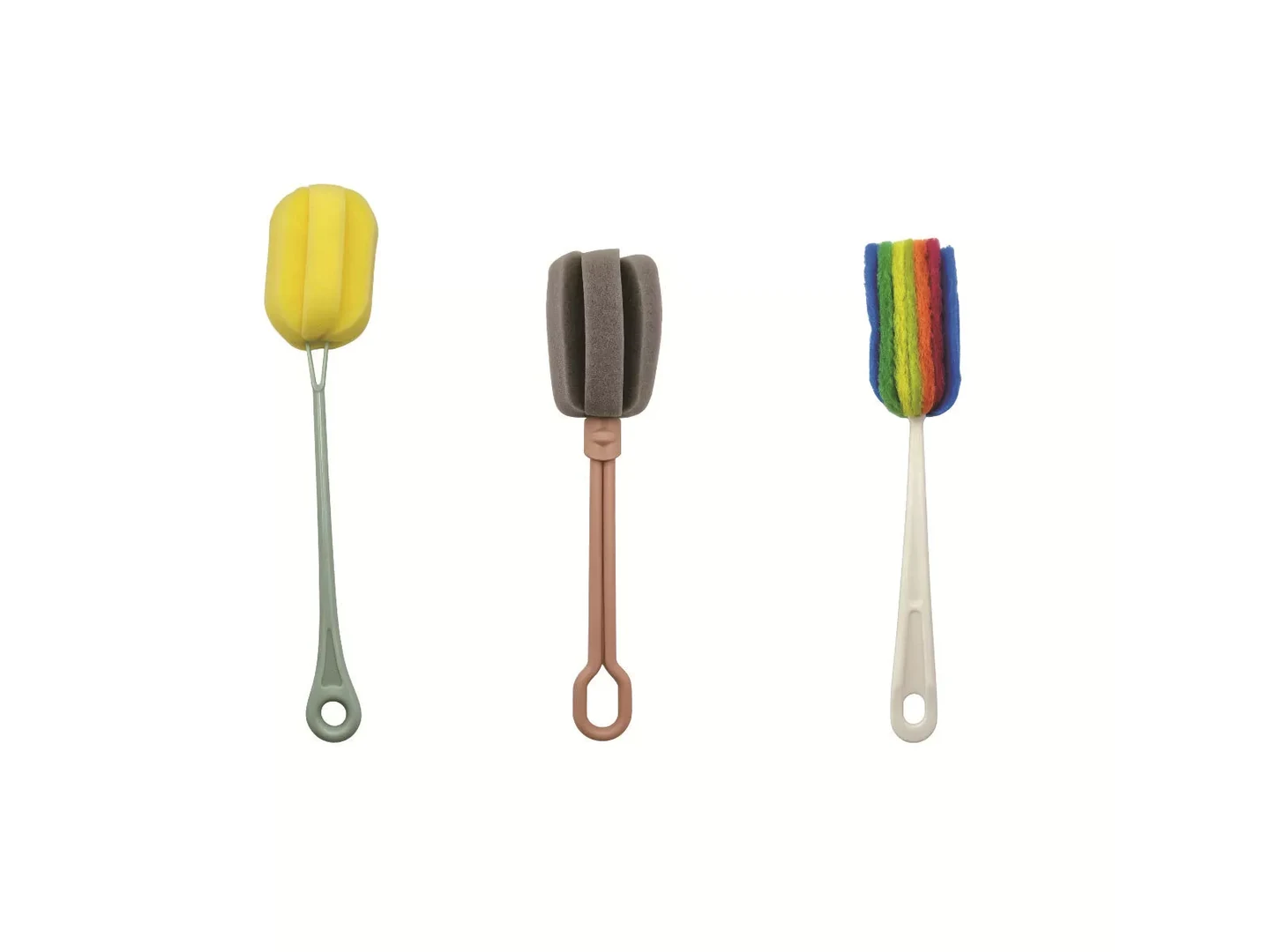
Small brush
500 pcs
Minimum order
Held in one hand: tube, bottle, detail and swab brushes — including long-handled ones with a small head.
Production lead time, once the specification is confirmed
- Up to 500 pcsWithin 7 days
- 501–50,000 pcsWithin 14 days
- Over 50,000 pcsWithin 21 days
Peak season can extend these times; the shipping date is confirmed in writing with your quotation. Sampling and shipping are quoted separately.
A hand-guided cleaning brush with a deliberately curved handle and nylon PA bristles, built to reach corners, gaps, and recessed surfaces without forcing the operator’s wrist into an awkward position. It removes grease, soap film, lint, crumbs, and light residues from cookware, appliances, equipment housings, and other hard-to-access detail areas.
What can this brush do for you?
Curved Handle Keeps the Wrist Neutral During Detail Scrubbing
The bend in the handle places the grip at a natural angle while the brush head stays flat against the cleaning surface. Operators can scrub inside corners, under rims, and behind equipment without twisting the wrist or pressing the back of the hand against adjacent parts, which reduces fatigue during repeated cleaning cycles.
Angled Head Reaches Where Straight Brushes Stop
Because the head is offset from the grip line, the bristle tips can enter narrow gaps and follow contours that a straight handle blocks. This matters for appliance door seals, track guides, and the inside corners of pots, pans, and lids, where a straight brush would require tilting the entire hand and losing contact pressure.
Nylon PA Bristles Scrub Without Excessive Abrasion
PA6 or PA66 filaments provide enough stiffness to break up grease, soap film, and dried-on food particles, yet they are significantly softer than wire or abrasive pads. That allows effective removal on non-stick coatings, plastics, and anodized metal surfaces without immediate scratching or dulling the finish.
Polypropylene Handle Stands Up to Water and Detergents
The PP handle does not absorb water, resists common household and industrial detergents, and remains dimensionally stable through repeated washing. It also keeps the brush lightweight, which matters when operators use it for extended hand-cleaning shifts or when the brush is part of a daily cleaning kit.
Filament Diameter and Trim Length Can Be Matched to the Residue
This brush is made to order, so filament diameter can be set from 0.10 mm to 0.80 mm and trim length from 8 mm to 40 mm. Finer filaments with shorter trim deliver a gentle scrub for delicate surfaces, while coarser filaments with longer trim provide more aggressive removal for thicker or more stubborn residues.
What is a Curved Handle Cleaning Brush?
A Curved Handle Cleaning Brush is a manual scrubbing tool whose handle includes a deliberate bend between the grip and the brush head. That bend positions the bristle block at an angle to the operator’s hand, allowing the head to lie flat on a surface while the wrist remains in a neutral position. The brush is designed for detail cleaning rather than large-area scrubbing, and it is normally used with short scrub-and-push or scrub-and-pull strokes in confined spaces.
The exact shape of the bend, the head geometry, and the bristle configuration are determined by the application. The standard configuration uses a polypropylene handle and nylon PA bristles, but other thermoplastics can be substituted when the cleaning chemical or temperature demands it. The brush is not a bottle brush, a tube brush, or a wire brush; it is chosen when access is awkward and a straight handle would cause poor contact or operator fatigue.
During use, the operator grips the curved section and pushes the bristle tips along the target surface. The curve angle should be selected so that the head stays flush while the forearm and hand remain relaxed. If the brush is used on heated surfaces or with hot water, the combination of materials must be checked against the upper temperature limit.
Technical Specifications
The values below represent standard ranges for a custom-built curved handle cleaning brush. All parameters can be adjusted to the project requirements.
| Parameter | Standard Range / Options | Notes |
|---|---|---|
| Overall length | 120–450 mm | Selected for reach and operator comfort |
| Handle curve angle | 15–45° (typical) | Custom angles available; angle affects wrist position and access |
| Head width | 3–100 mm | Width matched to the gap or surface being cleaned |
| Working length | 10–120 mm | Length of the bristle block along the cleaning direction |
| Trim length | 8–40 mm | Distance from bristle base to tip; shorter trim = stiffer feel |
| Filament diameter | 0.10–0.80 mm | Finer filaments are softer; coarser filaments scrub harder |
| Handle diameter | 8–35 mm | Grip diameter can be sized for use with or without gloves |
| Use temperature | 5–100°C | Material combination rated for this range |
| Fill material | Nylon PA (PA6, PA66) | Other filaments available on request |
| Handle material | Polypropylene (PP) | TPE overmold or other thermoplastics possible |
| Brush type | Custom Handheld Detail Brushes | |
| How it is driven | Hand-guided | |
| Cleaning target | cookware and bakeware, appliance gasket and seal, and machine track and guide rail cleaning | |
| Surface or part | corners, gaps, cookware, housings, seals, bends, pans, and pots | |
| Residue or debris | soap film, grease, lint, light residue, crumbs, food debris, dust, and lubricant | |
| Mounting / connection | Fixed |
Where does this brush work best?
This brush is used in situations where the cleaning target is small, recessed, or awkwardly angled, and where an operator must maintain control for repeated strokes. Typical applications include:
- Cookware and bakeware: inside corners of pots and pans, under lid rims, around handle joints, and along the seam between bottom and sidewall where food debris collects.
- Appliance gaskets and seals: refrigerator door gaskets, dishwasher seals, oven door gaps, and washing machine boots where grease, soap film, and lint accumulate.
- Machine tracks and guide rails: removing swarf, dust, and old lubricant from narrow channels that a rag or straight brush cannot reach.
- Tile and grout: scrubbing grout lines, corners, and edges in kitchens and bathrooms where soap film and mildew start to form.
- Vents and louvers: cleaning fins and slots on HVAC covers, equipment vents, and non-energized electronics housings.
- Food processing equipment: detail cleaning around seals, sensors, mounting brackets, and other hard-to-reach points that are missed by large surface scrubbers.
How do I choose the right one?
The correct configuration is determined by the access space, the surface material, and the type of residue you need to remove. Work through the following steps before requesting a quote.
1. Measure the access space and define the curve angle
Measure the minimum gap width, depth, and the angle you can hold your hand while reaching the target. The handle curve angle should allow the brush head to lie flat on the surface while your wrist stays neutral and your knuckles stay clear of obstacles. A good test is to make a cardboard mock-up of the handle bend and check whether you can reach the spot without rotating your forearm.
2. Choose bristle stiffness based on residue and surface
For grease, soap film, and light food residue on standard surfaces, a medium-stiffness PA6 filament with a diameter around 0.30–0.50 mm is usually effective. For softer residues or scratch-sensitive coatings, select a finer filament or a shorter trim length. For dried-on or thicker residues, move to a coarser filament or consider a stiffer material such as PBT. If the surface is polished metal or optical glass, nylon PA may still be too abrasive—consider a natural fiber or a flagged filament tip.
3. Match head shape and dimensions to the target area
The head width and working length must fit inside the space while still providing enough bristle contact to clean efficiently. A head that is too wide will skip corners; one that is too narrow will require many passes. Common head shapes for this brush are rectangular, triangular, and tapered. A triangular head reaches into 90-degree corners better than a rectangular one.
4. Confirm handle length and diameter
Longer handles increase reach but reduce leverage and control in tight spaces. Shorter handles give more precise scrubbing but may force the hand closer to hot or dirty surfaces. Handle diameter should match operator hand size and whether gloves are worn. A 25–30 mm diameter is comfortable for most ungloved hands; with thick chemical gloves, 30–35 mm may be preferred.
5. Consider temperature and chemical exposure
Nylon PA and polypropylene handle water and most detergents up to 100°C. For steam cleaning, boiling water, or concentrated acids and solvents, confirm the exact chemical and temperature before finalizing materials. Polypropylene can degrade in strong oxidizing environments, and nylon absorbs water over time, which can soften the filament slightly.
When a different brush is the better choice
Use a wire brush if the residue is rust, scale, or carbonized material that requires aggressive mechanical action. Use a tube brush or bottle brush if the target is the inside of a narrow tube, bore, or container neck. Use a deck brush or floor scrubber for large flat areas where speed matters more than detail. For very delicate surfaces such as coated optics or polished aluminum, a natural fiber or microfiber applicator may be safer than any nylon brush.
Can I customize this brush?
Yes. This brush is manufactured to the buyer’s specification. We will need the following information to define the configuration: the exact access dimensions, surface material, residue type, cleaning chemical and temperature, desired handle length and curve angle, and any packaging or marking requirements. A drawing, photo, or sample of the target area speeds up the design process.
Customizable elements include:
- Handle geometry: curve angle, overall length, grip diameter, grip profile, and material (PP standard, TPE overmold, or other thermoplastics).
- Bristle block: head shape (rectangular, triangular, tapered, custom), head width and working length, filament material (PA6, PA66, PBT, or other), filament diameter, trim length, and bristle density.
- Stiffness and feel: we can adjust the flex of the handle and the scrub aggressiveness of the bristle by changing material grades, wall thickness, and filament geometry.
- Color and marking: custom color, pad printing, embossed logo, laser marking, or identification coding.
- Packaging: bulk packing, individual polybag, retail card, or project-specific packing with barcodes and labels.
If your project requires material declarations, inspection reports, third-party testing, or support for specific regulatory documentation, we can assist during the customization process. These items are handled per project and are not part of the standard product specification.
When is a curved handle cleaning brush worn out rather than just dirty?
How do I verify that the curve angle is right for my cleaning task?
Make a simple template from cardboard or bent wire that mimics the handle bend. Place the template against the target area and check that a hypothetical brush head would lie flat while your hand and wrist remain in a relaxed position. If you have to cock your wrist more than about 20 degrees from neutral or if your knuckles hit an obstacle, the angle needs to be changed.
What surfaces should I avoid using this brush on?
Nylon PA bristles can scratch soft coatings, polished finishes, and certain plastics if too stiff or too coarse. Avoid using this brush on optical glass, highly polished decorative metal, and non-stick cookware that is already damaged. For those surfaces, choose a softer filament or an alternative brush material such as natural fiber.
How do I clean and store the brush after use?
Rinse the bristles thoroughly with water to remove loosened residue, then shake out excess water. Store the brush hanging with the bristles pointing down so they do not bend or trap moisture. Avoid leaving the brush in standing water, strong solvents, or direct sunlight for extended periods. The PP handle can be wiped with a mild detergent.
When should I replace the brush?
Replace the brush when the bristles become permanently bent, splayed, or shortened by more than 30% of the original trim length. Also replace it if the handle develops cracks, or if the bristles no longer spring back after being pressed. A worn brush requires more passes and leaves residue behind, which defeats the purpose of a detail-cleaning tool.
Does the curved handle reduce the amount of scrubbing pressure I can apply?
The curve can slightly reduce direct leverage compared to a straight handle, but a well-designed angle improves control and wrist comfort in confined spaces, which usually results in more effective scrubbing over a longer period. For heavy pressure on large flat surfaces, a straight handle or a deck brush is more efficient. The curved handle is meant for access and ergonomics, not maximum force.
Can this brush be used with hot water and strong cleaning chemicals?
It can be used with water up to 100°C and with most common detergents and degreasers. For concentrated acids, strong alkalis, or solvents such as acetone, specify the exact chemical and exposure time before ordering. We can then confirm material compatibility or recommend an alternative filament and handle material.
Guides that go deeper on this
We have not written a guide specific to this one yet. The material that covers selection, filament, dimensions, maintenance and sourcing is collected in the technical resources library.
Custom Manufacturing RFQ
Describe Your Application
To quote this brush accurately, send the size, material, cleaning target, residue, quantity, and any available drawing or sample photo.
Drawing or photo optional — it speeds things up, it does not gate the enquiry.
Custom Brush RFQ
Send Your Brush Project
Upload a drawing, product photo, or sample photo and provide the core dimensions and cleaning conditions.
“We need a brush to remove wet residue from a stainless steel conveyor, about 800mm wide. The current brush wears quickly. We can send photos.”
“We sell drinkware and need a cleaning brush to include with the product. Quantity around 5,000 pieces.”