
Custom Cleaning Brush
End Tuft Brush
End tuft brush with brass wire or nylon PA filament for spot rust, oxide, paint and residue removal in holes, threads and recessed surfaces.
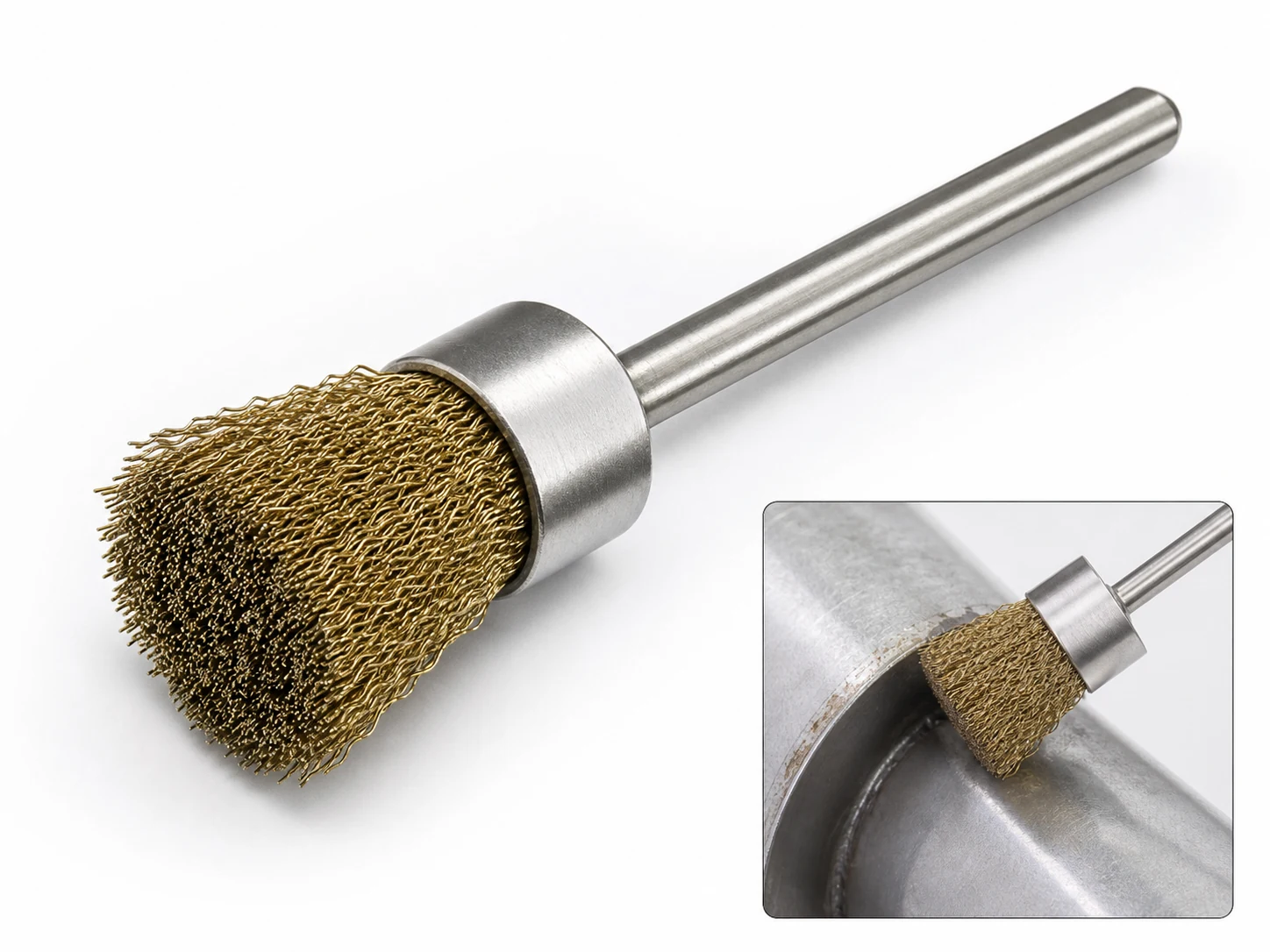
Medium brush
100 pcs
Minimum order
Worked with two hands or on a pole: chimney, gutter and pond-filter brushes, discs, cups and tank brushes.
Production lead time, once the specification is confirmed
- Up to 100 pcsWithin 7 days
- 101–5,000 pcsWithin 14 days
- 5,001–50,000 pcsWithin 21 days
- Over 50,000 pcsConfirmed with your quotation
Peak season can extend these times; the shipping date is confirmed in writing with your quotation. Sampling and shipping are quoted separately.
A compact hand-guided end tuft brush for spot removal of rust, oxide, paint, carbon, adhesive and light scale from holes, threads, corners and recessed surfaces. Available with brass wire or nylon PA filament and supplied as a handled tool or bare shank for low-speed rotary and machine mounting.
What can this brush do for you?
Enters blind holes, corners and thread roots
The entire working surface is a concentrated bundle of filaments at the end of the handle or shank, rather than a wide brush face. That concentrated form lets an operator reach into drilled holes, tapped threads, keyways, mold vents, ejector-pin bores and similar recesses where a full-width brush would never make contact.
Brass wire removes deposits without the aggressiveness of steel
Brass is softer than steel, so the wire tips lift rust, oxide, light scale, old paint, carbon and dried adhesive while working the surface less aggressively than a steel wire end brush. This makes it the safer choice when the part cannot tolerate deep scratching, and its non-sparking contact is useful in areas where solvents or fuel vapors may be present.
Nylon PA gives you a non-metallic alternative
Nylon filament versions remove light debris and polishing residue without steel or brass wire contact. Nylon cannot rust, leaves no ferrous contamination, and works on plated, anodized, aluminum or non-metallic surfaces where wire might mark the finish.
Spot pressure exactly where it is needed
Because the tuft is small, the operator can apply controlled pressure to a single recess without brushing across surrounding machined, coated or finished areas. This is especially useful during mold cleaning, thread preparation and small-part deburring.
Hand use or machine mounting from the same brush configuration
Choose a wooden or plastic handle with ferrule for bench and maintenance work, or a bare round or hex shank from 3 mm to 8 mm to fit a holder, collet or low-speed rotary tool. Both styles use the same brass wire or nylon PA filament options and trim geometry.
What is an End Tuft Brush?
An end tuft brush is a small brush in which the entire working surface is a compact bundle of wire or polymer filament extending from one end of a handle or shank. The tuft, not the handle, is the tool. Used with short push-pull strokes, a dabbing motion, or low-speed rotation, it cleans the bottom and walls of a recessed feature rather than a broad open surface.
This product is supplied in two working forms: a hand-held brush with a ferrule-mounted tuft at one end, and a shank-mount version for fixtures, collets and low-speed drive systems. The fill is brass wire or nylon PA, selected by the surface material, the residue, and how much contact pressure the part can accept.
An end tuft brush is not a substitute for a wide-face brush on large surfaces, and a hand version should not be spun in a power tool unless it has been configured and speed-rated for that use. Its value is controlled access, not high coverage.
Technical Specifications
The following parameters are the standard selection range. Tuft diameter, trim length, overall length, handle and shank can be adjusted to match the recess geometry and mounting method.
| Parameter | Standard value / range |
|---|---|
| Fill material | Brass wire (CuZn70/30) or nylon PA6 / PA6.6 filament |
| Wire / filament diameter | Brass: 0.08–0.35 mm; nylon: 0.10–0.60 mm |
| Tuft diameter | 3–12 mm standard round tuft; tapered, flat or rectangular forms on request |
| Free trim length | 8–25 mm standard; longer trims available for deeper reach |
| Overall length | 150–250 mm standard; extended versions up to 400 mm |
| Handle / shank | Wooden or plastic handle with ferrule; bare round or hex shank 3–8 mm |
| Tuft form | Single end tuft; double-end and dual-tuft configurations on request |
| Contact style | Filament tips only; short strokes or low-speed rotation |
| Mounting | Hand-held or holder / collet mount for shank versions |
| Brush type | Custom Handheld Detail Brushes |
| How it is driven | Machine-driven, mounted in the equipment |
| Cleaning target | mold and die maintenance, tapped hole and threaded fastener, and electrical hardware cleaning |
| Surface or part | thread, holes, corners, recesses, molds, bores, vents, and plastic |
| Residue or debris | rust, paint, adhesive, oxide, scale, carbon, light scale, and mold |
| Mounting / connection | Wooden or plastic handle with ferrule; bare round or hex shank 3–8 mm; Hand-held or holder / collet mount for shank versions |
If the brush will be used in a powered holder, provide the target speed and duty cycle during configuration so the filament set and shank are matched to the application.
Where does this brush work best?
- Mold and die maintenance — cleaning vent slots, ejector-pin bores, water-line face recesses, and other small openings where a mold brush or cloth cannot get firm contact.
- Tapped holes and threaded fasteners — removing chips, old thread compound, light corrosion and debris before reassembly or thread gauging.
- Electrical hardware — cleaning oxidation and tarnish from terminals, bus bars, grounding lugs and connector seats; brass wire is a common choice for non-sparking contact.
- Machined small parts — light deburring of cross-drilled holes, keyways, internal grooves and part edges after turning or milling.
- Surface prep and repair — spot removal of rust, paint, adhesive and gasket residue from corners, fillets, brackets and welded joints before recoating or bonding.
- Restoration and maintenance work — cleaning recessed hardware, lock recesses, data-plate areas and small mechanical components without disassembly.
How do I choose the right one?
Select the fill material first, then the tuft geometry, then the handle or shank.
Match the fill to the surface and residue
Brass wire is the aggressive-but-controlled option for rust, oxide, paint, carbon and light scale on iron, steel, copper and brass parts. Choose it when the surface can accept mild wire contact and the job needs more cutting than nylon can provide. Nylon PA is the choice for plated, anodized, aluminum, plastic or composite surfaces, or where ferrous contamination is unacceptable. It removes dust, adhesive film and light residue but will not cut hard oxide or scale.
Size the tuft to the recess
The tuft should enter the smallest feature with modest clearance. If the tuft is too large, only the outer filament tips contact and the center does not work. If it is too small, you lose contact pressure and cleaning speed. For threaded holes, keep the tuft diameter below the minor diameter of the thread and leave enough trim length to reach the thread root.
Choose trim length by reach and stiffness
Longer free trim reaches deeper but flexes more, which reduces scrubbing force. Shorter trim is stiffer and more aggressive. In a blind hole, use the shortest trim that still reaches the bottom; in a delicate corner, a longer trim applies less localized pressure.
Decide between handle and shank
A ferrule-mounted wooden or plastic handle is the standard choice for bench and on-site maintenance. A bare round or hex shank fits a collet, drill chuck, or custom holder when the brush is used in fixtures or low-speed powered cleaning. For powered use the shank version should be speed-rated for the application; a handled brush is not meant to be driven.
| Condition | Recommended configuration |
|---|---|
| Rust, oxide, paint or carbon on steel / iron | Brass wire, 0.15–0.30 mm, short to medium trim |
| Plated, anodized or aluminum surface | Nylon PA, 0.20–0.40 mm, medium trim |
| Tapped or threaded hole | Tuft diameter below minor diameter, trim long enough for thread root |
| Blind recess or narrow corner | Tapered or small round tuft, extended overall length if needed |
| Fixture-held or low-speed powered cleaning | Bare shank matched to holder, speed provided at order |
Use a steel wire end brush for hardened scale, welding spatter or heavy rust where brass lacks the cutting action. Use a tube brush or spiral brush if the passage is too deep or narrow for a practical tuft diameter. Use a full-width brush for open surfaces; an end tuft brush cleans small features efficiently, not broad areas.
Can I customize this brush?
End tuft brushes are almost always sized to the recess, the residue, and the way the brush is held. Prepare the following before requesting a custom configuration: recess diameter or thread size, recess depth, surface material, residue to be removed, cleaning chemical if any, handle or shank requirement, and whether the brush will be hand-held or power-driven.
We can adjust:
- Fill material — brass wire diameter, brass alloy, nylon PA grade, or a mixed-fill option where the project requires it
- Tuft geometry — diameter, round / flat / tapered / rectangular form, density, and free trim length
- Filament ends — standard cut ends, flagged or softened ends, or special tip treatment for delicate work
- Handle and shank — wooden, plastic or metal handle; ferrule style; bare round or hex shank 3–8 mm; custom holder interface
- Overall configuration — single-end or double-end, extended length, or dual tuft on one carrier
- Marking and packaging — handle color, custom marking, bulk pack, individual wrapping, or private-label packing
For project requirements that include material declarations, pre-shipment inspection, or third-party testing, we can support the documentation and verification steps during customization.
Which filament survives the cleaning and still lasts on an end tuft brush?
Will brass wire leave a mark on aluminum or stainless steel?
Under light pressure brass usually does not mark, but heavy pressure can leave a faint brass-colored transfer on softer or polished metal. Test on a hidden area first. If any visible color change is unacceptable, switch the fill to nylon PA.
Can I run this brush in a drill or die grinder?
Only the shank-mount version can be considered for powered use, and only after the operating speed and duty cycle have been reviewed. A handled brush is not intended to be spun in a power tool, because the handle and ferrule are not designed for rotational loads.
How do I know the tuft is worn out?
Compare the current trim length with a new or reference brush. When the free length is visibly shorter, the filaments splay beyond the nominal tuft diameter, or the brush no longer removes residue with normal pressure, replace it. A worn tuft increases effort instead of improving cleaning.
What is the smallest recess this brush can clean?
A practical lower limit is around a 3 mm tuft diameter, depending on trim length and filament stiffness. The tuft should enter with light clearance; if it binds at the opening, the diameter is too large. If the hole is smaller than 3 mm or is deeper than the trim can reach, a tube brush or spiral brush usually gives better access.
How should I store the brush between uses?
Knock out loose debris, wash or solvent-rinse if the process allows, and store dry. Brass may tarnish over time but tarnish does not reduce brushing action; trapped moisture and crushed tufts do more damage than normal use. Keep the tuft from being bent under weight.
Does brushing leave the surface ready for coating or bonding?
No. End tuft brushing removes attached deposits mechanically, but it does not produce a final cleaned surface. Follow the brushing step with the project-specified solvent wipe or cleaning procedure before coating, bonding or assembly.
Guides that go deeper on this
We have not written a guide specific to this one yet. The material that covers selection, filament, dimensions, maintenance and sourcing is collected in the technical resources library.
Custom Manufacturing RFQ
Describe Your Application
To quote this brush accurately, send the size, material, cleaning target, residue, quantity, and any available drawing or sample photo.
Drawing or photo optional — it speeds things up, it does not gate the enquiry.
Custom Brush RFQ
Send Your Brush Project
Upload a drawing, product photo, or sample photo and provide the core dimensions and cleaning conditions.
“We need a brush to remove wet residue from a stainless steel conveyor, about 800mm wide. The current brush wears quickly. We can send photos.”
“We sell drinkware and need a cleaning brush to include with the product. Quantity around 5,000 pieces.”