
Custom Cleaning Brush
Glassware Cleaning Brush Kit
Laboratory glassware brush kit with nylon PA bristles sized for test tubes, flasks, beakers, cylinders and narrow-neck bottles. Customizable kit contents.
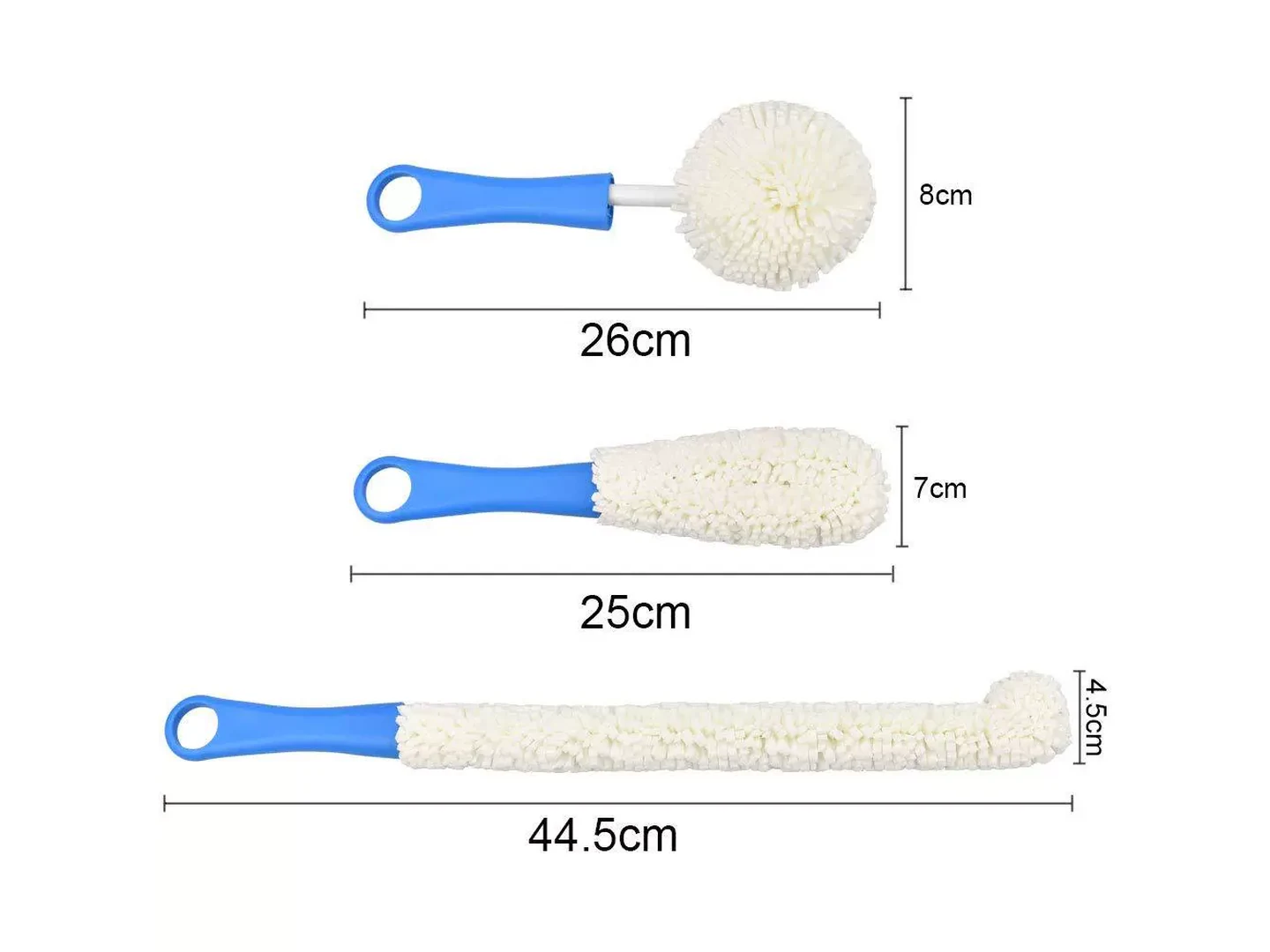
Small brush
500 pcs
Minimum order
Held in one hand: tube, bottle, detail and swab brushes — including long-handled ones with a small head.
Production lead time, once the specification is confirmed
- Up to 500 pcsWithin 7 days
- 501–50,000 pcsWithin 14 days
- Over 50,000 pcsWithin 21 days
Peak season can extend these times; the shipping date is confirmed in writing with your quotation. Sampling and shipping are quoted separately.
A laboratory glassware brush kit built around nylon PA bristle brushes that cover the common interior shapes and openings in a working lab — test tubes, beakers, flasks, cylinders, funnels, and narrow-neck bottles. Each brush is sized to remove powders, precipitates, oils, and detergent films from glass without scratching the surface.
What can this brush do for you?
One matched set covers the glassware your lab actually cleans
Instead of ordering separate test tube brushes, flask brushes, and bottle brushes, the kit groups the diameters and lengths most labs reach for daily. You keep one SKU on the shelf, and technicians always have a size that fits the vessel in front of them.
Reaches bases, shoulders, and narrow necks that cloths and sponges miss
The twisted-wire stem bends through the neck of a volumetric flask or reagent bottle, while tufted and fan ends stay in contact with the bottom and sidewall as the brush rotates. Bottle-form profiles narrow to pass the neck and then expand at the working end to contact the inside of a narrow-mouth vessel without requiring a wide-diameter stem.
Removes lab residue without etching or scratching glass
Nylon PA filaments are softer than borosilicate and soda-lime glass but firm enough to lift precipitate, powder, oil film, and detergent residue. Filament diameters from 0.15 mm to 0.40 mm let you match scrubbing pressure to the residue instead of using one aggressive brush for every job.
Controlled contact for repeatable cleaning results
Working with near-size contact for wiping and a 5–20% oversize condition for flexible polymer filaments keeps brush pressure low and uniform. Typical surface loads of 0.5–3 N/cm² prevent the bristle from smearing softer residues into the glass or bending the wire stem.
Wet-area construction with loop handles for rack storage
Twisted galvanized or stainless steel wire handles resist washdown moisture, and loop ends hang easily on drying racks or pegboards. When one size wears out, replace that single brush instead of retiring the whole kit.
What is a Glassware Cleaning Brush Kit?
The Glassware Cleaning Brush Kit is a coordinated set of hand-guided, twisted-wire brushes with nylon PA filament fill, assembled to cover the most common glassware interiors in a laboratory. It is not a single universal brush: the kit works because each brush has a defined working diameter, fill length, end shape, and overall length matched to a class of glassware.
In use, the operator selects the brush whose fill diameter approaches the glassware ID, inserts it through the opening, and uses push-and-rotate strokes to scrub the sidewall, shoulder, and base. Detergent or solvent softens the residue while the nylon filaments dislodge it. The loosened material is then rinsed away. The tool’s job is mechanical removal — it does not replace chemical cleaning, rinsing, or sterilization steps.
This kit is intended for routine lab glassware cleaning of soft or loosely bonded residues: precipitates, powders, oil films, and detergent deposits. It is not designed for removing baked-on carbon, hard mineral scale, polymerized residues, or for contact with strong oxidizing acids or prolonged high temperatures. For those applications, a metal-wire, abrasive, or higher-temperature polymer brush is a better match.
Technical Specifications
| Parameter | Value / Options |
|---|---|
| Bristle material | Nylon PA filament fill |
| Filament diameter | 0.15 / 0.20 / 0.30 / 0.40 mm |
| Brush diameter (fill OD) | 25–76 mm, selected to near-size engagement with vessel ID |
| Brush length (fill section) | 76–152 mm |
| Overall length | 229–914 mm, including handle |
| End shapes | Tufted, fan, cylindrical, bottle-form |
| Stem / core | Twisted galvanized steel or stainless steel wire; loop or extended handle |
| Contact guidance | Near-size for wiping; 5–20% oversize only for flexible polymer filament; lower interference with wire core |
| Surface load | 0.5–3 N/cm² recommended |
| Wash temperature | Up to 90 °C (194 °F) for standard nylon PA fill |
| Kit contents | Standard assortments available; diameters, lengths, and end shapes configurable by glassware program |
| Packaging / hanging | Loops for hanging; packaging configurable |
| Brush type | Custom Bottle & Container Brushes |
| How it is driven | Hand-guided |
| Cleaning target | test tube and culture tube, beaker and erlenmeyer or volumetric flask, and graduated cylinder and burette cleaning |
| Surface or part | glassware, tubes, test tubes, flasks, cylinders, sidewalls, beakers, and glass |
| Residue or debris | precipitate, oil, powder, oil film, detergent residue, detergent film, mineral scale, and carbon |
| Mounting / connection | Threaded Removable / Fixed |
Nylon PA is compatible with common laboratory detergents and neutral or alkaline wash solutions. Avoid prolonged exposure to strong acids, oxidizing agents, phenols, or aggressive solvents; verify chemical compatibility for your specific wash chemistry before specifying the kit.
Where does this brush work best?
- Test tubes and culture tubes — cylindrical and tufted ends reach the bottom while the wire stem follows the tube curve.
- Beakers and Erlenmeyer or volumetric flasks — fan-form fill contacts the wide body and curved shoulder; bottle-form reaches through narrow necks.
- Graduated cylinders and burettes — long narrow cylinder forms clean the full internal length without damaging calibration marks.
- Reagent bottles and narrow-mouth bottles — bottle-form tips expand inside to scrub the sidewall and base.
- Funnels, condenser tubes, and tubing — smaller diameter cylindrical brushes follow the bore.
- General glassware washdown in QC, R&D, university, clinical, pharmaceutical, and contract labs — removing precipitate, powder, oil film, and detergent residue before rinsing.
How do I choose the right one?
- List the glassware IDs. Measure the narrowest internal diameter the brush must pass through and the depth to the base. Group similar sizes; one kit cannot cover every extreme.
- Match brush diameter to ID. Choose near-size contact for wiping. For flexible nylon filament fill, up to 5–20% oversize is acceptable for more scrubbing. With twisted-wire core brushes, keep the fill at or slightly below the opening to avoid binding or stem bending.
- Pick the filament diameter. Use 0.15 mm for thin films and sensitive glass such as cuvettes; 0.20–0.30 mm for general precipitates and powders; 0.40 mm for sticky oils or heavier precipitate that need more push without scratching.
- Choose the end shape. Tufted ends wipe the bottom, fan forms cover wide curved bodies, cylindrical fill follows straight bores, and bottle-form ends reach through narrow necks to the sidewall and base. A mixed-shape kit is usually more useful than one shape repeated in many sizes.
- Set stem style and overall length. Loop handles hang for drying and are convenient for standard vessels. Longer handles reach deep vessels but reduce control if too flexible; total length should let the operator contact the base while holding the brush outside the vessel.
- Check chemical and temperature conditions. Nylon PA suits common lab detergents and hot water up to about 90 °C. Strong acids, oxidizing agents, phenols, or hot solvents require PBT, polypropylene, PTFE, or stainless steel bristle configurations instead.
If you are cleaning heavy baked-on deposits, carbonized residues, hard mineral scale, or polymerized material, use a stainless steel, brass, or abrasive-grit brush after a chemical soak. For very small capillary bores, micro swabs or pipe cleaners are the right tool. For soft plasticware, choose a softer filament or silicone brush to avoid leaving brush marks.
Can I customize this brush?
Brush kits are naturally project-configurable because every lab’s glassware program, wash chemicals, and handling flow are different. We can assemble the kit from brush diameters, filament diameters, end shapes, stem lengths, and handle styles that match your glassware inventory.
- Kit composition — which brush diameters and lengths are included, quantity of each, and replaceable refill packs.
- Filament fill — nylon PA type, filament diameter, trim length, and fill density.
- End geometry — tufted, fan, cylindrical, bottle-form, or custom molded end profiles.
- Stem / core — twisted galvanized or stainless steel, coated wire for chemical protection, loop or straight long handle, color-coded handles.
- Marking and identification — color-coded handles or bands, engraved or printed labels, private label or distributor branding.
- Packaging — bulk bag, individual sleeve, hang-tag, lab supply box, refill pack, or retail kit packaging.
- Project support — if your project requires material declarations, inspection reports, or third-party testing, provide those requirements during the customization process.
To define a custom configuration, send a list of target glassware types and internal diameters, vessel depths, residue types, wash chemicals and temperature, preferred handle and hanging style, and required kit contents or packaging. A drawing or sample photo of problem glassware speeds up the configuration.
Which filament survives the cleaning chemicals a glassware cleaning brush kit meets?
How do I check whether a brush size fits my glassware before ordering?
Measure the narrowest internal diameter the brush must pass through and the internal depth to the base. The brush fill diameter should be at or slightly below that opening for wiping, with up to 5–20% oversize only if you are using flexible nylon filament fill. Insert the brush by hand: it should enter without bending the wire stem and still contact the sidewall when rotated.
What is the difference between tufted, fan, cylindrical, and bottle-form ends?
A tufted end is dense at the tip for scrubbing the bottom and inside shoulder. A fan form flares the fill to contact wide curved bodies such as beakers and flask shoulders. Cylindrical fill follows straight bores such as test tubes and condenser tubes. Bottle-form ends narrow to pass a bottle neck and then expand slightly inside to reach the sidewall and base.
Will the nylon PA bristles scratch glass?
Under normal hand pressure, nylon PA is significantly softer than borosilicate and soda-lime glass, so the filament ends do not scratch the surface. However, grit trapped in the filament from a previous job can act as an abrasive. Rinse the brush before use and keep brushes used on heavily soiled glass separate from those used on optical or volumetric glassware.
Can these brushes be autoclaved or sterilized?
Nylon PA and stainless steel wire can tolerate limited steam exposure, but repeated autoclave cycles gradually stiffen and embrittle the nylon fill. If your process requires frequent high-temperature sterilization, specify a PBT or metal-fill brush instead. Validate any sterilization step against your own cycle and replacement schedule.
How should the brushes be cleaned and stored after use?
Rinse the full fill length with water to remove loosened residue and detergent, then inspect the base of the tufts and the twisted-wire stem for trapped particles. Hang by the loop to dry. Store dry and separate from dirty brushes. Replace any brush that shows flattened, broken, or chemically degraded filament or a corroded or bent stem.
Does brushing replace chemical cleaning or rinsing?
No. Brushing provides the mechanical force to dislodge attached residue. The loosened material must still be removed by rinsing, and your lab’s cleaning chemistry still handles dissolution, neutralization, or sanitization. Use the brush as one step in a full wash-rinse-verify sequence.
Guides that go deeper on this
We have not written a guide specific to this one yet. The material that covers selection, filament, dimensions, maintenance and sourcing is collected in the technical resources library.
Custom Manufacturing RFQ
Describe Your Application
To quote this brush accurately, send the size, material, cleaning target, residue, quantity, and any available drawing or sample photo.
Drawing or photo optional — it speeds things up, it does not gate the enquiry.
Custom Brush RFQ
Send Your Brush Project
Upload a drawing, product photo, or sample photo and provide the core dimensions and cleaning conditions.
“We need a brush to remove wet residue from a stainless steel conveyor, about 800mm wide. The current brush wears quickly. We can send photos.”
“We sell drinkware and need a cleaning brush to include with the product. Quantity around 5,000 pieces.”