
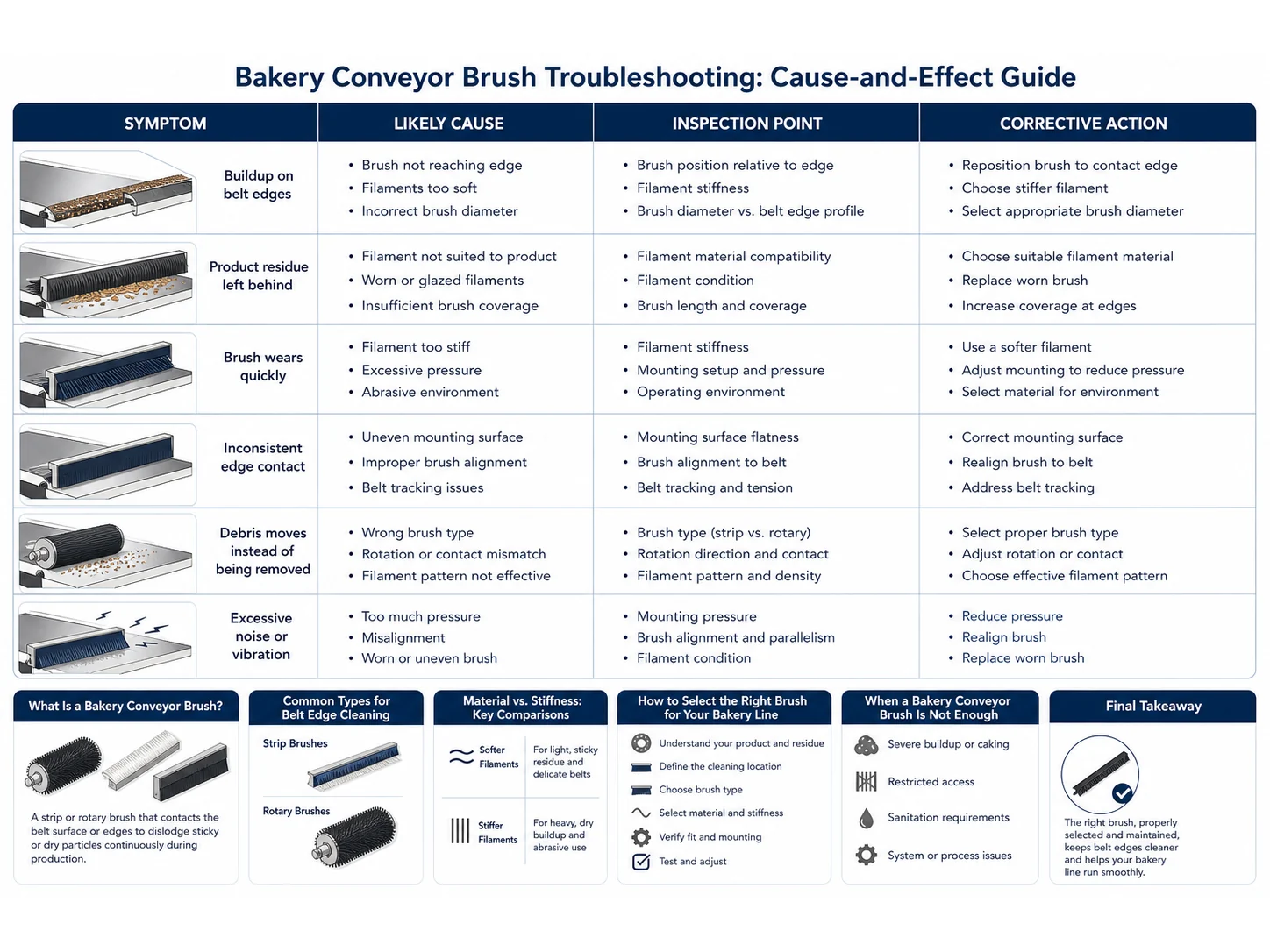
What Is a Bakery Conveyor Brush?
A bakery conveyor brush is a strip or rotary brush that contacts the belt surface or edges to dislodge sticky or dry particles continuously during production. In food-grade applications, the brush must withstand frequent washdowns, resist chemical cleaning agents, and comply with hygiene standards. The goal is not just to clean but to do so without damaging the belt, creating dust clouds, or introducing contamination risks.
Common Types for Belt Edge Cleaning
For belt edge contamination, three main configurations are used:
- Strip brushes with holders: Mounted alongside the belt, the bristle strip runs parallel to the edge and wipes away debris. Often held in aluminum or stainless steel channels for easy replacement.
- Rotary brush assemblies: A motor-driven cylindrical brush positioned at a return roller or near the discharge point. Rotary action provides more aggressive cleaning for heavy residue.
- Spiral wound or coil brushes: Less common for belt edges but used when a continuous helical bristle pattern is needed for self-cleaning or when debris tends to wrap around the brush shaft.
Material vs. Stiffness: Key Comparisons
The table below compares common bristle materials used in bakery conveyor brushes. Select based on the type of residue, belt material, and cleaning environment.
| Material | Stiffness | Best For | Moisture/Chemical Resistance | Food Contact Notes |
|---|---|---|---|---|
| Polypropylene (PP) | Medium to stiff | Wet environments, sticky dough, washdown areas | Excellent; resists most chemicals and moisture | FDA compliant grades available; color options for coding |
| Nylon 6/6 or 6/12 | Medium-soft to stiff | Dry crumbs, flour, abrasive resistance | Good, but absorbs moisture over time; avoid constant wet exposure | FDA compliant; good heat resistance up to ~200°F |
| Polyester (PET/PBT) | Medium to stiff | Oily residues, high-temperature areas | Very good; low moisture absorption; resilient in hot washdowns | FDA compliant; often used with metal detectable additives |
| Natural fibers (Tampico, horsehair) | Soft to medium-soft | Delicate belts, light dusting, antique processes | Poor; absorbs water, promotes bacteria growth | Generally not recommended for modern sanitary bakeries |
Bristle stiffness is usually defined by filament diameter and trim length. For belt edge cleaning, a medium stiffness (0.020–0.030 inch filament) typically balances cleaning power with belt safety. Always test on a sample belt section first.
How to Select the Right Brush for Your Bakery Line
Before shortlisting a brush, answer these five practical questions:
- What is the residue type? Sticky dough requires a material that releases easily (polypropylene or coated nylon). Dry flour might need a stiffer filament for agitation.
- How sensitive is the belt surface? Rubber or modular plastic belts can scratch if the bristle is too aggressive. Match stiffness to the belt manufacturer’s tolerance.
- Will the brush run wet or dry? Wet environments demand moisture-resistant filaments and stainless steel cores/holders. Dry environments allow more material flexibility.
- What is the cleaning frequency and accessibility? If the brush must be changed daily, quick-release holders or clip-on strips save time. If the location is hard to reach, consider longer service intervals.
- Are you bound by specific hygiene protocols? USDA or BRC standards may require metal-detectable bristles, encapsulated filaments, or one-piece holders without crevices.
Common Mistakes When Choosing a Bakery Conveyor Brush
- Selecting by diameter or length alone: A brush that fits the gap mechanically may not have the right filament stiffness, causing poor cleaning or belt damage.
- Overlooking moisture absorption: Nylon can swell and soften in washdown environments, losing effectiveness and harboring bacteria. Specify an alternative if constant wetness is expected.
- Ignoring FDA or metal-detectable requirements: Using a non-food-grade brush risks audit failure or product recall. Always ask for material certification documents.
- Choosing wire brushes for food zones: Steel wire bristles can break off and contaminate dough. Avoid entirely unless the brush is positioned away from the food zone and paired with magnets or detectors.
- Skipping a trial on actual residue: Lab data does not mimic real production with variable temperature, humidity, and belt speed. Request sample strips and run a one-week test.
- Neglecting static electricity: Dry flour and plastic belts generate static, causing particles to cling. Anti-static filament options or grounding measures may be needed.
When a Bakery Conveyor Brush Is the Wrong Choice
While a well-chosen brush solves many edge contamination problems, it may not be sufficient in these situations:
- Heavy, compacted buildup: If dough is baked onto the belt edge, a pre-scraper or heated blade may be required before brushing.
- Severe belt misalignment: Wandering belts create uneven wear and reduce brush contact. Fix tracking issues first, then reassess the brush setup.
- Extremely high-speed lines: Rotary brushes may fling debris at high RPMs. Alternative enclosed vacuum systems or air knives could be safer.
- Aggressive chemical sanitization: If the area undergoes daily exposure to corrosive chemicals like peracetic acid, standard filament materials may degrade quickly. Consult a supplier about chemically resistant options.
- In-house engineering limitations: Custom brush dimensions require precise CAD drawings and tolerance checks. If your team cannot provide clear specs, request an on-site assessment or a supplier-provided drawing review before ordering.
Final Takeaway
Selecting a bakery conveyor brush for belt edge contamination is a balance between cleaning power and belt protection, dictated by the residue type, washdown environment, and food safety requirements. Start by defining your worst-case cleaning scenario, test a sample strip on your residual product, and verify hygiene compliance before finalizing an order. A supplier that offers custom filament blends, quick-change mounting, and material traceability will likely provide the most long-term value.
Frequently Asked Questions
Can I use the same brush for belt edges and the full belt width?
Usually not. Edge brushes are often narrower and mounted at a specific angle to target side contact. A full-width brush may interfere with product flow and requires different stiffness and mounting. Use separate brushes for each task.
How do I know if a brush material is truly FDA compliant?
Ask the supplier for a letter of compliance or material test report stating the specific FDA 21 CFR section. Acceptable filaments are often color-coded (e.g., blue for food contact) and should be free of DEHP or other prohibited plasticizers.
What mounting options work best in high-hygiene zones?
Stainless steel holders with smooth welds and no crevices are preferred. Some systems use magnetic mounts or clip-on brackets to allow tool-free removal during sanitation. Avoid aluminum in direct food contact zones unless anodized and food-grade approved.
How often should I replace a bakery conveyor brush?
There is no universal rule. Monitor bristle wear weekly. When the filament length is worn down by 30–40%, or when cleaning performance drops noticeably, it’s time to replace. Keep spare strips on hand to minimize downtime.
Can I design my own brush dimensions and have it custom-made?
Yes. Many manufacturers accept custom drawings for brush length, filament material, density, and holder profile. Provide accurate measurements of the gap between the belt edge and the nearest obstacle, and specify if you need a continuous brush or segmented sections.
Is a motorized rotary brush always better than a static strip brush?
Not necessarily. Static strip brushes work well for light, dry debris and require no power. Rotary brushes are more effective for sticky or heavy residues but add complexity and maintenance. Assess the residue load and energy savings before automating.
Does brush filament color matter?
In food plants, color-coding supports hygiene auditing. Blue filaments are commonly used for food-contact brushes because they are highly visible if a bristle breaks off. Some facilities use different colors to designate areas (allergen vs. non-allergen). Confirm with your quality team.
Technical References
- eCFR — 21 CFR 177.1500 Nylon Resins
- eCFR — 21 CFR 177.1520 Olefin Polymers
- eCFR — 21 CFR 177.1630 Polyethylene Phthalate Polymers
- OSHA — Machine Guarding
- OSHA — Control of Hazardous Energy
- eCFR — 21 CFR Part 117 Human Food CGMP and Preventive Controls
Which bristle material fits this job — Nylon PA, AISI 304 Stainless Steel Wire or Anti-static Filament?
| Material | Continuous temperature (°C) | Peak temperature (°C) | Water absorption | Hardness |
|---|---|---|---|---|
| Nylon PA | 93 | 121 | 0.3–9% by PA grade and conditioning | Medium to firm; filament diameter and trim length control bending force. |
| AISI 304 Stainless Steel Wire | 400 | 500 | 0% | Rockwell B 70–95 depending on temper and cold work |
| Anti-static Filament | 80–110 | 130–160 | 0.5–2.5% | Shore D 72–86 |
| Polypropylene PP | 80–100 | 120–140 | ≤0.03% | Shore D 65–75 |
Figures as published by Brushtec / DuPont; Alleima; Perlon. Confirm the exact grade against the supplier datasheet before ordering.
What should replace Nylon PA when it stops working?
- Nylon PA — Compare Nylon PA with PP, PBT, PET. Change material when wet stiffness, temperature, chemical resistance, conductivity, particle shedding, or surface marking becomes the limiting factor.
- AISI 304 Stainless Steel Wire — Use AISI 316 stainless steel wire for chloride, marine, dairy, beverage, chemical washdown, or higher pitting-resistance requirements. Use carbon steel for dry aggressive cutting and brass or abrasive nylon for lower marking risk.
- Anti-static Filament — Compare Anti-static Filament with Conductive nylon, carbon fiber, metal fiber, ordinary nylon. Change material when wet stiffness, temperature, chemical resistance, conductivity, particle shedding, or surface marking becomes the limiting factor.
- Polypropylene PP — Compare Polypropylene PP with Nylon, PBT, PET. Change material when wet stiffness, temperature, chemical resistance, conductivity, particle shedding, or surface marking becomes the limiting factor.