
What Is a Brush Roller Conveyor for Belt Edge Contamination Control?
A brush roller conveyor is a powered or passive cleaning device consisting of a cylindrical brush mounted near the conveyor belt edge. As the belt moves, the rotating or stationary bristles sweep off fines, sticky residues, or dust that cling to the belt edge—the area most prone to buildup because it is often outside the main product stream and directly exposed to spillage. This simple mechanical action reduces carryover, improves belt tracking, and extends belt life.
Common Types and Material Options
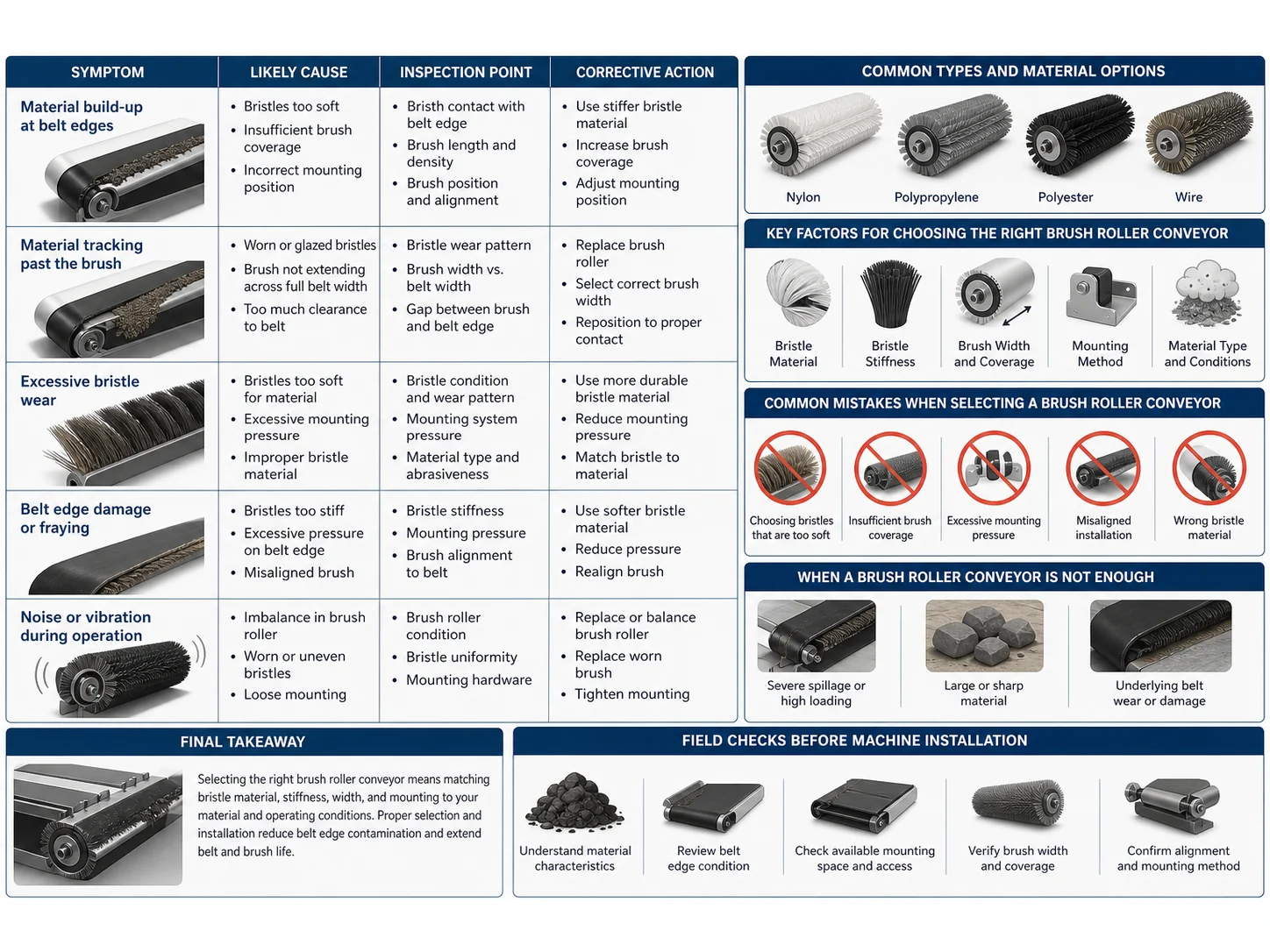
Selecting the right brush roller conveyor starts with understanding bristle materials, core design, and mounting styles. The table below summarizes the most common options and where they fit.
| Feature | Option | Typical Use Case | Considerations |
|---|---|---|---|
| Bristle Material | Nylon (solid or abrasive-impregnated) | Light to medium debris, abrasive products | Good stiffness, moderate wear; abrasive types can damage soft belts |
| Polypropylene | Wet environments, chemical resistance | Flexible, absorbs less moisture, resists many chemicals; less stiff than nylon | |
| Natural fiber (horsehair, Tampico) | Food contact, delicate surfaces | Soft, gentle; limited temperature and chemical resistance | |
| Stainless steel wire | Heavy buildup, high heat | Aggressive; can scratch belt or equipment if misapplied | |
| Bristle Stiffness/Diameter | 0.10–0.30 mm (soft) | Light dust, non-sticky residue | Gentle on belt, may not dislodge compacted material |
| 0.30–0.60 mm (medium) | General dry powders, crumbs | Balanced performance for most applications | |
| 0.60–1.00+ mm (stiff) | Heavy, sticky, or compacted residue | May require lower RPM to avoid belt wear | |
| Core/Handle Design | Shaft-mounted | Direct drive, fixed position | Solid connection, easy replacement of entire brush |
| Split/segmented core | Retrofitting, limited access | Mount without removing shaft; easier maintenance | |
| Mounting Style | Bracket-mounted | Fixed position brushing | Simple, consistent contact pressure |
| Spring-loaded/tensioned | Varying belt thickness, self-adjustment | Compensates for wear, maintains effective cleaning |
Key Factors for Choosing the Right Brush Roller Conveyor
Match the brush to the real cleaning problem, not just to the belt specification.
- Residue type: Powders need different bristle stiffness than sticky pastes or oily films. Identify whether the contaminant is dry, wet, fibrous, abrasive, or corrosive.
- Surface sensitivity: A soft synthetic belt may be damaged by aggressive bristles. Food-grade or delicate belt surfaces often require soft natural fibers or polypropylene.
- Equipment interface: Confirm available mounting space, shaft diameter, and clearance around the belt edge. Consider if the brush must integrate with existing spring, pneumatic, or fixed mount points.
- Wet or chemical exposure: Washdown areas demand moisture-resistant materials like polypropylene or stainless steel. Check chemical compatibility if cleaning agents are used.
- Hygiene expectations: In food or pharmaceutical environments, brush design must allow thorough cleaning with minimal harborage points. Shaft seals and core design matter here.
- Maintenance frequency: Choose a core design (split or shaft-mounted) that allows quick brush changes without lengthy downtime. Softer bristles wear faster on abrasive residues.
- Custom size requirements: Off-the-shelf brushes may not fit unique conveyor edge profiles. Many suppliers offer custom lengths, diameters, and bristle patterns when standard options fall short.
Common Mistakes When Selecting a Brush Roller Conveyor
- Choosing by size alone: A brush that physically fits may have the wrong bristle stiffness for the residue, leading to ineffective cleaning or belt damage.
- Ignoring belt compatibility: Hard brushes on lightweight belts accelerate wear; too-soft bristles on abrasive contamination fail quickly.
- Overlooking mounting adjustability: Fixed brackets work only if belt tension and position are constant. Spring-loaded or floating mounts are safer for dynamic conditions.
- Assuming one brush fits all edges: Different belt edges (tensioned side vs. slack side, head vs. tail pulley) may need different brush orientations or densities.
- Skipping a trial or sample test: Residue behavior can vary under conveyor speed, temperature, or humidity. A short running test prevents expensive mis-specifications.
When a Brush Roller Conveyor Is the Wrong Choice
A brush roller conveyor solves edge contamination but cannot replace a complete belt cleaning system if the problem extends beyond the edges. If carryback is happening mid-belt, primary and secondary belt scrapers are still needed. In applications with very sticky, large, or high-temperature debris, a brush alone may not provide sufficient cleaning force; consider a combination with air knives or washing stations. If static charge causes re-attraction of dust after brushing, evaluate anti-static measures. In hygienic processes where brush filaments can shed, an alternative like a drip pan or sealed scraper might be required. Always ask for a supplier drawing review and, when possible, test the proposed brush on a sample belt section to confirm it cleans without causing surface damage.
Final Takeaway
Choosing the right brush roller conveyor means starting with your residue and belt surface, then working through bristle material, stiffness, core design, and mounting style. A well-matched brush prolongs belt life, reduces cleaning labor, and prevents tracking issues—without overcomplicating the setup. When in doubt, consult technical drawings and insist on real-world testing before finalizing a specification.
Frequently Asked Questions
What bristle material is best for dry food powder on a belt edge?
Medium-stiffness nylon or polypropylene bristles around 0.3–0.5 mm diameter work well. Avoid natural fibers if frequent washdowns are required, as they can absorb moisture and degrade.
Can I use the same brush roller conveyor for both sides of the belt?
You can, but you may need different mounting orientations or bristle angles. The contaminant load and belt edge condition often differ between the tensioned and slack sides. Inspect both edges before ordering.
How do I know if the brush is too aggressive for my belt?
Run a short test and check for surface scuffing, glazing, or accelerated wear on the belt edge. If the belt surface changes after a few hours of operation, switch to a softer bristle or reduce contact pressure.
What is the advantage of a split-core brush roller over a shaft-mounted one?
A split core lets you replace just the brush segment without removing the shaft or disassembling adjacent equipment. This reduces maintenance time significantly, especially on conveyors with limited access.
Are brush roller conveyors suitable for oily residues?
They can work if paired with an appropriate bristle material such as polypropylene or stainless steel, but oily residues may eventually impregnate a dry brush. Regular cleaning or a combination with a scraper or wash system often yields better results.
How often should I replace the brush roller conveyor?
Replacement timing depends on bristle material, residue abrasiveness, and operating hours. In heavy-duty applications, a brush might last months; in light dust removal, it could last over a year. Monitor cleaning effectiveness and bristle length to set your schedule.
What information should I provide when requesting a quote for a custom brush roller conveyor?
Include: conveyor belt width and edge dimension, residue type, belt surface material, operating speed, environmental conditions (temperature, moisture, chemicals), mounting constraints, and any hygiene standards required. If possible, share a photo or drawing of the current edge buildup.
Technical References
- OSHA — Machine Guarding
- OSHA — Control of Hazardous Energy
- OSHA — Combustible Dust
- EPA — Particulate Matter Basics
Which bristle material fits this job — AISI 304 Stainless Steel Wire, Nylon PA or Horsehair?
| Material | Continuous temperature (°C) | Peak temperature (°C) | Water absorption | Hardness |
|---|---|---|---|---|
| AISI 304 Stainless Steel Wire | 400 | 500 | 0% | Rockwell B 70–95 depending on temper and cold work |
| Nylon PA | 93 | 121 | 0.3–9% by PA grade and conditioning | Medium to firm; filament diameter and trim length control bending force. |
| Horsehair | 60–80 | 100–120 | 8–15% | — |
Figures as published by Alleima; Brushtec / DuPont. Confirm the exact grade against the supplier datasheet before ordering.
What should replace AISI 304 Stainless Steel Wire for conveyor belt?
- AISI 304 Stainless Steel Wire — Use AISI 316 stainless steel wire for chloride, marine, dairy, beverage, chemical washdown, or higher pitting-resistance requirements. Use carbon steel for dry aggressive cutting and brass or abrasive nylon for lower marking risk.
- Nylon PA — Compare Nylon PA with PP, PBT, PET. Change material when wet stiffness, temperature, chemical resistance, conductivity, particle shedding, or surface marking becomes the limiting factor.
- Horsehair — Compare Horsehair with Boar bristle, goat hair, microfiber. Change material when wet stiffness, temperature, chemical resistance, conductivity, particle shedding, or surface marking becomes the limiting factor.