
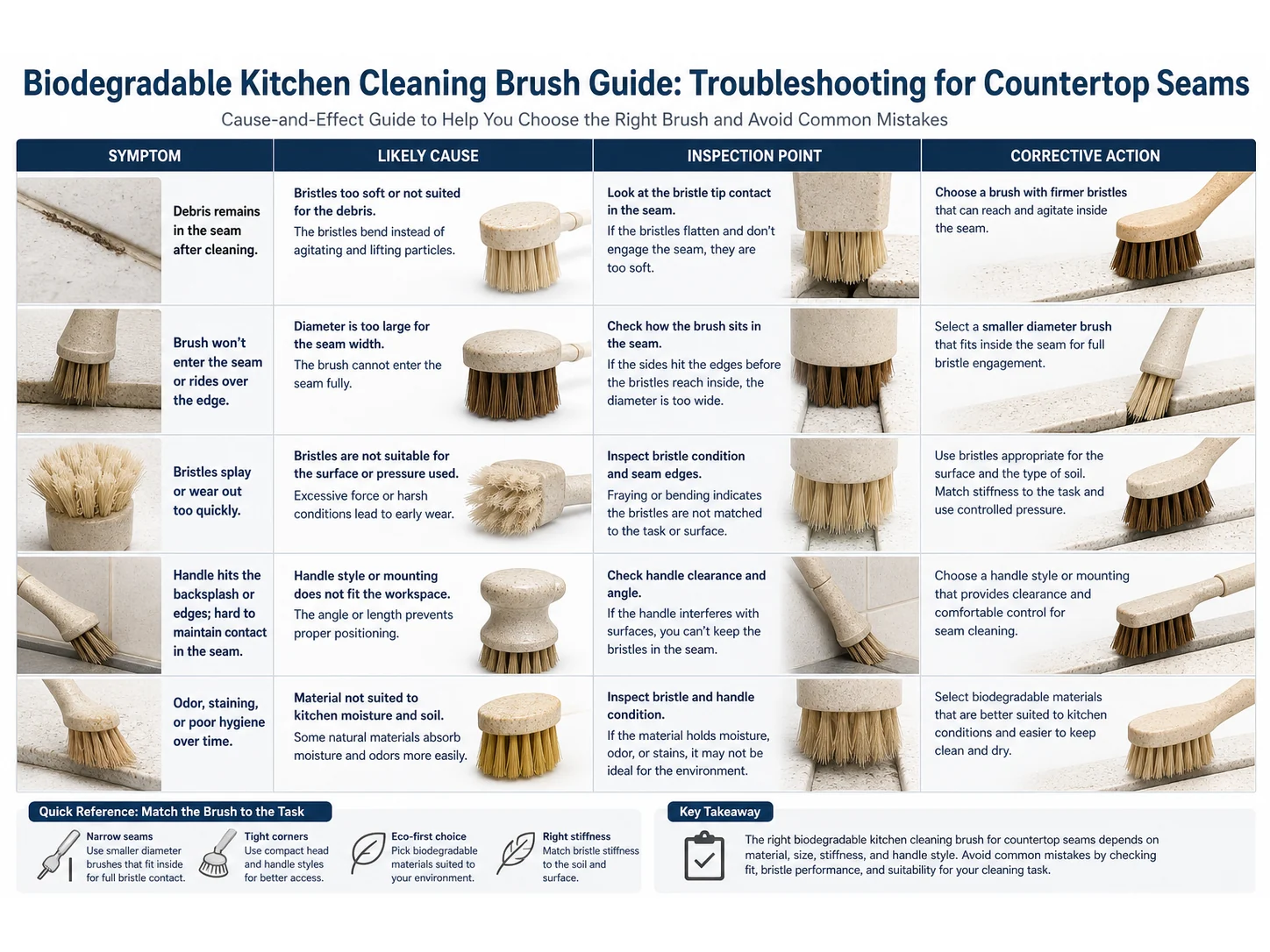
What Is a Biodegradable Kitchen Cleaning Brush?
A biodegradable kitchen cleaning brush is a cleaning tool where both the bristles and the handle are manufactured from materials that break down naturally after disposal. Unlike plastic brushes that persist in landfills, these brushes use natural fibers and wood or plant-based cores. The primary use is for cleaning hard-to-reach areas, especially the gaps where two countertop sections meet. Those seams collect crumbs, oil, and liquid spills that can cause staining and unsanitary conditions if not cleaned regularly.
Common Biodegradable Materials for Bristles and Handles
Several natural bristle materials work well for kitchen cleaning. Tampico fiber, derived from agave plants, offers medium stiffness and good water resistance. Union fiber, a softer blend of plant and animal fibers, works gently on sensitive surfaces. Horsehair provides extreme softness for very fine seams or polished stone. Sisal comes from agave leaves and is stiffer, useful for scrubbing tough residue. Bassine, from a palm tree, has medium‑stiff bristles that hold up to scrubbing. Handles are commonly made from bamboo or FSC‑certified beechwood, both biodegradable. Some modern options use plant‑based nylon that degrades under industrial composting conditions.
Comparing Biodegradable Brush Options by Material and Use
| Bristle Material | Typical Stiffness | Handle/Core Material | Best For | Avoid When |
|---|---|---|---|---|
| Horsehair | Very soft | Bamboo, wood | Polished granite, marble, delicate seams | Heavy grease or baked-on residue |
| Union fiber | Soft | Bamboo, FSC wood | Sealed stone, routine wipe-downs, sensitive surfaces | Deep scrubbing of textured surfaces |
| Tampico | Medium | Bamboo, twisted wire core | General kitchen seams, moderate residue, wet cleaning | Very soft stones that scratch at medium stiffness |
| Bassine | Medium‑stiff | Beechwood, bamboo | Laminate, solid surface, scrubbing dried spills | High-gloss polished surfaces |
| Sisal | Stiff | Bamboo, twisted wire | Tough residue removal, textured stone seams | Marble, soft stone, lacquered wood |
| Plant‑based nylon | Medium | Bamboo, recycled fiber core | Modern eco-designs, consistent stiffness | Outdoor composting only; verify industrial compostability |
Size and Fit: Choosing the Right Diameter for Your Seams
Seam width determines the ideal brush diameter. A brush too small will not contact both sides of the gap effectively; too large will not fit. Measure the narrowest part of the seam with a feeler gauge or a slim ruler. For seams under 1 mm (approx. 1/16 inch), use a brush with bristle diameter around 2–3 mm. For 1–2 mm seams, 3–5 mm diameter works. For wider gaps up to 3 mm, choose 5–8 mm. Also consider bristle trim length—longer trim makes it easier to reach the bottom of a deep seam but may reduce scrubbing force.
Handle Style and Mounting: How You Actually Use It
Biodegradable kitchen brushes come in several configurations. Handheld brushes with a short handle give direct control for detail work. Long-handled brushes with a 20–30 cm biodegradable wooden handle reduce bending over counters and improve reach. Angled head designs make it easier to clean side-by-side seams without splashing. Twisted‑in‑wire brushes with a central metal wire core (often steel) with a biodegradable handle provide a sturdy scrubbing tool, but the wire core may not be biodegradable; confirm with the supplier if full biodegradability matters. Some brushes fit onto extension poles for floor-level seams, though such poles are usually not biodegradable.
How to Choose: Matching the Brush to Your Cleaning Task
Start by identifying the type of residue: dry crumbs need light sweeping; sticky sugars or sauces require medium stiffness and some scrubbing; baked-on grease demands stiffer bristles but may risk scratching sensitive surfaces. Next, consider the countertop material. Polished stone (granite, marble) calls for soft bristles to avoid micro-scratches. Laminate and solid surfaces tolerate medium bristles. Unsealed stone or wood may absorb water, so a brush that stays dry might be better. If you use a chemical cleaner, check if the bristle material swells or degrades—Tampico and Bassine resist mild chemicals, while Horsehair can weaken. In food prep areas, hygiene matters: softer bristles leave fewer scratches that trap bacteria. Plan for replacement frequency; natural bristles wear faster than synthetic, so factor in cost‑per‑use and waste reduction goals. For non‑standard seam widths, many brush manufacturers offer custom diameter and trim lengths. Request a drawing review or a pre‑production sample before ordering large quantities.
Common Mistakes When Selecting a Biodegradable Kitchen Cleaning Brush
- Ignoring seam measurement. Guessing the diameter leads to brushes that either jam or clean poorly.
- Choosing stiffness based only on cost drivers or availability. Too stiff scratches; too soft leaves residue.
- Assuming all “natural” bristles are equally biodegradable. Check if the handle uses synthetic glue or the core contains non‑degradable wire.
- Overlooking handle durability. Bamboo splinters if left soaking; dry after use.
- Not testing chemical compatibility. Natural fibers can swell or rot with harsh degreasers.
- Buying disposable bulk without replacement strategy. Stocking too many may lead to unused brushes that degrade in storage if not kept dry.
When a Biodegradable Kitchen Cleaning Brush Is the Wrong Choice
A biodegradable brush may not be the right choice for extremely tough, carbonized grease or heavy scale. In those cases, a stainless steel or brass wire brush might be needed, though it will not be biodegradable. For commercial kitchens with strict HACCP cleaning procedures, the lack of not Help confirmd antimicrobial properties in natural fibers could be a concern; you might need a brush specifically certified for food contact, which many natural bristle brushes do not carry. If your cleaning process uses high-temperature steam or strong caustic chemicals, natural bristles degrade quickly, and you may need synthetic or metal alternatives. Custom biodegradable brushes are possible but require lead time and minimum order quantities that may not suit one‑off users. In such situations, consult a brush manufacturer for a hybrid solution or a sample test program to verify performance before committing.
Final Takeaway
Choosing the right biodegradable kitchen cleaning brush for countertop seams starts with accurate seam measurement and a clear understanding of your residue type and surface sensitivity. Compare bristle materials honestly: soft for polished stone, medium for general laminate, stiff only when necessary. Check the handle construction and confirm that all components meet your biodegradability goals. Whenever possible, test a sample brush on a small section of your countertop before a bulk order. The right brush will clean effectively, protect your surfaces, and align with your environmental values.
Frequently Asked Questions
How do I know if a brush is truly biodegradable?
Look for brushes that disclose bristle material and handle composition. Natural fibers like Tampico, Horsehair, and Sisal with bamboo or untreated wood handles are reliably biodegradable. Avoid brushes labeled simply “natural” without specifics, and watch for mixed synthetic/synthetic tufts. Ask the supplier for a materials declaration if you need industrial composting compatibility.
Can I use a biodegradable brush with hot water?
Most natural bristles tolerate warm (not boiling) water for a short time. However, prolonged soaking or water above 60°C (140°F) can cause Tampico and Bassine to soften and horsehair to lose shape. Dry the brush thoroughly after each use to extend its life.
How often should I replace a biodegradable kitchen cleaning brush?
Replace when bristles become flattened, splayed, or start to shed excessively. In a busy household, that might be every 3–6 months. In a commercial setting, inspect weekly. A worn brush cleans less effectively and can scratch surfaces as the bristle tips degrade.
Can I order a custom diameter if standard sizes don’t fit my countertop seams?
Yes, many brush manufacturers offer custom brush making. Provide the exact seam width, desired bristle material, and preferred trim length. Be prepared to discuss minimum order quantities and lead times. A drawing review or pre‑production sample is highly recommended.
Is there a biodegradable brush safe for polished marble?
Yes, choose an ultra‑soft horsehair or union fiber brush with a smooth bamboo handle. Even then, test on an inconspicuous area first. Avoid sisal or bassine on marble; even Tampico can leave micro‑scratches on high‑polish surfaces.
How do I clean and maintain the brush itself?
Rinse thoroughly under warm water after each use, remove trapped debris with your fingers or a comb, and shake out excess water. Store vertically with bristles down or hanging to air dry. Do not soak in bleach or disinfectants; mild soap is enough. Replace if mold or mildew appears inside the tuft hole.
What is the difference between a biodegradable brush and a compostable one?
“Biodegradable” means materials break down naturally over time. “Compostable” usually requires specific industrial composting conditions and often follows a standard like EN 13432. A brush may be biodegradable without being certified compostable. Always check the supplier’s claims and, if in doubt, treat it as biodegradable rather than municipally compostable.
Are twisted‑in‑wire brushes fully biodegradable?
Not always. The bristles and handle may be natural, but the central twisted wire is usually steel, which is not biodegradable (though it is recyclable). If you need a fully biodegradable tool, look for a bamboo skewer core or a handle that attaches without metal. Clarify with the manufacturer.
Technical References
- CDC — Preventing Food Poisoning
- eCFR — 21 CFR 177.1500 Nylon Resins
- CDC MMWR — Wire Bristle Grill-Brush Ingestion Injuries
- FDA — Food Safety in Your Kitchen
- NIST — Metric SI
Which bristle material fits this job — Horsehair, Nylon PA or AISI 304 Stainless Steel Wire?
| Material | Continuous temperature (°C) | Peak temperature (°C) | Water absorption | Hardness |
|---|---|---|---|---|
| Horsehair | 60–80 | 100–120 | 8–15% | — |
| Nylon PA | 93 | 121 | 0.3–9% by PA grade and conditioning | Medium to firm; filament diameter and trim length control bending force. |
| AISI 304 Stainless Steel Wire | 400 | 500 | 0% | Rockwell B 70–95 depending on temper and cold work |
| Tampico Fiber | 70–90 | 110–130 | 10–18% | — |
Figures as published by Brushtec / DuPont; Alleima. Confirm the exact grade against the supplier datasheet before ordering.
What should replace Horsehair for seams?
- Horsehair — Compare Horsehair with Boar bristle, goat hair, microfiber. Change material when wet stiffness, temperature, chemical resistance, conductivity, particle shedding, or surface marking becomes the limiting factor.
- Nylon PA — Compare Nylon PA with PP, PBT, PET. Change material when wet stiffness, temperature, chemical resistance, conductivity, particle shedding, or surface marking becomes the limiting factor.
- AISI 304 Stainless Steel Wire — Use AISI 316 stainless steel wire for chloride, marine, dairy, beverage, chemical washdown, or higher pitting-resistance requirements. Use carbon steel for dry aggressive cutting and brass or abrasive nylon for lower marking risk.
- Tampico Fiber — Compare Tampico Fiber with Compare with horsehair for softer dry contact, sisal for firmer plant-fiber scrubbing and nylon for more uniform recovery. Change material when wet stiffness, temperature, chemical resistance, conductivity, particle shedding, or surface marking becomes the limiting factor.