
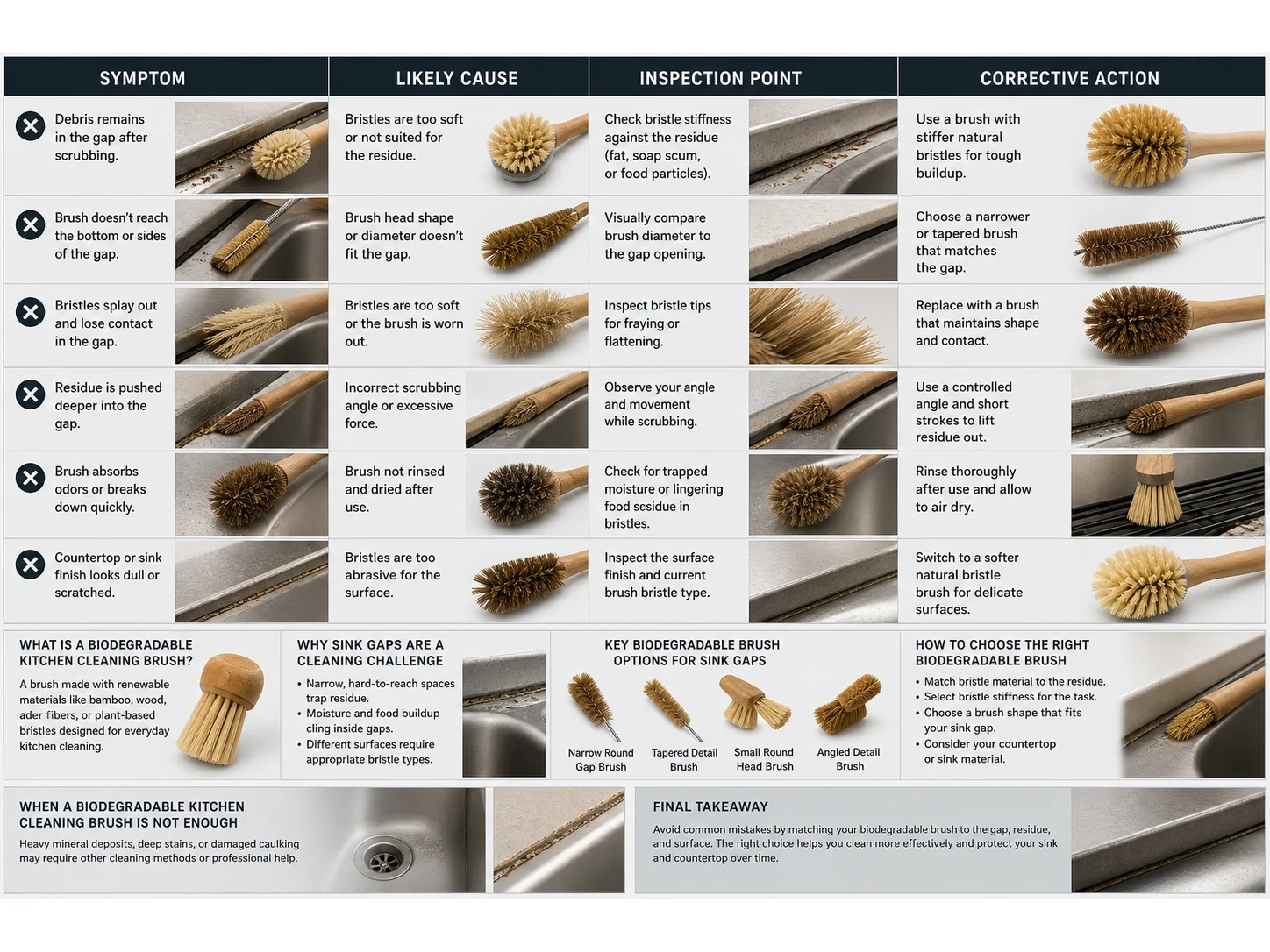
What Is a Biodegradable Kitchen Cleaning Brush?
A biodegradable kitchen cleaning brush uses a handle and bristles derived from renewable, compostable resources. Common bristle materials include tampico fiber (a stiff agave leaf fiber), sisal, coconut coir, and bassine. Handles are typically bamboo or untreated beechwood. Unlike plastic kitchen brushes, these alternatives are designed to return safely to the soil at the end of their useful life — provided they are free of metal staples, synthetic adhesives, and non‑biodegradable coatings.
Why Sink Gaps Are a Cleaning Challenge
Sink gaps are typically 2–8 mm wide, hard to see, and constantly exposed to moisture, food oils, and soap scum. A standard kitchen sponge or bulky plastic brush cannot reach deep into the crevice. Biodegradable brushes with slim profiles and targeted bristle bundles can work well, but only if the diameter, stiffness, and handle design match the gap dimensions and the type of residue you’re tackling.
6 Common Mistakes When Using a Biodegradable Brush in Sink Gaps
- Choosing a brush that’s too thick for the gap. Even a few millimeters too wide prevents the bristles from entering the crevice. Always measure your sink gap before ordering.
- Picking the wrong bristle stiffness. Very stiff bristles like coarse coir can scratch polished stainless steel or quartz composite surfaces, while overly soft horsehair mixes may not remove dried‑on sugar or starch buildup.
- Believing all “biodegradable” claims. Some brushes labeled eco‑friendly include hidden polypropylene fibers or metal wire staples. Check for full material disclosure and, if possible, look for certifications such as OK compost INDUSTRIAL or ASTM D6400 equivalence for home composting scenarios.
- Neglecting the attachment method. Brushes assembled with zinc‑plated metal staples or synthetic epoxy can leave behind small debris that contaminates the compost stream. Opt for brushes tufted with natural latex glue or hand‑tied with plant‑fiber thread.
- Leaving the brush wet between uses. Natural fibers absorb water and will develop mildew if stored in a damp caddy. Always rinse, shake out excess water, and hang the brush bristles‑down to air dry.
- Using the same brush for food‑contact surfaces without a replaceable head. In a commercial or shared kitchen, cross‑contamination is a risk. If brush heads are not replaceable, assign different brushes to sink gap duty and dish scrubbing.
Key Biodegradable Brush Options for Sink Gaps
The table below compares typical biodegradable bristle and handle combinations relevant to tight kitchen crevices. Use it as a starting point, not as an endorsement of any single product.
| Bristle Material | Handle Material | Typical Bundle Diameter (mm) | Stiffness | Attachment Method | Best Suited For | Biodegradability Notes |
|---|---|---|---|---|---|---|
| Tampico fiber | Bamboo | 3–8 | Medium | Heat‑fused or natural latex glue | General food particles, medium gaps | Fully biodegradable; OK compost certification common as a material |
| Sisal | Beechwood | 5–12 | Firm | Natural rubber adhesive | Stubborn dried‑on residues, wider or textured gaps | Marine‑degradable; industrial compost facility recommended |
| Coconut coir | Bamboo | 4–10 | Firm/Abrasive | Twisted‑in‑wire (cotton‑covered) | Heavy grease buildup, rough‑surface gaps | High lignin content slows home composting; can be composted commercially |
| Bassine (palmyra) | Wood (FSC) | 2–6 | Medium‑soft | Tufted with PLA hot melt | Delicate surfaces, very narrow gaps | Plant‑based fiber; handle and bristles will biodegrade over time |
| Horsehair mix | Bamboo | 2–5 | Soft | Wire‑free compression fit | Polishing, cleaning hairline gaps where scratching is a concern | Animal‑origin but fully biodegradable; check with supplier |
How to Choose the Right Biodegradable Brush for Your Sink Gap
- Measure the gap width first. Use a metric feeler gauge or a piece of cardstock. Order a brush whose bristle bundle diameter is 0.5–1 mm smaller than the gap to allow easy entry without jamming.
- Match stiffness to your countertop material. Granite, tile, and stainless steel can tolerate firm bristles; engineered quartz and glossy laminates need medium or soft bristles to avoid micro‑scratching.
- Consider residue type. Greasy buildup benefits from slightly abrasive coir or sisal. Dry, powdery debris cleans easily with tampico or bassine.
- Check hygiene requirements. In food processing or commercial kitchens, choose brushes that can be steamed or boiled (bamboo handles often tolerate this). Ask the supplier for test data if needed.
- Factor in replacability. For high‑use environments, select a brush with a replaceable head or plan to replace the entire brush monthly to avoid bacterial buildup.
- Custom sizing. If no off‑the‑shelf brush fits your gap, many manufacturers offer custom diameters and bristle blends. Provide a dimensioned drawing and request a pre‑production sample to verify fit before bulk ordering.
When a Biodegradable Kitchen Cleaning Brush Is the Wrong Choice
A biodegradable brush works well for regular maintenance of sink gaps, but there are situations where it reaches its limits:
- Gaps narrower than 2 mm. Even the finest horsehair bristle bundle may not fit. A flexible silicone seal scraper or a thin stainless‑steel gap tool (non‑biodegradable) may be necessary for initial deep cleaning, after which you can use the brush for quick wipes.
- Deep mold or biofilm. If black mold has penetrated the silicone sealant, no brush will remove it. Treat the area with a food‑safe mold killer, then reseal. The brush should only be used on the cured sealant surface afterward.
- Constant chemical exposure. Commercial kitchens using high‑concentration chlorine or alkali cleaners can degrade natural fibers faster. In these cases, request a material resistance chart from the brush supplier or consider a validated sample test before committing to a large order.
- Wire brush alternative. For extremely stubborn, embedded carbon‑like deposits, a wire brush with a long handle may be more effective. However, wire bristles can scratch sinks and are not biodegradable. Reserve them for rare deep‑clean scenarios and always test on an inconspicuous area.
Final Takeaway
Choosing a biodegradable kitchen cleaning brush for sink gaps isn’t just about being eco‑friendly. It’s about matching the bristle diameter to your gap, picking a stiffness that won’t damage your counters, and verifying the brush’s compostability from core to tuft. Measure first, select the right fiber and attachment method, and dry the brush after each use. When standard brushes can’t reach, consider a custom size or pair your biodegradable tool with another gap‑cleaning method for the deep clean.
Frequently Asked Questions
How do I measure my sink gap without special tools?
Slide a stack of sticky notes or a piece of cardstock into the gap until you feel firm contact. Mark the depth, measure the stack thickness with a ruler, and subtract about 0.5 mm to account for compression. That gives you a practical gap width to order a brush.
Can I boil a biodegradable brush to sterilize it?
Brushes with bamboo handles and heat‑resistant natural‑fiber bristles (tampico, sisal) can usually withstand brief immersion in boiling water for 1–2 minutes. Avoid boiling brushes with PLA‑based adhesives or horsehair bristles, as they may deform. Always check the supplier’s cleaning instructions.
What if the biodegradable brush starts to smell sour?
This is a sign of bacterial growth in trapped moisture. Soak the bristle end in a 1:1 white vinegar‑water solution for 15 minutes, rinse thoroughly, and dry the brush completely in sunlight or a well‑ventilated area. If the smell persists, replace the brush.
Are there brushes specifically designed for curved or irregular sink gaps?
Most biodegradable brushes are linear. For curved gaps, look for a brush with a narrow, flexible wire handle that can be bent gently by hand, or order a custom brush with a pre‑curved bamboo handle from a manufacturer that accepts technical drawings.
How often should I replace a biodegradable kitchen cleaning brush used in sink gaps?
In a residential kitchen, expect 3–6 months with daily use and proper drying. In a commercial setting, inspect bristles weekly for splaying or trapped debris and replace every 1–2 months, or sooner if the brush starts to soften excessively from hot water and detergent exposure.
Do I need a different brush if I also want to clean behind the faucet?
A brush that fits your sink gap may not have a long enough or thin enough handle to reach behind a gooseneck faucet. A separate, long‑handle gap brush with a slim profile is often more effective. Using the same brush for multiple zones is fine as long as you’re only dealing with similar non‑food‑contact residue.
Can biodegradable brushes handle commercial degreasers?
Some can, but it depends on the chemical. Strong alkaline degreasers (pH >11) can break down natural fibers like tampico after prolonged exposure. If your cleaning protocol requires aggressive chemicals, ask the brush supplier for a chemical compatibility data sheet or run a 48‑hour submersion test with a sample brush before ordering in bulk.
Technical References
- CDC — Preventing Food Poisoning
- eCFR — 21 CFR 177.1520 Olefin Polymers
- CDC MMWR — Wire Bristle Grill-Brush Ingestion Injuries
- FDA — Food Safety in Your Kitchen
Which bristle material fits this job — Horsehair, AISI 304 Stainless Steel Wire or Tampico Fiber?
| Material | Continuous temperature (°C) | Peak temperature (°C) | Water absorption | Hardness |
|---|---|---|---|---|
| Horsehair | 60–80 | 100–120 | 8–15% | — |
| AISI 304 Stainless Steel Wire | 400 | 500 | 0% | Rockwell B 70–95 depending on temper and cold work |
| Tampico Fiber | 70–90 | 110–130 | 10–18% | — |
| Silicone | 200–250 | 280–300 | 0.1–1.0% | Shore A 20–80 |
Figures as published by Alleima. Confirm the exact grade against the supplier datasheet before ordering.
What should replace Horsehair for sink gaps?
- Horsehair — Compare Horsehair with Boar bristle, goat hair, microfiber. Change material when wet stiffness, temperature, chemical resistance, conductivity, particle shedding, or surface marking becomes the limiting factor.
- AISI 304 Stainless Steel Wire — Use AISI 316 stainless steel wire for chloride, marine, dairy, beverage, chemical washdown, or higher pitting-resistance requirements. Use carbon steel for dry aggressive cutting and brass or abrasive nylon for lower marking risk.
- Tampico Fiber — Compare Tampico Fiber with Compare with horsehair for softer dry contact, sisal for firmer plant-fiber scrubbing and nylon for more uniform recovery. Change material when wet stiffness, temperature, chemical resistance, conductivity, particle shedding, or surface marking becomes the limiting factor.
- Silicone — Compare Silicone with PP, TPE, Nylon. Change material when wet stiffness, temperature, chemical resistance, conductivity, particle shedding, or surface marking becomes the limiting factor.