
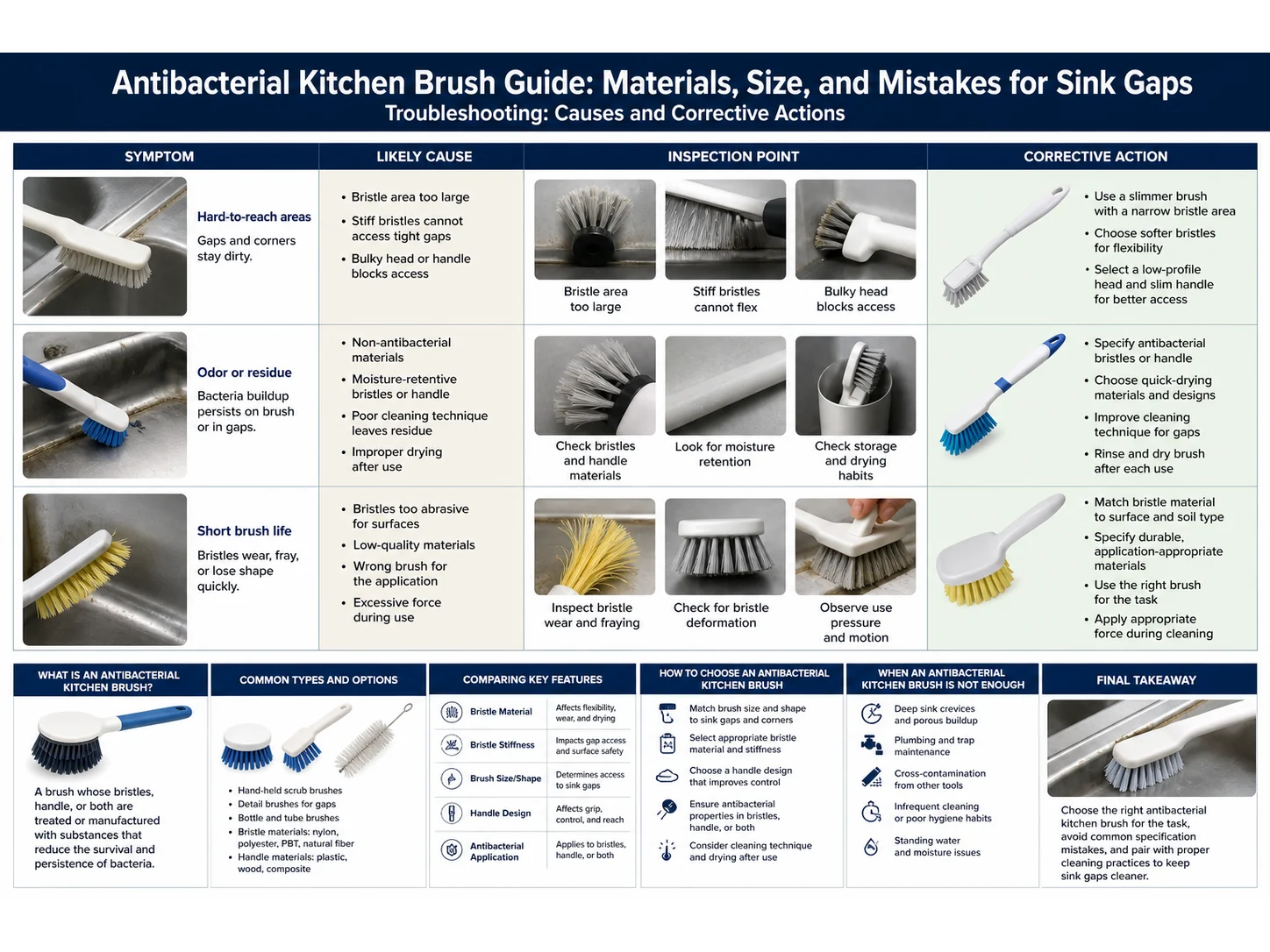
What Is an Antibacterial Kitchen Brush?
An antibacterial kitchen brush is a brush whose bristles, handle, or both are treated or manufactured with substances that reduce the survival and multiplication of bacteria on the tool. Common antimicrobial agents include silver‑ion additives, zinc‑based compounds, or specially engineered polymers. Unlike standard brushes, these are intended for hygiene‑critical areas in food preparation zones, where a brush that stays cleaner between uses helps prevent cross‑contamination. The antibacterial feature addresses bacterial growth on the brush itself, not on the surface being cleaned—mechanical scrubbing removes residue, but the brush remains less of a vector.
Common Types and Options
Antibacterial kitchen brushes come in several forms, each suited to different sink‑gap geometries and user preferences:
- Angled detail brush: A small head set at 45–90 degrees to reach under sink rims and around faucet bases.
- Narrow groove brush: Very thin bristle rows or a single row, ideal for gaps between counter and sink or tight drain slots.
- T‑handle scrub brush: Provides a firm grip for applying more pressure on stuck‑on grime.
- Interdental‑style sink brush: Tiny, pointed tip for millimeter‑wide crevices.
- Replaceable‑head system: Handle stays, only the brush head is swapped, reducing waste and cost over time.
Materials range from nylon with embedded antimicrobial agents to polyester blends that resist moisture. Handles may be plastic, stainless steel, or overmolded with soft grips. Mounting options include hanging loops, magnetic backs, or suction cups for under‑sink storage.
Comparing Key Features of Antibacterial Kitchen Brushes
| Feature | Option A | Option B | Option C | Why It Matters |
|---|---|---|---|---|
| Material | Nylon with silver‑ion additive | Polyester (moisture‑resistant) | Natural bristle (often untreated) | Determines antimicrobial durability and chemical resistance |
| Diameter | Narrow (≤ 1/4 in / 6 mm) | Medium (1/2 in / 13 mm) | Wide (> 1/2 in) | Must fit the specific gap; narrow is for tight crevices |
| Stiffness | Soft (food‑safe silicone or fine bristle) | Medium (general scrubbing) | Firm (stubborn residue) | Match stiffness to surface sensitivity and debris type |
| Handle / Core | Plastic (lightweight) | Stainless steel (durable, rust‑free) | Overmolded grip (ergonomic) | Impacts longevity, comfort, and chemical exposure tolerance |
| Mounting / Storage | Hanging loop | Suction cup | Magnetic back | Proper drying prevents bacterial growth on the brush |
How to Choose an Antibacterial Kitchen Brush
Selecting the right brush goes beyond purchasing the first “antibacterial” label. Base your decision on these practical factors:
- Residue type: Greasy soils need firmer bristles; sticky syrups may require a brush that is easy to rinse thoroughly.
- Surface sensitivity: For stainless steel sinks, a medium‑stiffness nylon brush prevents scratching; for rubber gaskets, use soft bristles.
- Equipment interface: Will you clean removable sink parts or fixed installations? A long, flexible handle helps reach under fixed edges.
- Wet and chemical exposure: In commercial kitchens with frequent sanitizer use, verify the brush material withstands quaternary ammonium or chlorine solutions without degrading the antibacterial additive.
- Hygiene expectations: In HACCP‑managed kitchens, brushes should carry recognized antimicrobial certification or third‑party test data provided by the supplier.
- Maintenance frequency: Brushes that can be disassembled or replaced frequently reduce biofilm buildup.
- Custom size needs: If sink‑gap dimensions fall outside standard brush sizes, request a custom diameter or head shape from the manufacturer, supported by a drawing.
Common Mistakes When Specifying an Antibacterial Kitchen Brush
- Prioritizing cost drivers over antimicrobial longevity: Inexpensive brushes may lose antibacterial properties after a few washes.
- Ignoring bristle diameter: A brush that is too thick will not enter the gap, leaving debris untouched.
- Using overly stiff bristles on delicate surfaces: Causes micro‑scratches that later trap bacteria.
- Assuming “antibacterial” means self‑cleaning: The brush still requires regular rinsing, drying, and replacement.
- Overlooking chemical compatibility: Some antimicrobial agents are deactivated by bleach or acidic cleaners.
- Neglecting handle design: A slippery or short handle is a safety and ergonomic issue in wet conditions.
- Skipping fit testing: Ordering in bulk without testing a sample against the actual sink geometry often leads to wasted inventory.
When an Antibacterial Kitchen Brush Is the Wrong Choice
An antibacterial brush is a line of defense, not a standalone sanitation solution. In commercial food processing, it must be integrated into a comprehensive cleaning and disinfection program. If sink gaps are extremely narrow (≤ 2 mm) or irregularly shaped, even a custom brush may not fully remove biofilm; alternative tools such as steam cleaners, pressure washers, or disposable swabs might be needed. When hygiene validation is required (e.g., ATP testing), the brush alone cannot Help confirm microbiological compliance—swab sampling and documentation are essential. Additionally, if the brush must withstand frequent autoclaving or aggressive chemical baths, verify that the antibacterial treatment survives those conditions; otherwise, a standard brush replaced more frequently may be more cost‑effective. For unique or first‑time requirements, request a supplier drawing and a pre‑production sample to confirm fit and function before finalizing the order.
Final Takeaway
Choosing an antibacterial kitchen brush for sink gaps is a matter of matching material, size, and stiffness to your specific cleaning task and hygiene standards. Always validate the antimicrobial claim with data, test a sample in the actual sink, and factor in maintenance and chemical exposure. The right brush reduces bacterial transfer, but it is one component of an effective kitchen sanitation routine.
Frequently Asked Questions
How long does the antibacterial property last?
Longevity varies by material and usage. Silver‑ion infused nylon may remain effective for the life of the brush, while surface‑treated bristles can wear off after repeated scrubbing or harsh chemical exposure. Request durability data from the supplier.
Can antibacterial brushes be used with bleach or other disinfectants?
Check the manufacturer’s chemical compatibility chart. Some antimicrobial agents, especially organic‑based ones, may degrade when in contact with strong oxidizers like bleach. If heavy disinfection is required, look for brushes tested against common kitchen sanitizers.
What bristle diameter is best for sink gaps?
Most standard sink gaps accept a brush with a diameter between 1/4 inch and 3/8 inch (6–10 mm). For very tight crevices, a 1/8‑inch (3 mm) detail brush or a custom thin profile may be necessary. Always measure the narrowest point of the gap before ordering.
Are there replaceable heads to reduce waste?
Yes, several manufacturers offer brush systems with interchangeable heads. Confirm that the replacement heads carry the same antibacterial certification as the original, and that the connection mechanism does not trap moisture.
How often should I replace my antibacterial kitchen brush?
Replace the brush when bristles become frayed, bent, or unable to effectively clean—typically every 1–3 months in commercial use. Even if the antibacterial property remains, mechanical wear reduces cleaning performance.
What’s the difference between antimicrobial and antibacterial?
Antibacterial products target bacteria specifically. Antimicrobial is a broader term that may include activity against mold, mildew, and some viruses. For kitchen hygiene, either term is relevant, but always verify the scope of protection with the supplier’s test data.
Can I order a custom size for an unusual sink gap?
Yes. Many brush manufacturers accept custom orders. Provide accurate drawings and gap measurements, and request a sample to confirm fit before committing to a production run.
Do antibacterial brushes require special storage?
To preserve the antibacterial effect and prevent moisture buildup, allow the brush to dry completely between uses. Hanging the brush or using a magnetic holder that keeps bristles clear of standing water is recommended.
Technical References
- CDC — Preventing Food Poisoning
- eCFR — 21 CFR 177.1500 Nylon Resins
- eCFR — 21 CFR 177.1630 Polyethylene Phthalate Polymers
- CDC MMWR — Wire Bristle Grill-Brush Ingestion Injuries
- FDA — Food Safety in Your Kitchen
- NIST — Metric SI
Which bristle material fits this job — Nylon PA, AISI 304 Stainless Steel Wire or Silicone?
| Material | Continuous temperature (°C) | Peak temperature (°C) | Water absorption | Hardness |
|---|---|---|---|---|
| Nylon PA | 93 | 121 | 0.3–9% by PA grade and conditioning | Medium to firm; filament diameter and trim length control bending force. |
| AISI 304 Stainless Steel Wire | 400 | 500 | 0% | Rockwell B 70–95 depending on temper and cold work |
| Silicone | 200–250 | 280–300 | 0.1–1.0% | Shore A 20–80 |
| Rubber | 100 | 130 | very low | Specified by compound and Shore hardness; published TPE families can span roughly 50–80 Shore A, but that is a product-family example rather than a universal rubber range. |
Figures as published by Brushtec / DuPont; Alleima. Confirm the exact grade against the supplier datasheet before ordering.
What should replace Nylon PA for sink gaps?
- Nylon PA — Compare Nylon PA with PP, PBT, PET. Change material when wet stiffness, temperature, chemical resistance, conductivity, particle shedding, or surface marking becomes the limiting factor.
- AISI 304 Stainless Steel Wire — Use AISI 316 stainless steel wire for chloride, marine, dairy, beverage, chemical washdown, or higher pitting-resistance requirements. Use carbon steel for dry aggressive cutting and brass or abrasive nylon for lower marking risk.
- Silicone — Compare Silicone with PP, TPE, Nylon. Change material when wet stiffness, temperature, chemical resistance, conductivity, particle shedding, or surface marking becomes the limiting factor.
- Rubber — Compare Rubber with Silicone elastomer, TPE, PVC profile, PVA sponge. Change material when wet stiffness, temperature, chemical resistance, conductivity, particle shedding, or surface marking becomes the limiting factor.