What Is a Small Detail Cleaning Brush?
A small detail cleaning brush is a precision cleaning tool with a bristle head diameter that typically ranges from a few millimeters to about 25 mm. It is built to scrub, sweep, or dislodge buildup in confined areas where access is limited. Unlike a general‑purpose scrub brush, a detail brush is selected by three measurable factors: bristle material, overall brush diameter, and handle length or flexibility. The right brush prevents surface scratching, reaches fully into the gap, and withstands the cleaning chemistry used.
For wire grill-brush bristle injury and inspection context, this section references CDC MMWR — Wire Bristle Grill-Brush Ingestion Injuries.
For PPE and operator protection context, this section references OSHA — Personal Protective Equipment.
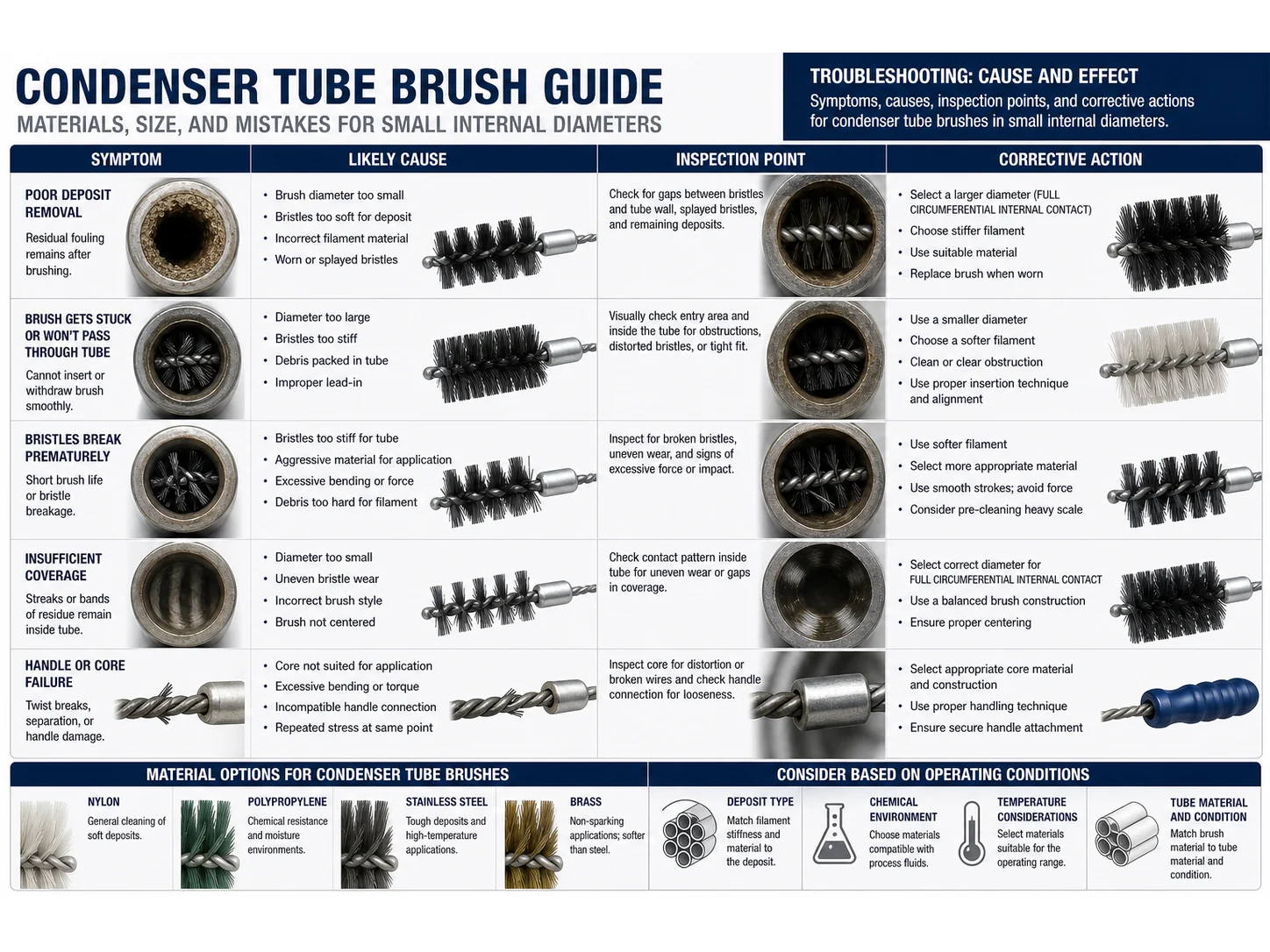
Common Bristle Materials and Their Trade‑offs
Different sink gap residues and surface sensitivities require different bristle materials. The table below compares typical options for small detail brushes, including those frequently specified for food‑zone, janitorial, and household maintenance cleaning.
For food-service sanitation and cleaning-equipment context, this section references FDA — Food Code.
For food manufacturing CGMP and preventive-control context, this section references eCFR — 21 CFR Part 117 Human Food CGMP and Preventive Controls.
For general food-safety and safe food-handling context, this section references FDA — Safe Food Handling.
| Material | Typical Stiffness | Best for Residue Type | Surface Sensitivity | Chemical / Moisture Resistance | Common Mounting / Core |
|---|---|---|---|---|---|
| Nylon (soft or medium) | Low ‑ medium | Light grease, soap scum, dust | Safe on most sinks (stainless, porcelain, composite) | Good with mild acids and alkalis; avoid strong solvents | Twisted‑wire, plastic handle, or ferrule |
| Nylon (stiff / abrasive‑filled) | Medium‑high | Baked‑on residues, mineral deposits | Test on polished stone or colored grout first | Similar to nylon; some abrasive‑filled bristles may degrade faster with bleach | Often twisted‑wire core |
| Brass | High | Hard water scale, rust stains, heavy buildup | Risk of scratching soft sinks (stainless with mirror finish, marble) | Excellent with water, mild chemicals; avoid acids that attack brass | Wire handle, twisted‑wire, or brush‑on‑a‑stick |
| Stainless Steel | Very high | Tough deposits, weld splatter cleaning (industrial context) | Will scratch most residential sink materials; use only where damage is acceptable | Excellent chemical resistance | Wire handle, twisted‑wire |
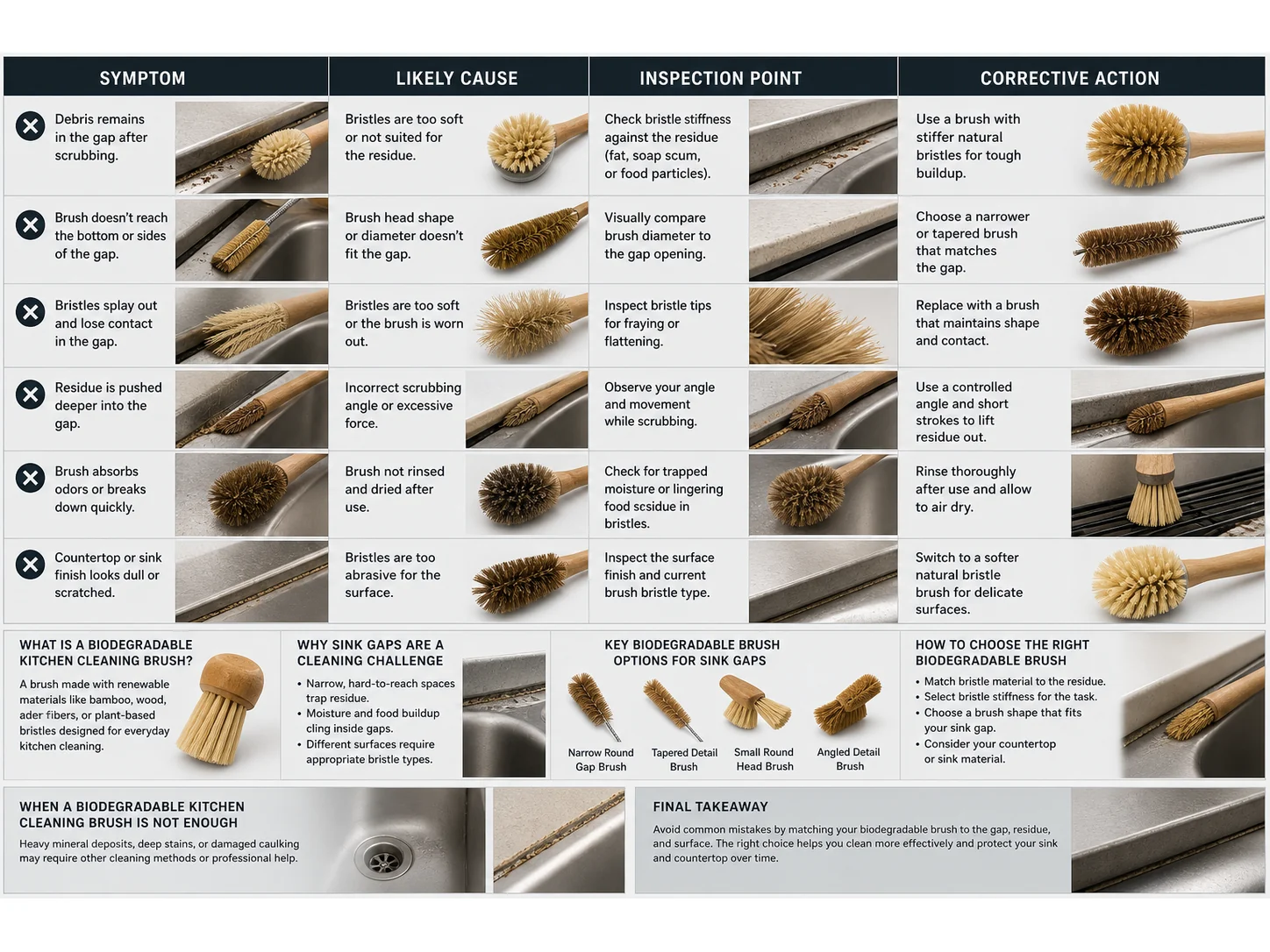
| Natural Fiber (Tampico, Palmyra) | Medium | General cleaning, scrubbing without scratching | Very safe on delicate surfaces | Fair; may swell or soften with prolonged water exposure | Wood or plastic handle, twisted‑wire |
Size and Diameter: Matching the Gap, Not Guesswork
For sink gaps, the most critical dimension is the bristle diameter—the overall width of the brush head when the bristles are relaxed. A brush that is too wide will not enter the gap; one that is too narrow cleans inefficiently and may not apply enough side pressure.
For engineering drawing, dimensions, tolerance, thread, fit, and RFQ specification context, this section references ASME — Y14.5 Dimensioning and Tolerancing.
- Measure the narrowest point of the gap you intend to clean. Use a feeler gauge or a set of drill bits to find the smallest opening.
- Choose a brush diameter 1–2 mm smaller than the gap width to allow insertion without excessive force, yet provide enough contact pressure. For a 4 mm gap, a 2.5–3 mm diameter bristle section often works well.
- Bristle length (trim length) affects reach and stiffness. For deep gaps, longer bristles may fold instead of scrub; a shorter trim length increases scrubbing action.
- Round vs. flat shape: Round brushes suit circular gaps around faucets; flat or paddle‑style small brushes are better for parallel crevices (e.g., between a sink and backsplash).
Handle, Core, and Ergonomics
The connection between the bristle head and the user’s hand determines how much force can be applied and how long the brush lasts.
- Twisted‑wire core: The most common for small detail brushes. The wire is twisted around the bristles, creating a sturdy, flexible stem that can be bent by hand to reach awkward angles. Good for light to medium scrubbing; frequent bending may fatigue the wire.
- Plastic handle with ferrule: Found on smaller bottle‑style brushes. Offers a comfortable grip but limits access to straight‑on approaches. The ferrule‑to‑handle joint can weaken with aggressive side loads.
- Long reach / flexible wire handle: Useful for cleaning behind sink rims or deep into disposal flanges. Stiffness must be balanced—too flexible and it won’t transfer pressure; too rigid and it can’t navigate curves.
- Brush‑on‑a‑stick / machine‑mount: For operators who need to clean hundreds of sink‑gap areas daily, a small brush mounted on a reciprocating or rotary tool may be considered. These demand precise diameter and shank specifications.
How to Choose Based on Residue and Surface Sensitivity
Match the brush to what you are removing and what you are protecting:
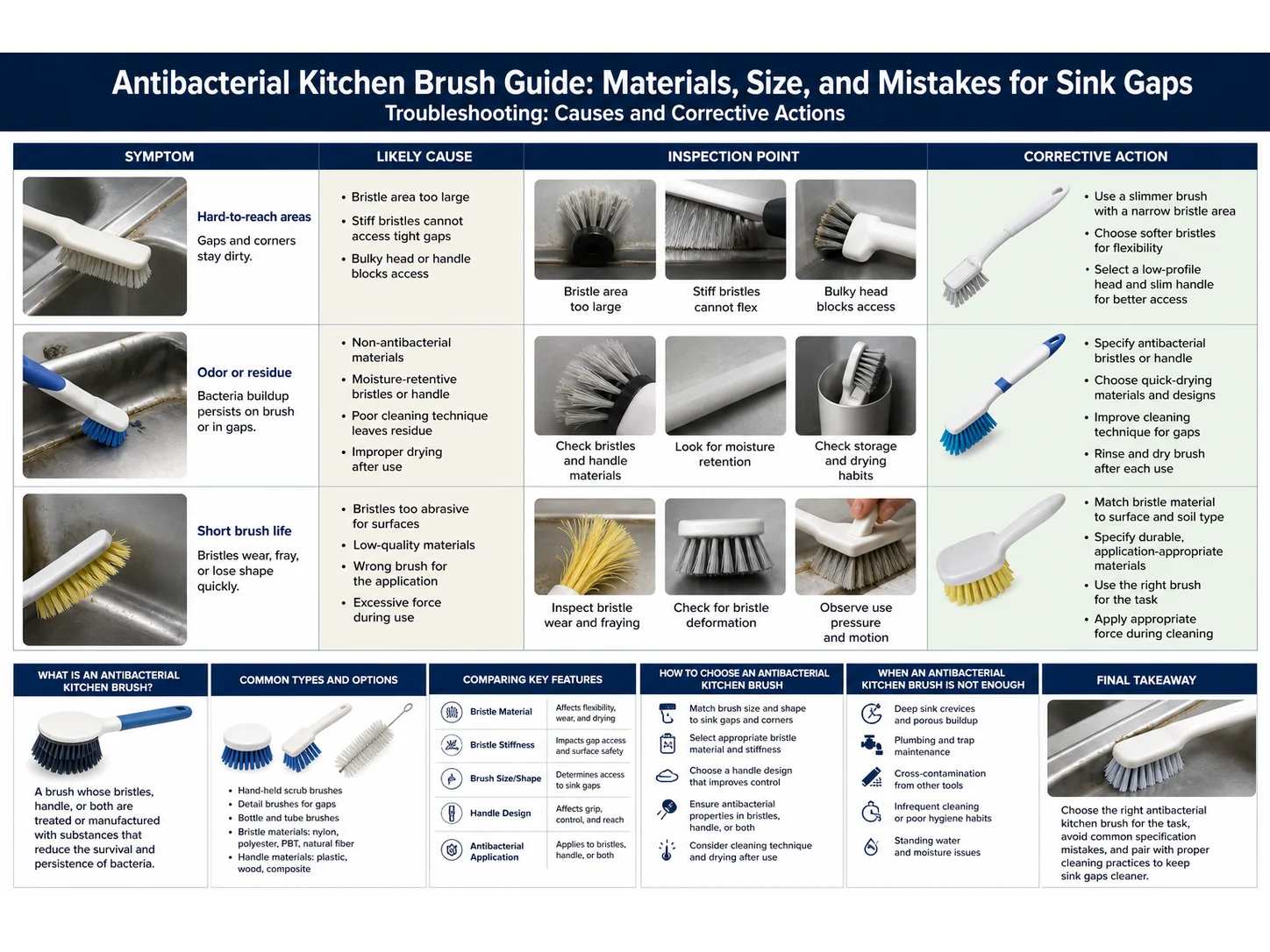
- Identify the residue: Soap scum and light grease respond well to nylon. Hard water scale or rust benefits from brass or stiff nylon with an abrasive additive. Mold and mildew in caulk lines require a brush that can reach into the porous joint without tearing the sealant.
- Evaluate the surface material: Stainless steel sinks with a brushed finish tolerate brass or stiff nylon better than polished surfaces. Natural stone like granite or marble requires non‑metallic bristles. Glazed ceramic is forgiving but thin glaze edges can chip with heavy metal‑brush use.
- Consider cleaning chemistry: If bleach‑based cleaners are used, avoid natural fibers and certain nylons that degrade. Strong acids demand polypropylene or stainless bristles. Check the brush core as well—a galvanized wire may corrode under harsh chemicals.
- Hygiene expectations: In food‑prep environments, non‑porous, dishwasher‑safe materials like nylon or stainless without wooden handles are preferred. Color‑coding can help segregate brushes by area to prevent cross‑contamination.
- Maintenance frequency: High‑volume cleaning (multiple sinks per shift) calls for brushes that resist matting and retain stiffness. A twisted‑wire brush with dense nylon fill may last longer than a glued‑bristle plastic handle.
Common Specification Mistakes
- Choosing by overall look instead of measured diameter. A brush “looks small” may be 30 mm wide and unable to enter a 4 mm gap. Always check the relaxed diameter, not the package photo.
- Ignoring bristle stiffness rating. A “medium” nylon from one supplier may be stiffer than a “stiff” from another. Ask for a durometer range or a sample if the application is critical.
- Assuming all metal‑core brushes are stainless. Galvanized wire cores can corrode in wet sink cleaning, leaving rust marks. Request corrosion‑resistant trim wire if the brush will stay wet.
- Overlooking chemical compatibility of the handle. A wood‑handled brush left in a cleaning solution will swell and crack. If the brush is dipped or soaked, specify a fully synthetic construction.
- Buying a single brush shape for all gap types. A round brush cannot scrub flat crevices efficiently; a flat brush won’t clean a circular faucet base evenly. Maintain a small set of shapes.
- Focusing on cost drivers per brush instead of cost per gap cleaned. A cheaper brush that mats after 10 gaps costs more in labor and replacement than a slightly higher‑priced brush that lasts 100 cycles.
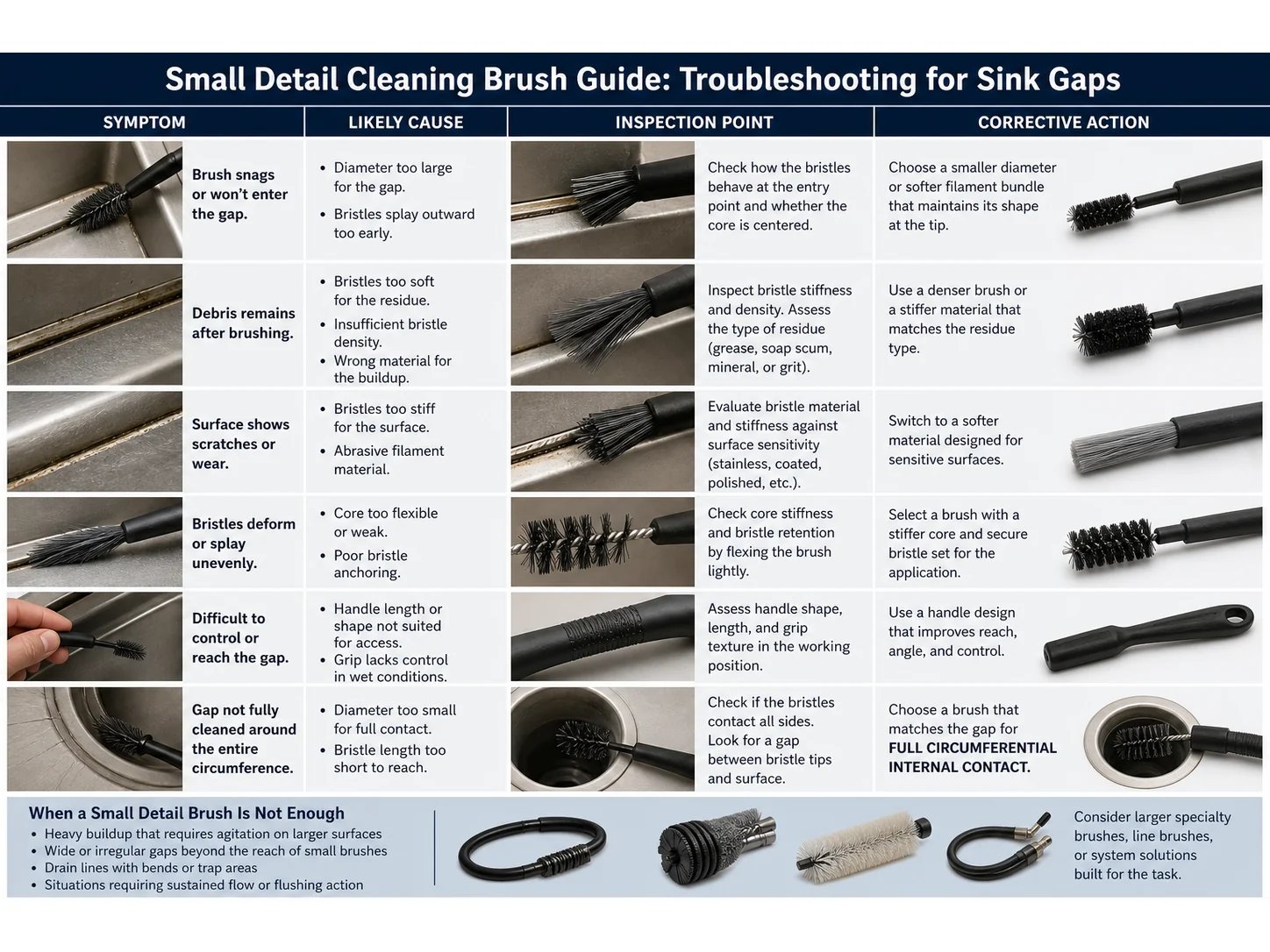
When a Small Detail Brush Is Not Enough
A small detail brush excels at mechanical scrubbing in confined spaces, but it has limits:
- Deep, blind cavities: If the gap is deep and has no rear access, a brush may compress debris instead of removing it. A flushing tool (syringe or targeted spray) may be needed first, followed by the brush.
- Heavy scale buildup: Thick calcium layers may require a descaling chemical soak before brushing; a brush alone will wear quickly and produce poor results.
- Delicate plated finishes: Gold‑plated or PVD‑coated sink fixtures can be scratched even by soft nylon if pressed hard. Non‑abrasive cloths or soft sponges are safer first choices; a brush should only be used with extreme care or not at all.
- Automated or high‑speed cleaning: For production‑line sink cleaning, small handheld brushes slow the process. A custom brush roll or rotary brush designed for the specific gap and a machine is more efficient. In such cases, involve a supplier who can review a drawing of the gap profile and recommend a solution.
- Verification of fit before ordering large quantities: If you are specifying custom small detail brushes for a new sink design, always request a physical sample or a dimensioned drawing. A measurement error of 0.5 mm can render thousands of brushes unusable.
Final Takeaway
Selecting the right small detail cleaning brush for sink gaps comes down to three measured facts: the bristle material matches the residue and surface sensitivity, the relaxed diameter fits the gap with a small safety margin, and the handle supports the access angle and operator frequency. Avoid specification mistakes by requesting samples, checking chemical resistance of all components, and not relying solely on product photos. A well‑chosen brush reduces cleaning time and prevents surface damage, while a poorly chosen one increases maintenance costs.
Frequently Asked Questions
Can I use a brass brush on my kitchen sink without scratching it?
On brushed stainless steel, a soft‑to‑medium brass brush may be acceptable if used lightly. On polished stainless, colored stone, or composite sinks, brass is more likely to leave marks. Always test on an inconspicuous area first, and never use brass on surfaces with a mirror finish.
How do I measure the gap correctly when I can’t fit a ruler inside?
Use a set of plastic or metal feeler gauges from an automotive or hardware store. Alternatively, gently insert the shank end of small drill bits until you find the largest size that slips into the gap easily. That bit size approximates the clearance needed. Choose a brush diameter about 1 mm smaller.
What bristle material is safest for cleaning around caulk joints?
Soft nylon or natural Tampico fiber is less likely to tear or lift the caulk bead. Avoid metal bristles entirely in sealed joints. If the caulk is old and brittle, even a soft brush may damage it—replace the caulk first, then maintain it with a gentle brush.
Can small detail brushes be sanitized in a dishwasher or autoclave?
Many nylon and stainless steel brushes can withstand dishwasher cycles if the handle and core are also heat‑resistant. Wood‑handled or natural fiber brushes should not be autoclaved. Check with the brush manufacturer for maximum temperature ratings. Color‑coded nylon brushes are commonly used in food service and can be machine‑washed.
My brush lost its shape after one cleaning session. What went wrong?
Likely the bristle material was too soft for the job, or the brush was used with a side‑scrubbing motion that permanently bent the bristles. Twisted‑wire core brushes can sometimes be reshaped by hand, but frequent deformation indicates a mismatch. Switch to a stiffer bristle or a shorter trim length for the same diameter.
When should I consider a custom brush instead of an off‑the‑shelf option?
If your gap is non‑standard (e.g., an oval drain collar, a curved seam), or you need hundreds of identical brushes with a consistent diameter, custom is worth exploring. You will need to provide a dimensioned drawing of the gap profile and specify bristle material, trim length, and core type. Always ask for a pre‑production sample to confirm fit and stiffness.
Is a wire brush handle better than a plastic handle for sink detail work?
It depends on access. A twisted‑wire handle can be bent to angle into tight spots, which plastic handles cannot. However, wire can fatigue and snap, and it may scratch surfaces if the coating wears off. For straight‑down cleaning into a gap with open overhead access, a rigid plastic handle may give better control.
How long should a small detail brush last in daily commercial kitchen use?
With proper rinsing and drying, a quality nylon twisted‑wire brush used several times a day on sink gaps might last 2–4 weeks before bristles mat or the wire core fatigues. Harsh chemicals, lack of drying, and aggressive scrubbing shorten life. Set a replacement schedule based on visual inspection, not a calendar, and stock spares to avoid downtime.