
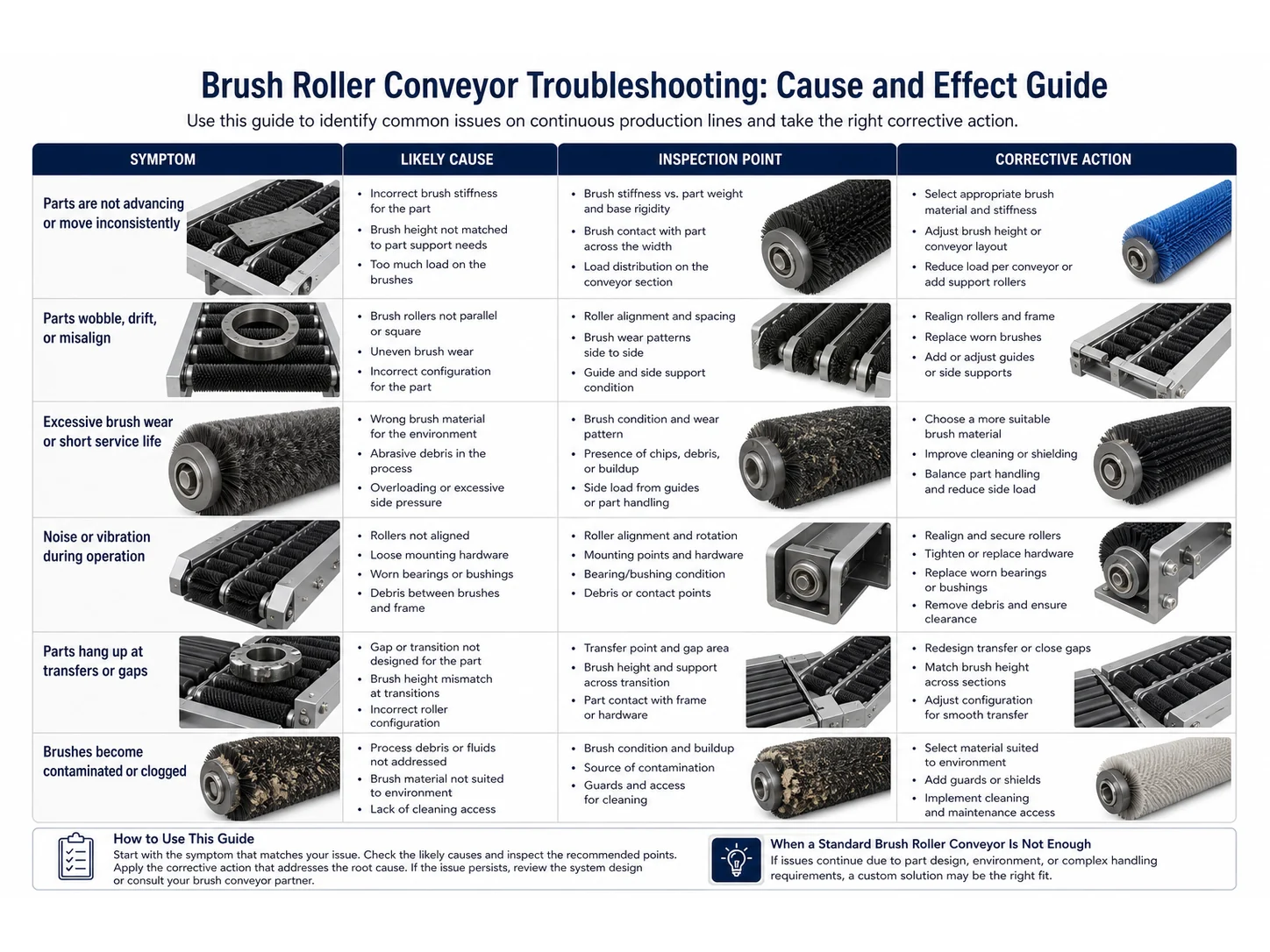
What Is a Brush Roller Conveyor?
A brush roller conveyor is a rotating cylindrical brush mounted on a shaft—often inside a conveyor system—that performs cleaning, positioning, surface treatment, or product handling. In continuous production lines, it is commonly used to remove debris from conveyor belts, wipe residues from products, apply thin coatings, or control product spacing. The brush roller’s filament material, stiffness, diameter, and mounting design determine its effectiveness and lifespan.
Common Types and Configurations
Brush roller conveyors come in several basic forms to suit different conveyor designs and tasks:
- Shaft‑mounted roller brushes: The brush is built around a solid or hollow core and mounted directly onto a driven shaft. Used for cleaning wide belts or treating products passing underneath.
- Conveyor belt cleaning brush rollers: Specifically designed to clean the return side of a conveyor belt, often spring‑loaded or fixed in a bracket assembly.
- Strip brush rollers: Formed by winding a continuous strip brush around a core, creating a spiral or full‑coverage pattern. Easy to customize length and bristle density.
- Custom roller brushes: Built to spec for unique mounting arrangements, shaft ends, or non‑standard diameters.
Material and Size Comparison for Brush Roller Conveyors
The table below compares common filament materials used in brush roller conveyors. Selection depends on the residue type, conveyor environment, and surface sensitivity.
| Filament Material | Stiffness | Chemical Resistance | Temperature Range | Moisture Absorption | Typical Use Cases |
|---|---|---|---|---|---|
| Nylon (PA 6, 6.6, 6.12) | Medium to Firm | Good in dry, limited in harsh chemicals | -40°F to 250°F | High (can soften wet) | General debris removal, dry food lines, packaging |
| Polypropylene (PP) | Soft to Medium | Excellent in acids, alkalis | Up to 190°F | Very Low | Wet environments, chemical washdown, fruit & vegetable cleaning |
| Polyester (PET, PBT) | Medium to Firm | Good, resists most cleaning agents | -20°F to 300°F | Low | High‑temp belts, abrasive particles, bake‑out environments |
| Natural Fibers (Tampico, Sisal) | Soft to Medium | Poor in acids/alkalis | Up to 180°F | High (may degrade) | Delicate surfaces, polishing, low‑dust requirements |
| Abrasive‑Filled Nylon (Silicon Carbide) | Extra Firm | Good | Up to 200°F | Medium | Heavy residue removal, scale, baked‑on soils |
Size and mounting considerations:
- Outer diameter (OD): Typically 2″ to 12″, chosen to match conveyor clearance and required surface speed.
- Face length: Must cover the full belt width or product path, with slight overhang if needed.
- Core / handle type: Solid for high torque, hollow for weight reduction, keyed or set‑screw shaft ends for secure mounting.
- Mounting style: Pillow block bearings, flange mounts, spring‑loaded brackets, or quick‑release designs for washdown lines.
How to Choose a Brush Roller Conveyor
Start by clearly defining the residue or task, then work through these decision points:
- Residue type: Dry dust, sticky paste, abrasive grit, or oily film each demand different filament materials and stiffness.
- Surface sensitivity: Will the brush scratch the product or belt? For polished surfaces, use a softer filament or natural fiber.
- Conveyor speed and duty cycle: High‑speed lines may need denser fill to maintain contact; intermittent use allows lighter construction.
- Environment: Wet washdown, chemical exposure, or high heat narrow down material choices. Look for FDA‑compliant filaments if food‑contact is possible.
- Maintenance frequency: Quick‑change mounts and wear‑indicating filaments reduce downtime for brush replacement.
- Custom dimensions: Verify shaft diameter, overall length, and bearing fits with your conveyor manufacturer. Always request a detailed drawing.
- Compatibility: The brush roller’s rotation direction, speed, and pressure against the belt or product must be adjustable or factory‑set.
Installation and Operation Factors
Even the best‑specified brush roller conveyor can fail if installed incorrectly. Check these points before startup:
- Brush overlap: The brush face must fully contact the belt or product across the entire width.
- Tension and pressure: Too much pressure accelerates filament wear; too little fails to clean.
- Rotation direction: Running the brush with or against product flow changes cleaning action and debris throw pattern.
- Clearance: Ensure the brush does not bottom out or rub against metal framing.
- Drive coupling: Misalignment between motor and brush shaft causes vibration and premature bearing failure.
Common Mistakes When Specifying a Brush Roller Conveyor
These errors lead to early failure, product damage, or unnecessary costs:
- Selecting by cost drivers alone: Cheaper filaments may wear out five times faster in a tough environment.
- Ignoring filament stiffness: Too stiff a brush can scratch products or tear belts; too soft removes nothing.
- Overlooking chemical exposure: Nylon absorbs moisture and loses stiffness when wet, while polypropylene resists. Using the wrong material in a washdown area is a common failure mode.
- Using an abrasive brush on sensitive surfaces: Even a medium nylon can leave micro‑scratches on soft plastics or heat‑treated metals.
- Mismatched mounting: The shaft end, keyway, or bearing fit may not match your conveyor frame—always verify.
- Forgetting maintenance access: If the brush roller is buried deep inside the machine, replacement becomes a production‑stopping event.
- Skipping a sample test: No data sheet can fully predict how a brush will handle your specific residue blend at your line speed.
When a Brush Roller Conveyor Is the Wrong Choice
A standard catalog brush roller solves many problems, but certain situations call for a more specialized approach:
- When the residue composition is unknown or highly variable, a custom sample test with different materials is essential.
- If the conveyor space is extremely tight or the profile is unusual, a custom‑engineered brush roller drawing from a supplier is required.
- For high‑precision applications such as electronic circuit cleaning, static‑dissipative filaments and extremely uniform trim may be necessary, which are not off‑the‑shelf.
- When hygiene demands leave no room for error (e.g., dairy, medical), HACCP‑compliant brush design and materials with full traceability must be specified.
- If the brush cannot be isolated for safe maintenance, alternative cleaning methods like automatic scraper systems or ultrasonic washing may be more practical.
Final Takeaway
A brush roller conveyor looks simple, but its performance hinges on matching material, stiffness, diameter, and mounting to your real production conditions. Define your residue and environment, talk to suppliers early with a detailed spec, and always request a sample or factory reference before you buy. The right brush roller cuts downtime and keeps your line moving.
Frequently Asked Questions
What is the difference between a brush roller conveyor and a conveyor belt cleaning brush?
A brush roller conveyor is a general term for any rotating brush used on a conveyor line, while a conveyor belt cleaning brush is a specific type designed primarily to scrape the return side of a belt. Many belt cleaning brushes are roller‑style, but they may include additional mounting brackets and tensioners.
Can a brush roller conveyor be used for both cleaning and product transfer?
Yes. Some brush rollers are designed to move products while simultaneously cleaning them, such as in fruit washing lines. However, the brush must be stiff enough to push the product without damaging it, which requires careful material selection.
How do I know if I need a soft, medium, or firm filament?
Determine the required cleaning aggression. Soft filaments (e.g., Tampico, soft polypropylene) are for delicate surfaces or light dust. Medium filaments (nylon, polyester) handle general debris. Firm filaments (abrasive‑filled nylon) break up baked‑on residues. Supplier sample kits let you compare.
Does brush diameter affect performance?
Yes. A larger diameter brush provides more surface contact and typically lasts longer, but it also requires more drive torque and may not fit in tight conveyor gaps. Smaller diameters spin faster for the same surface speed and can reach narrow spaces.
Can I use the same brush roller for wet and dry applications?
Not always. Nylon absorbs water and loses stiffness, making it unsuitable for continuous wet use. Polypropylene is a better choice for washdown lines. If your line cycles between wet and dry, specify a moisture‑resistant material or plan for more frequent replacement.
What maintenance is needed for a brush roller conveyor?
Regular inspection for filament wear, core erosion, and bearing noise. Replace brushes when the filament length drops below the minimum effective length—typically when it fails to contact the belt or product. Clean out built‑up residue and re‑lubricate bearings per the schedule.
How do I measure for a replacement brush roller?
Measure the overall length, the face length (the bristled section), the shaft diameter at both ends, and the keyway or set‑screw dimensions. Take photos of the mounting arrangement. Send these to the supplier with the existing brush roller if possible.
Can brush rollers be custom‑made for non‑standard conveyors?
Yes, custom roller brushes are common. Manufacturers can match any diameter, length, filament material, trim, and shaft end style. The lead time and minimum order quantity will be higher, but the brush will fit perfectly.
Technical References
- OSHA — Machine Guarding
- OSHA — Control of Hazardous Energy
- OSHA — Combustible Dust
- EPA — Particulate Matter Basics
- NIST — Metric SI
Which bristle material fits this job — Nylon PA, Polypropylene PP or PBT?
| Material | Continuous temperature (°C) | Peak temperature (°C) | Water absorption | Hardness |
|---|---|---|---|---|
| Nylon PA | 93 | 121 | 0.3–9% by PA grade and conditioning | Medium to firm; filament diameter and trim length control bending force. |
| Polypropylene PP | 80–100 | 120–140 | ≤0.03% | Shore D 65–75 |
| PBT | 120–140 | 160–180 | 0.05–0.20% | Shore D 80–90 |
Figures as published by Brushtec / DuPont; Perlon. Confirm the exact grade against the supplier datasheet before ordering.
What should replace Nylon PA for conveyor belt cleaning?
- Nylon PA — Compare Nylon PA with PP, PBT, PET. Change material when wet stiffness, temperature, chemical resistance, conductivity, particle shedding, or surface marking becomes the limiting factor.
- Polypropylene PP — Compare Polypropylene PP with Nylon, PBT, PET. Change material when wet stiffness, temperature, chemical resistance, conductivity, particle shedding, or surface marking becomes the limiting factor.
- PBT — Compare PBT with Nylon, PP, PET. Change material when wet stiffness, temperature, chemical resistance, conductivity, particle shedding, or surface marking becomes the limiting factor.