
What Is a Ceramic Substrate Cleaning Brush?
A ceramic substrate cleaning brush is a specialized brush engineered to remove burrs, dust, and process residues from the edges of ceramic wafers or substrates. Unlike general-purpose brushes, it uses soft, antistatic, and often chemically resistant filaments to avoid scratching the brittle ceramic surface. Typical applications include semiconductor manufacturing, LED production, and solar cell processing, where even microscopic defects can cause yield loss.
Common Types of Brushes for Edge Deburring
Before comparing, it helps to understand the brush landscape:
- Standard Wire Brushes: Use metal bristles (steel, brass) for aggressive deburring. High risk of scratching ceramics and leaving conductive particles.
- Abrasive Nylon Brushes: Nylon filaments embedded with abrasive grit (silicon carbide, aluminum oxide). Effective for heavy burrs but may micro-chip brittle ceramic edges.
- Natural Fiber Brushes: Tampico, horsehair, or goat hair. Gentle but often absorb moisture, shed, and lack consistent edge breaking.
- Ceramic Substrate Cleaning Brushes: Purpose-built with antistatic, chemically inert fibers and designed for low-pressure, contamination-free finishing.
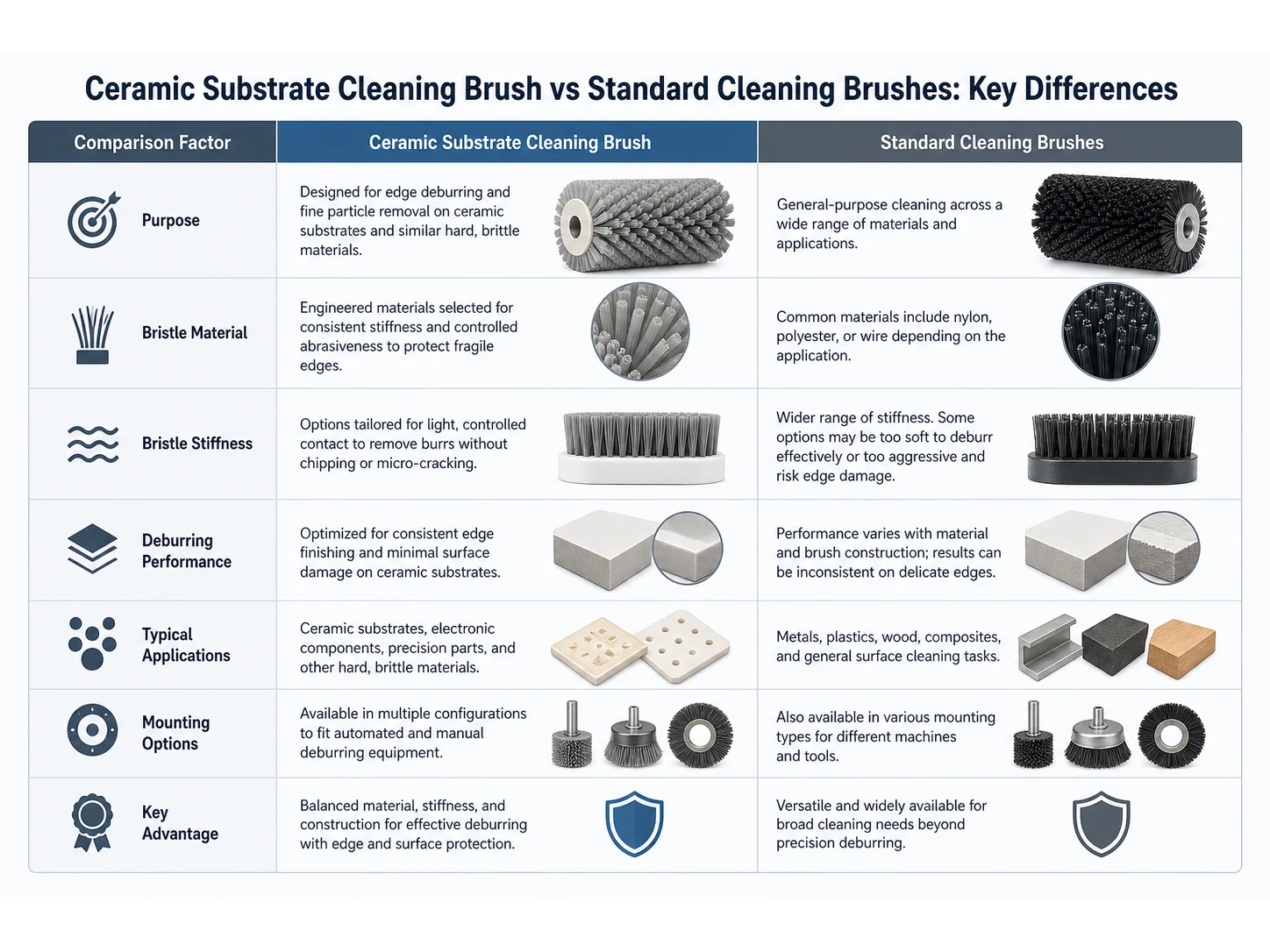
Ceramic Substrate Cleaning Brush vs Standard Cleaning Brushes: Key Differences
| Factor | Ceramic Substrate Cleaning Brush | Standard Cleaning Brush |
|---|---|---|
| Bristle Material | Antistatic fibers (carbon-filled nylon, conductive polymers), ultra-soft natural blends | Wire, abrasive nylon, untreated natural fibers |
| Hardness / Abrasiveness | Very low; designed to deburr without scratching | Varies; often too aggressive for ceramics |
| Static Dissipation | Excellent; prevents ESD damage | Poor to none; can build up static and attract particles |
| Wet Chemical Compatibility | High; resistant to solvents, DI water, mild acids | Depends on material; wire rusts, some nylons degrade |
| Contamination Risk | Low; minimal shedding, cleanroom compatible | Higher; bristle breakage, metallic residue |
| Edge Quality | Smooth, chip-free finish | Often leaves micro‑cracks or residual particles |
| Typical Lifespan | Longer in controlled environments | Variable; wire brushes wear quickly on ceramics |
| Cost | Higher initial investment | Lower unit cost, but higher defect risk |
How to Choose the Right Brush for Edge Deburring
Use these decision factors to match the brush to your specific process:
- Residue Type: Light dust or microscopic burrs favor ceramic brushes; heavy cutting burrs may need a two-step approach (abrasive brush then ceramic brush).
- Surface Sensitivity: High-purity alumina or thin-film ceramic demands the gentle touch of a ceramic substrate cleaning brush.
- Equipment Interface: Manual, CNC, or robotic arms require specific mounting (arbor hole, shaft diameter). Ceramic brushes often come with machined mounts for precision alignment.
- Wet or Chemical Exposure: If your process uses solvents or DI water, choose a brush with chemically resistant bristles and a corrosion‑resistant core.
- Hygiene Expectations: Cleanroom settings (ISO 5–7) demand antistatic, low‑shedding filaments. Ceramic brushes are better suited than standard alternatives.
- Maintenance Frequency: Quick‑change hubs or standardized lengths reduce downtime. Ceramic brushes designed for easy replacement can offset higher initial cost.
- Custom Size Requirements: Standard brushes come in fixed diameters and lengths; if your edge profile or machine demands a non‑standard dimension, a custom ceramic brush drawing may be necessary.
Common Mistakes When Choosing a Deburring Brush
- Choosing by cost drivers alone: A cheaper standard brush may cause thousands of dollars in scrap due to edge chipping or contamination.
- Ignoring static dissipation: Charged surfaces attract airborne particles; always verify antistatic properties for ESD‑sensitive assemblies.
- Overlooking bristle stiffness: Too stiff, and you crack the ceramic edge; too soft, and you leave burrs. Match bristle flex to the specific substrate hardness.
- Assuming all “ceramic” brushes are equal: Some are merely labeled for ceramic but use standard nylon; verify material composition and intended use.
- Neglecting wet process compatibility: A brush that works dry may swell, soften, or lose bristles when exposed to cleaning fluids.
- Wrong mounting interface: A brush designed for a hand tool may not fit your automated machine arbor, causing runout and uneven deburring.
When a Ceramic Substrate Cleaning Brush Is the Wrong Choice
A ceramic substrate cleaning brush excels at fine deburring and cleaning, but it has limits:
- Heavy, raised burrs: A pre‑step with an abrasive brush or a mechanical chamfering tool may be needed.
- High‑volume, high‑pressure automation: In extremely fast cycles, a more durable industrial brush may last longer, though at the cost of edge quality.
- Deep scratches or chips: If the substrate already has physical damage, cleaning alone cannot restore it; rework or replacement is required.
- Non‑standard geometries: A custom brush design drawing and sample testing are essential; off‑the‑shelf ceramic brushes may not reach complex recesses.
Always request a sample test and review the supplier’s application drawing before scaling up.
Final Takeaway
For ceramic edge deburring in sensitive electronics or cleanroom environments, a ceramic substrate cleaning brush is the safer, cleaner choice—even at a higher purchase cost drivers. Standard brushes may still serve as a rough‑prep step, but the risk of defects usually outweighs the savings. Evaluate your residue type, static control needs, chemical exposure, and mounting requirements, then test a brush that matches your exact edge profile.
Frequently Asked Questions
Can I use a standard nylon brush for ceramic edge deburring?
Not recommended. Standard nylon absorbs moisture and can generate static, leading to micro‑scratches or particle attraction on sensitive ceramic surfaces.
What bristle material is best for ceramic substrates?
Look for conductive carbon‑filled nylon, antistatic polymer blends, or soft natural fibers like high‑grade goat hair, depending on cleanliness and wet/dry requirements.
How do I know if I need a custom brush size?
If your machine’s arbor diameter, brush length, or edge profile differs from standard catalogs, a custom size is necessary. Provide a measured drawing to a brush manufacturer for review.
Do ceramic cleaning brushes work with wet cleaning processes?
Yes, many are designed for use with isopropyl alcohol (IPA), DI water, or mild alkaline cleaners. Always check chemical resistance of the bristle and core materials.
How often should I replace a ceramic deburring brush?
Monitor for bristle wear, tuft loss, or a decline in edge finish quality. In controlled environments, replacement may be needed after thousands of cycles; inspect weekly initially to establish a baseline.
Can the same brush be used for different ceramic materials?
Cross‑contamination is a risk. Dedicated brushes per material type are best practice, especially when switching between alumina, zirconia, or other formulations in cleanroom settings.
What is the typical cost difference between ceramic-specific and standard brushes?
Ceramic substrate cleaning brushes generally cost more due to specialized antistatic materials and tighter manufacturing tolerances, but they reduce scrap and rework in high‑value production.
Is a sample test always necessary before full production?
Strongly advised. A sample test confirms edge quality, bristle compatibility, and mounting fit under real‑world conditions, saving downtime and costly batch failures.
Technical References
Which bristle material fits this job — Nylon PA, Abrasive Nylon or Goat Hair?
| Material | Continuous temperature (°C) | Peak temperature (°C) | Water absorption | Hardness |
|---|---|---|---|---|
| Nylon PA | 93 | 121 | 0.3–9% by PA grade and conditioning | Medium to firm; filament diameter and trim length control bending force. |
| Abrasive Nylon | 120 | 150 | 0.1–1.0% | Abrasive filament; stiffness and cutting level is controlled by PA base, grit type, grit size, filament diameter and trim height. |
| Goat Hair | 50–70 | 90–110 | 12–20% | — |
| Horsehair | 60–80 | 100–120 | 8–15% | — |
| PVA Sponge | 60 | 90 | — | Soft absorbent contact material; hardness/compression is controlled by foam or sponge density. |
Figures as published by Brushtec / DuPont; Perlon. Confirm the exact grade against the supplier datasheet before ordering.
What should replace Roller and Conveyor Brushes for ceramic substrate cleaning brush?
- Roller and Conveyor Brushes — Roller and conveyor brushes hold cylindrical line contact across a working width, including helix-wound builds where the filament path is set to move loosened material toward one side; a strip brush holds the same line without rotating, so it seals or wipes but cannot carry residue along the width.
- Nylon PA — Compare Nylon PA with PP, PBT, PET. Change material when wet stiffness, temperature, chemical resistance, conductivity, particle shedding, or surface marking becomes the limiting factor.
- Abrasive Nylon — Compare Abrasive Nylon with PP, PBT, PET. Change material when wet stiffness, temperature, chemical resistance, conductivity, particle shedding, or surface marking becomes the limiting factor.
- Goat Hair — Compare Goat Hair with Boar bristle, goat hair, microfiber. Change material when wet stiffness, temperature, chemical resistance, conductivity, particle shedding, or surface marking becomes the limiting factor.